Market Overview
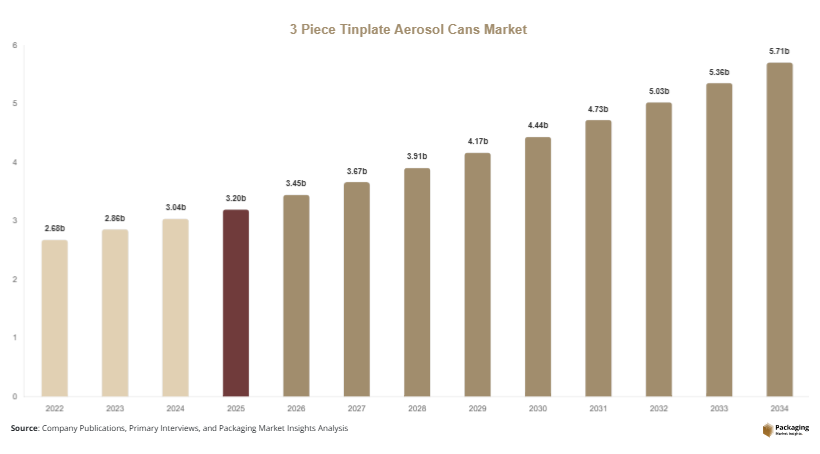
The 3 Piece Tinplate Aerosol Cans Market is witnessing steady expansion due to increasing demand for durable, recyclable, and high-strength metal packaging solutions across personal care, household, automotive, and industrial applications. In 2025, the global market size is estimated at USD 3.20 billion, reflecting stable consumption across developed and emerging economies. By 2026, the market is projected to reach USD 3.45 billion, supported by rising aerosol-based product penetration in urban retail channels. Looking ahead, the market is expected to attain USD 5.80 billion by 2034, registering a CAGR of 6.5% during 2025–2034.
Several key growth factors are driving this trajectory. First, increasing demand for sustainable packaging materials is encouraging manufacturers to adopt tinplate-based aerosol cans due to their recyclability and lower environmental impact compared to plastic alternatives. Second, expansion in personal care and cosmetics industries is boosting consumption of deodorants, hair sprays, and shaving foams packaged in aerosol formats. Third, growth in industrial applications such as lubricants, paints, and maintenance sprays is further strengthening demand. Additionally, technological advancements in can manufacturing, including improved welding and coating technologies, are enhancing product durability and safety.
Key Highlights:
- North America dominated the 3 Piece Tinplate Aerosol Cans Market with the largest share of 36.8% in 2025.
- The Asia Pacific is expected to be the fastest-growing region in the 3 Piece Tinplate Aerosol Cans Market during the forecast period at a CAGR of 7.8%.
- Based on application type, the personal care segment dominated the market with a share of 42.5% in 2025.
- Based on end-use industry, the cosmetics and household care segment dominated the market with a share of 48.1% in 2025.
- Based on material coating type, epoxy lacquer coated cans held a dominant share of 44.6% in 2025.
- Based on distribution channel, direct sales to FMCG manufacturers accounted for 55.2% share in 2025.
- The US 3 Piece Tinplate Aerosol Cans Market size was valued at USD 0.88 billion in 2025 and is projected to reach USD 0.95 billion in 2026.
Explore more data points, trends and opportunities Download Free Sample Report
Market Trends
Shift Toward Eco-Friendly and Recyclable Metal Packaging
The 3 Piece Tinplate Aerosol Cans Market is increasingly influenced by sustainability-driven packaging strategies adopted by global FMCG brands. Companies are transitioning from plastic-based aerosol containers to tinplate cans due to higher recyclability rates and lower environmental footprint. Governments across Europe and North America are enforcing stricter regulations on single-use plastics, pushing manufacturers to adopt metal alternatives. Tinplate aerosol cans are also preferred for their ability to preserve product integrity without chemical leaching. This trend is particularly strong in personal care and household cleaning products, where brand owners are emphasizing eco-label certifications and sustainable packaging claims to attract environmentally conscious consumers. As a result, manufacturers are investing in low-emission production processes and recycled steel sourcing.
Technological Advancements in Can Manufacturing and Barrier Coatings
Another major trend shaping the market is the advancement in production technologies, including high-speed welding systems, precision cutting, and advanced internal coating technologies. These innovations improve can durability, corrosion resistance, and compatibility with a wider range of aerosol formulations. Barrier coatings are being enhanced to prevent chemical interactions between propellants and metal surfaces, increasing shelf life and safety standards. Additionally, lightweighting techniques are gaining traction, allowing manufacturers to reduce material usage while maintaining structural strength. This trend is particularly important for reducing transportation costs and improving supply chain efficiency. Industrial manufacturers and packaging suppliers are also integrating automation and AI-driven quality control systems, improving production consistency and reducing defect rates across large-scale manufacturing facilities.
Market Drivers
Expansion of Personal Care and Household Product Consumption
The growth of the personal care and household product industry is a primary driver for the 3 Piece Tinplate Aerosol Cans Market. Rising urbanization, increasing disposable income, and changing lifestyle patterns are fueling demand for deodorants, hair sprays, air fresheners, and cleaning sprays. These products extensively rely on aerosol packaging for convenience, controlled dispensing, and extended shelf life. Manufacturers prefer tinplate aerosol cans due to their durability and ability to withstand internal pressure, ensuring product safety. The rise of premium grooming and skincare products has further expanded aerosol usage, particularly in emerging economies. Additionally, e-commerce growth has amplified packaged consumer goods demand, further strengthening market expansion across global distribution networks.
Industrial and Automotive Application Growth
The industrial and automotive sectors significantly contribute to the expansion of the market. Aerosol cans are widely used for lubricants, paints, rust removers, adhesives, and maintenance sprays in manufacturing plants and vehicle servicing industries. The robustness of 3 piece tinplate aerosol cans makes them suitable for high-pressure industrial formulations. Increasing automotive production and rising demand for aftermarket maintenance products are boosting consumption. Moreover, industrial automation and machinery maintenance activities require efficient and portable spray solutions, further enhancing adoption. The growing construction and infrastructure sectors also contribute to demand for protective coatings and spray-based chemicals packaged in tinplate aerosol cans.
Market Restraint
One of the key restraints in the 3 Piece Tinplate Aerosol Cans Market is the volatility in raw material prices, particularly steel and tinplate. Fluctuations in global steel prices directly impact manufacturing costs, affecting profit margins for packaging producers. Additionally, geopolitical tensions, supply chain disruptions, and trade restrictions can lead to inconsistent raw material availability. This creates challenges for manufacturers in maintaining stable pricing for FMCG clients, who often operate under strict cost control frameworks. Smaller manufacturers are particularly affected as they lack the financial resilience to absorb sudden cost increases. Furthermore, the energy-intensive nature of tinplate production contributes to higher operational expenses. Environmental compliance costs associated with emissions and industrial waste management also add to production burdens, making cost stability a persistent challenge in the market.
Market Opportunities
Rising Demand in Emerging Economies
Emerging economies in Asia Pacific, Latin America, and parts of Africa present significant opportunities for the 3 Piece Tinplate Aerosol Cans Market. Rapid urbanization, expanding middle-class populations, and increasing consumption of packaged goods are driving demand for aerosol-based products. Countries such as India, Vietnam, Indonesia, and Brazil are witnessing strong growth in personal care, cleaning, and automotive sectors. This creates a favorable environment for aerosol packaging manufacturers. Local production expansion and foreign direct investment in packaging infrastructure are further strengthening market penetration. Additionally, increasing retail modernization and organized FMCG distribution channels are supporting consistent demand growth for tinplate aerosol cans in these regions.
Innovation in Lightweight and Smart Packaging Solutions
Technological innovation presents another major opportunity for market expansion. Manufacturers are increasingly focusing on lightweight tinplate aerosol cans that reduce material usage while maintaining strength and safety standards. This helps reduce transportation costs and carbon emissions. Additionally, integration of smart packaging features such as QR codes, traceability systems, and product authentication technologies is gaining traction. These innovations improve consumer engagement and supply chain transparency. Companies investing in advanced coating technologies and digital printing solutions are also expected to gain competitive advantage. The growing demand for premium packaging aesthetics in cosmetics and personal care products further enhances opportunities for innovation-driven product differentiation.
Report Scope
| Report Metric | Details |
|---|---|
| Market Size in 2025 | USD 3.20 billion |
| Market Size in 2026 | USD 3.45 billion |
| Market Size in 2034 | USD 5.80 billion |
| CAGR | 6.5% (2026-2034) |
| Base Year for Estimation | 2025 |
| Historical Data | 2022-2024 |
| Forecast Period | 2026-2034 |
| Report Coverage | Revenue Forecast, Competitive Landscape, Supply Chain Disruption, Growth Factors, Environment & Regulatory Landscape and Trends |
| Geographies Covered | North America, Europe, APAC, Middle East and Africa, LATAM |
| Countries Covered | U.S., Canada, U.K., Germany, France, Spain, Italy, Russia, Nordic, Benelux, Rest of Europe, China, South Korea, Japan, India, Australia, Singapore, Taiwan, South East Asia, Rest of Asia-Pacific, UAE, Turky, Saudi Arabia, South Africa, Egypt, Nigeria, Rest of MEA, Brazil, Mexico, Argentina, Chile, Colombia, Rest of LATAM |
Explore more data points, trends and opportunities Download Free Sample Report
Segmental Analysis
By Application
The personal care segment dominated the 3 Piece Tinplate Aerosol Cans Market with a 2025 share of 42.5%, driven by widespread use in deodorants, hair sprays, and grooming products. Increasing consumer focus on hygiene and grooming continues to support demand. Brand owners prefer tinplate aerosol cans for their safety, durability, and premium appearance, making them ideal for cosmetic applications in competitive retail environments.
The industrial segment is expected to be the fastest-growing, registering a CAGR of 7.1% during the forecast period. Growth is driven by rising demand for lubricants, maintenance sprays, and protective coatings across automotive and manufacturing sectors. Expansion of industrial automation further strengthens this segment.
By End-Use Industry
The cosmetics and household care segment held the largest share of 48.1% in 2025, supported by high consumption of spray-based personal care products. The segment benefits from strong branding and packaging innovation trends.
The automotive segment is projected to grow at a CAGR of 6.9%, driven by increasing vehicle production and aftermarket maintenance requirements. Aerosol-based lubricants and cleaners are key contributors.
By Material Type
Epoxy lacquer coated cans dominated with a 44.6% share in 2025, due to strong corrosion resistance and chemical compatibility. These coatings ensure product safety and shelf stability.
BPA-free coatings are expected to grow at a CAGR of 7.4%, driven by regulatory restrictions and rising health awareness among consumers and manufacturers.
3 Piece Tinplate Aerosol Cans Market Segmentations
By Application
- Personal Care
- Household Care
- Industrial
By End-Use Industry
- Cosmetics
- Automotive
- Home Care Products
By Material Type
- Epoxy Coated Tinplate
- BPA-Free Coated Tinplate
- Uncoated Specialty Tinplate
By Distribution Channel
- Direct Sales (FMCG Manufacturers)
- Distributors
- Retail Packaging Suppliers
Regional Analysis
North America
North America accounted for 36.8% market share in 2025, with a projected CAGR of 6.2% through 2034. The region benefits from strong demand in personal care and industrial maintenance applications. High consumer awareness regarding sustainable packaging supports market expansion.
The United States dominates the regional landscape due to its large FMCG sector and advanced manufacturing infrastructure. Growth is driven by increasing adoption of eco-friendly aerosol packaging in household and automotive product lines.
Europe
Europe held 28.4% share in 2025, with a CAGR of 6.7%. Strict environmental regulations and circular economy initiatives strongly support tinplate aerosol can adoption.
Germany leads the region, driven by its strong chemical and automotive industries. Sustainability mandates and recycling infrastructure development further enhance market growth.
Asia Pacific
Asia Pacific captured 24.9% share in 2025, expected to grow at the highest CAGR of 7.8%. Rapid industrialization and urban consumer growth are key drivers.
China dominates the region due to large-scale FMCG production and expanding manufacturing capacity for aerosol packaging solutions.
Middle East & Africa
Middle East & Africa accounted for 5.3% share in 2025, with a CAGR of 5.9%. Growth is supported by industrial expansion and rising consumer goods imports.
Saudi Arabia leads the region, driven by diversification of its industrial base and increasing packaging demand in retail sectors.
Latin America
Latin America held 4.6% share in 2025, with a CAGR of 6.1%. Growth is driven by rising urban consumption and expanding FMCG distribution networks.
Brazil dominates due to strong demand in personal care and automotive maintenance products, supporting aerosol packaging adoption.
Competitive Landscape
The 3 Piece Tinplate Aerosol Cans Market is moderately consolidated, with leading players focusing on capacity expansion, sustainability initiatives, and technological advancements. Key companies include Ball Corporation, Crown Holdings Inc., Ardagh Group, Trivium Packaging, and Colep Packaging. Among these, Crown Holdings Inc. holds a leading position due to its global production footprint and strong supply agreements with FMCG brands. Recent developments include expansion of lightweight aerosol can production lines and increased investment in recycled steel sourcing to reduce environmental impact and production costs. Competitive strategies also include mergers, acquisitions, and regional expansion into high-growth Asian markets.
Key Players List
- Ball Corporation
- Crown Holdings Inc.
- Ardagh Group
- Trivium Packaging
- Colep Packaging
- Mauser Packaging Solutions
- Toyo Seikan Group
- CCL Container
- Nampak Ltd.
- Silgan Holdings Inc.
- Showa Aluminum Can Corporation
- BWAY Corporation
- Jamestrong Packaging
- Shanghai Sunhome Packaging
- TUBEX GmbH