Market Overview
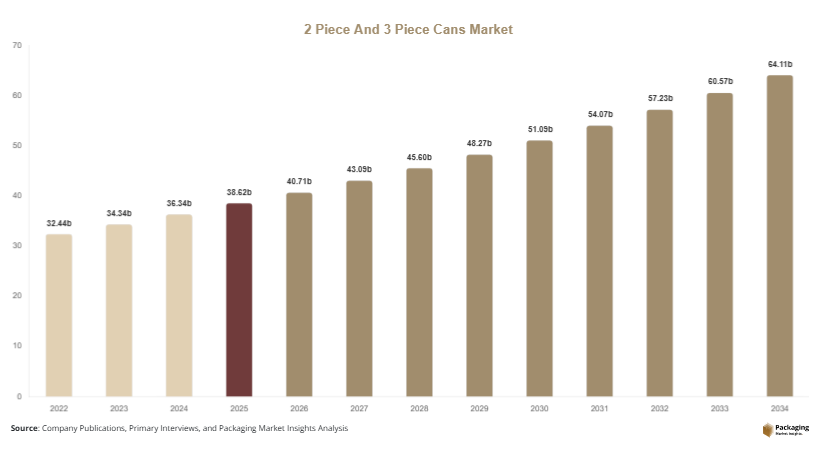
The global 2 Piece And 3 Piece Cans Market size was valued at USD 38.62 billion in 2025 and is estimated to reach USD 40.71 billion in 2026, reflecting steady upward momentum across packaging end-use industries. The market is projected to grow from USD 40.71 billion in 2026 to USD 64.18 billion by 2034, registering a compound annual growth rate (CAGR) of 5.84% during the forecast period of 2025 to 2034. This growth trajectory is supported by rising demand for lightweight, recyclable, and cost-efficient metal packaging across beverage, food, personal care, and industrial chemical sectors.
Two piece and three piece cans remain among the most widely adopted rigid packaging formats due to their durability, barrier protection, and compatibility with high-speed filling lines. Two piece cans, formed through a drawing and wall-ironing process, dominate the beverage segment because of their seamless body construction, which reduces leakage risk and enhances shelf appeal. Three piece cans, manufactured with a separately welded or soldered body seam, continue to serve food and aerosol applications where structural rigidity and stackability are essential.
Key Highlights:
- North America dominated the 2 Piece And 3 Piece Cans Market with the largest share of 34.18% in 2025.
- Asia Pacific is expected to be the fastest-growing region in the 2 Piece And 3 Piece Cans Market during the forecast period at a CAGR of 7.62%.
- Based on can type, the two piece cans segment dominated the market with a share of 58.46% in 2025.
- Based on material, the aluminum segment dominated the market with a share of 61.27% in 2025.
- Based on application, the beverage cans segment dominated the market with a share of 49.83% in 2025.
- Based on end-use industry, the food and beverage segment dominated the market with 66.92% in 2025.
- The US 2 Piece And 3 Piece Cans Market size was valued at USD 11.46 billion in 2025 and is projected to reach USD 12.18 billion in 2026.
Explore more data points, trends and opportunities Download Free Sample Report
Market Trends
Premiumization and Sustainable Design Innovation in Can Packaging
A prominent trend reshaping the 2 Piece And 3 Piece Cans Market is the growing emphasis on premiumization through enhanced printing technology, matte finishes, embossed textures, and slim or sleek can formats. Beverage brands are increasingly using cans as a marketing tool, applying high-definition digital printing to create limited-edition packaging that strengthens shelf presence and consumer loyalty. At the same time, manufacturers are investing in lightweighting initiatives that reduce aluminum and steel content per can without compromising strength, supporting both cost efficiency and sustainability targets. This dual focus on aesthetic appeal and material optimization is encouraging long-term contracts between can makers and major consumer brands, reinforcing stable order pipelines across the forecast period.
Rising Adoption of Cans in Alcoholic and Functional Beverage Categories
Another significant trend is the accelerating shift of alcoholic beverages, including craft beer, wine, and ready-to-drink cocktails, toward can-based packaging, moving away from traditional glass bottles. Cans offer portability, lower transportation weight, and better protection against light exposure, which preserves flavor integrity. Functional beverages such as protein drinks, kombucha, and electrolyte-infused waters are also increasingly packaged in two piece cans to capture health-conscious consumers seeking convenient, on-the-go formats. This category diversification is broadening the customer base for can manufacturers beyond traditional carbonated soft drinks, creating new revenue streams and reducing dependency on a single beverage category for volume growth.
Market Drivers
Accelerating Shift Toward Recyclable and Circular Packaging Materials
Environmental regulations and corporate sustainability commitments are driving brand owners to transition from plastic and multilayer packaging toward aluminum and steel cans, which are widely recognized as among the most recyclable packaging formats available. Many national governments have introduced extended producer responsibility frameworks and deposit return schemes that incentivize the use of metal packaging with high recovery rates. Consumer packaged goods companies are setting public recyclability targets, often exceeding 90% by 2030, which directly favors two piece and three piece cans over composite alternatives. This regulatory and corporate alignment is creating a durable structural driver that supports consistent order volumes for can manufacturers across both developed and emerging markets.
Expansion of the Ready-to-Drink and Craft Beverage Industry
The global expansion of the ready-to-drink beverage industry, encompassing energy drinks, hard seltzers, canned wine, and craft beer, is a central driver of demand for two piece aluminum cans. Smaller craft breweries and beverage startups favor cans due to lower minimum order quantities, faster cooling times, and reduced packaging weight compared to glass bottles, which lowers freight costs. Retailers also prefer cans because they occupy less shelf space and reduce breakage-related losses during transit and storage. As disposable incomes rise in emerging economies and beverage consumption diversifies beyond traditional carbonated drinks, can manufacturers are scaling production capacity to meet this growing and increasingly varied demand base.
Market Restraints
Volatility in Raw Material Prices and Supply Chain Disruptions
The 2 Piece And 3 Piece Cans Market faces a persistent restraint in the form of fluctuating prices for aluminum and tinplate steel, the two primary raw materials used in can manufacturing. Aluminum prices are particularly sensitive to global energy costs, smelting capacity constraints, and geopolitical trade tensions, which can cause sudden cost spikes that compress manufacturer margins. Can producers often operate on long-term supply contracts with beverage and food companies, limiting their ability to pass through raw material cost increases in the short term. For example, periods of elevated energy prices in major aluminum-producing regions have historically led to smelter curtailments, tightening global supply and pushing input costs higher across the packaging value chain. This volatility also affects smaller and mid-sized can manufacturers disproportionately, as they typically lack the scale to hedge raw material purchases or negotiate favorable long-term pricing agreements with metal suppliers. In addition, logistics bottlenecks, port congestion, and fluctuating freight rates can delay raw material delivery, disrupting production schedules and creating inventory management challenges. Manufacturers are responding by diversifying their supplier base, increasing use of recycled aluminum to reduce dependency on primary metal markets, and adopting lightweighting techniques to lower per-unit material consumption, though these measures only partially offset the broader cost volatility affecting the industry.
Market Opportunities
Growth Potential in Emerging Economies Through Rising Urbanization
Emerging economies across Asia Pacific, Latin America, and parts of the Middle East and Africa present substantial growth opportunities for can manufacturers as urbanization, rising disposable incomes, and modern retail penetration accelerate packaged food and beverage consumption. As organized retail formats such as supermarkets and convenience stores expand into smaller cities, demand for shelf-stable, easily transportable packaging formats like cans is increasing. Local governments in several emerging markets are also investing in cold chain and food processing infrastructure, which supports greater adoption of three piece cans for processed foods, dairy products, and ready meals. Can manufacturers that establish regional production facilities in these markets can benefit from lower logistics costs and improved responsiveness to local demand patterns.
Expansion of Specialty and Functional Packaging Formats
There is a growing opportunity for can manufacturers to diversify into specialty formats, including resealable can ends, slim cans for premium beverages, and aerosol cans for personal care and household products. Innovations such as easy-open lids, smart packaging with QR-enabled traceability, and tamper-evident seals are gaining traction among brand owners seeking to enhance consumer convenience and product authentication. The personal care and pharmaceutical sectors are also increasingly exploring aerosol and three piece can formats for deodorants, sanitizers, and topical applications, creating new application avenues beyond traditional food and beverage packaging. Manufacturers investing in flexible production lines capable of switching between formats can capture incremental revenue from these emerging specialty segments.
Report Scope
| Report Metric | Details |
|---|---|
| Market Size in 2025 | USD 38.62 billion |
| Market Size in 2026 | USD 40.71 billion |
| Market Size in 2034 | USD 64.18 billion |
| CAGR | 5.84% (2026-2034) |
| Base Year for Estimation | 2025 |
| Historical Data | 2022-2024 |
| Forecast Period | 2026-2034 |
| Report Coverage | Revenue Forecast, Competitive Landscape, Supply Chain Disruption, Growth Factors, Environment & Regulatory Landscape and Trends |
| Geographies Covered | North America, Europe, APAC, Middle East and Africa, LATAM |
| Countries Covered | U.S., Canada, U.K., Germany, France, Spain, Italy, Russia, Nordic, Benelux, Rest of Europe, China, South Korea, Japan, India, Australia, Singapore, Taiwan, South East Asia, Rest of Asia-Pacific, UAE, Turky, Saudi Arabia, South Africa, Egypt, Nigeria, Rest of MEA, Brazil, Mexico, Argentina, Chile, Colombia, Rest of LATAM |
Explore more data points, trends and opportunities Download Free Sample Report
Segmental Analysis
By Can Type
The two piece cans segment dominated the 2 Piece And 3 Piece Cans Market, accounting for a share of 58.46% in 2025. This dominance is attributed to the segment's widespread use across the global beverage industry, particularly for carbonated soft drinks, beer, and energy drinks, where seamless construction reduces leakage risk and supports high-speed filling operations. Two piece cans also offer manufacturing efficiencies, including lower material usage per unit and compatibility with advanced drawing and wall-ironing production techniques, which reduce per-unit costs at scale. Beverage companies favor this format because it supports vibrant 360-degree printing for branding purposes, enhancing shelf differentiation in competitive retail environments. The consistent global growth of canned beverage consumption, combined with established supply relationships between major can manufacturers and multinational beverage companies, continues to reinforce the leading position of two piece cans within the overall market structure.
The three piece cans segment is projected to register a relatively faster niche growth rate within select applications, particularly in food and aerosol packaging, supported by a CAGR of 6.34% through the forecast period. Growth in this segment is driven by rising demand for processed and shelf-stable food products in emerging economies, where three piece cans offer superior structural rigidity for products such as canned vegetables, meats, and pet food. The format's compatibility with welded body seams also makes it well suited for larger volume containers used in industrial and institutional food service applications. As food processing infrastructure expands across Asia Pacific and Latin America, demand for three piece cans in this application is expected to grow steadily, supported by increasing investment in regional manufacturing capacity.
By Material
The aluminum segment dominated the 2 Piece And 3 Piece Cans Market with a share of 61.27% in 2025, primarily due to its widespread use in beverage can manufacturing. Aluminum offers a favorable strength-to-weight ratio, excellent recyclability, and compatibility with high-speed two piece can production lines, making it the preferred material for carbonated soft drinks, beer, and energy drinks globally. The metal's infinite recyclability without quality degradation aligns closely with corporate sustainability commitments among major beverage brands, further reinforcing its market position. Additionally, aluminum cans provide superior barrier protection against light and oxygen, preserving product freshness and flavor over extended shelf life periods. The combination of recyclability, lightweight characteristics, and proven production efficiency continues to support aluminum's leading share across the global can packaging industry.
The steel segment, particularly tinplate steel, is expected to witness a steady growth rate with a CAGR of 5.21% during the forecast period, driven primarily by demand in food and aerosol can applications. Steel offers higher structural rigidity compared to aluminum, making it well suited for three piece cans used in processed food packaging, where stacking strength and resistance to denting are important during storage and transportation. Growth in this segment is further supported by expanding demand for canned food products in emerging economies, where cost-effective steel packaging remains competitive against alternative materials. Manufacturers are also investing in thinner tinplate coatings to reduce material costs while maintaining can integrity, supporting continued adoption of steel in cost-sensitive food packaging applications.
By Application
The beverage cans segment dominated the 2 Piece And 3 Piece Cans Market with a share of 49.83% in 2025, reflecting the central role of cans in packaging carbonated soft drinks, beer, energy drinks, and increasingly, ready-to-drink cocktails and functional beverages. This segment benefits from high consumption volumes, established global supply chains, and strong brand investment in can-based packaging formats. The rising popularity of canned alcoholic beverages, including hard seltzers and craft beer, has further expanded the addressable market within this segment, as consumers increasingly favor the portability and recyclability of cans over glass bottles. Beverage companies continue to expand canned product portfolios across new categories, reinforcing sustained demand growth within this application segment over the forecast period.
The food cans segment is projected to grow at a notable CAGR of 6.45% during the forecast period, driven by rising demand for shelf-stable and convenient food products across both developed and emerging markets. Growth in this segment is supported by increasing consumption of canned vegetables, fruits, soups, and pet food, particularly in regions where cold chain infrastructure remains limited and shelf-stable packaging offers practical storage advantages. Urbanization and busier consumer lifestyles are also contributing to higher demand for ready-to-eat canned meals, supporting expanded production capacity among food can manufacturers. As food processing investment increases across Asia Pacific, the Middle East, and Latin America, the food cans segment is expected to maintain a consistently strong growth trajectory.
2 Piece And 3 Piece Cans Market Segmentations
Can Type
- Two Piece Cans
- Three Piece Cans
Material
- Aluminum
- Steel (Tinplate)
Application
- Beverage Cans
- Food Cans
- Aerosol Cans
- Industrial and Paint Cans
End-Use Industry
- Food and Beverage
- Personal Care and Household
- Industrial and Chemicals
- Pharmaceuticals
Regional Analysis
North America
North America accounted for the largest share of the 2 Piece And 3 Piece Cans Market at 34.18% in 2025 and is projected to grow at a steady CAGR of 5.12% through 2034. The region benefits from a mature beverage industry, extensive recycling infrastructure, and strong consumer preference for canned carbonated soft drinks, beer, and energy drinks. Established relationships between major can manufacturers and beverage companies further reinforce the region's leading position in the global market.
The United States dominates the North American market, driven by the rapid expansion of the hard seltzer and craft beer industries, which rely extensively on two piece aluminum cans. A unique growth factor supporting this dominance is the widespread adoption of state-level deposit return and bottle bill programs, which improve aluminum recycling rates and reinforce brand commitments to sustainable packaging, encouraging continued investment in can manufacturing capacity across the country.
Europe
Europe held a significant share of the global 2 Piece And 3 Piece Cans Market in 2025 and is expected to expand at a CAGR of 5.34% during the forecast period. Stringent packaging waste regulations under the European Union's circular economy action plan are accelerating the shift from plastic to recyclable metal packaging, positioning cans as a preferred format among regional food and beverage producers seeking compliance with extended producer responsibility mandates.
Germany leads the European market, supported by its well-established deposit return system and strong beer and carbonated beverage consumption culture. A unique growth factor for Germany is the high public trust in its can recycling infrastructure, which achieves recovery rates exceeding most other European nations, encouraging beverage companies to expand canned product lines as part of their sustainability positioning across domestic and export markets.
Asia Pacific
Asia Pacific is projected to be the fastest-growing region in the 2 Piece And 3 Piece Cans Market, expanding at a CAGR of 7.62% during the forecast period, supported by rising urbanization, expanding middle-class populations, and growing packaged beverage consumption. The region's share is expected to increase steadily as global beverage and food companies expand manufacturing footprints to serve domestic demand directly.
China dominates the Asia Pacific market, driven by large-scale domestic beverage production and increasing exports of canned goods. A unique growth factor for China is the government's continued investment in modernizing food processing and cold chain logistics infrastructure, which is expanding the addressable market for three piece cans used in processed food and dairy applications across both urban and semi-urban regions.
Middle East & Africa
The Middle East and Africa region held a comparatively smaller share of the global 2 Piece And 3 Piece Cans Market in 2025 but is expected to grow at a CAGR of 6.08% through 2034. Growth is supported by expanding carbonated soft drink consumption, rising investment in local beverage bottling and canning facilities, and increasing demand for canned food products driven by population growth and urban migration.
Saudi Arabia leads the regional market, supported by large-scale investments in beverage manufacturing as part of broader economic diversification initiatives. A unique growth factor for Saudi Arabia is the government's push to localize food and beverage production under national industrial development programs, which is attracting can manufacturing investment and reducing reliance on imported packaged goods across the country.
Latin America
Latin America represented a moderate share of the global 2 Piece And 3 Piece Cans Market in 2025 and is anticipated to grow at a CAGR of 5.76% during the forecast period. The region benefits from a strong beer consumption culture, expanding soft drink markets, and increasing adoption of canned packaging for processed and convenience foods among urban consumers.
Brazil dominates the Latin American market, supported by its position as one of the largest beer-producing and consuming countries globally. A unique growth factor for Brazil is the extensive domestic aluminum production capacity, which reduces raw material import dependency and supports cost-competitive can manufacturing for both domestic consumption and regional export to neighboring South American markets.
Competitive Landscape
The 2 Piece And 3 Piece Cans Market is moderately consolidated, with a handful of large multinational manufacturers accounting for a substantial share of global production capacity, alongside numerous regional and specialty can makers serving local food and beverage industries. Competition is centered on production efficiency, sustainability credentials, printing and design capabilities, and the ability to offer flexible order volumes to both large multinational brands and smaller craft beverage producers. Leading companies are investing in expanded recycled aluminum sourcing, lightweighting technology, and digital printing infrastructure to differentiate their offerings and strengthen long-term supply agreements with major consumer packaged goods companies. Crown Holdings maintains a leading position in the market, supported by its extensive global manufacturing footprint and recent expansion of two piece can production capacity in key beverage growth markets, including new facility investments aimed at serving the rising demand for canned alcoholic and functional beverages. Strategic partnerships, capacity expansions, and sustainability-focused product innovation remain the primary competitive strategies shaping the industry landscape.
Key Players
- Crown Holdings, Inc.
- Ball Corporation
- Ardagh Group
- CANPACK Group
- Silgan Holdings Inc.
- Toyo Seikan Group Holdings, Ltd.
- Tata Steel Limited
- CPMC Holdings Limited
- Trivium Packaging
- Showa Denko Packaging Co., Ltd.
- Nampak Limited
- Universal Can Corporation
- Kian Joo Can Factory Berhad
- Massilly Group
- HUBER Packaging Group GmbH
- COFCO Packaging Co., Ltd.
- Visy Industries