Sanitary Cans Market Size and Growth
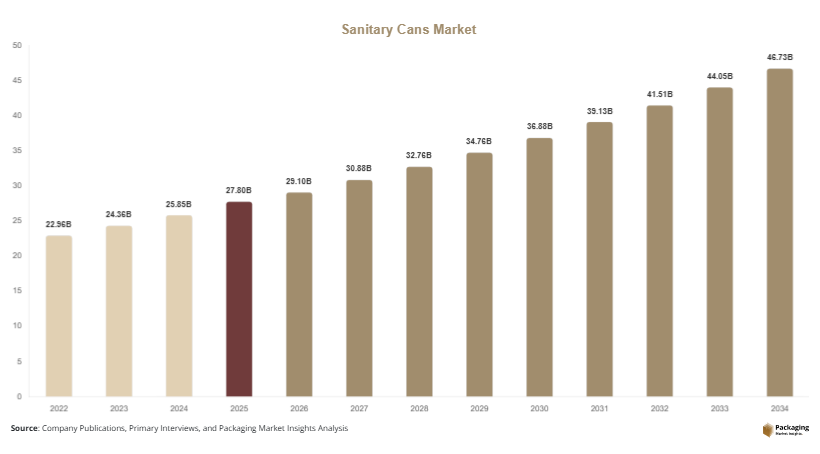
The global sanitary cans market size is estimated at USD 27.8 billion in 2025, increasing to approximately USD 29.1 billion in 2026. By 2034, the market is projected to reach nearly USD 46.7 billion, expanding at a CAGR of 6.1% during 2025–2034. The sanitary cans market is experiencing stable growth due to increasing demand for durable, hygienic, and shelf-stable food packaging solutions across developed and emerging economies. Sanitary cans are widely used in food preservation applications because they provide extended shelf life, resistance to contamination, and efficient transportation benefits. The market is expanding steadily as consumer demand for packaged food products continues to rise alongside urbanization and changing dietary patterns.
Several growth factors are contributing to market expansion. One major factor is the rising consumption of processed and ready-to-eat food products, particularly in urban regions where convenience-oriented lifestyles are becoming more common. Another important factor is the increasing focus on food safety and contamination prevention, which is encouraging manufacturers to adopt reliable metal packaging formats. Additionally, the growth of global food exports and cold-chain logistics is supporting demand for durable and stackable sanitary cans for long-distance transportation.
Key Highlights
- Asia Pacific dominated the market with a 38.1% share in 2025.
- Latin America is projected to grow at the fastest CAGR of 6.8%.
- Three-piece sanitary cans led the type segment with a 41.7% share.
- Steel packaging dominated with a 58.4% share.
- Food & beverage applications led the segment with 72.6% share.
- The US remained the dominant country with a market size of USD 4.8 billion in 2025 and USD 5.0 billion in 2026.
Explore more data points, trends and opportunities Download Free Sample Report
Market Trends
Increasing Adoption of Sustainable Metal Packaging Solutions
The sanitary cans market is witnessing strong momentum toward sustainable packaging materials and recyclable metal packaging systems. Food manufacturers and retailers are increasingly shifting toward recyclable steel and aluminum cans to align with sustainability commitments and government regulations on packaging waste reduction. For instance, canned vegetable and seafood producers in Europe are replacing multilayer plastic containers with lightweight metal cans that offer better recycling efficiency. Aluminum sanitary cans are also gaining popularity due to lower transportation weight and reduced carbon emissions. This trend is expected to strengthen further as consumers prefer environmentally responsible packaging formats. Future developments in low-carbon metal production and water-based internal coatings are likely to improve sustainability performance across the sanitary cans supply chain.
Growing Demand for Easy-Open and Convenience Packaging
Consumer preference for convenience-oriented food packaging is significantly influencing sanitary can innovation. Easy-open lids, resealable metal packaging, and portion-controlled sanitary cans are becoming increasingly popular in ready-to-eat meals, soups, beverages, and pet food products. For example, several canned food brands in North America have introduced pull-tab sanitary cans to improve consumer convenience and reduce packaging waste associated with additional tools. Single-serving canned meals are also gaining traction among working professionals and urban consumers. This trend is expected to create long-term opportunities for manufacturers focusing on ergonomic packaging design and advanced sealing technologies. Automation in food processing facilities will further accelerate adoption of standardized easy-open can systems.
Market Drivers
Rising Consumption of Processed and Ready-to-Eat Foods
The growing demand for processed, canned, and ready-to-eat food products is one of the primary drivers of the sanitary cans market. Rapid urbanization, increasing disposable income, and busy lifestyles are encouraging consumers to purchase packaged foods with extended shelf life and easy storage capabilities. Products such as canned vegetables, soups, meat, seafood, and dairy items are witnessing strong demand globally. For instance, supermarket chains in the U.S. and Europe have expanded their canned food offerings due to rising consumer preference for convenient meal solutions. The expansion of organized retail networks and online grocery platforms is further supporting the use of sanitary cans in food distribution systems.
Growth in Global Food Export and Storage Infrastructure
Global expansion of food exports and improvements in storage infrastructure are significantly driving sanitary cans demand. Metal cans provide strong barrier protection against moisture, oxygen, and microbial contamination, making them suitable for long-distance transportation and extended storage periods. Countries such as Thailand, China, and Brazil are increasing exports of canned seafood, fruits, and vegetables, creating strong demand for durable sanitary packaging. In addition, food security initiatives in developing countries are encouraging governments and food processors to invest in long-life packaged food solutions. This factor is expected to support sustained market growth throughout the forecast period.
Market Restraint
Fluctuating Raw Material Prices and Energy Costs
One of the major restraints affecting the sanitary cans market is the volatility in steel and aluminum prices combined with rising energy costs in metal manufacturing operations. Metal packaging production is energy-intensive, and fluctuations in raw material prices directly affect manufacturing profitability. For example, rising steel prices in Europe and North America have increased production costs for canned food manufacturers, forcing some companies to shift toward alternative packaging formats such as flexible pouches and plastic containers. Additionally, transportation costs and supply chain disruptions can further increase operational expenses. Smaller packaging manufacturers often struggle to absorb these cost increases, limiting their competitive position in the market. Although recycling initiatives can partially offset raw material dependency, cost instability remains a significant challenge for long-term market expansion.
Market Opportunities
Expansion of Premium and Specialty Food Packaging
The growing popularity of premium packaged foods presents a major opportunity for sanitary can manufacturers. Consumers are increasingly purchasing gourmet soups, organic vegetables, premium seafood, and specialty pet food products packaged in visually appealing metal cans. Food brands are investing in high-quality printing, embossed finishes, and innovative can designs to improve shelf visibility and brand differentiation. For example, premium seafood brands in Japan and Europe are using decorated aluminum sanitary cans with advanced coating systems to attract health-conscious consumers. Over the forecast period, rising disposable income and premium food consumption trends are expected to create additional demand for customized sanitary packaging solutions.
Technological Advancements in Lightweight and BPA-Free Cans
Technological innovation in lightweight packaging and BPA-free coatings is creating new growth opportunities for the sanitary cans market. Manufacturers are increasingly developing thinner metal walls and advanced sealing technologies to reduce material usage while maintaining product safety. BPA-free coatings are becoming more important due to growing health concerns associated with conventional can linings. Several food companies in North America have already transitioned to non-BPA sanitary can systems for baby food and dairy products. Future advancements in corrosion-resistant coatings and smart manufacturing technologies are expected to enhance packaging performance and production efficiency.
Report Scope
| Report Metric | Details |
|---|---|
| Market Size in 2025 | USD 27.8 Billion |
| Market Size in 2026 | USD 29.1 Billion |
| Market Size in 2034 | USD 46.7 Billion |
| CAGR | 6.1% (2026-2034) |
| Base Year for Estimation | 2025 |
| Historical Data | 2022-2024 |
| Forecast Period | 2026-2034 |
| Report Coverage | Revenue Forecast, Competitive Landscape, Supply Chain Disruption, Growth Factors, Environment & Regulatory Landscape and Trends |
| Geographies Covered | North America, Europe, APAC, Middle East and Africa, LATAM |
| Countries Covered | U.S., Canada, U.K., Germany, France, Spain, Italy, Russia, Nordic, Benelux, Rest of Europe, China, South Korea, Japan, India, Australia, Singapore, Taiwan, South East Asia, Rest of Asia-Pacific, UAE, Turky, Saudi Arabia, South Africa, Egypt, Nigeria, Rest of MEA, Brazil, Mexico, Argentina, Chile, Colombia, Rest of LATAM |
Explore more data points, trends and opportunities Download Free Sample Report
Segmental Analysis
Type Segment
Three-piece sanitary cans dominated the market in 2024 with approximately 41.7% market share. These cans are widely used across processed vegetables, seafood, meat products, and dairy applications because they offer strong structural durability and cost efficiency. Manufacturers prefer three-piece cans for high-volume food production due to their compatibility with automated filling and sealing systems. Food exporters also rely on these cans because they provide effective protection against contamination and physical damage during transportation. In developing countries, three-piece steel cans remain highly preferred due to lower production costs and broad availability of raw materials.
Easy-open sanitary cans are projected to be the fastest-growing subsegment, expanding at a CAGR of 6.9% during the forecast period. Rising demand for convenience food packaging and consumer-friendly product designs is supporting this growth. Easy-open lids reduce the need for external can-opening tools and improve accessibility for elderly consumers and busy households. Food brands are increasingly introducing pull-tab cans for soups, seafood, beverages, and ready meals to enhance customer convenience. Future innovations in resealable lid technology and lightweight opening systems are expected to further strengthen this segment’s growth.
Material Segment
Steel-based sanitary cans accounted for the dominant market share of 58.4% in 2024 due to their high strength, affordability, and excellent barrier protection properties. Steel cans are widely used in canned vegetables, meat, seafood, and dairy packaging because they can withstand high-temperature sterilization and long storage periods. Food processors favor steel cans for bulk packaging and export applications due to their durability and cost advantages. In addition, steel remains one of the most recycled packaging materials globally, supporting sustainability goals within the packaging industry.
Aluminum sanitary cans are expected to witness the fastest growth, registering a CAGR of 6.7% during the forecast period. The lightweight nature of aluminum reduces transportation costs and carbon emissions, making it attractive for beverage and premium food packaging applications. Aluminum also offers excellent corrosion resistance and supports high-quality printing for branding purposes. Manufacturers are increasingly investing in lightweight aluminum packaging systems to meet consumer demand for sustainable and visually appealing packaging solutions. Growth in canned beverage and specialty food categories is expected to accelerate aluminum can adoption globally.
End-Use Segment
Food & beverage applications dominated the sanitary cans market in 2024 with a market share of approximately 72.6%. The widespread use of sanitary cans for preserving vegetables, soups, dairy products, seafood, and beverages continues to support segment dominance. Food companies prefer sanitary cans because they offer long shelf life, reduced contamination risk, and efficient transportation capabilities. Demand is particularly strong in regions with growing urban populations and expanding organized retail sectors. Canned ready meals and shelf-stable beverages are also becoming increasingly popular among working consumers.
Pet food packaging is projected to emerge as the fastest-growing end-use segment with a CAGR of 6.5% during the forecast period. Rising pet ownership rates and increasing spending on premium pet nutrition products are fueling demand for sanitary cans in wet pet food packaging. Manufacturers are introducing easy-open and portion-controlled cans to improve product convenience and freshness. Growth in premium pet food categories across North America, Europe, and Asia Pacific is expected to create substantial long-term opportunities for sanitary can manufacturers.
Sanitary Cans Market Segmentations
By Type
- Three-Piece Sanitary Cans
- Two-Piece Sanitary Cans
- Drawn and Ironed Cans
- Easy-Open End Cans
By Material
- Aluminum
- Steel
- Tinplate
- Recycled Metal
By End-User
- Food Packaging
- Beverage Packaging
- Pet Food Packaging
- Pharmaceutical Packaging
- Industrial Products
Regional Analysis
North America
North America accounted for approximately 27.4% of the global sanitary cans market share in 2025 and is projected to expand at a CAGR of 5.6% during the forecast period. The region benefits from strong demand for canned food products, advanced food processing infrastructure, and widespread retail distribution systems. Increasing consumer preference for shelf-stable food packaging and rising investments in sustainable packaging technologies are supporting regional market growth. The U.S. and Canada continue to witness rising demand for canned soups, pet food, seafood, and ready-to-eat meals.
The United States dominates the North American market due to its large packaged food industry and strong retail supply chains. A unique growth factor in the country is the increasing adoption of BPA-free sanitary cans across baby food and organic food packaging applications. Several U.S.-based food manufacturers are investing in recyclable aluminum can production to meet sustainability targets and comply with environmental packaging standards. Expansion of online grocery retail platforms is also contributing to higher sanitary can demand.
Europe
Europe represented nearly 24.3% of the global sanitary cans market in 2025 and is expected to grow at a CAGR of 5.4% through 2034. The region’s market growth is supported by strict food safety regulations, rising preference for recyclable packaging, and increasing demand for premium canned food products. European consumers are showing strong interest in sustainable packaging solutions, encouraging manufacturers to expand recyclable steel and aluminum can production. Growth in seafood and organic food consumption is also strengthening market demand.
Germany remains the dominant country in Europe due to its advanced food manufacturing sector and strong export network. One unique driver supporting the German market is the growing use of lightweight sanitary cans in processed meat and dairy packaging applications. German packaging companies are investing in energy-efficient metal can manufacturing technologies to reduce operational costs and improve sustainability performance. Demand for premium canned pet food is also increasing steadily across the country.
Asia Pacific
Asia Pacific dominated the sanitary cans market with a 38.1% share in 2025 and is forecasted to grow at a CAGR of 6.7% during the forecast period. Rapid urbanization, population growth, and increasing consumption of processed food products are key growth factors supporting regional expansion. Countries such as China, India, Thailand, Japan, and Indonesia are witnessing rising demand for canned seafood, vegetables, dairy products, and beverages. Expansion of food processing industries and export-oriented manufacturing is also contributing to strong market development.
China is the leading country in the Asia Pacific market due to its large-scale food manufacturing capacity and growing export activities. A unique growth driver in China is the rapid expansion of canned seafood and ready-meal exports to Europe and North America. Chinese manufacturers are increasingly adopting automated can production technologies to improve manufacturing efficiency and reduce waste. Government initiatives supporting food preservation and export-oriented processing industries are expected to further accelerate market growth.
Middle East & Africa
The Middle East & Africa region accounted for approximately 5.8% of the global sanitary cans market in 2025 and is expected to grow at a CAGR of 5.2% during the forecast period. Rising urban populations, increasing packaged food imports, and improving retail infrastructure are supporting demand for sanitary cans in the region. The growth of tourism and hospitality industries is also increasing consumption of canned beverages and processed food products across Gulf countries.
Saudi Arabia dominates the regional market due to its expanding food processing and retail sectors. One unique growth factor driving the Saudi Arabian market is the rising demand for long-shelf-life packaged food products in remote and desert regions where food storage conditions can be challenging. Investments in domestic food manufacturing and import substitution strategies are increasing the adoption of metal food packaging formats. Demand for canned dairy products and seafood is also rising steadily across the country.
Latin America
Latin America held around 4.4% of the global sanitary cans market share in 2025 and is projected to register the fastest CAGR of 6.8% through 2034. The region’s growth is primarily driven by increasing food exports, rising consumption of canned meat products, and expanding retail distribution channels. Countries such as Brazil, Mexico, and Argentina are strengthening their food processing industries to support both domestic consumption and export demand.
Brazil is the dominant country in the Latin American market due to its strong agricultural and processed food sectors. A unique growth driver in Brazil is the increasing export of canned fruits, vegetables, and meat products to international markets. Brazilian food manufacturers are investing in lightweight sanitary cans and recyclable packaging systems to improve transportation efficiency and meet global sustainability standards. Expansion of modern supermarket chains is also contributing to rising canned food consumption.
Competitive Landscape
The global sanitary cans market is moderately consolidated, with several multinational metal packaging companies competing through product innovation, sustainability initiatives, and geographic expansion strategies. Key market participants include Ball Corporation, Crown Holdings Inc., Silgan Holdings Inc., Ardagh Group, and Can-Pack S.A. Companies are focusing on lightweight packaging solutions, BPA-free coatings, and recyclable metal materials to strengthen market competitiveness.
Ball Corporation remains one of the leading companies in the market due to its extensive global manufacturing network and strong expertise in aluminum packaging technologies. The company recently expanded its sustainable packaging operations in North America to increase production of recyclable metal cans for food and beverage applications. Crown Holdings is investing heavily in advanced can-forming technologies and lightweight packaging systems to reduce material consumption and improve operational efficiency.
Strategic partnerships between food manufacturers and packaging suppliers are increasing as companies seek to improve supply chain resilience and sustainability performance. Automation and digital manufacturing technologies are also becoming important competitive factors within the sanitary cans industry.
Key Players List
- Ball Corporation
- Crown Holdings Inc.
- Silgan Holdings Inc.
- Ardagh Group
- Can-Pack S.A.
- Toyo Seikan Group Holdings Ltd.
- CPMC Holdings Limited
- Kian Joo Can Factory Berhad
- Mssilly Holding SAS
- Huber Packaging Group GmbH
- Independent Can Company
- Trivium Packaging
- Baosteel Packaging Co., Ltd.
- Envases Universales Group
- Mauser Packaging Solutions