Pallet Racking Market Size and Growth
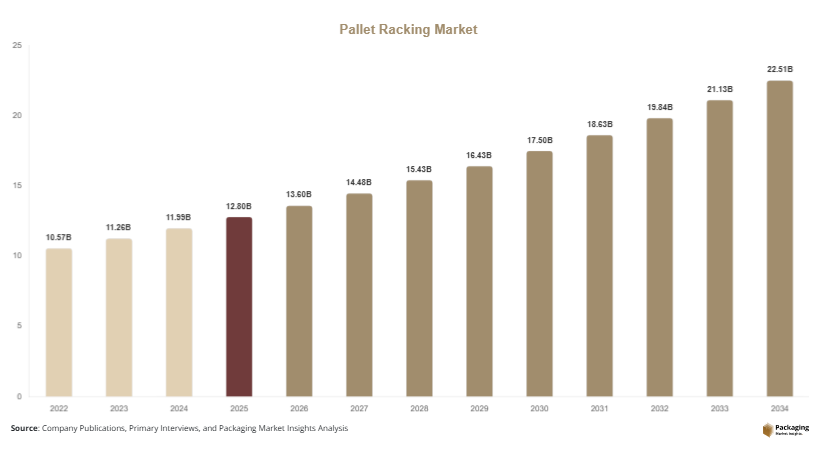
The global pallet racking market size was valued at USD 12.8 billion in 2025 and is estimated to reach USD 13.6 billion in 2026. By 2034, the market is projected to attain USD 22.5 billion, registering a CAGR of 6.5% during the forecast period (2025–2034). Growing investments in warehouse infrastructure, rising adoption of automation technologies, and increasing demand for efficient storage solutions are supporting market expansion worldwide.
The pallet racking market is witnessing significant growth as warehouses, distribution centers, manufacturing facilities, and retail logistics operators increasingly invest in efficient storage systems to maximize space utilization and improve inventory management. Pallet racking systems provide structured storage solutions that enable businesses to optimize warehouse capacity, streamline material handling operations, and support automated logistics processes. As global supply chains become more complex and e-commerce fulfillment requirements continue to expand, demand for advanced pallet racking solutions is increasing across multiple industries.
Key Market Highlights
- Asia Pacific dominated the market with a 39.1% share in 2025.
- Latin America is projected to grow at the fastest CAGR of 7.2%.
- Selective pallet racking led the type segment with a 36.8% share.
- Steel-based racking dominated the material segment with a 74.5% share.
- Retail and e-commerce applications led the end-use segment with 32.7% share.
- The US remained the dominant country with a market size of USD 2.4 billion in 2025 and USD 2.6 billion in 2026.
Explore more data points, trends and opportunities Download Free Sample Report
Market Trends
Integration of Automated Storage Systems with Pallet Racking
A major trend shaping the pallet racking market is the growing integration of automated storage and retrieval systems with modern racking infrastructure. Warehouse operators are increasingly implementing robotic technologies, automated forklifts, and warehouse management software that require highly compatible racking systems. Automated pallet shuttle systems and ASRS installations are becoming common in large fulfillment centers and manufacturing facilities. For example, major e-commerce distribution centers are deploying high-bay pallet racking systems integrated with automated retrieval technologies to improve throughput and inventory accuracy. As labor costs continue to rise and warehouse efficiency becomes increasingly important, demand for automation-compatible pallet racking systems is expected to grow significantly over the forecast period.
Rising Adoption of High-Density Storage Configurations
The growing need to maximize warehouse space utilization is encouraging the adoption of high-density pallet racking solutions. Businesses are increasingly investing in drive-in, push-back, pallet flow, and shuttle racking systems that allow greater storage capacity within limited floor space. This trend is particularly evident in urban logistics centers where warehouse real estate costs remain high. Food distributors, cold storage operators, and third-party logistics providers are adopting high-density storage configurations to reduce facility expansion costs while maintaining inventory availability. Looking forward, the increasing scarcity of industrial land in major logistics hubs is expected to accelerate demand for advanced high-density pallet racking systems.
Market Drivers
Expansion of E-Commerce Warehousing Infrastructure
The rapid growth of e-commerce platforms is significantly driving demand within the pallet racking market. Online retail operations require extensive warehousing capacity to manage large inventories and support fast order fulfillment. As e-commerce sales continue expanding globally, retailers and logistics providers are investing in new distribution centers equipped with advanced pallet racking systems. For instance, many fulfillment facilities now utilize multi-level racking structures to accommodate growing product volumes. This expansion directly increases demand for durable and scalable storage systems. As consumer expectations for faster delivery continue rising, warehouse operators are expected to further increase investments in pallet racking infrastructure.
Increasing Focus on Warehouse Efficiency and Inventory Optimization
Businesses across industries are prioritizing warehouse efficiency and inventory optimization to reduce operational costs and improve supply chain performance. Pallet racking systems enable organized storage, faster product retrieval, and improved inventory tracking. Manufacturing companies, wholesalers, and logistics providers increasingly rely on advanced racking solutions to enhance warehouse productivity. For example, selective and pallet flow racking systems help streamline stock rotation and reduce handling times. This cause-and-effect relationship between operational efficiency goals and storage infrastructure investment continues to drive market growth across multiple sectors.
Market Restraint
High Installation and Maintenance Costs of Advanced Racking Systems
One of the primary restraints affecting the pallet racking market is the substantial capital investment required for installation and maintenance of modern storage systems. High-density and automation-compatible racking solutions often involve significant expenditures related to engineering design, structural reinforcement, safety compliance, and equipment integration. Small and medium-sized enterprises may find these costs challenging, particularly when warehouse expansion budgets are limited.
The impact of this restraint is particularly evident in developing markets where logistics infrastructure investments remain constrained. For example, smaller warehouse operators frequently continue using conventional storage methods rather than upgrading to advanced pallet racking systems. In addition, ongoing maintenance requirements, safety inspections, and component replacements can increase total ownership costs. Although long-term operational benefits frequently justify these investments, high initial costs continue to limit adoption among budget-sensitive organizations.
Market Opportunities
Growth of Cold Storage and Temperature-Controlled Warehousing
The rapid expansion of cold chain logistics presents significant opportunities for pallet racking manufacturers. Food products, pharmaceuticals, biotechnology materials, and frozen goods require specialized storage facilities equipped with durable racking systems capable of operating in low-temperature environments. Cold storage operators are increasingly investing in corrosion-resistant pallet racking structures that maximize storage density while maintaining product accessibility. Future growth in pharmaceutical logistics and frozen food consumption is expected to create sustained demand for advanced pallet racking systems designed specifically for temperature-controlled warehouses.
Rising Investments in Emerging Market Logistics Infrastructure
Emerging economies are investing heavily in logistics modernization and warehouse development, creating attractive growth opportunities for the pallet racking market. Countries across Asia Pacific, Latin America, and the Middle East are expanding industrial zones, distribution networks, and transportation infrastructure. Modern warehouses require efficient storage systems to support growing manufacturing and retail activities. For example, large-scale logistics parks being developed in India and Southeast Asia increasingly incorporate advanced pallet racking installations. As industrialization and urbanization continue accelerating, demand for scalable warehouse storage solutions is expected to increase substantially.
Report Scope
| Report Metric | Details |
|---|---|
| Market Size in 2025 | USD 12.8 Billion |
| Market Size in 2026 | USD 13.6 Billion |
| Market Size in 2034 | USD 22.5 Billion |
| CAGR | 6.5% (2026-2034) |
| Base Year for Estimation | 2025 |
| Historical Data | 2022-2024 |
| Forecast Period | 2026-2034 |
| Report Coverage | Revenue Forecast, Competitive Landscape, Supply Chain Disruption, Growth Factors, Environment & Regulatory Landscape and Trends |
| Geographies Covered | North America, Europe, APAC, Middle East and Africa, LATAM |
| Countries Covered | U.S., Canada, U.K., Germany, France, Spain, Italy, Russia, Nordic, Benelux, Rest of Europe, China, South Korea, Japan, India, Australia, Singapore, Taiwan, South East Asia, Rest of Asia-Pacific, UAE, Turky, Saudi Arabia, South Africa, Egypt, Nigeria, Rest of MEA, Brazil, Mexico, Argentina, Chile, Colombia, Rest of LATAM |
Explore more data points, trends and opportunities Download Free Sample Report
Segmental Analysis
By Type
Selective Pallet Racking dominated the market in 2024 with approximately 36.8% share. This system remains the preferred choice for warehouses requiring direct access to individual pallets and flexible inventory management. Selective racking offers operational simplicity, compatibility with standard forklifts, and cost-effective installation. Industries including retail, manufacturing, and third-party logistics extensively utilize selective pallet racking due to its versatility and scalability. Large distribution centers often combine selective racking with warehouse management software to improve inventory visibility and operational efficiency. Continued demand for adaptable storage solutions supports the segment's leading position.
Shuttle Racking Systems are projected to be the fastest-growing type segment, expanding at a CAGR of 8.1% through 2034. Growth is driven by increasing warehouse automation and demand for high-density storage. Shuttle systems reduce forklift movement, improve storage efficiency, and enhance operational productivity. As businesses continue investing in automated logistics infrastructure, adoption of shuttle racking technology is expected to accelerate significantly.
By Material
Steel dominated the material segment with approximately 74.5% market share in 2024. Steel remains the preferred material because of its strength, durability, load-bearing capacity, and long service life. Most warehouse operators select steel racking systems for heavy-duty storage applications across industrial, retail, and logistics environments. Steel structures also offer excellent compatibility with automation technologies and can be configured for a wide range of storage requirements. Ongoing investments in large-scale warehouse facilities continue supporting strong demand for steel-based pallet racking systems.
Aluminum is expected to be the fastest-growing material segment, registering a CAGR of 6.9% during the forecast period. The material offers corrosion resistance, lightweight construction, and ease of installation. Industries requiring specialized storage environments, including pharmaceuticals and food processing, are increasingly adopting aluminum racking solutions. Future innovations focused on lightweight warehouse infrastructure are likely to support additional growth.
By End-Use
Retail & E-Commerce accounted for approximately 32.7% of total market share in 2024, making it the largest end-use segment. The rapid growth of online shopping has significantly increased demand for efficient storage systems capable of handling large product volumes and fast order fulfillment requirements. Retailers and logistics providers continue investing in modern warehouses equipped with advanced pallet racking configurations. These facilities require optimized storage capacity and streamlined inventory management processes to support competitive delivery timelines.
Cold Storage Facilities are expected to emerge as the fastest-growing end-use segment, expanding at a CAGR of 8.3% through 2034. Rising demand for frozen foods, pharmaceuticals, and temperature-sensitive products is increasing investments in refrigerated warehousing infrastructure. Cold storage operators require specialized pallet racking systems designed to withstand harsh environmental conditions while maximizing storage density. Continued growth of cold chain logistics is expected to drive substantial demand within this segment.
Pallet Racking Market Segmentations
By Type
- Selective Pallet Racking
- Drive-In Racking
- Push-Back Racking
- Pallet Flow Racking
- Shuttle Racking Systems
- Cantilever Racking
By Material
- Steel
- Aluminum
- Composite Materials
- Other Materials
By End-User
- Retail & E-Commerce
- Manufacturing
- Food & Beverage
- Cold Storage Facilities
- Pharmaceuticals
- Third-Party Logistics (3PL)
Regional Analysis
North America
North America accounted for approximately 28.4% of the global pallet racking market share in 2025 and is expected to register a CAGR of 6.1% through 2034. The region benefits from highly developed logistics infrastructure, advanced warehousing technologies, and strong e-commerce activity. Companies continue investing in warehouse modernization projects to improve storage efficiency and support faster order fulfillment. The growing adoption of automated material handling systems is also increasing demand for compatible pallet racking structures. Large-scale distribution centers across the United States and Canada remain key contributors to regional market growth.
The United States dominates the North American market. A unique growth driver is the rapid expansion of omnichannel retail fulfillment networks. Major retailers continue developing strategically located distribution centers designed to support same-day and next-day delivery services. Many of these facilities utilize advanced selective and shuttle racking systems integrated with automation technologies. This trend is strengthening demand for high-performance storage infrastructure and supporting long-term market expansion throughout the country.
Europe
Europe represented approximately 24.7% of global market share in 2025 and is projected to expand at a CAGR of 6.0% through 2034. The region's mature logistics industry and extensive manufacturing base support steady demand for pallet racking systems. Increasing warehouse automation investments and growing emphasis on space optimization are encouraging businesses to upgrade storage infrastructure. Industrial facilities across Germany, France, Italy, and the United Kingdom continue implementing advanced racking solutions to improve operational efficiency. Sustainability initiatives promoting durable and recyclable warehouse equipment are also contributing to market growth.
Germany remains the leading country within Europe. A unique growth driver is the country's strong industrial manufacturing sector, particularly automotive and engineering industries. Manufacturing facilities increasingly require sophisticated warehouse storage systems to manage large inventories and streamline production logistics. The adoption of Industry 4.0 practices and automated warehouses is further supporting demand for advanced pallet racking solutions across the German market.
Asia Pacific
Asia Pacific dominated the global pallet racking market with a 39.1% share in 2025 and is expected to grow at a CAGR of 7.0% through 2034. Rapid industrialization, expanding manufacturing activities, and rising e-commerce penetration are fueling demand for modern warehousing infrastructure. Countries such as China, India, Japan, South Korea, and Australia are witnessing significant investments in logistics facilities and distribution centers. The increasing need for efficient inventory management and warehouse automation is creating substantial opportunities for pallet racking manufacturers across the region.
China leads the Asia Pacific market. A unique growth driver is the continuous expansion of large-scale manufacturing clusters and export-oriented logistics networks. Warehouses supporting electronics, consumer goods, and industrial production increasingly rely on high-capacity racking systems to optimize storage efficiency. The ongoing development of smart logistics parks and automated fulfillment centers is expected to sustain strong demand for pallet racking solutions in China.
Middle East & Africa
The Middle East & Africa accounted for approximately 4.8% of global market share in 2025 and is projected to grow at a CAGR of 6.8% during the forecast period. Infrastructure development, logistics diversification initiatives, and increasing investments in warehousing facilities are supporting market growth. Governments across the region are prioritizing supply chain modernization to strengthen trade competitiveness. The expansion of free trade zones and industrial parks is creating demand for efficient warehouse storage systems. Growth in food distribution and pharmaceutical logistics also contributes to rising pallet racking adoption.
The United Arab Emirates dominates the regional market. A unique growth driver is the country's role as a major international trade and logistics hub. Warehousing operators serving regional and global supply chains are investing in advanced pallet racking systems to maximize storage capacity and improve operational efficiency. The continued expansion of logistics infrastructure around key ports and airports is expected to support market growth.
Latin America
Latin America held approximately 3.0% of global market share in 2025 and is anticipated to register the fastest CAGR of 7.2% through 2034. Growing retail activity, industrial development, and increasing adoption of organized warehousing solutions are driving demand for pallet racking systems. Logistics providers are expanding distribution networks to support rising consumer demand and regional trade flows. Investments in warehouse modernization and inventory management technologies are also contributing to market expansion across the region.
Brazil remains the dominant country in Latin America. A unique growth driver is the modernization of food and beverage distribution networks that require efficient storage infrastructure. Retailers and logistics companies are increasingly investing in high-density pallet racking systems to improve warehouse productivity and accommodate growing product volumes. These developments are expected to strengthen market growth over the forecast period.
Competitive Landscape
The pallet racking market is highly competitive, with manufacturers focusing on product innovation, automation compatibility, warehouse optimization, and geographic expansion. SSI SCHAEFER Group is recognized as a leading market participant due to its extensive product portfolio, global presence, and strong expertise in integrated warehouse solutions.
Other major companies include Daifuku Co., Ltd., Mecalux S.A., Jungheinrich AG, and AR Racking. These firms are investing in automated storage technologies, modular racking systems, and digital warehouse solutions to strengthen their market positions. Strategic partnerships with logistics providers and warehouse automation companies remain common competitive strategies.
Recent industry developments include the launch of smart racking systems equipped with sensor technologies, expansion of automated shuttle racking offerings, and increased investment in sustainable steel manufacturing processes. Companies are also focusing on customized storage solutions tailored to specific industry requirements, including cold storage, pharmaceutical logistics, and e-commerce fulfillment operations. As warehouse modernization continues globally, competition among leading players is expected to intensify.
Key Players List
- SSI SCHAEFER Group
- Daifuku Co., Ltd.
- Mecalux S.A.
- Jungheinrich AG
- AR Racking
- Interroll Group
- Stow Group
- Averys Group
- Ridg-U-Rak Inc.
- Constructor Group AS
- Hannibal Industries Inc.
- Frazier Industrial Company
- Steel King Industries
- UNARCO Industries LLC
- Elite Storage Solutions