Esd Stackable Boxes Market Size
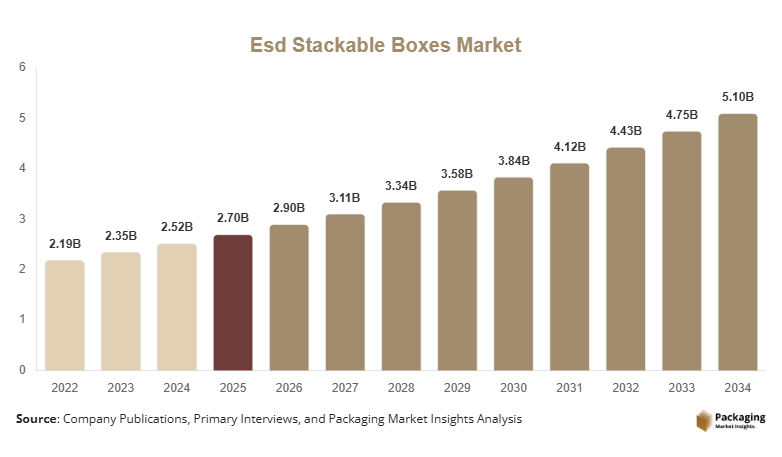
The ESD stackable boxes market size is projected at USD 2.9 billion in 2026 and is expected to hit USD 5.1 billion by 2034 with a CAGR of 7.3%. Increasing semiconductor production, electronics manufacturing expansion, and stringent electrostatic discharge protection standards continue to support industry development. The report provides detailed analysis of production capacity, segmentation, technological innovations, supply chain developments, and the competitive landscape across key manufacturing regions.
ESD stackable boxes are reusable conductive storage and transportation containers designed to protect sensitive electronic components from electrostatic discharge during manufacturing, storage, and logistics operations. Global production exceeded 118 million units in 2025, while annual output is projected to surpass 126 million units in 2026. Electronics manufacturing accounts for nearly 61% of total consumption, automotive contributes 24%, and aerospace & defense represents approximately 15%. Automated electronics facilities have achieved ESD packaging adoption exceeding 72%, strengthening the ESD stackable boxes market.
Explore more data points, trends and opportunities Download Free Sample Report
Esd Stackable Boxes Market Trends
Increasing Adoption of Reusable ESD Packaging Solutions
Manufacturers are replacing disposable packaging with reusable conductive stackable boxes to improve sustainability and reduce logistics costs. More than 68 million reusable ESD boxes are expected to be deployed globally in 2026, accounting for approximately 54% of total production. Smart inventory tracking systems are integrated into nearly 22% of premium ESD containers, while warehouse automation adoption exceeds 43% among electronics manufacturers. These developments continue strengthening the ESD stackable boxes market.
The growing production of semiconductors, printed circuit boards, and electric vehicle electronics is accelerating demand for high-performance conductive packaging. Annual manufacturing capacity has expanded by more than 9 million units, while conductive polymer utilization exceeds 63% of total production. Advanced anti-static materials and RFID-enabled containers continue supporting the ESD stackable boxes market.
Esd Stackable Boxes Drivers
Growing Semiconductor and Electronics Manufacturing
Global semiconductor production continues expanding, with annual chip shipments exceeding 1.4 trillion units. More than 74% of electronics manufacturers utilize certified ESD-safe storage systems, while production of printed circuit boards continues increasing by nearly 8% annually. Rising investments in electronics assembly continue driving ESD stackable box market growth.
Esd Stackable Boxes Restraints
High Manufacturing Cost of Conductive Materials
Conductive polymers and carbon-filled engineering plastics increase manufacturing costs compared with conventional plastic containers. Raw material prices fluctuate by 10%–17% annually, while conductive additives account for nearly 21% of total production expenses. Cost sensitivity among small manufacturers limits broader adoption across the ESD stackable boxes market.
Esd Stackable Boxes: Opportunities
Expansion of Electric Vehicle and Advanced Electronics Production
Electric vehicle manufacturing and advanced electronics assembly require reliable electrostatic protection during production and transportation. EV electronics production is increasing by more than 15% annually, while industrial automation investments exceed USD 40 billion globally. Expanding electronics manufacturing facilities continue creating attractive opportunities across the ESD stackable box market.
Challenges in Esd Stackable Boxes Market
Compliance with International ESD Standards and Supply Chain Constraints
Manufacturers must comply with increasingly stringent electrostatic discharge protection standards while managing raw material availability. Certification costs have increased by nearly 12%, while engineering plastic supply lead times average 10–14 weeks. These operational challenges continue affecting the ESD stackable boxes market.
Report Scope
| Report Metric | Details |
|---|---|
| Market Size in 2025 | USD 2.7 Billion |
| Market Size in 2026 | USD 2.9 Billion |
| Market Size in 2034 | USD 5.1 Billion |
| CAGR | 7.3% (2026-2034) |
| Base Year for Estimation | 2025 |
| Historical Data | 2022-2024 |
| Forecast Period | 2026-2034 |
| Report Coverage | Revenue Forecast, Competitive Landscape, Supply Chain Disruption, Growth Factors, Environment & Regulatory Landscape and Trends |
| Geographies Covered | North America, Europe, APAC, Middle East and Africa, LATAM |
| Countries Covered | U.S., Canada, U.K., Germany, France, Spain, Italy, Russia, Nordic, Benelux, Rest of Europe, China, South Korea, Japan, India, Australia, Singapore, Taiwan, South East Asia, Rest of Asia-Pacific, UAE, Turky, Saudi Arabia, South Africa, Egypt, Nigeria, Rest of MEA, Brazil, Mexico, Argentina, Chile, Colombia, Rest of LATAM |
Explore more data points, trends and opportunities Download Free Sample Report
Esd Stackable Boxes Market Segmentation
The market is segmented by material type and end-use industry. Conductive polypropylene accounts for approximately 47% of total demand, followed by conductive HDPE at 32% and carbon-filled plastic at 21%. Electronics manufacturing remains the dominant application with approximately 61% market contribution.
By Material Type
Conductive polypropylene represents approximately 47% of total production, exceeding 59 million units annually. These boxes provide lightweight construction, excellent impact resistance, and surface resistivity ranging between 10³ and 10⁶ ohms, making them suitable for semiconductor and electronics storage.
Conductive HDPE contributes nearly 32% of market demand, with annual production exceeding 40 million units. The material offers superior chemical resistance, high durability, and stackable structural performance for electronics logistics and warehouse operations.
Carbon-filled plastic accounts for approximately 21% of production, exceeding 27 million units annually. These containers provide enhanced conductivity, long service life, and excellent dimensional stability for transporting sensitive electronic assemblies.
By End-use Industry
Electronics manufacturing accounts for approximately 61% of market demand, consuming more than 77 million units annually. Semiconductor fabrication, PCB assembly, consumer electronics, and telecommunications equipment manufacturers maintain ESD packaging penetration exceeding 72%, making this the largest application segment.
Automotive applications contribute nearly 24% of global consumption, utilizing over 30 million units annually. Electric vehicles, automotive electronics, and battery manufacturing increasingly rely on conductive stackable boxes for component protection throughout production and logistics.
Aerospace and defense account for approximately 15% of total demand, consuming over 19 million units annually. High-value electronic components, avionics systems, and military equipment require certified ESD protection during manufacturing, storage, and transportation.
Esd Stackable Boxes Market Segmentations
Material Type
- Conductive Polypropylene
- Conductive HDPE
- Carbon-Filled Plastic
End-use Industry
- Electronics Manufacturing
- Automotive
- Aerospace & Defense
Esd Stackable Boxes Regional Outlook
North America
North America accounts for approximately 28% of global revenue. The United States contributes nearly 83% of regional production, supported by semiconductor manufacturing and aerospace electronics. Annual regional production exceeds 35 million units.
Europe
Europe represents approximately 25% of global demand. Germany, France, the United Kingdom, and Italy contribute over 71% of regional production. Annual output exceeds 31 million units, supported by automotive electronics and industrial automation.
Asia-Pacific
Asia-Pacific dominates with approximately 40% of the global market. China contributes nearly 48% of regional production, followed by Japan, South Korea, and Taiwan. Regional manufacturing exceeds 50 million units annually, driven by semiconductor and electronics industries.
Latin America
Latin America contributes approximately 4% of global demand. Brazil and Mexico account for nearly 68% of regional consumption, supported by automotive electronics manufacturing and industrial assembly operations.
Middle East & Africa
The Middle East & Africa account for approximately 3% of global consumption. UAE, Saudi Arabia, South Africa, and Israel continue investing in electronics manufacturing infrastructure, with annual production exceeding 4 million units.
Top Players In The ESD Stackable Boxes Market
- Schoeller Allibert,
- ORBIS Corporation,
- SSI SCHAEFER Group,
- Conductive Containers Inc.
- GWP Group,
- MFG Tray,
- Akro-Mils,
- RPP Containers,
- Protective Pak,
- Desco Industries Inc.
- Royal Case Company
- Antistat Inc.
Schoeller Allibert Estimated global market share: 15% Leading supplier of reusable industrial and ESD packaging solutions. Strong manufacturing footprint across Europe, North America, and Asia. Schoeller Allibert focuses on reusable conductive containers, sustainable material development, RFID-enabled logistics solutions, and advanced injection molding technologies. Continuous investment in automation, durable polymer engineering, and customized ESD packaging enables the company to strengthen its position across semiconductor, automotive, and electronics manufacturing industries while supporting circular packaging initiatives. ORBIS Corporation Estimated global market share: 12% Major provider of reusable packaging and material handling products. Strong customer presence across automotive, electronics, and logistics industries. ORBIS Corporation continues expanding its conductive packaging portfolio with durable stackable ESD containers designed for automated warehouses and electronics manufacturing facilities. Investments in recycled conductive polymers, lightweight designs, and customized storage solutions strengthen operational efficiency while meeting strict electrostatic discharge protection requirements across global industrial markets.