Corrugated Boxes For Transit Packaging Market Size and Growth
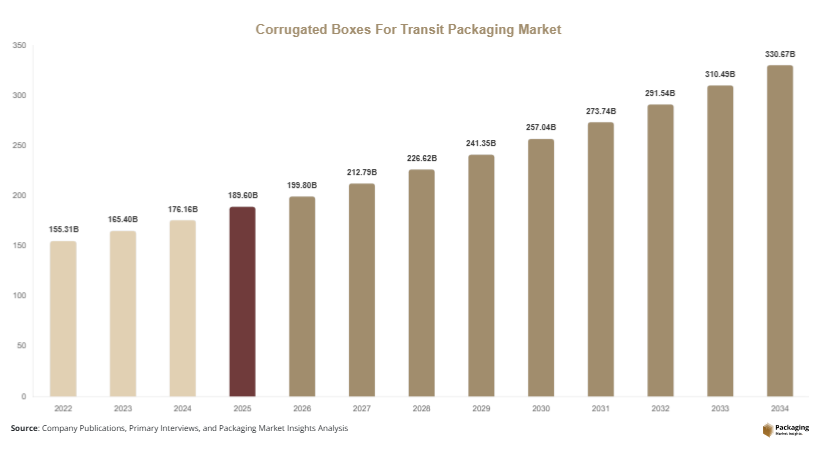
The global corrugated boxes for transit packaging market size was valued at USD 189.6 billion in 2025 and is projected to reach USD 199.8 billion in 2026, further expanding to approximately USD 352.4 billion by 2034, registering a CAGR of 6.5% during 2025–2034. Corrugated boxes remain a preferred packaging solution for transit applications due to their durability, cost-effectiveness, and recyclability, making them essential in modern supply chains. The orrugated boxes for transit packaging market is witnessing consistent expansion due to the rapid growth of logistics, e-commerce, and global trade activities.
One of the primary growth factors is the increasing penetration of e-commerce and direct-to-consumer delivery models. Online retail platforms require lightweight yet strong packaging materials that can protect goods during transportation. Corrugated boxes meet these requirements effectively, driving their widespread adoption across industries such as electronics, apparel, and consumer goods.
Key Highlights:
- Asia Pacific dominated the market with a 38.4% share in 2025, while Latin America is projected to grow at the fastest CAGR of 7.3%.
- Single-wall corrugated boxes led the type segment with a 52.7% share, while double-wall boxes are expected to grow at a CAGR of 6.9%.
- Recycled paper materials dominated with a 63.5% share, while virgin kraft paper is forecasted to grow at a CAGR of 6.8%.
- E-commerce logistics led the application segment with 34.8% share, while pharmaceutical transit packaging is expected to grow at a CAGR of 7.1%.
- China remained the dominant country with a market size of USD 34.6 billion in 2025 and USD 36.2 billion in 2026.
Explore more data points, trends and opportunities Download Free Sample Report
Market Trends
Increasing Adoption of Sustainable and Recyclable Packaging Materials
Sustainability continues to influence the corrugated boxes for transit packaging market, with companies prioritizing recyclable and biodegradable materials. Corrugated boxes are primarily produced from recycled paper, which reduces environmental impact and supports circular economy initiatives. Manufacturers are also improving fiber recovery rates and reducing water and energy consumption during production. This trend is particularly strong in regions with strict environmental regulations, where businesses are required to adopt eco-friendly packaging solutions. Additionally, brand owners are promoting sustainability through packaging design, which is increasing demand for certified and responsibly sourced corrugated materials.
Growth in Customization and Smart Packaging Solutions
Customization is becoming a significant trend as companies seek to optimize packaging for different products and logistics requirements. Corrugated boxes are being designed with specific dimensions, inserts, and cushioning features to improve protection and reduce material usage. The integration of smart packaging elements such as QR codes and tracking labels is also gaining traction. These features enable real-time tracking and improve supply chain visibility. Furthermore, high-quality digital printing allows companies to enhance branding and customer engagement, turning transit packaging into a communication tool.
Market Drivers
Rapid Expansion of E-commerce and Logistics Industry
The rapid growth of e-commerce has significantly increased the demand for transit packaging solutions. Corrugated boxes are widely used for shipping products due to their strength, lightweight nature, and cost efficiency. Online retailers require packaging that can withstand multiple handling stages during delivery. The rise of same-day and next-day delivery services has further increased the need for reliable packaging. As e-commerce continues to expand globally, the demand for corrugated boxes is expected to grow steadily.
Rising Demand from Manufacturing and Export Sectors
The expansion of manufacturing industries and global trade is another major driver of the market. Corrugated boxes are essential for transporting goods across long distances while ensuring product safety. Industries such as electronics, automotive, and pharmaceuticals rely on durable packaging solutions to prevent damage during transit. Additionally, the increasing volume of exports from emerging economies is driving demand for standardized and high-performance packaging solutions.
Market Restraint
Volatility in Raw Material Prices
Fluctuations in the prices of raw materials such as paper pulp and recycled fibers pose a significant challenge to the corrugated boxes for transit packaging market. Changes in supply and demand, as well as environmental regulations, can impact the availability and cost of these materials. For instance, disruptions in the recycling supply chain can lead to increased costs for manufacturers. This volatility can affect profit margins and pricing strategies, making it difficult for companies to maintain competitiveness. Additionally, rising energy costs further add to production expenses, impacting overall market growth.
Market Opportunities
Development of High-Strength and Lightweight Corrugated Solutions
Advancements in material science are enabling the development of corrugated boxes that are both strong and lightweight. These innovations help reduce transportation costs and improve efficiency in logistics operations. High-strength corrugated boxes can handle heavier loads while using less material, making them cost-effective and environmentally friendly. Companies investing in such technologies can gain a competitive advantage in the market.
Growth in Emerging Markets and Industrialization
Emerging markets present significant growth opportunities due to increasing industrialization and urbanization. Countries in Asia, Latin America, and Africa are experiencing rapid economic growth, leading to higher demand for packaged goods. The expansion of retail and e-commerce sectors in these regions is driving the need for efficient transit packaging solutions. As infrastructure improves, the adoption of corrugated boxes is expected to increase, creating new opportunities for market players.
Report Scope
| Report Metric | Details |
|---|---|
| Market Size in 2025 | USD 189.6 Billion |
| Market Size in 2026 | USD 199.8 Billion |
| Market Size in 2034 | USD 352.4 Billion |
| CAGR | 6.5% (2026-2034) |
| Base Year for Estimation | 2025 |
| Historical Data | 2022-2024 |
| Forecast Period | 2026-2034 |
| Report Coverage | Revenue Forecast, Competitive Landscape, Supply Chain Disruption, Growth Factors, Environment & Regulatory Landscape and Trends |
| Geographies Covered | North America, Europe, APAC, Middle East and Africa, LATAM |
| Countries Covered | U.S., Canada, U.K., Germany, France, Spain, Italy, Russia, Nordic, Benelux, Rest of Europe, China, South Korea, Japan, India, Australia, Singapore, Taiwan, South East Asia, Rest of Asia-Pacific, UAE, Turky, Saudi Arabia, South Africa, Egypt, Nigeria, Rest of MEA, Brazil, Mexico, Argentina, Chile, Colombia, Rest of LATAM |
Explore more data points, trends and opportunities Download Free Sample Report
Segmental Analysis
By Type
Single-wall corrugated boxes dominated the market, accounting for 52.7% share in 2024. These boxes are widely used for lightweight and medium-weight products due to their cost efficiency and ease of handling. They provide adequate protection for most consumer goods and are commonly used in e-commerce and retail applications.
Double-wall corrugated boxes are expected to be the fastest-growing segment, with a CAGR of 6.9%. These boxes offer enhanced strength and durability, making them suitable for heavy and fragile items. The growth of this segment is driven by increasing demand from industries such as electronics and automotive.
By Material
Recycled paper dominated the market with a 63.5% share in 2024, due to its sustainability and cost advantages. Corrugated boxes made from recycled paper are widely used across industries, as they reduce environmental impact and support circular economy initiatives.
Virgin kraft paper is the fastest-growing segment, with a CAGR of 6.8%. It offers higher strength and durability compared to recycled paper, making it suitable for heavy-duty applications. The increasing demand for high-performance packaging is driving the growth of this segment.
By Application
E-commerce logistics dominated the market, accounting for 34.8% share in 2024. The rapid growth of online retail has increased the demand for reliable and cost-effective packaging solutions. Corrugated boxes are widely used for shipping products due to their durability and versatility.
Pharmaceutical transit packaging is expected to be the fastest-growing segment, with a CAGR of 7.1%. The need for safe and secure transportation of medical products is driving demand for specialized corrugated packaging solutions. These boxes are designed to maintain product integrity and comply with regulatory requirements.
Corrugated Boxes For Transit Packaging Market Segmentations
By Type
- Single-Wall Corrugated Boxes
- Double-Wall Corrugated Boxes
- Triple-Wall Corrugated Boxes
By Material
- Recycled Paper
- Virgin Kraft Paper
By Application
- E-commerce Logistics
- Food & Beverage
- Electronics
- Pharmaceuticals
- Automotive
Regional Analysis
North America
North America accounted for approximately 27.6% of the market share in 2025 and is expected to grow at a CAGR of 6.1%. The region benefits from a mature logistics infrastructure and high adoption of corrugated packaging in e-commerce and retail sectors. The presence of large packaging manufacturers also supports market growth.
The United States dominates the regional market due to its extensive e-commerce network and high consumer demand. A key growth factor is the increasing adoption of sustainable packaging solutions, driven by regulatory requirements and consumer preferences for eco-friendly products.
Europe
Europe held a market share of 22.8% in 2025 and is projected to grow at a CAGR of 6.3%. The region is characterized by strong environmental regulations and a focus on sustainable packaging practices. Corrugated boxes are widely used due to their recyclability and compliance with regulatory standards.
Germany is the leading country in the European market, supported by its advanced manufacturing sector. A unique growth factor is the widespread adoption of circular economy practices, which encourage the use of recyclable materials and reduce packaging waste.
Asia Pacific
Asia Pacific dominated the market with a 38.4% share in 2025 and is expected to grow at a CAGR of 6.9%. Rapid urbanization, industrial growth, and increasing e-commerce activities are driving demand for corrugated boxes in the region.
China is the dominant country, driven by its large manufacturing base and export activities. A key growth factor is the increasing demand for cost-effective packaging solutions to support large-scale production and distribution.
Middle East & Africa
The Middle East & Africa region accounted for a 5.2% share in 2025 and is expected to grow at a CAGR of 6.7%. The market is expanding due to rising industrialization and growing demand for packaged goods.
The United Arab Emirates leads the regional market, supported by its strategic position as a trade hub. A unique growth factor is the expansion of logistics and warehousing infrastructure, which is increasing demand for transit packaging solutions.
Latin America
Latin America held a market share of 6.0% in 2025 and is projected to grow at the fastest CAGR of 7.3%. The region is experiencing increasing demand for packaged goods due to economic growth and changing consumer lifestyles.
Brazil is the dominant country in the region, supported by its large population and growing industrial sector. A key growth factor is the expansion of local manufacturing and export activities, which is driving demand for corrugated packaging solutions.
Competitive Landscape
The corrugated boxes for transit packaging market is highly competitive, with key players focusing on innovation, sustainability, and operational efficiency. Companies are investing in advanced manufacturing technologies and expanding their production capacities to meet growing demand.
International Paper Company is a leading player in the market, known for its extensive product portfolio and global presence. The company recently expanded its corrugated packaging production facilities to enhance supply capabilities. Other major players such as WestRock Company, Smurfit Kappa Group, DS Smith plc, and Mondi Group are also focusing on sustainable packaging solutions and strategic partnerships to strengthen their market positions.
Key Players List
- International Paper Company
- WestRock Company
- Smurfit Kappa Group
- DS Smith plc
- Mondi Group
- Packaging Corporation of America
- Georgia-Pacific LLC
- Stora Enso Oyj
- Nine Dragons Paper Holdings Limited
- Oji Holdings Corporation
- Rengo Co., Ltd.
- Pratt Industries Inc.
- Klabin S.A.
- Lee & Man Paper Manufacturing Ltd.
- Cascades Inc.