E commerce Packaging Market Size and Growth
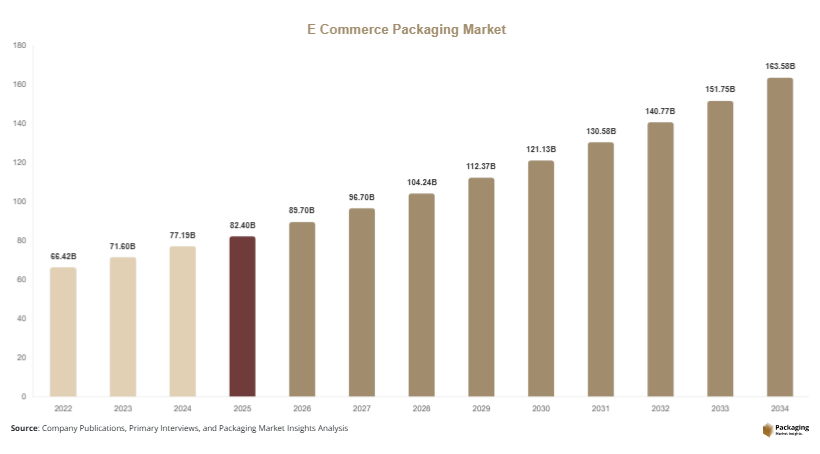
The global e commerce packaging market size was valued at approximately USD 82.4 billion in 2025 and is estimated to reach USD 89.7 billion in 2026. Over the forecast period, the market is projected to grow significantly and reach USD 164.3 billion by 2034, registering a compound annual growth rate (CAGR) of 7.8% from 2025 to 2034. Growth is largely supported by rising parcel shipments, improvements in fulfillment infrastructure, and increasing cross-border online trade.
The e commerce packaging market has experienced steady expansion over the past decade due to the rapid growth of online retail platforms and digital purchasing behavior across developed and emerging economies. Packaging plays a central role in protecting products during shipping, improving the customer experience, and enabling efficient logistics operations. As e-commerce platforms continue to expand their product offerings and geographic reach, the demand for reliable, sustainable, and cost-efficient packaging solutions is increasing across global supply chains.
Key Highlights
- Global e commerce packaging market size reached USD 82.4 billion in 2025
- Market projected to reach USD 164.3 billion by 2034
- CAGR of 7.8% (2025–2034)
- Sustainable packaging innovations are reshaping industry strategies
- Asia Pacific is emerging as the fastest-growing regional market
Explore more data points, trends and opportunities Download Free Sample Report
Market Trends
Shift Toward Sustainable and Recyclable Packaging Materials
Sustainability has become a major trend shaping the e commerce packaging market as governments, retailers, and consumers prioritize environmentally responsible packaging solutions. Companies are increasingly adopting recyclable materials such as corrugated cardboard, molded pulp, and paper-based cushioning to reduce plastic waste. Many e-commerce retailers are redesigning packaging structures to minimize material usage while maintaining product protection during transit. In addition, biodegradable packaging and compostable mailers are gaining attention as brands attempt to meet sustainability targets and comply with environmental regulations.
Another aspect of this trend involves circular packaging models. Several companies are experimenting with reusable shipping boxes and returnable packaging systems designed for multiple delivery cycles. These initiatives aim to reduce waste generation and improve resource efficiency across logistics operations. As environmental awareness increases among consumers, retailers are using eco-friendly packaging as part of their brand positioning strategy.
Adoption of Smart and Automated Packaging Technologies
Automation and smart packaging technologies are transforming operational efficiency across e-commerce fulfillment centers. Large online retailers are deploying automated packaging machines capable of producing customized box sizes based on product dimensions. These systems reduce packaging waste, improve shipping efficiency, and lower transportation costs. Automated packaging solutions also support high-volume order processing, which is essential during peak online shopping seasons.
Smart packaging technologies are also emerging as an important trend in the e commerce packaging market. QR codes, RFID tags, and digital tracking labels are being integrated into packaging designs to enhance supply chain visibility. These technologies enable real-time tracking, inventory monitoring, and improved customer communication. In addition, smart packaging allows brands to provide product information, authentication features, and interactive digital experiences for consumers.
Market Drivers
Rapid Growth of Global E-commerce Sales
The rapid expansion of online retail has become one of the strongest drivers of the e commerce packaging market. Increasing internet penetration, rising smartphone adoption, and convenient digital payment systems have enabled consumers to purchase products online more frequently. As a result, global parcel shipment volumes have grown significantly over the past few years. Each shipment requires durable and protective packaging solutions to ensure product safety during transit.
E-commerce companies are also expanding their product categories, including electronics, fashion, groceries, and home goods. This diversification requires a wide range of packaging formats such as corrugated boxes, padded envelopes, insulated containers, and protective cushioning materials. As online shopping continues to expand across emerging markets, packaging demand is expected to increase steadily.
Expansion of Logistics and Fulfillment Infrastructure
The expansion of logistics networks and automated fulfillment centers is another important factor supporting the growth of the e commerce packaging market. Retailers and third-party logistics providers are investing heavily in distribution hubs, warehouse automation systems, and last-mile delivery infrastructure. These facilities require efficient packaging solutions that support high-speed packaging operations and minimize handling damage.
Advanced fulfillment centers rely on standardized packaging materials that are compatible with automated packaging equipment and conveyor systems. Packaging designs that reduce dimensional weight and optimize storage space are becoming increasingly important for logistics efficiency. As e-commerce companies focus on improving delivery speed and reducing operational costs, demand for innovative packaging solutions continues to rise.
Market Restraint
Rising Raw Material Costs and Supply Chain Volatility
One of the major challenges affecting the e commerce packaging market is the increasing volatility in raw material prices. Packaging materials such as paperboard, corrugated fiberboard, plastics, and adhesives are influenced by fluctuations in global commodity markets. Changes in pulp prices, energy costs, and transportation expenses can significantly impact manufacturing costs for packaging producers.
In recent years, supply chain disruptions and geopolitical uncertainties have also affected the availability of key raw materials. Packaging manufacturers often face higher procurement costs and longer lead times, which can affect profitability and pricing strategies. Smaller manufacturers may experience greater pressure due to limited bargaining power with suppliers.
These cost challenges can lead to increased packaging expenses for e-commerce retailers. As companies attempt to maintain competitive pricing for online products, higher packaging costs may reduce profit margins or lead to cost optimization efforts. Some companies are addressing this issue by redesigning packaging structures to reduce material usage or shifting toward alternative materials with more stable pricing.
Market Opportunities
Growth of Sustainable Packaging Innovation
Sustainability initiatives present a major opportunity for companies operating in the e commerce packaging market. Governments and regulatory authorities in several countries are introducing stricter regulations on single-use plastics and packaging waste. This regulatory environment encourages manufacturers to develop eco-friendly packaging alternatives such as compostable mailers, fiber-based packaging, and recyclable cushioning materials.
Packaging companies that invest in sustainable innovation can gain a competitive advantage in the market. Many global retailers now require suppliers to meet environmental packaging standards as part of their procurement policies. By offering recyclable or biodegradable packaging solutions, manufacturers can strengthen long-term partnerships with major e-commerce companies and logistics providers.
Expansion of E-commerce in Emerging Markets
Emerging economies present significant growth opportunities for the e commerce packaging market. Countries across Asia, Latin America, and Africa are experiencing increasing internet penetration and rapid digitalization of retail sectors. As consumers adopt online shopping platforms, the demand for reliable shipping and packaging solutions is expanding quickly.
In these regions, local logistics infrastructure is also improving, enabling faster delivery times and broader geographic coverage. Packaging companies can benefit by establishing regional manufacturing facilities and distribution networks to serve growing e-commerce markets. Custom packaging designs tailored to regional logistics requirements can further support market expansion.
Report Scope
| Report Metric | Details |
|---|---|
| Market Size in 2025 | USD 82.4 Billion |
| Market Size in 2026 | USD 89.7 Billion |
| Market Size in 2034 | USD 164.3 Billion |
| CAGR | 7.8% (2026-2034) |
| Base Year for Estimation | 2025 |
| Historical Data | 2022-2024 |
| Forecast Period | 2026-2034 |
| Report Coverage | Revenue Forecast, Competitive Landscape, Supply Chain Disruption, Growth Factors, Environment & Regulatory Landscape and Trends |
| Geographies Covered | North America, Europe, APAC, Middle East and Africa, LATAM |
| Countries Covered | U.S., Canada, U.K., Germany, France, Spain, Italy, Russia, Nordic, Benelux, Rest of Europe, China, South Korea, Japan, India, Australia, Singapore, Taiwan, South East Asia, Rest of Asia-Pacific, UAE, Turky, Saudi Arabia, South Africa, Egypt, Nigeria, Rest of MEA, Brazil, Mexico, Argentina, Chile, Colombia, Rest of LATAM |
Explore more data points, trends and opportunities Download Free Sample Report
Segmental Analysis
Material Type
The corrugated cardboard segment dominated the e commerce packaging market in 2024, accounting for approximately 52% of the global market share. Corrugated packaging is widely used for shipping boxes due to its durability, lightweight structure, and cost efficiency. It provides strong protection for products during transportation while remaining recyclable and environmentally friendly. E-commerce retailers prefer corrugated packaging because it can be easily customized for different product sizes and shipping requirements. In addition, advancements in printing technologies allow companies to include branding and product information directly on the packaging surface.
The molded pulp packaging segment is expected to register the fastest growth with a CAGR of around 9.6% during the forecast period. This growth is driven by increasing demand for sustainable packaging materials that reduce plastic usage. Molded pulp packaging is made from recycled paper fibers and is biodegradable, making it an attractive alternative to plastic cushioning materials. E-commerce companies are adopting molded pulp inserts for electronics, cosmetics, and fragile products to enhance sustainability while maintaining protective performance.
Packaging Type
Among packaging types, boxes and cartons represented the largest share of the e commerce packaging market in 2024, accounting for nearly 58% of total revenue. Corrugated boxes are widely used for shipping a variety of products, including electronics, clothing, home appliances, and consumer goods. Their structural strength and stacking capability make them suitable for warehouse storage and transportation. Many e-commerce retailers also use branded boxes to enhance customer experience and strengthen brand identity.
The protective packaging segment, including air pillows, bubble wrap, and foam inserts, is projected to grow at the fastest CAGR of approximately 8.9% over the forecast period. The increasing shipment of fragile and high-value products has driven the demand for effective protective packaging solutions. Protective packaging helps reduce product damage during transit, improving customer satisfaction and reducing return rates for e-commerce retailers.
End-Use Industry
The consumer electronics segment held the dominant share of the e commerce packaging market in 2024, accounting for approximately 34% of the total market share. Electronics products require specialized packaging solutions to protect delicate components from physical damage, moisture, and electrostatic discharge during shipping. Packaging designs often include cushioning materials and compartmentalized structures to ensure product safety.
The food and beverage segment is expected to experience the highest growth with a CAGR of around 9.1% through 2034. The increasing popularity of online grocery delivery and meal-kit services has significantly increased demand for insulated and protective packaging solutions. These packaging systems are designed to maintain temperature control and prevent contamination during transportation.
E Commerce Packaging Market Segmentations
Material Type
- Corrugated Cardboard
- Plastic
- Molded Pulp
- Paper & Paperboard
Packaging Type
- Boxes & Cartons
- Mailers & Envelopes
- Protective Packaging
- Insulated Packaging
End-Use Industry
- Consumer Electronics
- Fashion & Apparel
- Food & Beverage
- Personal Care & Cosmetics
- Home & Furniture
Regional Analysis
North America
North America held a significant share of the global e commerce packaging market in 2025, accounting for approximately 32% of total revenue. The region is expected to maintain steady growth with a CAGR of around 6.9% through 2034. High consumer adoption of online shopping and strong logistics infrastructure support the demand for efficient packaging solutions. In addition, the presence of major e-commerce retailers and advanced fulfillment technologies contributes to consistent packaging demand.
The United States remains the dominant country in the regional market. A major growth factor is the expansion of automated fulfillment centers operated by large retailers and logistics companies. These facilities require standardized packaging solutions compatible with automation systems, driving demand for customized corrugated boxes and protective packaging materials.
Europe
Europe represented approximately 26% of the global e commerce packaging market share in 2025 and is expected to grow at a CAGR of 6.7% during the forecast period. The region’s focus on sustainability and environmental regulations strongly influences packaging design and material selection. Governments are promoting recyclable packaging materials and reducing single-use plastics, encouraging manufacturers to develop fiber-based packaging solutions.
Germany is the leading market in Europe due to its strong manufacturing base and advanced logistics infrastructure. A key growth factor is the increasing adoption of environmentally friendly packaging solutions. Retailers are implementing packaging reduction initiatives to meet sustainability goals and comply with regional environmental regulations.
Asia Pacific
Asia Pacific accounted for approximately 28% of the global e commerce packaging market in 2025 and is projected to register the fastest CAGR of around 9.3% through 2034. The rapid expansion of online retail platforms and growing middle-class populations are driving significant packaging demand. Improvements in logistics networks and digital payment systems are also accelerating e-commerce adoption across the region.
China dominates the Asia Pacific market due to its large e-commerce ecosystem and high parcel shipment volumes. One unique growth factor is the strong presence of integrated logistics platforms that operate massive distribution networks. These platforms require large volumes of packaging materials to support high-frequency deliveries.
Middle East & Africa
The Middle East & Africa region accounted for nearly 7% of the global e commerce packaging market share in 2025 and is projected to grow at a CAGR of 7.5% during the forecast period. Increasing internet penetration and smartphone adoption are contributing to rising online shopping activity in several countries across the region. Governments are also investing in digital infrastructure to support e-commerce development.
The United Arab Emirates leads the regional market due to its advanced logistics infrastructure and growing e-commerce sector. A key growth factor is the development of regional fulfillment hubs that support cross-border online trade. These logistics centers require efficient packaging solutions to handle increasing parcel shipments.
Latin America
Latin America represented approximately 7% of the global e commerce packaging market in 2025 and is expected to grow at a CAGR of 8.1% through 2034. Rising consumer demand for online shopping and improving delivery infrastructure are driving packaging demand in the region. Local e-commerce platforms are expanding their operations and increasing shipment volumes.
Brazil is the dominant market in the region. A major growth factor is the rapid expansion of online retail marketplaces and improved last-mile delivery services. Packaging manufacturers are establishing regional production facilities to support growing demand from local retailers and logistics providers.
Competitive Landscape
The global e commerce packaging market is moderately consolidated with several international and regional companies competing through product innovation, sustainable packaging solutions, and strategic partnerships with e-commerce retailers. Leading manufacturers are investing in advanced packaging technologies and automation-compatible packaging formats to strengthen their market position.
International Paper Company is considered one of the leading players in the market due to its strong global presence and extensive portfolio of corrugated packaging solutions. The company has expanded its packaging production capacity to support increasing demand from e-commerce retailers.
Other major companies such as WestRock Company, Smurfit Kappa Group, DS Smith Plc, and Mondi Group are also actively investing in sustainable packaging innovation. Many of these companies are developing recyclable and fiber-based packaging products designed specifically for online retail shipments. Recent developments include partnerships with e-commerce platforms to design packaging solutions that reduce shipping costs and improve product protection.
Key Players List
- International Paper Company
- WestRock Company
- Smurfit Kappa Group
- DS Smith Plc
- Mondi Group
- Sealed Air Corporation
- Pregis LLC
- Georgia-Pacific LLC
- Packaging Corporation of America
- Sonoco Products Company
- Amcor Plc
- Ranpak Holdings Corp.
- Huhtamaki Oyj
- UFP Industries Inc.
- Stora Enso Oyj