Layer Pads Market Size
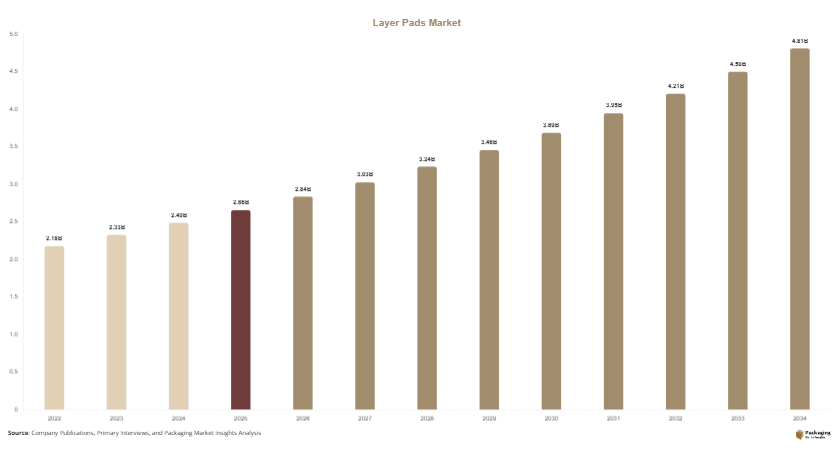
Layer pads' market size is projected at USD 2.84 billion in 2026 and is expected to hit USD 4.79 billion by 2034 with a CAGR of 6.8%. The report provides a comprehensive analysis of production capacity, raw material utilization, manufacturing technologies, pricing trends, supply chain dynamics, and competitive landscape across major regional markets. It further evaluates product segmentation, end-use industries, sustainability initiatives, and strategic developments shaping future industry expansion.
Layer pads are protective packaging sheets placed between stacked products to improve load stability, prevent damage, and enhance pallet efficiency during storage and transportation. These products are manufactured using corrugated board, solid fiberboard, or plastic materials depending on application requirements. Global production exceeded 15.8 billion units in 2025, while manufacturing utilization averaged 85%. Food and beverage applications accounted for approximately 46% of total consumption, industrial packaging represented 34%, and pharmaceuticals contributed nearly 20%. Increasing demand for protective transport packaging continues supporting the layer pads market.
Explore more data points, trends and opportunities Download Free Sample Report
Layer Pads Market Drivers
Expansion of Global Food and Beverage Distribution Networks
Growing demand for safe palletized transportation, increasing exports of packaged products, and expansion of warehouse automation continue driving layer pad consumption worldwide. Global pallet shipments exceeded 8.8 billion units during 2025, while demand for protective packaging materials increased by approximately 11%. More than 72% of beverage manufacturers utilize layer pads for bottle and can stabilization, supporting sustained expansion of the layer pads market.
Layer Pads Market Restraints
Raw Material Price Volatility
Fluctuating prices of paperboard, recycled fiber, and polymer materials continue affecting manufacturing costs. Raw materials account for approximately 58% of total production expenses, while recycled paper prices fluctuated by nearly 13% during recent supply chain disruptions. Rising transportation costs also impact profitability across the packaging value chain.
Layer Pads Market Opportunities
Increasing Adoption of Recyclable Packaging Materials
Growing investments in circular economy initiatives, recyclable corrugated products, and sustainable logistics continue creating substantial opportunities for manufacturers. Sustainable transport packaging adoption exceeded 43% globally, while recycled fiber utilization increased by approximately 19% during 2025. Rising demand from food exporters and e-commerce distribution centers further expands commercial opportunities.
Challenges in Layer Pads Market
Maintaining Product Strength While Reducing Material Usage
Manufacturers continue balancing lightweight construction with high compression strength and moisture resistance. Approximately 29% of newly developed products require enhanced structural testing before commercial deployment. Maintaining load-bearing capacities exceeding 1,200 kg while reducing board weight remains a significant engineering challenge across the layer-pad market.
Report Scope
| Report Metric | Details |
|---|---|
| Market Size in 2025 | USD 2.66 Billion |
| Market Size in 2026 | USD 2.84 Billion |
| Market Size in 2034 | USD 4.79 Billion |
| CAGR | 6.8% (2026-2034) |
| Base Year for Estimation | 2025 |
| Historical Data | 2022-2024 |
| Forecast Period | 2026-2034 |
| Report Coverage | Revenue Forecast, Competitive Landscape, Supply Chain Disruption, Growth Factors, Environment & Regulatory Landscape and Trends |
| Geographies Covered | North America, Europe, APAC, Middle East and Africa, LATAM |
| Countries Covered | U.S., Canada, U.K., Germany, France, Spain, Italy, Russia, Nordic, Benelux, Rest of Europe, China, South Korea, Japan, India, Australia, Singapore, Taiwan, South East Asia, Rest of Asia-Pacific, UAE, Turkey, Saudi Arabia, South Africa, Egypt, Nigeria, Rest of MEA, Brazil, Mexico, Argentina, Chile, Colombia, Rest of LATAM |
Explore more data points, trends and opportunities Download Free Sample Report
Layer Pads Market Segmentation
The market is segmented by type and application. Corrugated layer pads account for approximately 54% of global demand, while food and beverage applications contribute nearly 46% of overall consumption due to extensive palletized transportation and warehouse storage requirements.
By Type
Corrugated layer pads account for approximately 54% of market demand, with annual production exceeding 8.5 billion units. Lightweight construction, recyclable fiber composition, high compression strength, moisture resistance, and customizable dimensions make them suitable for palletized shipments across multiple industries.
Plastic layer pads represent nearly 28% of global demand, with production exceeding 4.4 billion units annually. Reusability, chemical resistance, washability, and superior durability support applications within beverage bottling, pharmaceuticals, and closed-loop logistics systems.
Solid fiber layer pads contribute approximately 18% of total production with annual manufacturing exceeding 2.9 billion units. Enhanced rigidity, smooth surface finish, excellent stacking performance, and printability support premium industrial packaging applications.
By Application
Food and beverage account for approximately 46% of market demand, consuming more than 7.3 billion units annually. Bottled beverages, canned foods, dairy products, and packaged foods utilize layer pads to improve pallet stability, minimize breakage, and enhance logistics efficiency.
Industrial packaging contributes nearly 34% of total consumption. Annual demand exceeded 5.4 billion units, while adoption surpassed 57% among manufacturers transporting automotive components, electronics, chemicals, and heavy industrial products requiring secure pallet loads.
Pharmaceutical applications represent approximately 20% of market demand with annual consumption exceeding 3.1 billion units. Hygienic packaging environments, product protection, contamination prevention, and dimensional consistency continue supporting increased utilization throughout pharmaceutical distribution networks.
Layer Pads Market Segmentations
Product Type
- Corrugated Layer Pads
- Plastic Layer Pads
- Solid Fiber Layer Pads
Application
- Food & Beverage
- Industrial Packaging
- Pharmaceuticals
End-use Industry
- Food Processing
- Beverage Manufacturing
- Industrial Manufacturing
- Healthcare & Pharmaceuticals
- Logistics & Warehousing
Layer Pads Market Regional Outlook
North America
North America accounts for approximately 30% of global revenue, supported by advanced logistics infrastructure and high packaged food consumption. The United States contributes nearly 84% of regional demand, while annual production exceeds 4.8 billion units across food processing, industrial manufacturing, and pharmaceutical sectors.
Europe
Europe represents approximately 29% of the global market, led by Germany, France, Italy, and the United Kingdom. Regional production exceeded 4.6 billion units, while recyclable packaging adoption surpassed 60% among major logistics providers due to stringent environmental regulations.
Asia-Pacific
Asia-Pacific holds approximately 36% of global demand and remains the fastest-growing regional market. China, India, Japan, and South Korea account for more than 81% of regional production. Annual manufacturing exceeded 5.7 billion units, supported by rapid industrialization, expanding exports, and growing food processing industries.
Latin America
Latin America contributes approximately 3% of global revenue, with Brazil and Mexico serving as major production and export hubs. Regional output exceeded 470 million units, driven by agricultural exports and packaged consumer goods manufacturing.
Middle East & Africa
The Middle East & Africa account for nearly 2% of the market. Growing investments in logistics infrastructure, industrial manufacturing, and food processing supported production exceeding 320 million units during 2025.
Top players in the layer pads market
- Smurfit Westrock
- DS Smith Plc
- Mondi Plc,
- International Paper Company
- Stora Enso Oyj
- Georgia-Pacific LLC
- Packaging Corporation of America
- VPK Packaging Group
- Klabin S.A.
- Cascades Inc.
- Sonoco Products Company
- Rengo Co., Ltd.
- Greif, Inc.
- Nine Dragons Paper Holdings Limited,
- Pratt Industries, Inc.
Smurfit Westrock's estimated global market share exceeds 16%, supported by its extensive portfolio of corrugated packaging, protective transport solutions, and sustainable fiber-based products. Smurfit Westrock emphasizes recyclable packaging materials, advanced converting technologies, lightweight board innovations, and customized industrial packaging solutions. Continuous investments in manufacturing automation, digital packaging systems, and circular economy initiatives strengthen its competitive position across food, beverage, industrial, and pharmaceutical packaging markets. DS Smith Plc. DS Smith holds an estimated 13% global market share with strong expertise in corrugated protective packaging and transport solutions. The company focuses on sustainable fiber sourcing, recyclable packaging innovations, automated manufacturing processes, and customized layer pad designs. Ongoing investments in environmentally responsible production, digital supply chain optimization, and customer-specific packaging solutions enable DS Smith to maintain strong global market positioning while supporting growing demand for sustainable logistics packaging.