Dunnage Packaging Market Size and Growth
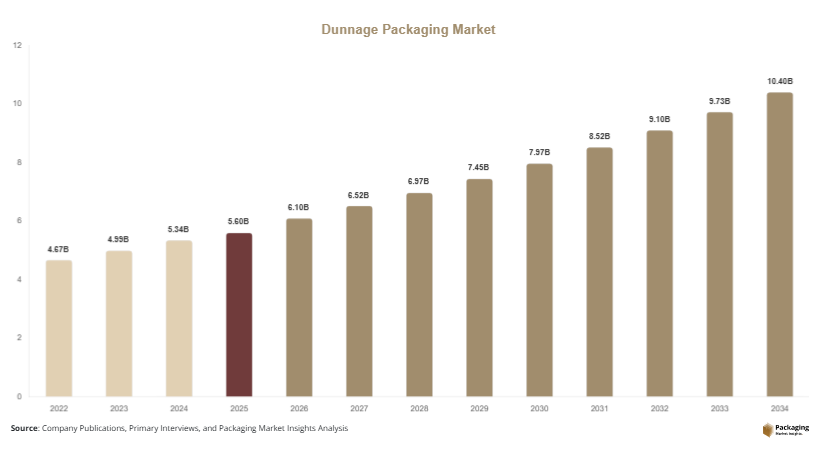
The global market size is estimated at USD 5.6 billion in 2025, and it is projected to reach USD 6.1 billion in 2026. By 2034, the market is expected to reach approximately USD 10.4 billion, registering a CAGR of 6.9% during the forecast period (2025–2034). The dunnage packaging market is experiencing steady expansion as industries increasingly prioritize product protection, load stabilization, and damage reduction during storage and transportation. Dunnage packaging solutions—such as inflatable bags, foam inserts, corrugated separators, molded pulp, and reusable plastic dunnage—are widely used across automotive, electronics, aerospace, and industrial manufacturing supply chains.
Growth in the market is primarily driven by rising global trade volumes and increasing complexity in logistics operations. As supply chains become more globalized, the need for protective packaging solutions that minimize damage during long-distance transportation is increasing. Another key factor is the expansion of automotive and electronics manufacturing, where components are highly sensitive to vibration, impact, and electrostatic discharge. Dunnage packaging helps maintain product integrity throughout multi-stage logistics networks. Additionally, sustainability trends are encouraging the adoption of reusable and recyclable dunnage materials, reducing dependency on single-use plastics.
Key Highlights:
- Asia Pacific dominated the market with a 37.4% share in 2025.
- Latin America is projected to grow at the fastest CAGR of 6.2%.
- Foam-based dunnage led the type segment with a 29.6% share.
- Plastic dunnage packaging dominated with a 52.3% share.
- Automotive applications led the segment with a 43.1% share.
- The US remained the dominant country, with a market size of USD 1.4 billion in 2025 and USD 1.5 billion in 2026.
Explore more data points, trends and opportunities Download Free Sample Report
Market Trends
Shift Toward Reusable Dunnage Systems
One of the major trends in the dunnage packaging market is the growing adoption of reusable packaging systems. Industries such as automotive and heavy manufacturing are replacing single-use foam and plastic fillers with durable plastic containers, racks, and collapsible dunnage systems. These solutions are designed for repeated use across closed-loop supply chains, reducing packaging waste and operational costs. For example, automotive OEMs now use custom-engineered returnable dunnage trays for engine components and transmission parts. This shift is driven by sustainability regulations and cost optimization goals. In the future, reusable systems will become more standardized and digitally tracked using RFID technology to improve logistics efficiency.
Rise of Lightweight and Air-Based Protective Packaging
Another key trend is the increasing use of inflatable and air-based dunnage packaging solutions. These include air pillows, inflatable bags, and air cushions that provide shock absorption while minimizing material usage and shipping weight. Electronics and e-commerce logistics providers are adopting these systems to reduce damage rates during transit. For instance, semiconductor manufacturers use inflatable dunnage to protect wafers and delicate components. This trend is expected to grow further as companies seek lightweight, cost-efficient, and environmentally friendly alternatives to traditional foam-based systems.
Market Drivers
Expansion of Global Manufacturing and Automotive Supply Chains
The expansion of global manufacturing, particularly in the automotive and industrial machinery sectors, is a major driver of the dunnage packaging market. Automotive components such as engines, gear systems, and electronic control units require high levels of protection during transportation. Dunnage packaging ensures stability and reduces vibration-related damage. As automotive production expands in countries like China, India, Mexico, and Germany, demand for customized protective packaging is increasing. For example, automotive suppliers use molded plastic racks and foam inserts to transport precision parts across assembly plants. This growing industrial interconnectivity is significantly boosting market demand.
Rising Demand for Damage-Free Logistics in Electronics Industry
The electronics industry is another key growth driver due to the fragility and high value of components such as semiconductors, displays, and circuit boards. Even minor physical impact or static discharge can lead to product failure. Dunnage packaging solutions such as anti-static foam, thermoformed trays, and cushioned inserts are widely used to prevent damage. The rapid expansion of consumer electronics manufacturing in Asia Pacific and increasing global exports are further strengthening demand. For instance, smartphone manufacturers rely heavily on custom dunnage systems during international shipments to maintain product integrity.
Market Restraint
High Cost of Customization and Return Logistics Complexity
One of the key restraints in the dunnage packaging market is the high cost associated with customized packaging design and return logistics for reusable systems. Many dunnage solutions require precise engineering based on product shape, weight, and fragility, which increases design and tooling costs. Additionally, reusable dunnage systems require reverse logistics infrastructure, including collection, cleaning, and redistribution processes. This can be expensive for small and mid-sized manufacturers. For example, companies using returnable plastic racks for automotive parts must manage logistics cycles efficiently to justify costs. In regions with underdeveloped supply chain infrastructure, this complexity limits adoption and slows market penetration.
Market Opportunities
Growth of Smart Tracking Enabled Dunnage Systems
The integration of smart tracking technologies presents a significant opportunity in the dunnage packaging market. RFID tags, IoT sensors, and GPS-enabled tracking systems are being incorporated into reusable dunnage containers to monitor location, usage cycles, and condition in real time. This improves supply chain visibility and reduces loss or misplacement of packaging assets. For example, automotive companies are deploying RFID-enabled returnable racks to track parts across global assembly plants. This trend is expected to expand further as digital supply chain management becomes standard across manufacturing industries.
Expansion in Emerging Manufacturing Economies
Emerging economies offer strong growth potential due to rising industrialization and foreign direct investment in manufacturing sectors. Countries in Southeast Asia, Latin America, and Africa are witnessing increased establishment of automotive assembly plants and electronics manufacturing hubs. This expansion is driving demand for cost-effective and durable dunnage packaging solutions. For instance, Mexico’s automotive export industry relies heavily on standardized protective packaging systems for cross-border shipments to the United States. As manufacturing ecosystems develop further, demand for localized dunnage production is expected to rise.
Report Scope
| Report Metric | Details |
|---|---|
| Market Size in 2025 | USD 5.6 Billion |
| Market Size in 2026 | USD 6.1 Billion |
| Market Size in 2034 | USD 10.4 Billion |
| CAGR | 6.9% (2026-2034) |
| Base Year for Estimation | 2025 |
| Historical Data | 2022-2024 |
| Forecast Period | 2026-2034 |
| Report Coverage | Revenue Forecast, Competitive Landscape, Supply Chain Disruption, Growth Factors, Environment & Regulatory Landscape and Trends |
| Geographies Covered | North America, Europe, APAC, Middle East and Africa, LATAM |
| Countries Covered | U.S., Canada, U.K., Germany, France, Spain, Italy, Russia, Nordic, Benelux, Rest of Europe, China, South Korea, Japan, India, Australia, Singapore, Taiwan, South East Asia, Rest of Asia-Pacific, UAE, Turky, Saudi Arabia, South Africa, Egypt, Nigeria, Rest of MEA, Brazil, Mexico, Argentina, Chile, Colombia, Rest of LATAM |
Explore more data points, trends and opportunities Download Free Sample Report
Segmental Analysis
By Type
Foam-based dunnage dominated the market in 2024 with a 31.2% share, driven by its widespread use in electronics, automotive, and industrial equipment protection. Foam offers excellent shock absorption and vibration resistance, making it ideal for fragile components. Industries use custom-cut foam inserts to secure parts during transit. For example, aerospace manufacturers use high-density foam dunnage to protect precision-engineered components. Its versatility and cost-effectiveness support its continued dominance.
Inflatable dunnage is the fastest-growing subsegment with a CAGR of 7.1%, driven by e-commerce logistics and lightweight shipping requirements. Air cushions and inflatable bags reduce material usage and shipping costs while providing effective protection. Growth is further supported by sustainability trends and automation in packaging lines.
By Material
Plastic dunnage dominated with a 54.3% share in 2024, due to its durability, reusability, and suitability for returnable logistics systems. Plastic racks and containers are widely used in automotive and manufacturing supply chains. These systems support closed-loop logistics and reduce packaging waste. For example, automotive suppliers use plastic returnable bins for engine parts transportation.
Recycled molded pulp is the fastest-growing segment with a CAGR of 6.9%, driven by sustainability initiatives. It is increasingly used in electronics and consumer goods packaging due to its biodegradability and protective strength.
By End-Use
Automotive led the market with a 44.1% share in 2024, as the industry relies heavily on dunnage for transporting heavy and precision components. Manufacturers use custom-engineered trays and racks to ensure assembly line efficiency.
Electronics is the fastest-growing end-use segment with a CAGR of 7.0%, driven by semiconductor and consumer device exports requiring high-precision protection systems.
Dunnage Packaging Market Segmentations
By Type
- Foam Dunnage
- Inflatable Dunnage
- Molded Pulp Dunnage
- Plastic Dunnage Systems
By Material
- Plastic
- Foam
- Paper & Pulp
- Hybrid Materials
By End-User
- Automotive
- Electronics
- Aerospace
- Industrial Equipment
Regional Analysis
North America
North America accounted for approximately 28.2% share in 2025, with a projected CAGR of 6.4% during 2025–2034. The region’s growth is driven by strong automotive manufacturing, aerospace production, and advanced logistics infrastructure. Dunnage packaging is widely used across high-value industrial shipments to ensure product safety and reduce damage-related costs. The presence of major OEMs and Tier-1 suppliers strengthens demand for reusable and engineered packaging systems. Sustainability initiatives are also encouraging the adoption of recyclable and returnable dunnage solutions across supply chains.
The United States dominates the regional market due to its large automotive and electronics manufacturing base. A key growth driver is the expansion of just-in-time manufacturing systems, where precise and damage-free logistics are essential. For example, automotive plants in Michigan and Ohio extensively use custom molded dunnage trays to streamline assembly operations and reduce handling errors.
Europe
Europe held a 24.6% share in 2025 and is expected to grow at a CAGR of 6.2%. The region benefits from a strong automotive industry, particularly in Germany, France, and the UK. Strict environmental regulations are also encouraging the use of reusable and recyclable dunnage systems. Manufacturers are focusing on reducing packaging waste and improving supply chain sustainability.
Germany leads the European market due to its dominant automotive production sector. A key growth driver is the integration of closed-loop logistics systems, where reusable dunnage is circulated between suppliers and manufacturers. German OEMs widely use returnable plastic containers for engine and transmission components.
Asia Pacific
Asia Pacific dominated the market with a 37.4% share in 2025, and is projected to grow at a CAGR of 7.5%. Rapid industrialization, expanding electronics manufacturing, and strong automotive production in China, Japan, South Korea, and India are driving demand. The region also benefits from cost-effective manufacturing of dunnage materials.
China remains the dominant country due to its massive manufacturing base. A unique growth driver is the expansion of export-oriented electronics production, where protective packaging is essential for global shipments of semiconductors and consumer devices.
Middle East & Africa
The Middle East & Africa accounted for a 5.8% share in 2025, with a projected CAGR of 6.1%. Growth is driven by increasing industrial diversification and expansion of logistics hubs in the UAE and Saudi Arabia. Demand for durable packaging is rising in oil & gas and industrial equipment sectors.
The UAE leads the region due to its logistics and re-export activities. A key growth factor is the development of free trade zones, where imported machinery and industrial goods require protective dunnage packaging during handling and redistribution.
Latin America
Latin America held a 4.2% share in 2025, and is expected to grow at the fastest CAGR of 6.8%. Growth is supported by automotive manufacturing expansion in Mexico and Brazil. Increasing foreign investment in industrial production is strengthening demand for protective packaging systems.
Brazil dominates the region due to its strong automotive and industrial base. A key growth driver is the expansion of export manufacturing, where dunnage packaging is used extensively to protect goods shipped to North America and Europe.
Competitive Landscape
The dunnage packaging market is moderately consolidated, with key players focusing on reusable systems, material innovation, and customized engineering solutions. Major companies include ORBIS Corporation, Schoeller Allibert, DS Smith, Nefab Group, and Myers Industries. Among these, ORBIS Corporation is a leading player due to its extensive reusable plastic dunnage portfolio and strong automotive industry partnerships.
Companies are increasingly investing in returnable packaging systems that support circular supply chains. For example, Schoeller Allibert focuses on modular plastic containers designed for automotive and industrial logistics. Nefab Group is expanding its engineered packaging solutions for electronics and telecom sectors. Strategic partnerships with OEMs are common, enabling co-development of customized protective systems. Recent developments include expansion of reusable packaging pools and integration of tracking technologies to improve logistics efficiency.
Key Players List
- ORBIS Corporation
- Schoeller Allibert
- DS Smith Plc
- Nefab Group
- Myers Industries
- SSI Schaefer
- UFP Technologies
- Creative Techniques Inc.
- Universal Protective Packaging
- Adams Plastics Inc.
- Rehrig Pacific Company
- PolyFlex Products Inc.
- Packaging Corporation of America
- Sealed Air Corporation
- Korber AG