Padded Mailers Market Size
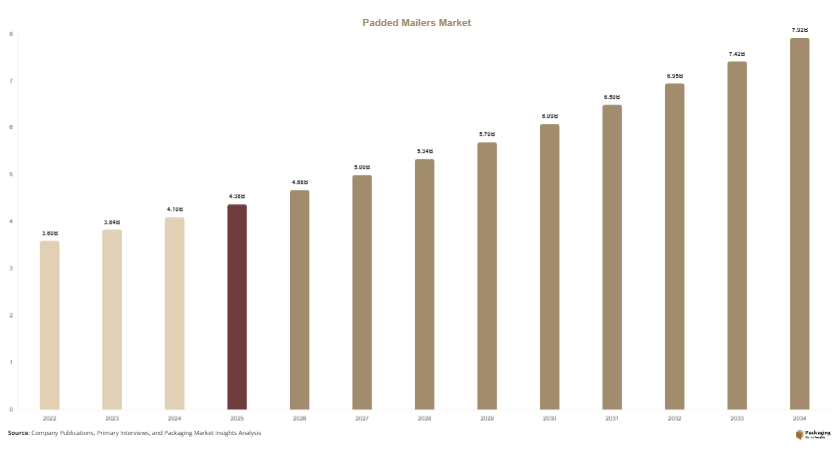
Padded mailers' market size is projected at USD 4.68 billion in 2026 and is expected to hit USD 7.94 billion by 2034 with a CAGR of 6.8%. Rising e-commerce shipments, increasing demand for lightweight protective packaging, and expanding cross-border parcel delivery continue to support market expansion. The report provides detailed market segmentation, production analysis, competitive benchmarking, regional outlook, and supply chain assessment across major economies.
Padded mailers are protective shipping envelopes manufactured using paper, kraft paper, or plastic with cushioning materials to safeguard products during transportation. Global production exceeded 16.5 billion units in 2025, while e-commerce applications accounted for approximately 58% of total consumption. Paper-based mailers represented nearly 47% of production, and adoption across online retail fulfillment centers exceeded 63%. Growing parcel delivery volumes continue strengthening the padded mailers market.
Explore more data points, trends and opportunities Download Free Sample Report
Padded Mailers Trends
Rising Demand for Sustainable Protective Shipping Solutions
Manufacturers are introducing recyclable and paper-based padded mailers to reduce plastic waste and meet sustainability objectives. Global production is projected to exceed 24 billion units by 2034, while recyclable mailer adoption has surpassed 41% among large online retailers. Investments exceeding USD 2.2 billion in sustainable packaging technologies continue supporting the padded mailers market.
Automation in fulfillment centers and digital printing technologies are improving production efficiency and customization capabilities. Automated manufacturing lines have increased output by nearly 20%, while customized branded mailers have experienced adoption growth exceeding 29%. Expanding online retail and direct-to-consumer shipping continue to reinforce the padded mailers market.
Padded Mailers Drivers
Expansion of Global E-commerce and Parcel Delivery
Rapid growth in online shopping and direct-to-consumer distribution continues driving demand for protective mailers. Global parcel shipments increased by approximately 9.4% annually, while e-commerce penetration exceeded 24% of retail sales in several developed economies. More than 16.5 billion units were produced annually, supporting continued padded mailer market growth.
Padded Mailers Restraints
Environmental Concerns Regarding Plastic-Based Mailers
Plastic-based padded mailers remain subject to increasing environmental regulations and recycling challenges. Nearly 38% of total production still relies on plastic materials, while recycling rates remain below 25% in several regions. Rising raw material prices by approximately 11% annually also increase production costs.
Padded Mailers Opportunities
Growing Adoption of Recyclable and Paper-Based Mailers
Increasing sustainability commitments among retailers are creating substantial opportunities for manufacturers. Paper-based protective packaging demand has increased by over 28% during the past five years, while investments exceeding USD 1.5 billion have supported recyclable mailer innovation. Expansion of eco-friendly shipping solutions continues creating new revenue opportunities.
Challenges in Padded Mailers Market
Balancing Cushioning Performance with Sustainability
Manufacturers must improve protective performance while reducing material consumption and maintaining recyclability. Lightweight paper mailers may experience a reduction in impact resistance of nearly 10% compared to multilayer plastic alternatives, while high-performance cushioning materials increase manufacturing costs by approximately 14%.
Report Scope
| Report Metric | Details |
|---|---|
| Market Size in 2025 | USD 4.38 Billion |
| Market Size in 2026 | USD 4.68 Billion |
| Market Size in 2034 | USD 7.94 Billion |
| CAGR | 6.8% (2026-2034) |
| Base Year for Estimation | 2025 |
| Historical Data | 2022-2024 |
| Forecast Period | 2026-2034 |
| Report Coverage | Revenue Forecast, Competitive Landscape, Supply Chain Disruption, Growth Factors, Environment & Regulatory Landscape and Trends |
| Geographies Covered | North America, Europe, APAC, Middle East and Africa, LATAM |
| Countries Covered | U.S., Canada, U.K., Germany, France, Spain, Italy, Russia, Nordic, Benelux, Rest of Europe, China, South Korea, Japan, India, Australia, Singapore, Taiwan, South East Asia, Rest of Asia-Pacific, UAE, Turkey, Saudi Arabia, South Africa, Egypt, Nigeria, Rest of MEA, Brazil, Mexico, Argentina, Chile, Colombia, Rest of LATAM |
Explore more data points, trends and opportunities Download Free Sample Report
Padded Mailers Market Segmentation
Material-based products account for nearly 61% of total market revenue, while e-commerce businesses contribute approximately 58% of global demand. Product innovation continues focusing on lightweight construction, recyclability, and improved protective performance.
By Material
Paper padded mailers account for approximately 47% of total production, exceeding 7.7 billion units annually. High-strength paper fibers, recyclable construction, and lightweight design make them suitable for books, apparel, cosmetics, and consumer goods.
Plastic mailers represent nearly 35% of market demand, with annual production exceeding 5.8 billion units. Polyethylene-based cushioning offers excellent moisture resistance, tear strength, and superior product protection during long-distance transportation.
Kraft paper mailers contribute approximately 18% of total production, exceeding 3 billion units annually. Durable outer layers, enhanced printability, and compatibility with recyclable cushioning materials support growing demand across premium retail packaging.
By End-use Industry
E-commerce dominates with approximately 58% of global demand, consuming over 9.5 billion units annually. Online retailers use padded mailers for electronics, fashion accessories, cosmetics, books, and health products to reduce shipping costs and improve customer satisfaction.
Logistics & Courier accounts for nearly 24% of total demand, exceeding 4 billion units annually. Courier companies increasingly utilize padded mailers for lightweight shipments, improving transportation efficiency and reducing packaging waste.
Consumer electronics contribute approximately 18% of market demand, with annual consumption exceeding 3 billion units. Protective cushioning safeguards smartphones, accessories, storage devices, and electronic components during transportation and distribution.
Padded Mailers Market Segmentations
Material
- Paper
- Plastic
- Kraft Paper
End-use Industry
- E-commerce
- Logistics & Courier
- Consumer Electronics
Padded Mailers: Regional/Counties Outlook
North America
North America accounts for approximately 31% of global revenue, producing more than 5 billion units annually. The United States contributes nearly 82% of regional demand due to strong e-commerce growth and advanced fulfillment infrastructure.
Europe
Europe represents approximately 27% of the global market, with production exceeding 4.5 billion units annually. Germany, France, Italy, and the United Kingdom collectively account for over 71% of regional consumption, driven by sustainability regulations and expanding online retail.
Asia-Pacific
Asia-Pacific leads market expansion with approximately 34% share and annual production exceeding 5.6 billion units. China contributes nearly 49% of regional production, followed by India, Japan, and South Korea through rapid e-commerce expansion and manufacturing growth.
Latin America
Latin America contributes approximately 5% of global demand, producing over 800 million units annually. Brazil and Mexico account for nearly 67% of regional consumption due to increasing digital commerce and parcel delivery services.
Middle East & Africa
The Middle East & Africa represents approximately 3% of the global market, producing more than 500 million units annually. Saudi Arabia, the UAE, and South Africa continue investing in logistics infrastructure and online retail ecosystems.
Top players in the padded mailers market
- Sealed Air Corporation
- Pregis, LLC,
- 3M Company,
- Ranpak Holdings Corp.
- Intertape Polymer Group Inc.,
- ProAmpac LLC,
- Novolex Holdings, LLC,
- PAC Worldwide Corporation, and
- Jiffy Packaging Co.
- Smurfit Westrock
- Mondi plc
- Storopack Hans Reichenecker GmbH
Sealed Air Corporation holds an estimated 14% of the global market. Maintains a leading position in protective packaging through continuous innovation in lightweight, recyclable, and high-performance padded mailers for e-commerce, healthcare, and industrial applications. Expands manufacturing capacity, automation technologies, and sustainable packaging solutions while strengthening partnerships with major global retailers and logistics providers. Pregis LLC accounts for approximately 11% of global market participation. Specializes in protective packaging products, including recyclable padded mailers, cushioning systems, and flexible packaging solutions serving retail and industrial customers. Continues investing in paper-based packaging innovations, advanced manufacturing technologies, and sustainable product development while expanding operations across North America and Europe.