Anti Static Foam Packaging Market Size and Growth
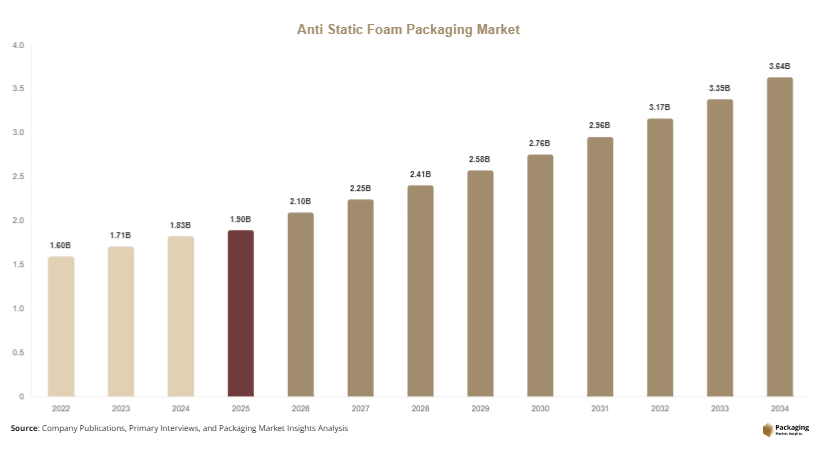
The global anti static foam packaging market size was valued at approximately USD 1.9 billion in 2025 and is expected to reach nearly USD 2.1 billion in 2026. By 2034, the market is projected to attain around USD 3.8 billion, registering a CAGR of 7.1% during 2025–2034. The anti static foam packaging market is witnessing steady expansion due to increasing demand for electrostatic discharge protection across electronics, automotive, healthcare, aerospace, and industrial manufacturing sectors. Anti static foam packaging materials are specifically designed to prevent electrostatic damage during storage, transportation, and handling of sensitive electronic components and precision equipment.
One of the primary growth factors driving the market is the rapid expansion of the global electronics industry. Increasing production of semiconductors, consumer electronics, printed circuit boards, and communication equipment has significantly increased demand for protective anti static packaging solutions. Anti static foam packaging helps reduce electrostatic discharge risks that may damage delicate electronic parts during shipping and warehousing. Another major growth factor is the growth of e-commerce electronics distribution. Online retail platforms require durable and shock-resistant packaging that can protect sensitive devices during long-distance transportation.
Key Highlights
- Asia Pacific dominated the market with a 41.2% share in 2025.
- Latin America is projected to grow at the fastest CAGR of 7.6%.
- Polyethylene foam led the type segment with a 39.4% share.
- Plastic-based foam materials dominated with a 62.1% share.
- Electronics applications led the segment with 52.7% share.
- The US remained the dominant country with a market size of USD 356 million in 2025 and USD 379 million in 2026.
Explore more data points, trends and opportunities Download Free Sample Report
Market Trends
Increasing Adoption of Sustainable and Recyclable Foam Packaging
Sustainability is becoming a major trend in the anti static foam packaging market as electronics and industrial manufacturers seek environmentally responsible packaging solutions. Traditional foam packaging materials are increasingly being replaced with recyclable polyethylene foams and reusable anti static cushioning materials to reduce packaging waste. Companies are also investing in lightweight foam structures that minimize raw material usage and transportation costs. For example, several electronics manufacturers in Europe are adopting recyclable conductive foam inserts for semiconductor and microchip packaging applications. Regulatory pressure regarding plastic waste reduction is encouraging packaging suppliers to develop eco-friendly anti static materials with improved recyclability. Over the forecast period, demand for sustainable anti static foam packaging is expected to rise significantly across electronics, automotive, and healthcare industries.
Rising Demand for Customized Protective Packaging Solutions
The growing complexity of electronic devices and industrial components is increasing demand for customized anti static foam packaging solutions. Manufacturers are developing die-cut foam inserts, molded cushioning systems, and precision-engineered packaging designs tailored for specific products. Consumer electronics companies increasingly require packaging that offers both electrostatic protection and impact resistance during global transportation. For instance, semiconductor manufacturers are using custom conductive foam trays to protect integrated circuits and precision chips from electrostatic discharge. The future impact of this trend is expected to include greater adoption of automated foam cutting technologies and digital packaging design systems. Customization is also likely to improve packaging efficiency and reduce material waste across supply chains.
Market Drivers
Rapid Expansion of Electronics and Semiconductor Manufacturing
The growth of electronics and semiconductor manufacturing is a major driver supporting the anti static foam packaging market. Consumer electronics, telecommunications equipment, automotive electronics, and industrial automation systems increasingly rely on sensitive electronic components that require electrostatic discharge protection during transportation and storage. Anti static foam packaging helps prevent product damage caused by static electricity and physical impact. Countries such as China, Taiwan, South Korea, and the United States are expanding semiconductor production capacities, increasing demand for specialized protective packaging solutions. For example, printed circuit board manufacturers extensively use anti static foam inserts to protect microprocessors and electronic assemblies during export shipments. The continued growth of global electronics manufacturing is expected to support long-term market expansion.
Increasing E-commerce Distribution of Electronic Products
The rapid growth of e-commerce retail platforms is significantly driving demand for anti static foam packaging solutions. Electronics products sold through online channels require strong protective packaging that can withstand long-distance shipping and multiple handling stages. Anti static foam materials provide cushioning protection while preventing electrostatic discharge damage during logistics operations. Smartphones, laptops, gaming consoles, and wearable devices increasingly utilize custom foam inserts and anti static cushioning systems for safe transportation. For example, several global electronics retailers have adopted conductive foam packaging for premium consumer electronics shipments to reduce product return rates. The expansion of cross-border e-commerce and direct-to-consumer electronics sales is expected to further strengthen market demand.
Market Restraint
Environmental Concerns Regarding Foam Disposal and Recycling Challenges
One of the major restraints affecting the anti static foam packaging market is the environmental concern associated with foam disposal and recycling limitations. Traditional anti static foam materials such as polyethylene and polyurethane can be difficult to recycle due to chemical additives used for conductivity and electrostatic protection. Many waste management systems lack infrastructure to process conductive foam packaging effectively, resulting in increased landfill waste. Governments across Europe and North America are implementing stricter regulations regarding plastic foam disposal and packaging sustainability, increasing compliance costs for manufacturers. For example, some electronics manufacturers face pressure to reduce non-recyclable foam packaging in export shipments to meet environmental standards. In addition, sustainable anti static foam alternatives often involve higher production costs and limited large-scale availability. Small and medium-sized packaging suppliers may struggle to invest in eco-friendly material innovation and recycling technologies. These challenges could slow adoption in cost-sensitive industries despite growing demand for electrostatic protective packaging.
Market Opportunities
Growth in Electric Vehicle Electronics Packaging
The increasing production of electric vehicles is creating strong opportunities for anti static foam packaging manufacturers. Electric vehicles rely heavily on batteries, sensors, semiconductors, and advanced electronic control systems that require electrostatic-safe packaging during transportation and assembly operations. Automotive manufacturers are increasingly sourcing custom anti static foam inserts to protect sensitive electronic components from static discharge and vibration damage. Future opportunities are expected to expand further as global electric vehicle production accelerates across Asia Pacific, Europe, and North America. Lightweight conductive foam materials designed for battery module transportation are also expected to gain significant market demand over the forecast period.
Expansion of Medical Electronics and Diagnostic Equipment Packaging
The healthcare industry presents major growth opportunities for anti static foam packaging due to increasing demand for electronic medical devices and diagnostic equipment. Sensitive healthcare products such as monitoring systems, imaging devices, portable diagnostic tools, and wearable healthcare electronics require specialized protective packaging during transportation and storage. Anti static foam packaging helps maintain product safety and functionality while reducing damage risks. Medical device manufacturers are increasingly adopting customized conductive foam inserts and sterile-safe packaging materials for sensitive equipment shipments. Future market opportunities are expected to increase as healthcare digitalization and home diagnostic technologies continue expanding globally.
Report Scope
| Report Metric | Details |
|---|---|
| Market Size in 2025 | USD 1.9 Billion |
| Market Size in 2026 | USD 2.1 Billion |
| Market Size in 2034 | USD 3.8 Billion |
| CAGR | 7.1% (2026-2034) |
| Base Year for Estimation | 2025 |
| Historical Data | 2022-2024 |
| Forecast Period | 2026-2034 |
| Report Coverage | Revenue Forecast, Competitive Landscape, Supply Chain Disruption, Growth Factors, Environment & Regulatory Landscape and Trends |
| Geographies Covered | North America, Europe, APAC, Middle East and Africa, LATAM |
| Countries Covered | U.S., Canada, U.K., Germany, France, Spain, Italy, Russia, Nordic, Benelux, Rest of Europe, China, South Korea, Japan, India, Australia, Singapore, Taiwan, South East Asia, Rest of Asia-Pacific, UAE, Turky, Saudi Arabia, South Africa, Egypt, Nigeria, Rest of MEA, Brazil, Mexico, Argentina, Chile, Colombia, Rest of LATAM |
Explore more data points, trends and opportunities Download Free Sample Report
Segmental Analysis
By Type
Polyethylene foam dominated the anti static foam packaging market in 2024, accounting for approximately 39.4% of the global market share. Polyethylene foam is widely used due to its lightweight structure, shock absorption properties, and effective electrostatic discharge protection capabilities. Electronics manufacturers extensively use polyethylene anti static foam inserts for packaging semiconductors, printed circuit boards, and communication devices because the material provides strong cushioning protection during shipping and handling. The foam is also resistant to moisture and chemicals, making it suitable for long-distance transportation and export applications. Several industrial equipment manufacturers prefer polyethylene foam packaging because it can be customized into trays, pouches, and die-cut inserts for complex product shapes. The dominance of this segment is further supported by increasing demand for lightweight packaging materials that reduce logistics costs and improve product safety.
Polyurethane foam is expected to emerge as the fastest-growing subsegment, registering a CAGR of 7.8% during the forecast period. The material is gaining popularity due to its flexibility, durability, and enhanced cushioning performance for sensitive electronics and medical equipment. Polyurethane anti static foam is increasingly used in precision packaging applications for aerospace electronics, automotive sensors, and diagnostic healthcare devices. Packaging manufacturers are introducing advanced conductive polyurethane foam solutions with improved electrostatic protection and lightweight properties. Rising demand for customized protective packaging and complex electronics transportation systems is expected to support future market growth. In addition, the increasing adoption of high-density polyurethane foam in electric vehicle battery packaging is likely to create substantial growth opportunities for manufacturers.
By Material
Plastic-based foam materials accounted for the dominant market share of 62.1% in 2024 due to their durability, flexibility, and cost-effectiveness. Conductive polyethylene and polyurethane foams are widely preferred for electrostatic-sensitive packaging because they provide effective shock absorption and electrostatic discharge protection. Electronics manufacturers extensively use plastic-based foam packaging for semiconductors, microchips, servers, and industrial control systems due to their compatibility with automated packaging processes. The segment also benefits from increasing global electronics trade and rising demand for secure transportation of high-value electronic equipment. Packaging suppliers are continuously improving foam density, cushioning performance, and lightweight properties to meet industrial packaging requirements. Plastic-based anti static foam materials remain highly suitable for reusable packaging systems and export-oriented supply chains.
Recyclable foam materials are projected to be the fastest-growing segment, expanding at a CAGR of 7.5% through 2034. Growing environmental concerns and stricter packaging sustainability regulations are encouraging manufacturers to develop eco-friendly conductive foam alternatives. Companies are increasingly investing in recyclable polyethylene structures and reusable cushioning materials to reduce packaging waste. Several electronics manufacturers are adopting recyclable anti static foam trays and inserts to improve sustainability performance across supply chains. Future demand is expected to increase as governments introduce stricter recycling targets for industrial packaging materials. Advances in bio-based conductive additives and recyclable foam technologies are also expected to support long-term market growth and innovation in sustainable electrostatic protective packaging solutions.
By End-Use
Electronics applications dominated the anti static foam packaging market in 2024, accounting for approximately 52.7% of total market revenue. The increasing production of semiconductors, smartphones, laptops, networking devices, and industrial electronics is creating strong demand for electrostatic-safe packaging solutions. Anti static foam packaging helps prevent product damage caused by electrostatic discharge, vibration, and physical impact during storage and transportation. Electronics manufacturers extensively use conductive foam trays, inserts, and cushioning systems for integrated circuits and delicate electronic assemblies. Rising exports of consumer electronics and growth in e-commerce distribution channels are further supporting segment expansion. In addition, increasing investments in semiconductor fabrication facilities and electronics manufacturing plants are driving continuous demand for advanced protective foam packaging materials worldwide.
Healthcare device packaging is anticipated to grow at the fastest CAGR of 7.9% during the forecast period. Medical devices such as diagnostic systems, patient monitoring equipment, imaging electronics, and wearable healthcare devices increasingly require secure anti static packaging during transportation and storage. Healthcare manufacturers are adopting customized conductive foam inserts and sterile-safe packaging materials to improve product safety and reduce equipment damage risks. The growth of telemedicine, home healthcare devices, and portable diagnostic technologies is expected to accelerate demand for specialized protective packaging solutions. Future opportunities are also likely to emerge in advanced medical electronics and robotic surgical equipment packaging applications as healthcare technology adoption expands globally.
Anti Static Foam Packaging Market Segmentations
By Product Type
- Polyethylene Foam
- Polyurethane Foam
- Conductive Foam
- Expanded Polystyrene Foam
- Cross-Linked Foam
By Material
- Plastic-Based Foam
- Recyclable Foam Materials
- Conductive Polymer Foam
- Polyurethane Materials
- Composite Foam Materials
By End-User
- Electronics
- Automotive Electronics
- Healthcare Devices
- Aerospace & Defense
- Industrial Equipment
By Distribution Channel
- Direct Industrial Supply
- Online Packaging Suppliers
- Electronics Component Distributors
- Industrial Equipment Vendors
- Specialty Protective Packaging Providers
Regional Analysis
North America
North America accounted for approximately 28.9% of the global anti static foam packaging market share in 2025 and is projected to grow at a CAGR of 6.3% during the forecast period. The region benefits from strong electronics manufacturing, advanced semiconductor production, and increasing demand for secure industrial packaging solutions. Consumer electronics distribution, aerospace manufacturing, and medical device production are major contributors to packaging demand across the United States and Canada. Companies are increasingly investing in lightweight conductive foam materials and recyclable anti static packaging technologies to improve sustainability performance. In addition, the growth of e-commerce electronics retail and automated logistics systems is supporting demand for customized foam cushioning solutions across regional supply chains.
The United States dominates the North American market due to its large semiconductor industry and extensive electronics manufacturing activities. One unique growth driver is the rapid expansion of defense and aerospace electronics production. Sensitive aerospace communication systems and military electronics require high-performance anti static foam packaging for transportation and storage applications. Several U.S.-based electronics manufacturers are also integrating automation technologies into packaging operations to improve product handling efficiency and reduce electrostatic risks. Growing investment in electric vehicle battery manufacturing is further contributing to demand for conductive foam packaging materials in the country.
Europe
Europe represented nearly 23.8% of the global anti static foam packaging market share in 2025 and is forecast to expand at a CAGR of 6.0% through 2034. The region’s market growth is driven by strong automotive electronics production, increasing industrial automation, and strict product safety standards. Countries such as Germany, France, and the United Kingdom are investing in advanced packaging technologies to support electronics exports and semiconductor manufacturing. Demand for anti static foam packaging is increasing across industrial robotics, telecommunications equipment, and healthcare electronics applications. Sustainability regulations are also encouraging companies to adopt recyclable foam packaging materials and reusable protective packaging systems across industrial supply chains.
Germany remains the dominant country in the European anti static foam packaging market due to its advanced automotive manufacturing sector and industrial electronics production capabilities. A unique growth factor is the rapid adoption of Industry 4.0 technologies and factory automation systems. German manufacturers increasingly require static-safe packaging for sensors, automation controllers, and precision electronic equipment used in smart manufacturing environments. Several packaging suppliers in the country are introducing recyclable conductive foam inserts and lightweight cushioning materials to meet environmental compliance targets while supporting electronics export growth.
Asia Pacific
Asia Pacific dominated the global anti static foam packaging market with a 41.2% share in 2025 and is expected to register a CAGR of 7.7% during the forecast period. Rapid industrialization, semiconductor manufacturing expansion, and strong consumer electronics production are major contributors to regional market growth. China, Japan, South Korea, Taiwan, and India are key electronics manufacturing hubs generating substantial demand for electrostatic protective packaging solutions. Increasing exports of smartphones, integrated circuits, and telecommunications equipment are driving adoption of conductive foam packaging systems. In addition, the expansion of e-commerce electronics retail channels is increasing demand for shock-resistant and anti static packaging solutions across the region.
China dominates the Asia Pacific market due to its extensive electronics manufacturing industry and large export-oriented production base. One unique growth driver is the rapid expansion of domestic semiconductor fabrication facilities supported by government investment initiatives. Chinese semiconductor manufacturers increasingly require high-quality anti static foam trays and conductive packaging materials for chip transportation and storage. The country is also witnessing growing demand for recyclable protective packaging as environmental regulations become stricter. Investments in automated foam cutting technologies and precision packaging systems are expected to support long-term market expansion across China.
Middle East & Africa
The Middle East & Africa accounted for approximately 3.9% of the global anti static foam packaging market share in 2025 and is projected to grow at a CAGR of 6.8% during the forecast period. Increasing industrial diversification, electronics imports, and healthcare infrastructure investments are supporting regional market growth. Countries such as the UAE, Saudi Arabia, and South Africa are witnessing rising demand for protective packaging solutions in electronics distribution and industrial equipment transportation. Growth in logistics infrastructure and free trade zones is also contributing to higher packaging consumption across regional supply chains. Companies are increasingly adopting lightweight anti static foam packaging materials to improve transportation efficiency in high-temperature environments.
The United Arab Emirates leads the regional market due to its advanced logistics network and increasing role as a regional electronics distribution hub. A unique growth factor is the rapid expansion of data centers and telecommunications infrastructure projects across Gulf countries. Sensitive electronic equipment used in networking and cloud computing applications requires secure anti static packaging during transportation and installation. Packaging suppliers in the UAE are increasingly offering customized conductive foam packaging solutions for imported electronic systems and industrial automation equipment. Rising investment in healthcare technology imports is also contributing to regional demand growth.
Latin America
Latin America held approximately 2.2% of the global anti static foam packaging market share in 2025 and is anticipated to grow at the fastest CAGR of 7.6% during the forecast period. The region is benefiting from increasing electronics assembly activities, industrial modernization, and rising consumer demand for electronic products. Countries such as Brazil and Mexico are expanding electronics manufacturing operations, creating demand for electrostatic-safe packaging solutions. Growth in regional e-commerce and automotive electronics production is also supporting higher packaging consumption. Packaging manufacturers are investing in localized foam production facilities to improve supply chain efficiency and reduce import dependency across the region.
Brazil dominates the Latin American anti static foam packaging market due to its growing automotive and consumer electronics industries. One unique growth driver is the increasing production of industrial automation systems and electronic control equipment used in manufacturing facilities. Brazilian companies are increasingly adopting anti static foam packaging for transportation of sensors, robotics components, and electronic assemblies. The expansion of local electronics exports and improvements in logistics infrastructure are expected to strengthen long-term market demand for protective conductive foam packaging solutions across the country.
Competitive Landscape
The anti static foam packaging market is moderately competitive, with companies focusing on product customization, sustainable materials, and advanced electrostatic protection technologies to strengthen market presence. Sealed Air Corporation remains one of the leading companies due to its broad portfolio of protective packaging solutions and strong global manufacturing network. The company recently introduced recyclable anti static foam packaging products designed for electronics and industrial applications.
Other major market participants include Pregis LLC, Foam Packaging Specialties, Desco Industries Inc., and Teknis Limited. These companies are investing in conductive foam innovations, lightweight cushioning materials, and automated packaging production systems to improve operational efficiency and product performance. Strategic collaborations with semiconductor manufacturers and electronics suppliers are becoming increasingly common across the industry. Packaging companies are also expanding regional manufacturing capacities in Asia Pacific to support rising demand from electronics exports and industrial automation sectors. Sustainability-focused product development and custom die-cut packaging technologies are expected to remain key competitive strategies over the forecast period.
Key Players List
- Sealed Air Corporation
- Pregis LLC
- Foam Packaging Specialties
- Desco Industries Inc.
- Teknis Limited
- GWP Group
- Botron Company Inc.
- Smurfit Kappa Group
- Conductive Containers Inc.
- Protektive Pak
- Elcom UK Ltd.
- Dou Yee Enterprises
- Polyfoam Corporation
- ESD Goods
- Statico
- Advance Packaging Corporation
- Electrotek Static Controls Pvt. Ltd.
- Corstat Inc.