Molded Wood Pallets Market Size
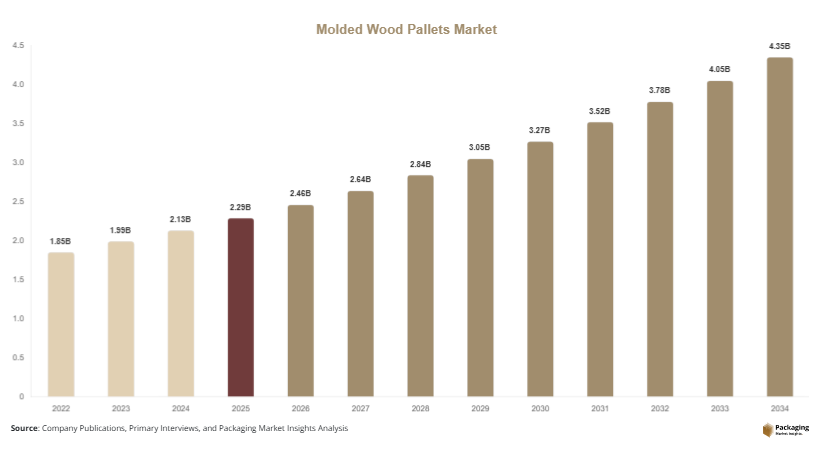
The molded wood pallets market size is projected at USD 2.46 billion in 2026 and is expected to hit USD 4.35 billion by 2034 with a CAGR of 7.4%. The report provides detailed analysis of manufacturing capacity, raw material utilization, production trends, supply chain dynamics, pricing, and competitive positioning across key global markets. It further evaluates market segmentation, regional production capabilities, sustainability initiatives, and strategic developments adopted by leading manufacturers.
Molded wood pallets are engineered load-bearing platforms manufactured from compressed wood fibers, sawdust, and wood residues using high-pressure molding processes. These pallets are lightweight, nestable, ISPM-15 compliant without heat treatment, and widely used in export logistics. Global production exceeded 118 million units in 2025, while manufacturing utilization averaged 83%. Logistics and transportation accounted for approximately 49% of total consumption, food and beverage represented 29%, and chemicals and pharmaceuticals contributed nearly 22%. Increasing adoption of sustainable logistics solutions continues supporting the molded wood pallets market.
Explore more data points, trends and opportunities Download Free Sample Report
Molded Wood Pallets Market Trends
Rising Adoption of Sustainable Logistics Packaging
Manufacturers and logistics providers are increasingly replacing conventional wooden pallets with molded wood alternatives to reduce transportation costs and improve storage efficiency. More than 64% of export-oriented manufacturers now utilize molded wood pallets for international shipments, while annual production exceeded 124 million units globally. Nestable pallet adoption increased by approximately 26% between 2023 and 2025 due to improved warehouse utilization and lower freight costs, strengthening the molded wood pallets market.
Automation in pallet manufacturing, improved compression molding technologies, and recycled wood fiber utilization continue enhancing production efficiency. Approximately 48% of newly commissioned manufacturing lines incorporate automated molding and quality inspection systems, reducing production waste by nearly 15%. Sustainable material sourcing and circular economy initiatives continue driving innovation across the molded wood pallets market.
Molded Wood Pallets Market Drivers
Growing Global Trade and Export Packaging Requirements
Rising international trade, expanding e-commerce logistics, and increasing export activities continue driving demand for molded wood pallets worldwide. Global container shipments exceeded 185 million TEUs during 2025, while export packaging demand increased by approximately 13%. More than 71% of exporters prefer ISPM-15 exempt molded pallets to simplify customs compliance and reduce logistics costs, supporting continued expansion of the molded wood pallets market.
Molded Wood Pallets Market Restraints
Volatility in Wood Raw Material Supply
Fluctuations in wood fiber availability, biomass prices, and transportation costs continue affecting manufacturing profitability. Raw material expenses account for nearly 56% of total production costs, while wood residue prices increased by approximately 12% during recent supply chain disruptions. Regional shortages of recycled wood materials also create production challenges for manufacturers.
Molded Wood Pallets Market Opportunities
Expansion of Sustainable Warehouse Operations
Growing investments in green logistics, recyclable packaging, and environmentally responsible warehousing continue creating substantial opportunities for molded wood pallet manufacturers. Sustainable logistics adoption exceeded 39% across multinational supply chains, while automated warehouse construction increased by 19% during 2025. Increasing preference for lightweight and recyclable pallets supports long-term commercial opportunities.
Challenges in Molded Wood Pallets Market
Competition from Plastic and Traditional Wooden Pallets
Manufacturers face increasing competition from plastic pallets offering extended durability and conventional wooden pallets with lower initial costs. Approximately 33% of logistics operators continue using traditional wooden pallets due to existing infrastructure, while plastic pallet adoption increased by 11% in automated warehouses. Continuous innovation in strength, durability, and lifecycle performance remains essential for market competitiveness.
Report Scope
| Report Metric | Details |
|---|---|
| Market Size in 2025 | USD 2.29 Billion |
| Market Size in 2026 | USD 2.46 Billion |
| Market Size in 2034 | USD 4.35 Billion |
| CAGR | 7.4% (2026-2034) |
| Base Year for Estimation | 2025 |
| Historical Data | 2022-2024 |
| Forecast Period | 2026-2034 |
| Report Coverage | Revenue Forecast, Competitive Landscape, Supply Chain Disruption, Growth Factors, Environment & Regulatory Landscape and Trends |
| Geographies Covered | North America, Europe, APAC, Middle East and Africa, LATAM |
| Countries Covered | U.S., Canada, U.K., Germany, France, Spain, Italy, Russia, Nordic, Benelux, Rest of Europe, China, South Korea, Japan, India, Australia, Singapore, Taiwan, South East Asia, Rest of Asia-Pacific, UAE, Turky, Saudi Arabia, South Africa, Egypt, Nigeria, Rest of MEA, Brazil, Mexico, Argentina, Chile, Colombia, Rest of LATAM |
Explore more data points, trends and opportunities Download Free Sample Report
Molded Wood Pallets Market Segmentation
The market is segmented by type and application. Nestable molded wood pallets account for approximately 52% of global demand, while logistics and transportation contribute nearly 49% of total consumption due to high export volumes and warehouse optimization requirements.
By Type
Nestable pallets account for approximately 52% of market demand with annual production exceeding 61 million units. Lightweight construction, stackability, reduced storage space, load capacities exceeding 900 kg, and ISPM-15 compliance make them suitable for export logistics and warehouse operations.
Stackable pallets represent nearly 29% of global demand, with production exceeding 34 million units annually. Enhanced structural rigidity, reusable design, compressive strength, and efficient material handling support applications across industrial manufacturing and distribution facilities.
Export-specific molded pallets contribute approximately 19% of total production with annual manufacturing exceeding 23 million units. Their fumigation-free design, dimensional consistency, moisture resistance, and international shipping compliance support increasing cross-border logistics activities.
By Application
Logistics and transportation account for approximately 49% of market demand, consuming more than 58 million pallets annually. Export shipments, warehouse distribution, freight consolidation, and intermodal transportation continue driving widespread adoption due to reduced shipping costs and efficient storage.
Food and beverage applications contribute nearly 29% of total consumption. Annual demand exceeded 34 million pallets, while adoption rates surpassed 47% among packaged food exporters requiring hygienic, lightweight, and ISPM-15-compliant pallet solutions.
Chemicals and pharmaceuticals represent approximately 22% of market demand, utilizing more than 26 million pallets annually. Clean handling characteristics, dimensional consistency, contamination resistance, and export compliance support increasing adoption throughout regulated supply chains.
Molded Wood Pallets Market Segmentations
Type
- Nestable Molded Wood Pallets
- Stackable Molded Wood Pallets
- Export Molded Wood Pallets
Application
- Logistics & Transportation
- Food & Beverage
- Chemicals & Pharmaceuticals
Molded Wood Pallets Market Regional Outlook
North America
North America accounts for approximately 31% of global revenue, supported by advanced logistics infrastructure and expanding warehouse automation. The United States contributes nearly 84% of regional demand, while annual pallet production exceeds 37 million units across logistics, manufacturing, and export industries.
Europe
Europe represents approximately 30% of the global market, led by Germany, France, Italy, and the Netherlands. Regional production exceeded 35 million units, while sustainable pallet adoption surpassed 55% among export-oriented manufacturers due to strict environmental regulations.
Asia-Pacific
Asia-Pacific holds approximately 33% of global demand and remains the fastest-growing regional market. China, India, Japan, and South Korea contribute more than 79% of regional production. Annual manufacturing exceeded 39 million molded wood pallets, supported by expanding exports, industrialization, and logistics infrastructure.
Latin America
Latin America contributes approximately 4% of global revenue, with Brazil and Mexico serving as major manufacturing and export hubs. Regional production exceeded 4.8 million units, driven by agricultural exports and industrial logistics.
Middle East & Africa
The Middle East & Africa account for nearly 2% of the market. Growing investments in logistics infrastructure, port modernization, and industrial exports supported production exceeding 2.4 million units during 2025.
Molded Wood Pallets Market Regional Outlook
North America
North America accounts for approximately 31% of global revenue, supported by advanced logistics infrastructure and expanding warehouse automation. The United States contributes nearly 84% of regional demand, while annual pallet production exceeds 37 million units across logistics, manufacturing, and export industries.
Europe
Europe represents approximately 30% of the global market, led by Germany, France, Italy, and the Netherlands. Regional production exceeded 35 million units, while sustainable pallet adoption surpassed 55% among export-oriented manufacturers due to strict environmental regulations.
Asia-Pacific
Asia-Pacific holds approximately 33% of global demand and remains the fastest-growing regional market. China, India, Japan, and South Korea contribute more than 79% of regional production. Annual manufacturing exceeded 39 million molded wood pallets, supported by expanding exports, industrialization, and logistics infrastructure.
Latin America
Latin America contributes approximately 4% of global revenue, with Brazil and Mexico serving as major manufacturing and export hubs. Regional production exceeded 4.8 million units, driven by agricultural exports and industrial logistics.
Middle East & Africa
The Middle East & Africa account for nearly 2% of the market. Growing investments in logistics infrastructure, port modernization, and industrial exports supported production exceeding 2.4 million units during 2025.
Top players in the molded wood pallets market
- Litco International, Inc.
- Presswood International B.V.
- NEFAB Group
- Millwood, Inc.
- Brambles Limited (CHEP)
- Craemer Group
- Loscam International Holdings Co., Ltd.,
- Engelvin Bois Moule SAS,
- IPL Packaging
- Faber Halbertsma Group
- INKA Paletten GmbH
- Binderholz GmbH
- PalletOne, Inc.
- John Rock, Inc.
- Kamps Pallets, Inc.
Litco International, Inc. Estimated global market share exceeds 15%, supported by its broad portfolio of molded wood pallets, export packaging products, and sustainable logistics solutions. Litco International focuses on lightweight pallet technologies, recycled wood fiber utilization, automated manufacturing, and ISPM-15-compliant export products. Continuous investments in compression molding technologies, manufacturing efficiency, and environmentally responsible production processes strengthen the company's competitive position. Its global distribution network and customized logistics solutions support customers across food, industrial, pharmaceutical, and export packaging industries. Presswood International B.V. Presswood International holds an estimated 13% global market share with strong expertise in molded wood pallet manufacturing. The company emphasizes recyclable wood fiber technology, precision molding systems, sustainable material sourcing, and export-ready pallet solutions. Ongoing investments in product innovation, lightweight structural design, and international distribution capabilities enable Presswood International to maintain strong market positioning across Europe, North America, and Asia-Pacific while supporting global sustainability objectives.