EPE Liner Market Size
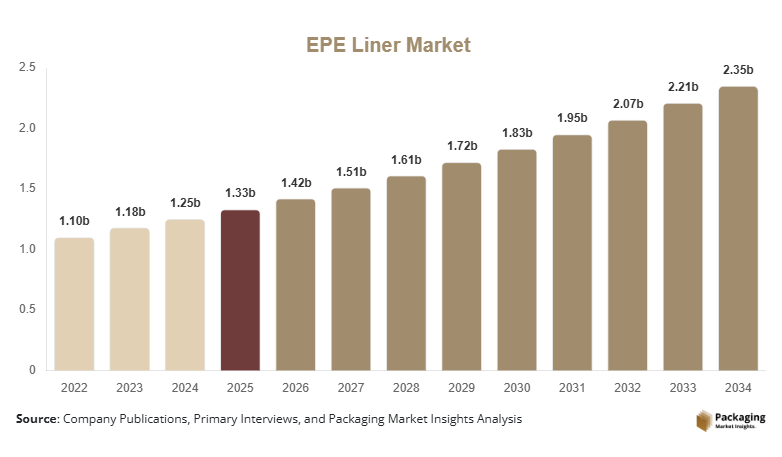
EPE Liner market size is projected at USD 1.42 billion in 2026 and is expected to hit USD 2.35 billion by 2034 with a CAGR of 6.50%. The report provides detailed evaluation of market performance, including production capacity, consumption volume, pricing analysis, segmentation framework, competitive landscape, and strategic developments across global regions. The study analyzes key manufacturers, application trends, raw material dynamics, and investment opportunities shaping the future of the EPE Liner Market.
The EPE Liner Market includes expanded polyethylene-based protective liners used for sealing, cushioning, and contamination prevention across multiple packaging industries. Global EPE liner production exceeded 3.8 billion units in 2025, with consumption reaching approximately 3.6 billion units, representing a utilization rate of 94.7%. Foam EPE liners accounted for nearly 58% of global demand, while film-based liners contributed around 29% and molded liners represented 13%. Food and beverage packaging generated approximately 44% of total demand, followed by industrial packaging at 34% and pharmaceutical applications at 22%, strengthening the EPE Liner Market.
Explore more data points, trends and opportunities Download Free Sample Report
EPE Liner Trends
Increasing Adoption of Sustainable and Lightweight Packaging Solutions
The growing emphasis on recyclable and lightweight packaging materials is accelerating innovation in EPE liner manufacturing. Global production of recyclable EPE liners surpassed 2.1 billion units in 2025, accounting for nearly 55% of total output. Manufacturers are adopting advanced extrusion technologies that reduce material consumption by 12–18% while maintaining sealing performance and impact protection. Demand from food, beverage, and personal care sectors increased by approximately 9%, supporting expansion across the EPE Liner Market.
Technology advancements in multilayer extrusion and customized liner designs are improving product performance. Automated manufacturing systems now represent nearly 42% of production facilities, improving operational efficiency by 20% and reducing production waste by 15%. Increasing adoption of tamper-resistant and moisture-barrier liners among premium packaging producers is creating new growth opportunities within the EPE Liner Market.
EPE Liner Drivers
Rising Demand for Protective and Leak-Resistant Packaging
Increasing consumption of packaged food, beverages, chemicals, and pharmaceuticals is driving demand for reliable sealing solutions. Global packaged product shipments exceeded 520 billion units in 2025, with EPE liners integrated into more than 7% of rigid container packaging formats. The food and beverage sector accounted for nearly 44% of liner consumption, while pharmaceutical packaging demand expanded by approximately 8.5% annually, supporting the EPE Liner Market.
EPE Liner Restraints
Fluctuating Polyethylene Raw Material Prices
EPE liners depend heavily on polyethylene resin availability, creating cost pressure due to raw material volatility. Polyethylene prices experienced fluctuations of approximately 7–12% during recent years, increasing manufacturing expenses by nearly 6% for producers. Small and medium-sized manufacturers face challenges due to energy costs, which represent around 18% of total production expenses, limiting profitability across the EPE Liner Market.
EPE Liner Opportunities
Expansion of Sustainable Packaging and E-Commerce Applications
The rapid growth of e-commerce packaging and sustainable product distribution is creating significant opportunities for EPE liner manufacturers. Global e-commerce shipments surpassed 160 billion parcels in 2025, increasing demand for lightweight protective packaging solutions. Recyclable liner adoption increased by nearly 22%, while customized packaging demand grew by 15%, creating additional opportunities within the EPE Liner Market.
Challenges in EPE Liner Market
Environmental Regulations and Recycling Limitations
Strict regulations related to plastic waste management are influencing product development strategies. More than 65 countries introduced packaging sustainability policies by 2025, increasing compliance costs by approximately 10%. Although EPE materials are recyclable, collection infrastructure limitations reduce effective recycling rates to nearly 35–45% in developing economies, creating challenges for long-term EPE Liner Market expansion.
Report Scope
| Report Metric | Details |
|---|---|
| Market Size in 2025 | USD 1.33 billion |
| Market Size in 2026 | USD 1.42 billion |
| Market Size in 2034 | USD 2.35 billion |
| CAGR | 6.50% (2026-2034) |
| Base Year for Estimation | 2025 |
| Historical Data | 2022-2024 |
| Forecast Period | 2026-2034 |
| Report Coverage | Revenue Forecast, Competitive Landscape, Supply Chain Disruption, Growth Factors, Environment & Regulatory Landscape and Trends |
| Geographies Covered | North America, Europe, APAC, Middle East and Africa, LATAM |
| Countries Covered | U.S., Canada, U.K., Germany, France, Spain, Italy, Russia, Nordic, Benelux, Rest of Europe, China, South Korea, Japan, India, Australia, Singapore, Taiwan, South East Asia, Rest of Asia-Pacific, UAE, Turky, Saudi Arabia, South Africa, Egypt, Nigeria, Rest of MEA, Brazil, Mexico, Argentina, Chile, Colombia, Rest of LATAM |
Explore more data points, trends and opportunities Download Free Sample Report
EPE Liner Market Segmentation
The EPE Liner Market is segmented by type and application based on material structure and end-use requirements. Foam-based liners dominate with approximately 58% market share due to superior cushioning performance, while food and beverage packaging remains the largest application segment with nearly 44% demand contribution.
By Type
Foam EPE Liners
Foam EPE liners accounted for approximately 58% of the market share in 2025, with production exceeding 2.2 billion units. These liners provide excellent cushioning, vibration resistance, and moisture protection. Thickness ranges typically vary between 1 mm and 10 mm, making them suitable for bottles, containers, and sensitive products.
Film EPE Liners
Film EPE liners represented nearly 29% of global demand with production volumes reaching approximately 1.1 billion units. These liners are preferred for lightweight sealing applications due to flexibility, chemical resistance, and cost efficiency. Film thickness generally ranges from 20 microns to 200 microns, supporting diverse packaging requirements.
Molded EPE Liners
Molded EPE liners contributed around 13% share with production exceeding 500 million units annually. These liners offer customized shapes, enhanced impact protection, and structural stability for industrial and specialty packaging applications.
By Application
Food & Beverage Packaging
Food and beverage packaging represented the largest application segment with approximately 44% share and consumption exceeding 1.6 billion units in 2025. EPE liners are widely used in bottles, jars, closures, and containers due to their sealing efficiency, hygiene properties, and moisture resistance.
Pharmaceutical Packaging
Pharmaceutical packaging accounted for nearly 22% market share, consuming more than 790 million units annually. These liners support contamination prevention, product stability, and tamper protection for medicines, healthcare products, and specialty formulations.
Industrial Packaging
Industrial packaging contributed around 34% demand with usage exceeding 1.2 billion units. Chemical containers, lubricants, paints, and automotive products utilize EPE liners due to durability, compression resistance, and leak prevention capabilities.
EPE Liner Market Segmentations
Type
- Foam EPE Liners
- Film EPE Liners
- Molded EPE Liners
Application
- Food & Beverage Packaging
- Pharmaceutical Packaging
- Industrial Packaging
EPE Liner Regional Outlook
North America
North America accounted for approximately 27% of global EPE Liner Market revenue in 2025. The United States contributed nearly 78% of regional demand, supported by advanced food packaging and pharmaceutical manufacturing. Regional consumption exceeded 950 million units, with industrial applications representing nearly 36% of usage.
Europe
Europe represented around 29% market share, with Germany, France, Italy, and the United Kingdom being major contributors. Regional production exceeded 1 billion units, supported by sustainability-focused packaging initiatives and recyclable material adoption exceeding 48% among major manufacturers.
Asia-Pacific
Asia-Pacific dominated global production with approximately 35% share. China, India, Japan, and South Korea collectively produced more than 1.4 billion units in 2025. Expanding food processing industries and pharmaceutical manufacturing contributed significantly to regional growth.
Latin America
Latin America accounted for nearly 6% of global demand, with Brazil and Mexico contributing more than 70% of regional consumption. Food and beverage packaging represented approximately 52% of liner usage.
Middle East & Africa
The Middle East & Africa region contributed around 3% share, with demand exceeding 110 million units. Increasing packaged food consumption and industrial development supported regional market expansion.
Top players in EPE Liner Market
- Sealed Air Corporation
- Berry Global Inc.
- Winpak Ltd.
- ProAmpac LLC
- Constantia Flexibles Group
- UFlex Limited
- Protective Packaging Corporation
- Pregis LLC
- Plastirama
- Intertape Polymer Group
- Flexi-Pak
- Foam Supplies, Inc.
Sealed Air Corporation
-
Estimated global market share: 8–10%.
-
Sealed Air maintains a strong position through advanced protective packaging technologies and sustainable material solutions.
-
The company focuses on lightweight EPE-based solutions for food, beverage, and industrial packaging applications.
-
Its global manufacturing network supports large-scale production exceeding millions of packaging components annually, strengthening its competitive position in the EPE Liner Market.
Berry Global Inc.
-
Estimated global market share: 6–8%.
-
Berry Global provides customized polymer-based packaging solutions across food, healthcare, and industrial sectors.
-
The company emphasizes recyclable materials, lightweight designs, and advanced extrusion capabilities.
-
Its broad product portfolio and global manufacturing presence enable strong penetration across developed and emerging markets.