Industrial Safety Products Market Size
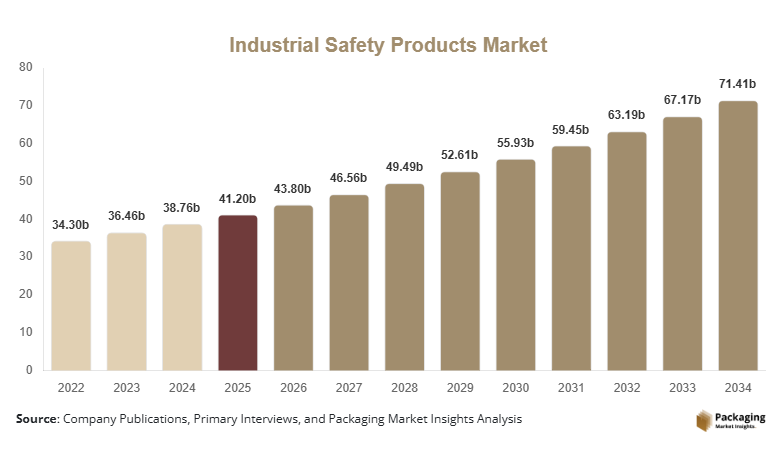
Industrial Safety Products market size is projected at USD 43.8 billion in 2026 and is expected to hit USD 71.6 billion by 2034 with a CAGR of 6.3%. Increasing workplace safety regulations across more than 180 countries, rising industrial automation, and expanding infrastructure investments are accelerating market expansion. The report evaluates detailed market segmentation, production capacity, supply chain developments, technological innovations, and the competitive landscape covering major global manufacturers and regional suppliers.
Industrial safety products include protective equipment, monitoring systems, respiratory protection devices, fall protection systems, and workplace safety solutions designed to reduce occupational hazards across manufacturing, mining, construction, oil & gas, transportation, and chemical industries. Global production exceeded 1.9 billion safety product units in 2025, while industrial facilities adopting certified safety equipment surpassed 78% across developed economies. Personal protective equipment represented nearly 48% of total product demand, while manufacturing accounted for approximately 36% of end-use consumption. Increasing regulatory compliance, digital safety monitoring, and workplace modernization continue strengthening the Industrial Safety Products market.
Explore more data points, trends and opportunities Download Free Sample Report
Industrial Safety Products Market Trends
Rising Adoption of Smart and Connected Safety Equipment
Industrial facilities are increasingly deploying smart helmets, connected gas detectors, wearable sensors, and AI-enabled monitoring platforms to improve workplace safety. More than 220 million connected safety devices were deployed globally during 2025, representing an annual increase of 14%. Digital monitoring systems now achieve adoption rates above 52% among large manufacturing facilities, while predictive safety analytics reduce workplace incidents by nearly 28%. Continuous investments in Industry 4.0 technologies reinforce the Industrial Safety Products market.
Growing investments in automation and high-risk industrial operations continue increasing demand for advanced respiratory protection, fall arrest systems, and intelligent PPE. Construction projects exceeding USD 14 trillion globally require higher safety compliance, while oil & gas facilities maintain safety equipment replacement cycles averaging 3–5 years. Nearly 67% of multinational industrial companies increased annual safety equipment spending during 2025, supporting the Industrial Safety Products market.
Industrial Safety Products Drivers
Stringent Workplace Safety Regulations Accelerate Equipment Adoption
Governments continue strengthening occupational safety regulations across manufacturing, mining, and construction industries. More than 3.1 million workplace injuries are reported globally each year, encouraging organizations to increase safety investments by over 11% annually. PPE compliance rates exceed 85% across regulated industries, while industrial employers allocate approximately 2–4% of operational expenditure toward worker safety. These regulatory developments continue supporting Industrial Safety Products growth.
Industrial Safety Products Restraints
High Product Costs and Compliance Expenses
Advanced respiratory systems, intelligent wearables, and specialized protective clothing involve substantial procurement and maintenance expenses. Smart PPE solutions can cost 30–45% more than conventional equipment, while periodic certification increases operating costs by approximately 12% annually. Small and medium-sized enterprises with fewer than 250 employees often delay equipment upgrades due to budget limitations, creating challenges for Industrial Safety Products growth.
Industrial Safety Products Opportunities
Expansion of Emerging Industrial Infrastructure
Industrialization across Asia-Pacific, Latin America, and the Middle East is creating strong opportunities for manufacturers. Infrastructure investments exceeded USD 3.8 trillion during 2025, while manufacturing output expanded by 6.8% across several developing economies. Safety equipment demand in emerging markets is projected to grow faster than mature regions as industrial employment surpasses 720 million workers, generating new opportunities for Industrial Safety Products.
Challenges in Industrial Safety Products
Counterfeit Safety Equipment and Supply Chain Disruptions
The availability of counterfeit PPE and inconsistent product certification remains a significant challenge. Counterfeit products account for an estimated 6–8% of certain regional markets, while logistics disruptions increased average delivery times by nearly 18% during recent years. Manufacturers continue investing in product authentication technologies, quality certifications, and regional production facilities to strengthen Industrial Safety Products.
Report Scope
| Report Metric | Details |
|---|---|
| Market Size in 2025 | USD 41.2 billion |
| Market Size in 2026 | USD 43.8 billion |
| Market Size in 2034 | USD 71.6 billion |
| CAGR | 6.3% (2026-2034) |
| Base Year for Estimation | 2025 |
| Historical Data | 2022-2024 |
| Forecast Period | 2026-2034 |
| Report Coverage | Revenue Forecast, Competitive Landscape, Supply Chain Disruption, Growth Factors, Environment & Regulatory Landscape and Trends |
| Geographies Covered | North America, Europe, APAC, Middle East and Africa, LATAM |
| Countries Covered | U.S., Canada, U.K., Germany, France, Spain, Italy, Russia, Nordic, Benelux, Rest of Europe, China, South Korea, Japan, India, Australia, Singapore, Taiwan, South East Asia, Rest of Asia-Pacific, UAE, Turky, Saudi Arabia, South Africa, Egypt, Nigeria, Rest of MEA, Brazil, Mexico, Argentina, Chile, Colombia, Rest of LATAM |
Explore more data points, trends and opportunities Download Free Sample Report
Industrial Safety Products Market Segmentation
The market is segmented by product type and application based on workplace risk levels, industrial production, and regulatory compliance. Personal protective equipment contributes approximately 48% of revenue, while manufacturing remains the leading application with nearly 36% market share.
By Type
Personal Protective Equipment (PPE) dominates the market with approximately 48% share. Annual production exceeded 1.1 billion units, including helmets, gloves, footwear, and protective clothing. Product compliance with ANSI, ISO, and EN standards continues supporting widespread industrial adoption.
Fall Protection Equipment accounts for nearly 22% of market demand. More than 120 million harnesses, lanyards, anchor systems, and lifelines are manufactured annually. Construction and maintenance sectors maintain adoption rates exceeding 70% due to stringent safety regulations.
Respiratory Protection Equipment represents around 18% of total demand. Global production surpassed 260 million respirators and breathing devices during 2025. Advanced filtration efficiency above 95% and reusable systems are driving replacement demand across chemical, pharmaceutical, and mining industries.
By Application
Manufacturing remains the largest application with nearly 36% market share. More than 620 million safety products are supplied annually to production facilities, where worker safety compliance exceeds 80% in developed economies.
Construction contributes approximately 29% of market demand. Large infrastructure projects require extensive use of helmets, safety harnesses, eye protection, and footwear, with adoption exceeding 90% on regulated commercial projects.
Oil & Gas accounts for roughly 16% of market consumption. High-risk operations require flame-resistant clothing, gas detection systems, and respiratory equipment, while equipment replacement typically occurs every 3–5 years to maintain compliance.
Industrial Safety Products Market Segmentations
Product Type
- Personal Protective Equipment (PPE)
- Fall Protection Equipment
- Respiratory Protection Equipment
- Hand Protection Equipment
- Head, Eye & Face Protection Equipment
Application
- Manufacturing
- Construction
- Oil & Gas
- Mining
- Chemical & Pharmaceutical
Distribution Channel
- Direct Sales
- Industrial Distributors
- Online Retail
- Specialty Safety Equipment Stores
- Authorized Dealers
Industrial Safety Products Regional Outlook
North America
North America holds approximately 33% of global revenue, supported by OSHA regulations, high industrial automation, and advanced manufacturing. The United States contributes nearly 82% of regional demand, while Canada continues increasing investments in mining and energy safety equipment. Annual production exceeds 430 million safety products.
Europe
Europe represents nearly 28% of the global market. Germany, France, Italy, and the United Kingdom collectively account for more than 72% of regional consumption. Manufacturing, chemicals, and automotive industries maintain PPE adoption rates above 88%, supported by strict workplace safety directives.
Asia-Pacific
Asia-Pacific accounts for around 31% of global demand and remains the fastest-growing region. China, India, Japan, and South Korea dominate regional production exceeding 820 million units annually. Rapid industrialization, infrastructure expansion, and manufacturing investments continue driving market growth.
Latin America, Middle East & Africa
These regions collectively contribute approximately 8% of global revenue. Brazil, Mexico, Saudi Arabia, South Africa, and the UAE continue expanding mining, construction, and oil & gas activities. Industrial safety investments are increasing at annual rates above 7%, supported by modernization initiatives.
Top players in Industrial Safety Products
- 3M Company
- Honeywell International Inc.
- MSA Safety Incorporated
- Ansell Limited
- DuPont
- Kimberly-Clark Corporation
- Drägerwerk AG
- Lakeland Industries Inc.
- Uvex Safety Group
- Radians Inc.
- Delta Plus Group
- Protective Industrial Products Inc.
3M Company
-
Holds an estimated 10–12% global market share.
-
Strong presence across respiratory protection, hearing protection, eye protection, and industrial PPE.
-
Extensive global manufacturing network supplying over 200 countries.
-
Continuous investment in filtration technologies and sustainable protective materials strengthens its competitive positioning.
Honeywell International Inc.
-
Accounts for approximately 8–10% global market share.
-
Leading supplier of connected PPE, gas detection systems, respiratory protection, and industrial automation safety solutions.
-
Broad customer base across aerospace, manufacturing, energy, and construction sectors.
-
Focuses on digital workplace safety platforms, wearable technologies, and integrated industrial risk management solutions.