Billing Paper Market Size
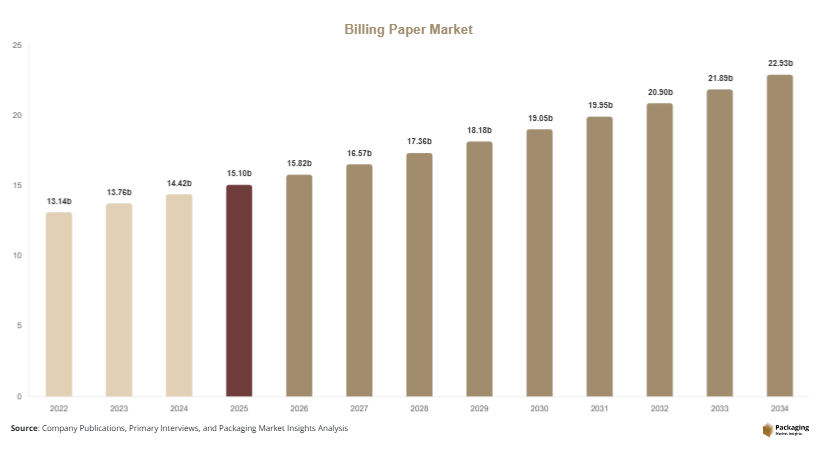
Billing Paper market size is projected at USD 15.82 billion in 2026 and is expected to hit USD 22.94 billion by 2034 with a CAGR of 4.75%. Increasing transaction volumes, expanding organized retail, and rising documentation requirements continue to support steady industry expansion despite ongoing digital transformation. The report evaluates detailed market segmentation, production capacity, consumption trends, supply chain developments, pricing analysis, and the competitive landscape across major regional markets while assessing opportunities emerging from technological improvements and sustainable paper manufacturing.
Billing paper refers to specialized paper products used for invoices, receipts, billing statements, transaction slips, and commercial documentation across retail stores, banking institutions, hospitality businesses, healthcare facilities, and government organizations. Global production exceeded 15.4 million metric tons in 2025, with thermal billing paper accounting for nearly 52% of total output, while carbonless products represented approximately 29%. Organized retail penetration surpassed 68% in developed economies, whereas commercial adoption exceeded 57% in emerging markets due to increasing POS installations and invoice generation requirements. Continuous investments in recyclable substrates and BPA-free coatings further strengthen the Billing Paper market.
Explore more data points, trends and opportunities Download Free Sample Report
Billing Paper Market Trends
Rising Demand for Sustainable and BPA-Free Billing Paper
Manufacturers are increasingly introducing recyclable and BPA-free billing paper products to comply with environmental regulations and customer preferences. More than 61% of newly manufactured thermal rolls now utilize phenol-free coatings, while recycled fiber usage has increased beyond 34% across commercial production facilities. Annual production of eco-friendly billing paper surpassed 5.2 million metric tons, supported by retail chains replacing conventional receipt rolls. These developments continue to reinforce the Billing Paper market.
Automation across retail and financial sectors is encouraging adoption of high-speed compatible billing paper capable of operating above 300 mm/second printing speeds with print durability exceeding 7 years. Over 48 million POS terminals globally consume billing paper daily, while hospitality establishments increased receipt printing volumes by nearly 9.4% during the past year. Enhanced coating technologies and better moisture resistance continue supporting the Billing Paper market.
Billing Paper Drivers
Expansion of Organized Retail and Point-of-Sale Infrastructure
The rapid increase in supermarkets, convenience stores, pharmacies, restaurants, and fuel stations continues driving billing paper demand worldwide. Global retail sales expanded by approximately 6.8%, while installed POS terminals exceeded 48 million units. More than 72% of retail transactions still require printed receipts in many commercial sectors, creating sustained demand for over 9 million metric tons of billing paper annually. Growing commercial documentation requirements continue supporting the Billing Paper market.
Billing Paper Restraints
Accelerating Digital Billing and Electronic Receipt Adoption
Digital invoicing platforms and electronic receipt systems continue reducing dependence on conventional billing paper across developed economies. Electronic receipt adoption exceeded 43% among large retailers, while online payment penetration crossed 71% in several mature markets. Corporate sustainability initiatives reduced paper consumption by approximately 11% across multinational enterprises, limiting demand expansion in selected applications and restraining the Billing Paper market.
Billing Paper Opportunities
Growing Demand Across Emerging Commercial Economies
Rapid urbanization and retail expansion across Asia-Pacific, Latin America, and Africa provide substantial opportunities for billing paper manufacturers. Organized retail floor space increased by 8.9%, banking branch transactions grew by 5.7%, and hospitality establishments expanded by nearly 6% annually across emerging regions. Production investments exceeding 1.6 million metric tons of additional capacity are expected to improve supply while expanding the Billing Paper market.
Challenges in Billing Paper
Raw Material Price Volatility and Environmental Compliance
Fluctuating pulp prices, coating chemical costs, and stricter environmental regulations continue challenging manufacturers. Wood pulp prices experienced annual fluctuations exceeding 14%, while energy costs increased by approximately 10% across several manufacturing regions. Compliance investments for wastewater treatment and recyclable production processes also increased operating expenses by nearly 8%, creating ongoing challenges for the Billing Paper market.
Report Scope
| Report Metric | Details |
|---|---|
| Market Size in 2025 | USD 15.10 billion |
| Market Size in 2026 | USD 15.82 billion |
| Market Size in 2034 | USD 22.94 billion |
| CAGR | 4.75% (2026-2034) |
| Base Year for Estimation | 2025 |
| Historical Data | 2022-2024 |
| Forecast Period | 2026-2034 |
| Report Coverage | Revenue Forecast, Competitive Landscape, Supply Chain Disruption, Growth Factors, Environment & Regulatory Landscape and Trends |
| Geographies Covered | North America, Europe, APAC, Middle East and Africa, LATAM |
| Countries Covered | U.S., Canada, U.K., Germany, France, Spain, Italy, Russia, Nordic, Benelux, Rest of Europe, China, South Korea, Japan, India, Australia, Singapore, Taiwan, South East Asia, Rest of Asia-Pacific, UAE, Turky, Saudi Arabia, South Africa, Egypt, Nigeria, Rest of MEA, Brazil, Mexico, Argentina, Chile, Colombia, Rest of LATAM |
Explore more data points, trends and opportunities Download Free Sample Report
Billing Paper Market Segmentation
Thermal billing paper remains the dominant segment with approximately 52% market contribution, followed by carbonless paper at 29% and bond billing paper at 19%. Retail applications account for nearly 49% of overall demand, supported by expanding commercial infrastructure.
By Type
Thermal Billing Paper
Holding around 52% market share, thermal billing paper exceeds 8 million metric tons of annual production. It offers rapid image formation without ink, supports print speeds exceeding 300 mm/second, and provides excellent compatibility with POS systems, ATMs, kiosks, and ticketing equipment.
Carbonless Billing Paper
Representing approximately 29% of demand, annual production surpasses 4.4 million metric tons. Multi-copy capability, pressure-sensitive coatings, and durable record generation make this paper suitable for invoices, logistics documentation, delivery receipts, and banking forms.
Bond Billing Paper
Accounting for nearly 19% of production, bond billing paper exceeds 3 million metric tons annually. High brightness above 90 ISO, superior archival performance, and compatibility with impact printers continue supporting government offices, financial institutions, and industrial documentation.
By Application
Retail
Retail contributes nearly 49% of market consumption, supported by over 32 million active checkout terminals worldwide. Billing paper remains essential for supermarkets, pharmacies, department stores, and fuel stations where receipt issuance continues exceeding 120 billion transactions annually.
Banking & Financial Services
Accounting for approximately 28% of consumption, banks utilize billing paper for transaction slips, account statements, and ATM receipts. More than 3 billion ATM receipts are printed annually with usage penetration remaining above 65% across financial institutions.
Hospitality
Hospitality represents nearly 23% of demand through hotels, restaurants, cafés, and entertainment venues. More than 18 billion customer receipts are generated annually, supported by growing tourism and digital POS integration.
Billing Paper Market Segmentations
Type
- Thermal Billing Paper
- Carbonless Billing Paper
- Bond Billing Paper
Application
- Retail
- Banking & Financial Services
- Hospitality
Billing Paper Regional Outlook
North America
North America accounts for approximately 29% of global consumption, producing over 4.3 million metric tons annually. The United States contributes nearly 82% of regional demand, driven by retail chains, financial institutions, healthcare facilities, and hospitality businesses.
Europe
Europe holds nearly 26% market share with production exceeding 3.8 million metric tons. Germany, France, Italy, and the United Kingdom dominate regional demand, while sustainable paper manufacturing continues expanding across commercial applications.
Asia-Pacific
Asia-Pacific represents approximately 35% of global demand and remains the fastest-growing regional market. China, Japan, India, and South Korea collectively account for over 78% of regional production, supported by retail modernization and banking expansion.
Latin America, Middle East & Africa
These regions collectively contribute around 10% of global consumption. Brazil, Mexico, Saudi Arabia, South Africa, and the UAE continue investing in retail infrastructure, increasing billing paper production beyond 1.5 million metric tons annually.
Top players in Billing Paper
- Oji Holdings Corporation
- Nippon Paper Industries Co., Ltd.
- Appvion Operations Inc.
- Koehler Paper Group
- Lecta Group
- Mitsubishi Paper Mills Limited
- Hansol Paper Co., Ltd.
- Jujo Thermal Ltd.
- Ricoh Industrial Solutions
- Twin Rivers Paper Company
- Asia Pulp & Paper
- Mondi plc
- Stora Enso Oyj
- UPM-Kymmene Corporation
- Suzano S.A.
Oji Holdings Corporation
-
Estimated global market presence of approximately 8–10%.
-
Strong manufacturing footprint across Asia-Pacific, North America, and Europe.
-
Extensive product portfolio covering thermal, carbonless, and specialty billing papers.
-
Focuses on sustainable forestry, recycled fiber utilization, and high-performance coating technologies. Continuous investments in production efficiency, environmentally compliant manufacturing, and premium paper solutions strengthen its competitive positioning across commercial printing, retail, and financial documentation markets.
Koehler Paper Group
-
Estimated market presence of approximately 6–8%.
-
Leading supplier of premium thermal and phenol-free billing paper products.
-
Strong emphasis on BPA-free technologies and recyclable specialty paper.
-
Operates advanced manufacturing facilities supporting retail, banking, transportation, and hospitality sectors. The company continues expanding environmentally responsible production while developing innovative thermal coatings with improved print durability, operational efficiency, and regulatory compliance.