Paper Packaging Market Size and Growth
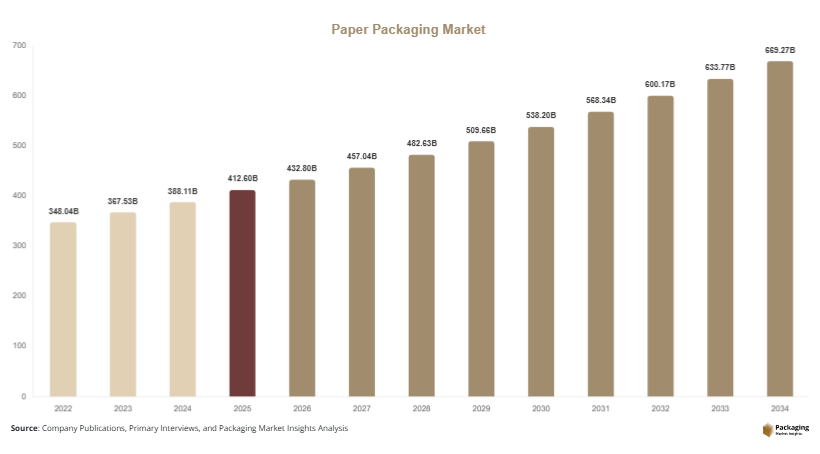
The global paper packaging market size is estimated at USD 412.6 billion in 2025, while the market is projected to reach USD 432.8 billion in 2026. By 2034, the market is forecasted to attain USD 671.4 billion, expanding at a CAGR of 5.6% during 2025–2034. The global paper packaging market is experiencing consistent growth due to rising demand for sustainable packaging solutions, rapid expansion of e-commerce industries, and increasing regulatory restrictions on plastic packaging materials. Paper packaging products, including corrugated boxes, folding cartons, paper bags, and paper-based protective packaging, are widely used across food and beverage, healthcare, consumer goods, electronics, and industrial sectors. The market has gained significant momentum as businesses and consumers increasingly prioritize recyclable and biodegradable packaging alternatives.
One of the major growth factors supporting the market is the rapid increase in online retail and home delivery services. E-commerce companies require durable and lightweight packaging materials for product transportation and damage prevention. Corrugated paper packaging has emerged as a preferred solution because of its recyclability and cost efficiency. Another important factor driving market expansion is the growing consumer preference for environmentally responsible packaging. Brands across food, cosmetics, and retail sectors are replacing conventional plastic packaging with recyclable paper alternatives to strengthen sustainability commitments and improve brand image.
Key Highlights
- Asia Pacific dominated the market with a 39.8% share in 2025.
- Latin America is projected to grow at the fastest CAGR of 6.2%.
- Corrugated boxes led the product segment with a 36.7% share.
- Food and beverage applications dominated the market with a 42.4% share.
- Retail and consumer goods companies led the end-use segment with 33.1% share.
- The US remained the dominant country with a market size of USD 74.2 billion in 2025 and USD 77.9 billion in 2026.
Explore more data points, trends and opportunities Download Free Sample Report
Market Trends
Increasing Adoption of Recyclable and Compostable Paper Packaging
The paper packaging market is witnessing strong demand for recyclable and compostable packaging materials as sustainability becomes a major business priority across industries. Manufacturers are introducing biodegradable coatings, water-based inks, and recyclable paper fibers to reduce environmental impact and improve packaging recyclability. Food and beverage companies are increasingly replacing plastic containers and wrappers with paper-based packaging to comply with environmental regulations and strengthen sustainability initiatives. Consumers are also favoring eco-friendly packaging solutions, encouraging retailers and consumer brands to adopt recyclable paper packaging formats. This trend is expected to accelerate investments in advanced paper processing technologies and circular packaging infrastructure over the forecast period.
Growth of Smart and Digitally Printed Packaging Solutions
Digitally printed and smart paper packaging solutions are becoming increasingly important in the market. Brands are using high-quality digital printing technologies to improve product visibility, personalized branding, and customer engagement. QR codes, interactive labels, and traceability features are being integrated into paper packaging to enhance supply chain transparency and consumer interaction. E-commerce retailers are also using digitally printed corrugated packaging for promotional and branding purposes. In addition, advancements in moisture-resistant coatings and durable paper materials are expanding the use of paper packaging across electronics, healthcare, and premium food applications where product protection and presentation are critical.
Market Drivers
Rising Regulatory Restrictions on Plastic Packaging
Increasing government regulations targeting single-use plastics are one of the major drivers supporting the paper packaging market. Countries across Europe, North America, and Asia are implementing policies to reduce plastic waste and encourage recyclable packaging alternatives. Foodservice operators, retail companies, and manufacturers are transitioning toward paper packaging solutions to comply with environmental standards and avoid penalties associated with plastic usage. Paper packaging offers advantages such as recyclability, biodegradability, and lower environmental impact compared to conventional plastic packaging materials. As regulatory pressure intensifies, businesses are expected to accelerate adoption of paper-based packaging solutions across multiple industries.
Expansion of Global E-Commerce and Retail Industries
The rapid expansion of e-commerce and organized retail industries is significantly contributing to paper packaging demand. Online retail platforms require durable and lightweight packaging materials for product transportation, branding, and damage protection. Corrugated boxes and paper-based protective packaging are widely used in e-commerce logistics because they provide efficient cushioning and are easy to recycle. Rising consumer demand for home delivery services and packaged goods is also increasing the need for sustainable shipping solutions. E-commerce companies are increasingly partnering with paper packaging manufacturers to develop customized packaging formats optimized for logistics efficiency and sustainability goals.
Market Restraint
Volatility in Raw Material Prices and Supply Chain Challenges
One of the primary restraints affecting the paper packaging market is the volatility in raw material prices and supply chain disruptions related to pulp and recycled paper availability. Paper packaging manufacturers rely heavily on wood pulp, recycled fibers, and energy-intensive production processes, making the industry sensitive to fluctuations in raw material and transportation costs. Rising energy prices and supply shortages can significantly increase manufacturing expenses and impact profit margins. For example, disruptions in global pulp supply chains or reduced recycling collection rates may lead to increased production costs for corrugated packaging manufacturers. In addition, some industries still perceive paper packaging as less durable than plastic alternatives in high-moisture or heavy-duty applications, limiting adoption in certain industrial sectors. These challenges may create operational and pricing pressures for manufacturers during the forecast period.
Market Opportunities
Expansion of Sustainable Food Delivery Packaging
The growing demand for sustainable food delivery packaging presents a major opportunity for paper packaging manufacturers. Online food delivery services, quick-service restaurants, and takeaway businesses are increasingly replacing plastic containers with paper-based alternatives to meet environmental regulations and consumer preferences. Paper bowls, cups, trays, and wrapping materials are gaining popularity because they are recyclable and biodegradable. Foodservice operators are also seeking customized paper packaging designs that improve brand visibility and customer experience. As food delivery platforms continue expanding globally, demand for innovative paper packaging products is expected to increase substantially.
Advancements in Barrier Coating Technologies
Technological advancements in barrier coating solutions are creating new growth opportunities in the paper packaging market. Traditional paper packaging often faces limitations related to moisture resistance and product protection. However, manufacturers are developing advanced biodegradable coatings and multilayer paper structures that improve barrier performance while maintaining recyclability. These innovations are enabling paper packaging adoption in applications such as frozen foods, pharmaceuticals, cosmetics, and industrial products. Companies investing in high-performance paper packaging technologies are expected to gain competitive advantages as industries increasingly seek sustainable packaging alternatives with enhanced functionality.
Report Scope
| Report Metric | Details |
|---|---|
| Market Size in 2025 | USD 412.6 Billion |
| Market Size in 2026 | USD 432.8 Billion |
| Market Size in 2034 | USD 671.4 Billion |
| CAGR | 5.6% (2026-2034) |
| Base Year for Estimation | 2025 |
| Historical Data | 2022-2024 |
| Forecast Period | 2026-2034 |
| Report Coverage | Revenue Forecast, Competitive Landscape, Supply Chain Disruption, Growth Factors, Environment & Regulatory Landscape and Trends |
| Geographies Covered | North America, Europe, APAC, Middle East and Africa, LATAM |
| Countries Covered | U.S., Canada, U.K., Germany, France, Spain, Italy, Russia, Nordic, Benelux, Rest of Europe, China, South Korea, Japan, India, Australia, Singapore, Taiwan, South East Asia, Rest of Asia-Pacific, UAE, Turky, Saudi Arabia, South Africa, Egypt, Nigeria, Rest of MEA, Brazil, Mexico, Argentina, Chile, Colombia, Rest of LATAM |
Explore more data points, trends and opportunities Download Free Sample Report
Segmental Analysis
By Product Type
Corrugated boxes dominated the paper packaging market in 2024 and accounted for approximately 36.7% of total market share. These packaging solutions are widely used across e-commerce, food delivery, electronics, and industrial logistics applications because of their durability, lightweight properties, and recyclability. Corrugated packaging provides strong product protection during transportation and storage while supporting cost-effective shipping operations. Manufacturers are increasingly adopting high-strength corrugated materials and digital printing technologies to improve branding and operational efficiency. The growth of online retail and home delivery services continues to strengthen demand for corrugated paper packaging worldwide.
Molded fiber packaging is expected to be the fastest-growing subsegment, registering a CAGR of 6.9% during the forecast period. Molded fiber packaging is gaining popularity because it offers biodegradable and compostable alternatives to plastic trays and protective packaging materials. Industries such as electronics, healthcare, and foodservice are increasingly adopting molded fiber products for sustainable packaging applications. Technological advancements in fiber molding and moisture-resistant coatings are improving product performance and expanding market adoption. Growing regulatory pressure on plastic packaging waste is also supporting rapid growth in this segment.
By Application
Food and beverage applications held the dominant position in the market in 2024 with a share of approximately 42.4%. Paper packaging products are extensively used for food cartons, takeaway containers, beverage carriers, paper cups, and wrapping materials. Food manufacturers and restaurants are increasingly replacing plastic packaging with recyclable paper solutions to comply with environmental regulations and meet changing consumer preferences. Rising demand for packaged foods, takeaway meals, and sustainable foodservice packaging is supporting continued market expansion. In addition, advancements in moisture-resistant coatings are improving the functionality of paper packaging for food applications.
E-commerce packaging is projected to witness the fastest CAGR of 6.8% during the forecast period. Online retailers require durable and lightweight packaging materials that provide product protection while reducing transportation costs. Corrugated boxes, paper mailers, and paper-based protective fillers are increasingly used across e-commerce supply chains because they are recyclable and customizable. The rapid growth of online shopping, same-day delivery services, and cross-border retail operations is significantly increasing demand for paper-based shipping solutions. Companies are also investing in branded packaging formats to improve customer experience and strengthen brand visibility.
By End-Use
Retail and consumer goods companies dominated the paper packaging market in 2024 and accounted for approximately 33.1% of total market revenue. Consumer product manufacturers increasingly use paper packaging for branding, sustainability, and transportation efficiency purposes. Paper-based cartons, boxes, and display packaging solutions are widely used across cosmetics, personal care, electronics, and household product industries. Rising demand for premium and sustainable packaging is encouraging retailers to adopt recyclable paper materials and customized packaging designs. The expansion of organized retail and consumer goods industries continues to support market growth.
Healthcare packaging is expected to record the fastest CAGR of 6.5% during the forecast period. Pharmaceutical companies and healthcare providers are increasingly using paper-based packaging solutions for medicines, medical devices, and healthcare logistics applications. Growing emphasis on sustainable healthcare operations and recyclable packaging materials is supporting segment expansion. Paper packaging manufacturers are also developing high-strength and contamination-resistant solutions for healthcare applications. Rising pharmaceutical production and global healthcare spending are expected to create long-term opportunities in this segment.
Paper Packaging Market Segmentations
By Product Type
- Corrugated Boxes
- Folding Cartons
- Paper Bags
- Molded Fiber Packaging
- Paper Sacks
By Application
- Food & Beverage Packaging
- E-Commerce Packaging
- Healthcare Packaging
- Consumer Goods Packaging
- Industrial Packaging
By End-User
- Retail & Consumer Goods
- Foodservice Industry
- Healthcare Industry
- Electronics Industry
- Industrial Sector
Regional Analysis
North America
North America accounted for approximately 26.4% of the global paper packaging market share in 2025 and is projected to grow at a CAGR of 5.2% during the forecast period. Strong demand from e-commerce, food delivery services, and consumer goods industries is supporting market expansion across the region. Businesses are increasingly adopting recyclable paper packaging materials to align with sustainability targets and comply with environmental regulations regarding plastic waste reduction.
The United States dominates the North American market because of its advanced retail infrastructure and large-scale e-commerce industry. A unique growth factor is the increasing adoption of sustainable packaging commitments by major retail and consumer goods companies. Brands are rapidly transitioning toward recyclable paper packaging formats to improve environmental performance and strengthen customer engagement strategies.
Europe
Europe held nearly 24.7% of the global paper packaging market share in 2025 and is expected to register a CAGR of 5.3% through 2034. The region benefits from strict environmental regulations, strong recycling infrastructure, and rising consumer awareness regarding sustainable packaging. Food manufacturers and retail companies are increasingly replacing plastic packaging materials with paper-based alternatives across multiple product categories.
Germany remains the dominant country in the European market due to its strong manufacturing sector and advanced recycling ecosystem. A unique growth factor is the country’s focus on circular economy initiatives and sustainable industrial packaging. German companies are investing heavily in recyclable corrugated packaging and fiber-based materials to support environmental compliance and long-term sustainability goals.
Asia Pacific
Asia Pacific dominated the paper packaging market with a 39.8% share in 2025 and is projected to grow at a CAGR of 6.1% during the forecast period. Rapid industrialization, population growth, and expansion of e-commerce industries are major factors driving regional market growth. Increasing demand for packaged foods, electronics, and retail products is supporting strong consumption of paper packaging solutions throughout the region.
China remains the dominant country in Asia Pacific because of its extensive manufacturing capabilities and rapidly expanding online retail sector. One unique growth factor is the country’s large-scale investment in sustainable packaging production and recycling infrastructure. Chinese manufacturers are increasing production capacity for corrugated boxes and paper-based shipping materials to meet rising domestic and export demand.
Middle East & Africa
The Middle East & Africa region accounted for approximately 4.8% of the global market share in 2025 and is forecast to grow at a CAGR of 5.1%. Urbanization, growth in organized retail, and expansion of food delivery services are contributing to rising demand for paper packaging products. Governments and businesses are also promoting sustainable packaging initiatives to reduce environmental impact and improve waste management systems.
Saudi Arabia dominates the regional market because of strong investments in retail infrastructure and foodservice industries. A unique growth factor is the expansion of tourism and hospitality sectors, which is increasing demand for takeaway food packaging and consumer goods packaging solutions. Businesses are increasingly adopting recyclable paper packaging to align with sustainability objectives.
Latin America
Latin America represented around 4.3% of the global paper packaging market share in 2025 and is projected to grow at the fastest CAGR of 6.2% during the forecast period. The market is benefiting from increasing e-commerce penetration, rising packaged food consumption, and growing environmental awareness among consumers. Retailers and foodservice companies are increasingly using paper-based packaging materials to reduce plastic waste and improve sustainability practices.
Brazil leads the Latin American market due to its expanding retail industry and strong food processing sector. A unique growth factor is the increasing adoption of paper packaging by agricultural exporters and food manufacturers. Corrugated paper packaging is widely used for transporting fresh produce and packaged foods, supporting market growth throughout the country.
Competitive Landscape
The global paper packaging market is highly competitive, with major companies focusing on sustainable material innovation, production expansion, and advanced digital printing technologies. Market participants are investing heavily in recyclable packaging materials and lightweight paper solutions to address changing consumer preferences and regulatory requirements. Strategic partnerships with e-commerce companies, food manufacturers, and retail brands are also strengthening competitive positioning.
International Paper Company remains one of the leading companies in the market because of its broad product portfolio and strong global manufacturing network. In 2024, the company expanded its recyclable corrugated packaging production capabilities to support growing e-commerce demand. Other major companies include Smurfit Westrock, DS Smith Plc, Mondi Group, and Stora Enso Oyj. These firms are emphasizing sustainable packaging technologies, circular economy initiatives, and advanced fiber-based materials to strengthen market competitiveness and support long-term growth.
Key Players List
- International Paper Company
- Smurfit Westrock
- DS Smith Plc
- Mondi Group
- Stora Enso Oyj
- Packaging Corporation of America
- Oji Holdings Corporation
- Nippon Paper Industries Co., Ltd.
- Sonoco Products Company
- Graphic Packaging International LLC
- Nine Dragons Paper Holdings Limited
- Sappi Limited
- Georgia-Pacific LLC
- Rengo Co., Ltd.
- Svenska Cellulosa Aktiebolaget (SCA)