Honeycomb Packaging Paper Market Size and Growth
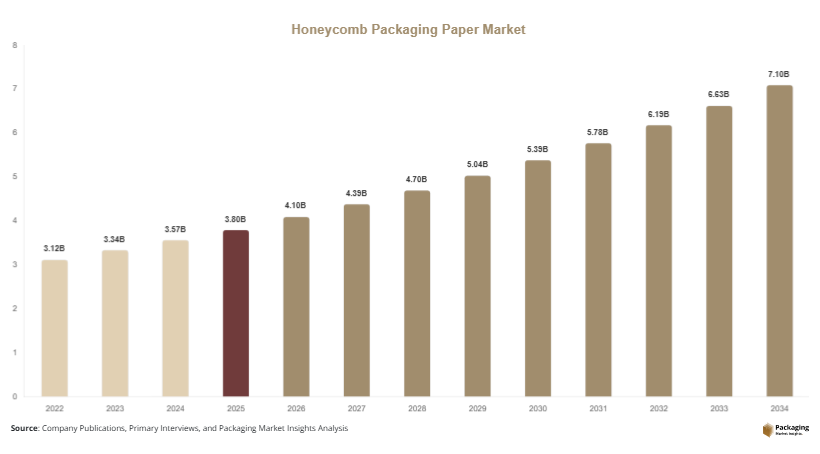
The honeycomb packaging paper market was valued at USD 3.8 billion in 2025 and is projected to reach USD 4.1 billion in 2026. By 2034, the market is forecast to attain USD 7.6 billion, registering a CAGR of 7.1% during the forecast period from 2025 to 2034. Honeycomb packaging paper has gained strong traction across e-commerce, consumer electronics, automotive, food & beverage, and industrial logistics sectors because it offers cushioning strength while reducing plastic dependency. The honeycomb packaging paper market is experiencing steady expansion due to the growing global preference for sustainable and lightweight protective packaging materials.
The increasing adoption of recyclable and biodegradable packaging solutions is one of the primary factors supporting market growth. Governments across North America and Europe continue to introduce strict regulations regarding single-use plastics and non-recyclable packaging materials. As a result, manufacturers are shifting toward paper-based alternatives that provide comparable protective performance with lower environmental impact. Honeycomb paper structures provide excellent shock absorption and compression resistance, making them suitable for fragile product transportation.
Key Highlights
- Asia Pacific dominated the market with a 39.2% share in 2025.
- Latin America is projected to grow at the fastest CAGR of 7.8%.
- Continuous honeycomb paper led the type segment with a 34.5% share.
- Kraft paper dominated the material segment with a 58.6% share.
- E-commerce applications led the end-use segment with 41.3% share.
- The US remained the dominant country with a market size of USD 0.9 billion in 2025 and USD 1.0 billion in 2026.
Explore more data points, trends and opportunities Download Free Sample Report
Market Trends
Rising Adoption of Sustainable Protective Packaging
The growing shift toward environmentally responsible packaging solutions has become a major trend in the honeycomb packaging paper market. Businesses across retail, consumer goods, and logistics sectors are replacing plastic bubble wraps and foam inserts with recyclable honeycomb paper alternatives. The material provides lightweight cushioning and shock absorption while supporting sustainability goals. E-commerce companies are increasingly promoting plastic-free shipping solutions to improve brand positioning and comply with environmental regulations. Several packaging converters are introducing curbside recyclable honeycomb paper wraps designed for fragile products such as cosmetics, electronics, and glassware. Future demand is expected to rise as companies adopt carbon reduction targets and expand paper-based packaging investments.
Automation and Smart Packaging Integration
Automation in packaging production and fulfillment operations is becoming increasingly important in the market. Honeycomb packaging paper manufacturers are integrating automated dispensing and cutting systems that improve operational efficiency and reduce labor costs. Packaging automation allows high-volume e-commerce warehouses to process shipments faster while maintaining product protection standards. Smart converting technologies also enable customized paper dimensions for various product categories. For example, electronics companies are using precision-cut honeycomb sleeves for device protection during shipping. Over the coming years, the integration of automation and digital packaging customization is expected to improve material utilization, reduce waste generation, and support faster production cycles across industrial packaging applications.
Market Drivers
Expansion of Global E-commerce Industry
The continuous rise of e-commerce activities is significantly driving the honeycomb packaging paper market. Online retailers require cost-efficient and lightweight protective packaging to minimize shipping damage and optimize logistics costs. Honeycomb packaging paper offers superior cushioning properties while reducing overall package weight compared to plastic-based protective materials. Major e-commerce fulfillment centers are increasingly adopting paper-based packaging systems to improve sustainability performance and reduce packaging waste. Growth in same-day and cross-border delivery services has also increased the need for protective transit packaging. Countries including China, the United States, India, and Germany are witnessing strong investments in warehouse infrastructure, which continues to support long-term market expansion.
Regulatory Pressure Against Plastic Packaging
Government regulations restricting single-use plastics and non-recyclable packaging materials are accelerating the adoption of honeycomb paper packaging solutions. Regulatory agencies in Europe and North America are implementing stricter recycling mandates and waste reduction policies that encourage sustainable packaging alternatives. Many consumer brands are voluntarily transitioning toward recyclable protective materials to improve ESG performance and meet consumer expectations. Honeycomb packaging paper aligns with circular economy initiatives because it is recyclable, biodegradable, and produced using renewable resources. Food delivery companies, electronics brands, and industrial manufacturers are increasingly adopting paper-based cushioning solutions to comply with sustainability regulations while enhancing brand reputation.
Market Restraint
Fluctuating Raw Material Costs and Limited Moisture Resistance
The honeycomb packaging paper market faces challenges related to fluctuating raw material prices and product performance limitations in humid environments. Kraft paper and recycled paper pulp prices are highly influenced by global pulp supply, energy costs, and recycling infrastructure availability. Sudden price fluctuations can impact manufacturer profit margins and increase production costs. In addition, honeycomb paper packaging may offer lower moisture resistance compared to plastic protective materials. Industries operating in high-humidity or cold-chain logistics environments often require additional coatings or hybrid packaging solutions, increasing overall packaging expenses. For example, exporters shipping products across tropical regions may prefer plastic cushioning materials for moisture-sensitive goods. These limitations can slow adoption rates in certain industrial applications despite growing sustainability demand.
Market Opportunities
Growth of Recyclable Industrial Packaging
Industrial manufacturers are increasingly searching for lightweight and recyclable protective packaging solutions to reduce shipping costs and improve sustainability performance. Honeycomb packaging paper is gaining popularity in automotive parts, machinery components, and furniture transportation applications because of its strength-to-weight ratio. Manufacturers are replacing expanded polystyrene and foam inserts with honeycomb paper cushioning systems to meet environmental objectives. Growth in export-oriented manufacturing economies such as Vietnam, Mexico, and India is expected to generate substantial future demand. Packaging suppliers investing in high-strength industrial honeycomb paper products are likely to benefit from rising industrial logistics activities and stricter waste reduction regulations.
Customized Premium Packaging Applications
The increasing focus on premium unboxing experiences presents a major opportunity for market participants. Luxury consumer goods, cosmetics, electronics, and specialty beverage brands are adopting aesthetically designed honeycomb paper packaging to improve brand presentation while maintaining sustainability standards. Digital printing and customized die-cutting technologies allow manufacturers to create branded protective packaging with enhanced visual appeal. Premium retail brands are also integrating colored and printed honeycomb wraps for high-end packaging applications. Future demand is expected to grow as consumers increasingly value environmentally responsible packaging that also enhances product presentation and customer experience.
Report Scope
| Report Metric | Details |
|---|---|
| Market Size in 2025 | USD 3.8 Billion |
| Market Size in 2026 | USD 4.1 Billion |
| Market Size in 2034 | USD 7.6 Billion |
| CAGR | 7.1% (2026-2034) |
| Base Year for Estimation | 2025 |
| Historical Data | 2022-2024 |
| Forecast Period | 2026-2034 |
| Report Coverage | Revenue Forecast, Competitive Landscape, Supply Chain Disruption, Growth Factors, Environment & Regulatory Landscape and Trends |
| Geographies Covered | North America, Europe, APAC, Middle East and Africa, LATAM |
| Countries Covered | U.S., Canada, U.K., Germany, France, Spain, Italy, Russia, Nordic, Benelux, Rest of Europe, China, South Korea, Japan, India, Australia, Singapore, Taiwan, South East Asia, Rest of Asia-Pacific, UAE, Turky, Saudi Arabia, South Africa, Egypt, Nigeria, Rest of MEA, Brazil, Mexico, Argentina, Chile, Colombia, Rest of LATAM |
Explore more data points, trends and opportunities Download Free Sample Report
Segmental Analysis
By Type
Continuous honeycomb paper dominated the type segment with a 34.5% market share in 2024. The segment’s leadership is primarily attributed to its widespread use in e-commerce, industrial packaging, and protective transit applications. Continuous honeycomb paper offers flexibility, easy dispensing, and efficient cushioning performance for fragile products. Packaging converters prefer this format because it can be customized for different product sizes while reducing material waste. E-commerce retailers use continuous honeycomb paper wraps for glassware, electronics, cosmetics, and consumer goods shipments. The rising adoption of automated paper dispensing systems in fulfillment centers is further contributing to segment growth. Manufacturers are also improving paper strength and flexibility to enhance product protection and operational efficiency.
Expandable honeycomb paper is projected to register the fastest CAGR of 8.1% through 2034. Growth is supported by increasing demand for lightweight and visually appealing protective packaging materials. Expandable structures provide superior cushioning while reducing storage space requirements during transportation and warehousing. Luxury packaging brands are increasingly utilizing expandable honeycomb paper for premium unboxing experiences and decorative protective applications. The segment is also benefiting from growing adoption in electronics and cosmetic packaging where aesthetics and sustainability are important purchasing factors. Future growth opportunities are expected to emerge from customized branded packaging and automated expansion technologies that improve packaging productivity.
By Material
Kraft paper accounted for the largest market share of 58.6% in 2024 due to its durability, recyclability, and cost-effectiveness. Kraft paper provides strong tensile strength and excellent shock absorption, making it highly suitable for industrial transit packaging applications. Manufacturers across automotive, electronics, and furniture industries prefer kraft-based honeycomb packaging because it offers structural integrity while maintaining lightweight performance. The increasing use of virgin kraft paper in export packaging applications has also supported segment growth. Several packaging suppliers are investing in high-strength kraft paper production to improve load-bearing capacity and reduce product damage rates during long-distance transportation.
Recycled paper materials are expected to grow at the fastest CAGR of 8.4% during the forecast period. Rising environmental concerns and circular economy initiatives are encouraging manufacturers to utilize recycled fiber materials in packaging production. Recycled paper-based honeycomb packaging supports sustainability goals while reducing raw material consumption and waste generation. E-commerce retailers and consumer brands are increasingly prioritizing recycled-content packaging solutions to strengthen ESG commitments. Governments in Europe and North America are also promoting recycled packaging adoption through recycling mandates and sustainability targets. Future advancements in recycled fiber processing and paper treatment technologies are likely to improve product performance and expand application areas.
By End-Use
E-commerce applications led the end-use segment with a 41.3% market share in 2024. The rapid increase in online shopping and parcel deliveries has significantly increased demand for protective transit packaging solutions. Honeycomb packaging paper is widely used for cushioning fragile consumer products while reducing shipping costs through lightweight packaging structures. Online retailers are increasingly replacing plastic fillers with recyclable paper alternatives to improve sustainability performance and reduce packaging waste. Fulfillment centers also prefer honeycomb paper due to its compatibility with automated packaging systems. Rising demand for sustainable shipping solutions in electronics, cosmetics, and food delivery industries continues to support segment dominance.
Electronics packaging is projected to expand at the fastest CAGR of 8.2% through 2034. The increasing shipment of smartphones, tablets, laptops, and consumer electronics is driving demand for protective and lightweight cushioning materials. Electronics manufacturers require packaging solutions that prevent shock damage while maintaining sustainability compliance. Honeycomb paper structures provide effective product protection and can be customized for precision-fit packaging applications. Several electronics brands are introducing eco-friendly packaging initiatives that replace foam and plastic inserts with recyclable paper cushioning. Future growth is expected to benefit from rising global electronics consumption and expanding cross-border online retail activities.
Honeycomb Packaging Paper Market Segmentations
By Type
- Expanded Honeycomb Paper
- Honeycomb Paper Rolls
- Honeycomb Paper Sheets
- Custom Die-Cut Honeycomb Paper
By Material
- Virgin Kraft Paper
- Recycled Paper
- Bleached Paper
- Coated Honeycomb Paper
By End-User
- E-commerce Packaging
- Consumer Electronics
- Food & Beverage
- Furniture Packaging
- Industrial Goods
- Automotive Components
Regional Analysis
North America
North America accounted for 24.1% of the honeycomb packaging paper market share in 2025 and is projected to register a CAGR of 6.8% through 2034. The region benefits from strong demand for sustainable e-commerce packaging and rising adoption of recyclable protective materials across logistics operations. Large online retailers and third-party logistics providers continue to invest in paper-based packaging systems to reduce plastic consumption and improve corporate sustainability performance. The growing preference for lightweight packaging that lowers transportation costs also supports market expansion. The United States and Canada are witnessing increased demand for curbside recyclable cushioning products, particularly in electronics, food delivery, and furniture shipping applications.
The United States dominates the regional market due to the presence of advanced packaging manufacturers and large-scale retail distribution networks. One major growth driver is the rapid expansion of omnichannel retail logistics. Retailers are increasingly focusing on eco-friendly packaging strategies to reduce carbon emissions and enhance customer perception. Several fulfillment centers are replacing plastic bubble wraps with expandable honeycomb paper wraps for fragile product shipments. The growth of subscription-based consumer goods packaging and rising warehouse automation investments are further contributing to long-term market growth across North America.
Europe
Europe held 27.6% of the honeycomb packaging paper market in 2025 and is expected to grow at a CAGR of 6.9% during the forecast period. Strong environmental regulations and circular economy initiatives are key factors supporting market growth across the region. Countries including Germany, France, Italy, and the Netherlands are promoting recyclable and biodegradable packaging alternatives through packaging waste directives and plastic reduction policies. The increasing use of paper-based transit packaging in consumer electronics and food delivery applications is also contributing to market expansion. European manufacturers are actively investing in recycled fiber packaging solutions to meet sustainability goals and comply with regulatory standards.
Germany remains the dominant country in the regional market due to its strong industrial manufacturing and export activities. One unique growth driver is the country's emphasis on sustainable industrial logistics. Automotive component manufacturers and machinery exporters are increasingly adopting honeycomb paper cushioning materials for lightweight protective shipping applications. German packaging converters are also investing in automated paper converting technologies that improve production efficiency and customization capabilities. The expansion of eco-conscious retail packaging across European supermarkets and e-commerce channels is expected to sustain long-term regional growth.
Asia Pacific
Asia Pacific dominated the honeycomb packaging paper market with a 39.2% share in 2025 and is forecast to grow at a CAGR of 7.5% through 2034. Rapid industrialization, expanding e-commerce activities, and increasing packaging consumption are major contributors to regional growth. Countries such as China, India, Japan, South Korea, and Vietnam are witnessing strong demand for lightweight and cost-efficient protective packaging solutions. The region’s growing manufacturing sector continues to increase the need for industrial transit packaging. Rising investments in sustainable packaging infrastructure and paper recycling facilities are further strengthening market development across Asia Pacific.
China leads the regional market because of its large-scale manufacturing base and export-oriented packaging demand. One important growth driver is the country’s rapidly expanding e-commerce sector, which requires high volumes of protective shipping materials. Chinese packaging companies are increasing production capacity for recyclable paper cushioning products to support online retail logistics. In addition, electronics manufacturers are increasingly adopting customized honeycomb packaging for mobile devices and consumer electronics transportation. Government initiatives encouraging sustainable packaging and recycling practices are expected to further accelerate market growth across China and neighboring Asian economies.
Middle East & Africa
The Middle East & Africa accounted for 4.9% of the honeycomb packaging paper market in 2025 and is projected to expand at a CAGR of 6.3% through 2034. The region is witnessing growing demand for sustainable industrial packaging solutions across food exports, construction materials, and consumer goods transportation. Rising urbanization and retail modernization are contributing to higher packaging consumption levels. Several Gulf countries are investing in recycling infrastructure and environmentally friendly packaging initiatives to reduce landfill waste. The increasing adoption of paper-based protective packaging in logistics and retail distribution is also supporting regional market growth.
Saudi Arabia dominates the regional market due to its expanding industrial diversification initiatives and logistics investments. One unique growth driver is the rapid growth of food processing and export packaging activities. Food exporters are increasingly adopting recyclable honeycomb paper cushioning to meet international sustainability standards and reduce transportation damage. The expansion of modern warehousing infrastructure and rising retail distribution networks are further increasing demand for protective paper packaging products. Future market growth is expected to benefit from continued investments in manufacturing and regional trade connectivity.
Latin America
Latin America represented 4.2% of the honeycomb packaging paper market in 2025 and is anticipated to register the fastest CAGR of 7.8% through 2034. The growing penetration of e-commerce platforms and rising demand for affordable sustainable packaging solutions are key factors supporting regional expansion. Packaging producers in Brazil, Mexico, Chile, and Colombia are increasingly investing in paper-based protective packaging production. Retailers and exporters are seeking lightweight materials that reduce transportation expenses while improving environmental performance. Expanding industrial trade activities and rising consumer awareness regarding recyclable packaging are expected to strengthen long-term market growth across the region.
Brazil leads the Latin American market because of its large retail sector and growing paper recycling industry. One major growth driver is the rapid expansion of local e-commerce fulfillment operations. Retail companies are adopting honeycomb paper wraps and cushioning materials to reduce plastic packaging use and improve shipping sustainability. Domestic furniture and electronics manufacturers are also increasing the use of recyclable transit packaging. The growing availability of recycled kraft paper materials and investments in local converting operations are expected to support regional market development during the forecast period.
Competitive Landscape
The honeycomb packaging paper market is moderately fragmented, with both global packaging companies and regional converters competing through product innovation, sustainability strategies, and capacity expansion. Leading companies are focusing on recyclable material development, automated paper converting technologies, and customized protective packaging solutions to strengthen market position. The market leader, Ranpak Holdings Corp., maintains a strong competitive presence through its extensive sustainable packaging portfolio and automated paper dispensing systems.
Major companies are increasingly investing in recycled paper sourcing and high-performance cushioning technologies. Strategic collaborations with e-commerce retailers and logistics providers are becoming common as manufacturers seek long-term supply agreements. Several companies are also expanding production facilities in Asia Pacific and Latin America to meet growing regional demand. Digital printing integration and customized packaging solutions are emerging as important differentiation strategies across premium retail and electronics packaging applications.
Key Players List
- Ranpak Holdings Corp.
- Smurfit Kappa Group
- DS Smith Plc
- Packaging Corporation of America
- Sonoco Products Company
- Sealed Air Corporation
- Mondi plc
- International Paper Company
- WestRock Company
- Pregis LLC
- Stora Enso Oyj
- EcoCushion Paper Packaging
- Dufaylite Developments Ltd.
- HexcelPack LLC
- Jiangsu Zhongtian Technology Co., Ltd.