Matte Paper Market Overview
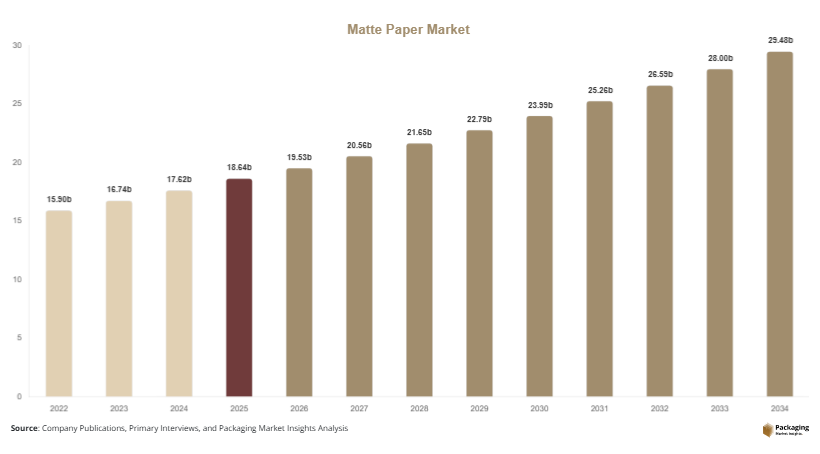
The Matte Paper Market was valued at USD 18.64 billion in 2025 and is projected to reach USD 19.53 billion in 2026. The market is expected to expand to approximately USD 29.48 billion by 2034, registering a compound annual growth rate (CAGR) of 5.28% during the forecast period (2025–2034). Matte paper continues to gain widespread acceptance across commercial printing, publishing, advertising, packaging, educational materials, photography, and premium branding applications due to its non-reflective surface, excellent readability, and premium appearance. Unlike glossy paper, matte paper minimizes glare, making it suitable for catalogs, books, brochures, magazines, business reports, and luxury packaging.
Growing investments in sustainable paper production and environmentally responsible printing solutions are supporting market expansion. Manufacturers are increasingly introducing recyclable and FSC-certified matte paper products to comply with tightening environmental regulations while meeting consumer expectations for sustainable materials. Rising demand for premium printed marketing materials, despite digital transformation, also continues to create stable opportunities across corporate branding and promotional campaigns.
Key Highlights:
- North America dominated the Matte Paper Market with the largest share of 36.24% in 2025.
- Asia Pacific is projected to register the fastest CAGR of 6.81% during the forecast period.
- Based on type, Coated Matte Paper dominated the market with a 58.42% share in 2025.
- Based on application, Commercial Printing accounted for 46.35% of the market in 2025.
- Based on end-use industry, Publishing & Printing held the largest market share of 41.27% in 2025.
- The U.S. Matte Paper Market was valued at USD 4.62 billion in 2025 and is expected to reach USD 4.85 billion in 2026.
Explore more data points, trends and opportunities Download Free Sample Report
Market Drivers
Expansion of Commercial Printing and Publishing Activities
Commercial printing remains one of the largest consumers of matte paper worldwide. Advertising agencies, publishing houses, educational institutions, and corporate organizations continue producing brochures, catalogs, annual reports, books, magazines, and marketing materials that require high readability and professional presentation. Matte paper offers reduced glare and excellent color consistency, making it highly suitable for long-form reading materials. Increasing investments in educational infrastructure and publishing activities across emerging economies further contribute to stable consumption, while modern printing technologies improve production efficiency and reduce operational costs.
Increasing Demand from Premium Consumer Goods Packaging
Luxury goods manufacturers increasingly rely on matte paper packaging to strengthen product differentiation and brand positioning. Cosmetics, electronics, specialty food products, wines, and fashion accessories frequently utilize matte-coated cartons, labels, and inserts to create premium customer experiences. Matte finishes communicate sophistication while enhancing print clarity and tactile quality. Growth in online retail and direct-to-consumer brands has also encouraged companies to invest in attractive packaging that improves customer engagement and repeat purchases. These factors continue supporting sustained expansion across packaging applications.
Market Restraint
Digital Media Adoption Reducing Traditional Printing Volumes
The widespread adoption of digital media continues to restrain portions of the Matte Paper Market, particularly within newspapers, magazines, office printing, and traditional publishing. Businesses increasingly distribute reports, catalogs, brochures, and marketing materials through digital platforms to reduce costs and improve accessibility. Educational institutions are gradually transitioning toward electronic learning resources, reducing demand for printed textbooks in some regions. While premium printing and packaging applications remain resilient, declining demand for conventional print products places pressure on manufacturers that rely heavily on commercial printing volumes. Companies are responding by diversifying into specialty packaging, premium labeling, and sustainable paper grades to offset reductions in traditional paper consumption and maintain long-term profitability.
Market Opportunities
Expansion of Luxury Packaging Across Emerging Economies
Growing middle-class populations and increasing consumer spending on premium products are creating favorable opportunities for matte paper manufacturers. Luxury cosmetics, skincare, gourmet foods, premium beverages, and fashion brands continue expanding throughout Asia Pacific, Latin America, and the Middle East. These industries increasingly require premium packaging materials capable of enhancing product appearance while supporting sustainable branding initiatives. Manufacturers investing in specialty coatings, customized finishes, and environmentally responsible production processes are well positioned to capture rising demand from premium packaging applications.
Technological Innovation in Specialty Paper Manufacturing
Continuous advancements in paper coating technologies are opening opportunities for manufacturers to develop matte papers with enhanced durability, water resistance, print quality, and lightweight characteristics. Smart manufacturing systems improve production efficiency while reducing waste and energy consumption. Digital printing compatibility also enables customized printing, short production runs, and personalized marketing materials. These innovations allow suppliers to expand into new commercial segments, including premium publishing, high-quality photography, specialty labeling, and customized packaging, strengthening long-term market competitiveness.
Report Scope
| Report Metric | Details |
|---|---|
| Market Size in 2025 | USD 18.64 billion |
| Market Size in 2026 | USD 19.53 billion |
| Market Size in 2034 | USD 29.48 billion |
| CAGR | 5.28% (2026-2034) |
| Base Year for Estimation | 2025 |
| Historical Data | 2022-2024 |
| Forecast Period | 2026-2034 |
| Report Coverage | Revenue Forecast, Competitive Landscape, Supply Chain Disruption, Growth Factors, Environment & Regulatory Landscape and Trends |
| Geographies Covered | North America, Europe, APAC, Middle East and Africa, LATAM |
| Countries Covered | U.S., Canada, U.K., Germany, France, Spain, Italy, Russia, Nordic, Benelux, Rest of Europe, China, South Korea, Japan, India, Australia, Singapore, Taiwan, South East Asia, Rest of Asia-Pacific, UAE, Turky, Saudi Arabia, South Africa, Egypt, Nigeria, Rest of MEA, Brazil, Mexico, Argentina, Chile, Colombia, Rest of LATAM |
Explore more data points, trends and opportunities Download Free Sample Report
Segmental Analysis
By Type
Coated Matte Paper dominated the market during 2024 with a 59.18% revenue share. Superior print quality, smooth surface characteristics, improved ink absorption, and premium visual appearance continue driving widespread adoption across publishing, advertising, catalogs, brochures, magazines, and premium packaging applications. Commercial printers favor coated matte paper because it delivers consistent image quality while minimizing glare. Growing demand from luxury consumer goods packaging further strengthens segment leadership as companies prioritize attractive branding and durable packaging materials.
Uncoated Matte Paper is projected to register the fastest CAGR of 5.91% through 2034. Increasing environmental awareness, growing demand for natural paper textures, and expanding educational printing activities continue supporting market growth. Businesses increasingly utilize uncoated paper for notebooks, books, office printing, and environmentally responsible packaging solutions. Manufacturers continue introducing lightweight grades with improved durability and print compatibility, expanding application opportunities across commercial printing and sustainable packaging industries.
By Application
Commercial Printing accounted for the largest market share of 46.82% during 2024. Demand remains strong across brochures, catalogs, annual reports, magazines, promotional materials, and educational publications. Matte paper enhances readability by reducing glare while delivering consistent print quality suitable for professional communication materials. Increasing investments in digital printing infrastructure further strengthen segment growth by enabling cost-effective short production runs and personalized printed materials for businesses.
Packaging Applications are expected to register the fastest CAGR of 6.27% throughout the forecast period. Rapid expansion of e-commerce, luxury retail, cosmetics, and premium food industries continues increasing demand for matte-coated packaging solutions. Brand owners increasingly invest in premium cartons, labels, inserts, and gift packaging that improve consumer experience while supporting sustainable branding objectives. Advanced coating technologies are also enhancing durability and print quality, encouraging broader adoption across packaging markets.
By End-Use Industry
Publishing & Printing represented the largest end-use segment with a 42.14% market share during 2024. Educational institutions, government organizations, publishing houses, advertising agencies, and corporate businesses continue relying on matte paper for books, journals, magazines, reports, catalogs, and instructional materials. Excellent readability, cost efficiency, and compatibility with various printing technologies contribute to sustained market demand despite ongoing digital transformation in selected publishing segments.
Retail & Consumer Goods Packaging is anticipated to witness the fastest CAGR of 6.43% through 2034. Premium product presentation, luxury branding strategies, and growing online retail activities continue supporting demand for matte-coated packaging materials. Consumer goods manufacturers increasingly prefer recyclable matte paper solutions that combine visual appeal with environmental responsibility. Continuous innovation in specialty coatings and premium finishing techniques further expands adoption across cosmetics, electronics, food, beverages, and lifestyle products.
Matte Paper Market Segmentations
Type
- Coated Matte Paper
- Uncoated Matte Paper
Application
- Commercial Printing
- Packaging
- Publishing
- Photography
- Advertising Materials
- Others
End-Use Industry
- Publishing & Printing
- Retail & Consumer Goods
- Food & Beverage
- Healthcare
- Education
- Others
Regional Analysis
North America
North America accounted for 36.24% of the global Matte Paper Market in 2025 and is expected to maintain a healthy CAGR of 4.82% through 2034. Strong commercial printing infrastructure, advanced packaging technologies, and high adoption of premium branded packaging continue supporting market expansion. Demand remains stable across publishing, advertising, educational printing, and luxury packaging applications. Investments in sustainable paper production and digital printing technologies are further strengthening regional competitiveness while encouraging manufacturers to introduce innovative coated paper solutions.
The United States remains the dominant country within North America due to its large publishing industry, sophisticated printing infrastructure, and extensive consumer goods sector. Increasing demand for premium product packaging represents a major regional growth factor. Luxury retail brands continue investing in matte-coated cartons and labels that improve brand image while supporting sustainability objectives. Canada also contributes through environmentally responsible paper manufacturing and expanding exports.
Europe
Europe represented approximately 28.31% of the Matte Paper Market during 2025 and is projected to expand at a CAGR of 4.95% through 2034. Strong environmental regulations continue encouraging manufacturers to produce recyclable and sustainably sourced matte paper. Established publishing industries, premium packaging demand, and high-quality commercial printing services support regional market stability. Investments in energy-efficient manufacturing technologies further strengthen production capabilities while reducing environmental impact across the paper industry.
Germany dominates the European market because of its advanced printing equipment, packaging industry, and strong manufacturing capabilities. Growing demand for environmentally certified packaging materials represents a major regional growth factor. Food, cosmetics, pharmaceutical, and luxury goods manufacturers increasingly utilize premium matte-coated packaging solutions that align with sustainability commitments while maintaining product quality and visual appeal.
Asia Pacific
Asia Pacific held approximately 23.46% of global market revenue in 2025 and is anticipated to record the fastest CAGR of 6.81% through 2034. Rapid industrialization, expanding consumer markets, rising publishing activities, and increasing commercial printing investments continue driving regional demand. The expansion of digital printing facilities and packaging manufacturing industries further supports widespread adoption of matte paper products across diverse commercial applications.
China dominates the Asia Pacific market due to its extensive paper manufacturing capacity and rapidly growing packaging industry. Rising e-commerce activities represent a significant regional growth factor, increasing demand for premium cartons, labels, inserts, and customized packaging materials. India and Southeast Asian countries are also witnessing growing educational printing requirements and expanding commercial advertising activities that support sustained market development.
Middle East & Africa
The Middle East & Africa accounted for around 6.02% of the Matte Paper Market in 2025 and is forecast to register a CAGR of 5.43% through 2034. Improving commercial infrastructure, expanding retail industries, and increasing packaging investments continue creating opportunities across the region. Governments are also encouraging domestic manufacturing activities, stimulating demand for commercial printing and packaging materials suitable for various industries.
Saudi Arabia leads the regional market due to ongoing industrial diversification and expanding consumer goods manufacturing. Growing investments in premium retail packaging represent a major growth factor supporting matte paper demand. Luxury brands, food companies, and cosmetics manufacturers increasingly require visually attractive packaging solutions to strengthen product differentiation while meeting rising consumer expectations for premium presentation.
Latin America
Latin America captured approximately 5.97% of the global Matte Paper Market in 2025 and is expected to grow at a CAGR of 5.18% through 2034. Economic recovery, expanding publishing activities, and rising demand for branded packaging continue supporting regional growth. Local manufacturers are increasing investments in modern printing technologies and environmentally responsible production methods to improve competitiveness within domestic and export markets.
Brazil dominates the Latin American market due to its large packaging industry and established commercial printing sector. Growing food and beverage packaging demand represents a major regional growth factor. Expanding retail distribution networks and increasing consumer spending encourage manufacturers to utilize premium matte paper packaging that enhances product visibility while supporting recyclable packaging initiatives.
Competitive Landscape
The Matte Paper Market remains moderately competitive, with established global paper manufacturers focusing on sustainable production technologies, specialty coatings, and premium packaging applications. Companies continue expanding manufacturing capacity while investing in environmentally responsible production processes to strengthen long-term competitiveness. Product innovation remains a primary competitive strategy as suppliers develop lightweight, recyclable, and high-performance matte paper grades compatible with advanced digital printing technologies.
International Paper Company remains one of the market leaders due to its diversified product portfolio, extensive manufacturing network, and strong presence across commercial printing and packaging markets. A recent development includes expanding investments in sustainable fiber sourcing and premium paper product innovation to address growing demand for environmentally responsible packaging materials. Other leading participants continue strengthening strategic partnerships, production automation, and regional expansion initiatives to improve operational efficiency and customer reach.
Key Players
- International Paper Company
- Stora Enso Oyj
- UPM-Kymmene Corporation
- Mondi plc
- Sappi Limited
- Nippon Paper Industries Co., Ltd.
- Nine Dragons Paper Holdings Limited
- Oji Holdings Corporation
- Asia Pulp & Paper
- Domtar Corporation
- Fedrigoni S.p.A.
- Lecta Group
- Burgo Group S.p.A.
- APPM Limited
- Suzano S.A.