Textile Transfer Paper Market Size
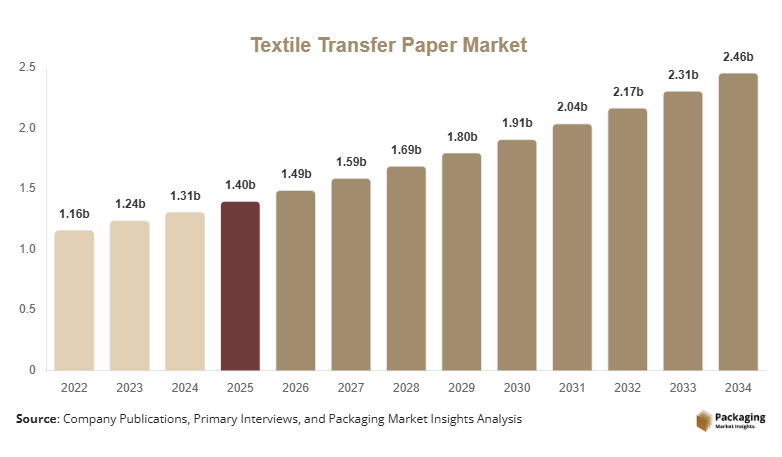
Textile Transfer Paper market size is projected at USD 1.49 billion in 2026 and is expected to hit USD 2.46 billion by 2034 with a CAGR of 6.45%. The market is expanding with rising digital textile printing, customized apparel production, and demand for short-run fabric decoration. This report delivers detailed market sizing, segmentation analysis, production statistics, technology assessment, and competitive landscape for manufacturers and investors.
The textile transfer paper market comprises specialty coated papers used to transfer printed graphics, images, and designs onto textile substrates using heat and pressure. Global production exceeded 8.9 billion transfer paper sheets in 2025, while digital printing accounted for nearly 67% of total demand. Apparel manufacturers represented approximately 58% of total consumption, followed by promotional product producers with 24% and home textile applications with 18%. More than 63% of commercial printing facilities have adopted digital heat transfer technology, reinforcing the textile transfer paper market.
Explore more data points, trends and opportunities Download Free Sample Report
Textile Transfer Paper Trends
Growing Adoption of Digital Textile Printing Technologies
Digital textile printing continues transforming production as over 4.2 billion transfer sheets were processed using inkjet-based systems during 2025. Automated printing equipment improved production efficiency by 23%, while transfer accuracy exceeded 98% across industrial manufacturing lines. More than 61% of textile decorators now utilize digital transfer solutions to reduce inventory and enable mass customization, strengthening the textile transfer paper market.
Demand for eco-friendly coated transfer papers increased by 19% as textile manufacturers adopted recyclable substrates and water-based coatings. Production of sublimation transfer paper exceeded 2.8 billion sheets, supported by polyester apparel growth and sportswear demand. Approximately 47% of new product launches incorporated low-emission coatings and improved color transfer efficiency, supporting continued expansion of the textile transfer paper market.
Textile Transfer Paper Drivers
Rising Demand for Customized Apparel and Promotional Printing
Global customized apparel production surpassed 15 billion garments in 2025, while promotional merchandise printing increased by 14% year-over-year. More than 69% of textile printing companies expanded digital transfer capabilities to meet short-run production requirements. Heat transfer technology reduced setup time by 32% and minimized production waste by 18%, accelerating the textile transfer paper market.
Textile Transfer Paper Restraints
Volatility in Raw Material and Coating Prices
Specialty paper pulp prices increased by approximately 11%, while silicone coating material costs rose by 9% during 2025. Raw material fluctuations affected nearly 34% of manufacturers, increasing production expenses by 7–10%. Rising logistics costs and supply chain disruptions continue creating pricing pressure across the textile transfer paper market.
Textile Transfer Paper Opportunities
Expansion of Sustainable Textile Decoration Solutions
Demand for environmentally friendly textile printing increased by 21%, encouraging investments in recyclable transfer papers and water-based coatings. More than 55% of apparel brands introduced sustainability targets supporting eco-friendly printing materials. Annual investments exceeding USD 340 million in green textile printing technologies present long-term opportunities for the textile transfer paper market.
Challenges in Textile Transfer Paper
Competition from Direct-to-Garment Printing Technologies
Direct-to-garment printing adoption exceeded 38% among commercial textile printers, reducing dependence on traditional transfer paper in selected applications. Equipment investments grew by 17%, while operational costs declined by 15% for high-volume producers. Manufacturers continue improving transfer durability and print quality to maintain competitiveness within the textile transfer paper market.
Report Scope
| Report Metric | Details |
|---|---|
| Market Size in 2025 | USD 1.40 billion |
| Market Size in 2026 | USD 1.49 billion |
| Market Size in 2034 | USD 2.46 billion |
| CAGR | 6.45% (2026-2034) |
| Base Year for Estimation | 2025 |
| Historical Data | 2022-2024 |
| Forecast Period | 2026-2034 |
| Report Coverage | Revenue Forecast, Competitive Landscape, Supply Chain Disruption, Growth Factors, Environment & Regulatory Landscape and Trends |
| Geographies Covered | North America, Europe, APAC, Middle East and Africa, LATAM |
| Countries Covered | U.S., Canada, U.K., Germany, France, Spain, Italy, Russia, Nordic, Benelux, Rest of Europe, China, South Korea, Japan, India, Australia, Singapore, Taiwan, South East Asia, Rest of Asia-Pacific, UAE, Turky, Saudi Arabia, South Africa, Egypt, Nigeria, Rest of MEA, Brazil, Mexico, Argentina, Chile, Colombia, Rest of LATAM |
Explore more data points, trends and opportunities Download Free Sample Report
Textile Transfer Paper Market Segmentation
Sublimation transfer paper dominates with approximately 46% of total revenue due to growing polyester textile production, while apparel & fashion applications account for nearly 58% of global consumption. Continuous product innovation and digital printing adoption remain key factors supporting market expansion.
By Type
Light Transfer Paper accounts for nearly 28% of market demand, with annual production exceeding 2.1 billion sheets. It is widely used for white and light-colored cotton fabrics, delivering high-definition image transfer and wash durability exceeding 40 wash cycles.
Dark Transfer Paper represents approximately 26% of global demand, producing over 1.9 billion sheets annually. Enhanced opacity coatings improve image vibrancy on dark fabrics while maintaining transfer efficiency above 95%.
Sublimation Transfer Paper leads with around 46% market share and production exceeding 4.1 billion sheets. It supports high-resolution printing on polyester textiles with transfer rates exceeding 98%, making it the preferred solution for sportswear and fashion applications.
By Application
Apparel & Fashion holds approximately 58% of the market as customized garments and sportswear production continue expanding. Annual transfer paper consumption exceeds 5.2 billion sheets, with digital printing penetration reaching 71% among leading apparel manufacturers.
Promotional Products contribute nearly 24% of market demand through customized T-shirts, bags, caps, and branded merchandise. Production volumes surpassed 1.8 billion transfer sheets, supported by increasing corporate branding activities.
Home Textiles account for approximately 18% of total demand, including cushions, curtains, bedding, and decorative fabrics. Advanced transfer technologies improve color consistency while reducing production waste by 16%.
Textile Transfer Paper Market Segmentations
Product Type
- Light Transfer Paper
- Dark Transfer Paper
- Sublimation Transfer Paper
Application
- Apparel & Fashion
- Promotional Products
- Home Textiles
Distribution Channel
- Direct Sales
- Industrial Distributors
- Online Sales
- Specialty Printing Suppliers
- Wholesale Dealers
Textile Transfer Paper Regional Outlook
North America
North America accounts for nearly 27% of global revenue, supported by customized apparel production and advanced digital printing infrastructure. The United States contributes approximately 79% of regional demand, while Canada continues expanding commercial textile decoration facilities.
Europe
Europe represents around 25% of the market, with Germany, Italy, France, and the United Kingdom leading textile printing equipment adoption. Sustainable textile manufacturing initiatives have increased eco-friendly transfer paper usage by 18%.
Asia-Pacific
Asia-Pacific dominates with approximately 39% of global demand. China contributes nearly 49% of regional production, while India, Japan, South Korea, and Vietnam continue expanding garment manufacturing and textile exports.
Latin America
Latin America holds about 5% market share, led by Brazil and Mexico. Rising fashion manufacturing and promotional printing activities increased transfer paper consumption by 12% during 2025.
Middle East & Africa
The Middle East & Africa account for approximately 4% of global demand. Growth is supported by expanding textile production, promotional merchandise manufacturing, and investments in digital printing technologies.
Top players in Textile Transfer Paper
- Neenah Coldenhove
- A-SUB
- Hansol Paper
- Dae Ha Co., Ltd.
- Sappi Limited
- Koehler Paper
- Guangdong Guanhao High-Tech Co., Ltd.
- Felix Schoeller Group
- Seiko Epson Corporation
- Jiangyin Allnice Digital Technology Co., Ltd.
- Nekoosa Coated Products
- TransOurDream
- Forever GmbH
- Jetcol Hanks Paper
- PG Paper Company
Neenah Coldenhove
-
Estimated market share of 14%–16% globally.
-
Operates advanced coated transfer paper manufacturing facilities serving more than 80 countries.
-
Strong portfolio of sublimation transfer papers with high ink release efficiency exceeding 98%.
-
Focuses on sustainable coatings, premium quality, and continuous innovation for industrial textile printing applications.
Hansol Paper
-
Estimated global market share of 10%–12%.
-
Recognized for premium transfer papers supporting digital textile printing and commercial graphics.
-
Invests in advanced coating technologies, production automation, and environmentally responsible paper manufacturing.
-
Maintains strong distribution across Asia-Pacific, Europe, and North America through strategic partnerships and continuous product development.