Envelope Paper Market Size
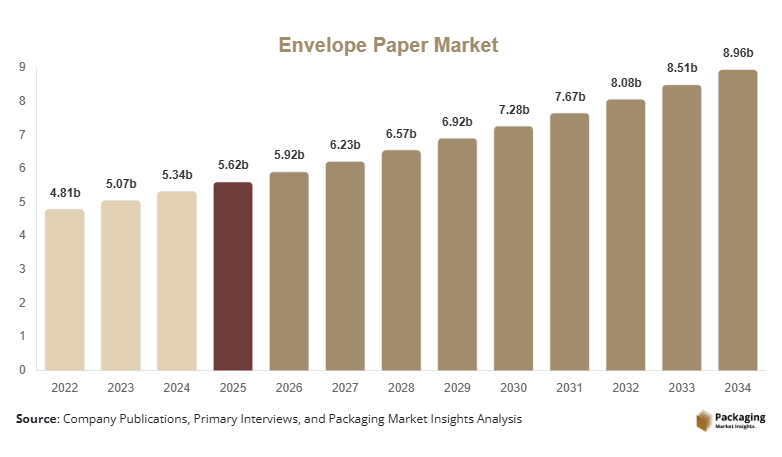
Envelope Paper market size is projected at USD 5.92 billion in 2026 and is expected to hit USD 8.96 billion by 2034 with a CAGR of 5.32%. The market continues to expand with sustained demand from commercial correspondence, government documentation, financial institutions, and premium stationery applications. The report provides comprehensive market data, segmentation analysis, production statistics, technology developments, and competitive landscape assessment.
Envelope paper is a specialty paper manufactured with specific opacity, printability, strength, and folding characteristics for envelope production. Global production surpassed 9.8 million metric tons in 2025, with commercial applications accounting for approximately 52% of total consumption. Recycled fiber utilization exceeded 43%, while automated paper converting lines represented nearly 67% of manufacturing capacity. These developments continue strengthening the envelope paper market.
Explore more data points, trends and opportunities Download Free Sample Report
Envelope Paper Trends
Growing Adoption of Sustainable and Recycled Fiber Papers
Manufacturers are increasing the use of recycled fiber and FSC-certified raw materials to meet environmental regulations and customer preferences. More than 4.2 million metric tons of recycled envelope paper were produced during 2025, while sustainable paper adoption increased by 19%. Premium lightweight grades reduce raw material consumption by approximately 14%, supporting the envelope paper market.
Digital printing compatibility and high-speed paper converting technologies are transforming production capabilities. Nearly 64% of paper mills operate automated finishing systems capable of processing over 350 meters per minute. Demand for customized printed envelopes and branded stationery continues expanding across corporate and institutional sectors, reinforcing the envelope paper market.
Envelope Paper Drivers
Increasing Demand from Commercial and E-commerce Documentation
Business correspondence, legal documentation, banking communications, and e-commerce invoices continue driving paper envelope consumption. More than 82 billion envelopes are used globally every year, while commercial users account for nearly 52% of total demand. Premium envelope paper improves print quality by approximately 28%, supporting envelope paper market growth.
Envelope Paper Restraints
Digital Communication Reducing Conventional Mail Volumes
Growing digitalization and electronic document management systems continue reducing traditional mail usage. Physical business mail volumes have declined by approximately 4–6% annually in several developed economies, while paper prices fluctuated between 9% and 16% over recent years. These factors continue limiting the envelope paper market.
Envelope Paper Opportunities
Expansion of Premium and Eco-Friendly Stationery
Demand for premium stationery, luxury packaging, wedding invitations, and recyclable paper products continues creating growth opportunities. Sales of specialty envelope paper increased by nearly 17%, while investments in sustainable paper manufacturing exceeded USD 2.1 billion globally. These developments create attractive opportunities within the envelope paper market.
Challenges in Envelope Paper
Managing Raw Material Costs and Sustainability Targets
Manufacturers must balance increasing recycled fiber usage while maintaining brightness, printability, and strength. Virgin pulp prices have fluctuated by 12–20%, while environmental compliance costs increased by approximately 10%. Achieving cost efficiency alongside sustainability remains a significant challenge for the envelope paper market.
Report Scope
| Report Metric | Details |
|---|---|
| Market Size in 2025 | USD 5.62 billion |
| Market Size in 2026 | USD 5.92 billion |
| Market Size in 2034 | USD 8.96 billion |
| CAGR | 5.32% (2026-2034) |
| Base Year for Estimation | 2025 |
| Historical Data | 2022-2024 |
| Forecast Period | 2026-2034 |
| Report Coverage | Revenue Forecast, Competitive Landscape, Supply Chain Disruption, Growth Factors, Environment & Regulatory Landscape and Trends |
| Geographies Covered | North America, Europe, APAC, Middle East and Africa, LATAM |
| Countries Covered | U.S., Canada, U.K., Germany, France, Spain, Italy, Russia, Nordic, Benelux, Rest of Europe, China, South Korea, Japan, India, Australia, Singapore, Taiwan, South East Asia, Rest of Asia-Pacific, UAE, Turky, Saudi Arabia, South Africa, Egypt, Nigeria, Rest of MEA, Brazil, Mexico, Argentina, Chile, Colombia, Rest of LATAM |
Explore more data points, trends and opportunities Download Free Sample Report
Envelope Paper Market Segmentation
Wove paper dominates approximately 47% of the market due to its superior printability and smooth finish. Commercial applications account for nearly 52% of total demand because of business correspondence and financial documentation.
By Paper Type
Wove paper accounts for approximately 47% of market revenue with annual production exceeding 4.6 million metric tons. The material offers excellent printability, opacity, and smoothness for premium envelope manufacturing.
Kraft paper represents nearly 31% market share with production exceeding 3 million metric tons annually. It provides high tear resistance, durability, and sustainability for mailing and industrial envelopes.
Recycled paper contributes approximately 22% of market demand. It supports environmental compliance while offering competitive strength and print performance for commercial envelope production.
By End-Use
Commercial applications dominate with approximately 52% market share. More than 5.1 million metric tons of envelope paper are consumed annually by banks, corporate offices, logistics companies, and retailers.
Institutional applications account for approximately 30% of total demand. Government agencies, educational institutions, and healthcare organizations continue using secure paper correspondence.
Personal applications represent nearly 18% of the market, supported by greeting cards, invitations, premium stationery, and direct mail communication.
Envelope Paper Market Segmentations
Paper Type
- Wove Paper
- Kraft Paper
- Recycled Paper
End-Use
- Commercial
- Institutional
- Personal
Distribution Channel
- Direct Sales
- Paper Distributors
- Office Supply Stores
- Online Retail
Envelope Paper Regional Outlook
North America
North America accounts for approximately 30% of global market revenue. The United States and Canada maintain strong commercial mailing infrastructure while producing more than 2.7 million metric tons annually.
Europe
Europe represents nearly 29% of the market. Germany, France, Italy, and the United Kingdom continue investing in sustainable paper manufacturing and recycled fiber technologies.
Asia-Pacific
Asia-Pacific holds approximately 33% market share and remains the fastest-growing regional market. China, India, Japan, and South Korea collectively produce over 3.4 million metric tons of envelope paper annually.
Latin America
Latin America contributes approximately 5% of global demand. Brazil and Mexico lead production with expanding commercial printing and packaging industries.
Middle East & Africa
The Middle East & Africa account for around 3% of the market. Increasing business activities, educational investments, and government communication continue supporting regional demand.
Top players in Envelope Paper Market
- International Paper Company
- Mondi plc
- Stora Enso Oyj
- UPM-Kymmene Corporation
- Sappi Limited
- Nippon Paper Industries Co., Ltd.
- Oji Holdings Corporation
- Sylvamo Corporation
- Domtar Corporation
- Lecta Group
- Fedrigoni S.p.A.
- Mitsubishi Paper Mills Limited
- Asia Pulp & Paper (APP)
- Nine Dragons Paper Holdings Limited
- JK Paper Limited
International Paper Company
-
Holds an estimated 11–13% share of the global market.
-
Operates one of the world's largest paper manufacturing networks with integrated pulp and paper production facilities.
-
Focuses on sustainable forestry, recycled fiber utilization, specialty paper grades, and premium printing papers while supplying envelope manufacturers across North America, Europe, and Asia through advanced converting and distribution capabilities.
Mondi plc
-
Commands approximately 8–10% market share globally.
-
Maintains a diversified portfolio of specialty papers, kraft papers, and sustainable packaging materials.
-
Invests heavily in recyclable paper technologies, energy-efficient production systems, and premium paper innovations while expanding sustainable envelope paper manufacturing capacity across Europe and international markets.