Vacuum Sealing Machine Market Size and Growth
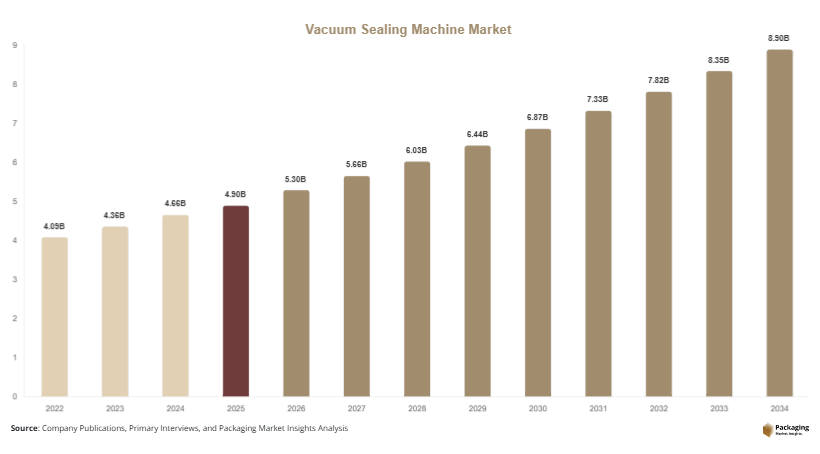
The global vacuum sealing machine market size was valued at approximately USD 4.9 billion in 2025 and is projected to reach USD 5.3 billion in 2026, with expectations to grow to nearly USD 8.9 billion by 2034, registering a compound annual growth rate (CAGR) of 6.7% from 2025 to 2034. Vacuum sealing machines are widely used across food processing, healthcare, electronics, and industrial sectors due to their ability to remove air and prevent contamination, oxidation, and spoilage. The vacuum sealing machine market is experiencing consistent growth as industries and households increasingly prioritize food preservation, product safety, and extended shelf life.
One of the primary growth factors driving the market is the rising demand for packaged and processed food products. Consumers are increasingly seeking convenient and longer-lasting food options, which has led manufacturers to adopt vacuum sealing technologies. This is particularly relevant in urban areas where changing lifestyles and higher disposable incomes are fueling demand for ready-to-eat and frozen food products. Vacuum sealing helps maintain freshness, flavor, and nutritional value, making it a preferred solution for food packaging.
Key Highlights:
- Asia Pacific dominated the market with a 38.1% share in 2025, while Latin America is projected to grow at the fastest CAGR of 7.1%.
- External vacuum sealers led the type segment with a 33.6% share, while chamber vacuum sealers are expected to grow at a CAGR of 6.9%.
- Plastic packaging applications dominated with a 55.2% share, while eco-friendly packaging is forecasted to grow at a CAGR of 6.5%.
- Food & beverage applications led the segment with 47.8% share, while healthcare packaging is expected to grow at a CAGR of 6.8%.
- China remained the dominant country with a market size of USD 1.1 billion in 2025 and USD 1.2 billion in 2026.
Explore more data points, trends and opportunities Download Free Sample Report
Market Trends
Rising Adoption of Smart and Automated Vacuum Sealing Machines
The vacuum sealing machine market is witnessing increased adoption of smart and automated systems that enhance operational efficiency and precision. Manufacturers are integrating digital interfaces, programmable settings, and sensor-based technologies into vacuum sealing machines to optimize performance. These features allow users to control sealing pressure, temperature, and cycle time, ensuring consistent results across applications. Automation is particularly beneficial for large-scale food processing facilities where high throughput is required. Additionally, the integration of Internet of Things (IoT) capabilities enables real-time monitoring and predictive maintenance, reducing downtime and operational costs. This trend is expected to continue as industries seek advanced solutions that improve productivity and quality.
Growing Demand for Compact and Household Vacuum Sealers
There is a noticeable increase in demand for compact vacuum sealing machines designed for household use. Changing consumer lifestyles, coupled with a growing focus on food preservation and waste reduction, are driving this trend. Consumers are increasingly adopting these machines to store perishable items such as meat, vegetables, and leftovers for longer periods. Compact vacuum sealers are designed to be user-friendly, energy-efficient, and space-saving, making them suitable for residential applications. The rising popularity of home cooking and bulk purchasing is further supporting demand. As awareness about food safety and storage continues to grow, the adoption of household vacuum sealing machines is expected to increase steadily.
Market Drivers
Increasing Demand for Processed and Packaged Food
The growing consumption of processed and packaged food products is a major factor driving the vacuum sealing machine market. Urbanization and changing dietary habits have led to increased demand for convenience foods that offer longer shelf life and easy storage. Vacuum sealing machines play a crucial role in preserving food quality by preventing exposure to air and contaminants. Food manufacturers are investing in advanced sealing technologies to meet consumer expectations for freshness and safety. This driver is particularly strong in developing regions where the food processing industry is expanding rapidly.
Expansion of E-Commerce and Cold Chain Logistics
The rapid growth of e-commerce and cold chain logistics is significantly contributing to the demand for vacuum sealing machines. Online food delivery services and retail platforms require reliable packaging solutions to maintain product quality during transportation. Vacuum sealing helps protect products from spoilage and contamination, ensuring that they reach consumers in optimal condition. The expansion of cold storage facilities and refrigerated transportation networks is further supporting this trend. As e-commerce continues to grow, the demand for efficient packaging solutions is expected to increase.
Market Restraint
High Initial Investment and Maintenance Costs
The vacuum sealing machine market faces challenges related to the high initial investment required for advanced equipment and the associated maintenance costs. Industrial-grade vacuum sealing machines are equipped with sophisticated features such as automation and digital controls, which can increase their cost significantly. Small and medium-sized enterprises may find it difficult to invest in such equipment, limiting market penetration. Additionally, regular maintenance and replacement of components such as sealing bars and vacuum pumps can add to operational expenses. For example, food processing units operating on tight budgets may opt for traditional packaging methods instead of investing in advanced vacuum sealing technologies. These cost-related challenges can hinder market growth to some extent.
Market Opportunities
Increasing Adoption in Healthcare and Pharmaceutical Packaging
The growing use of vacuum sealing machines in healthcare and pharmaceutical applications presents significant opportunities for market growth. These machines are used to package medical devices, surgical instruments, and pharmaceutical products in a sterile environment. Vacuum sealing helps prevent contamination and ensures product safety, which is critical in healthcare settings. As the demand for medical products continues to rise, the need for reliable packaging solutions is expected to increase. This creates opportunities for manufacturers to develop specialized vacuum sealing machines tailored to healthcare applications.
Development of Eco-Friendly and Sustainable Packaging Solutions
The shift toward sustainable packaging solutions is creating new opportunities for the vacuum sealing machine market. Manufacturers are developing machines that are compatible with eco-friendly materials such as biodegradable films and recyclable packaging. This aligns with global efforts to reduce environmental impact and promote sustainability. Companies are also focusing on improving energy efficiency and reducing waste during the sealing process. As industries and consumers become more environmentally conscious, the demand for sustainable vacuum sealing solutions is expected to grow.
Report Scope
| Report Metric | Details |
|---|---|
| Market Size in 2025 | USD 4.9 Billion |
| Market Size in 2026 | USD 5.3 Billion |
| Market Size in 2034 | USD 8.9 Billion |
| CAGR | 6.7% (2026-2034) |
| Base Year for Estimation | 2025 |
| Historical Data | 2022-2024 |
| Forecast Period | 2026-2034 |
| Report Coverage | Revenue Forecast, Competitive Landscape, Supply Chain Disruption, Growth Factors, Environment & Regulatory Landscape and Trends |
| Geographies Covered | North America, Europe, APAC, Middle East and Africa, LATAM |
| Countries Covered | U.S., Canada, U.K., Germany, France, Spain, Italy, Russia, Nordic, Benelux, Rest of Europe, China, South Korea, Japan, India, Australia, Singapore, Taiwan, South East Asia, Rest of Asia-Pacific, UAE, Turky, Saudi Arabia, South Africa, Egypt, Nigeria, Rest of MEA, Brazil, Mexico, Argentina, Chile, Colombia, Rest of LATAM |
Explore more data points, trends and opportunities Download Free Sample Report
Segmental Analysis
By Type
External vacuum sealers accounted for the largest share of the vacuum sealing machine market in 2024, holding approximately 33.6% of the total market. These machines are widely used due to their affordability, ease of use, and suitability for both commercial and household applications. They are commonly used for packaging dry and semi-moist food products and are favored by small businesses and residential users. The growing demand for cost-effective packaging solutions is supporting the dominance of this segment. Additionally, advancements in design and functionality are enhancing the performance of external vacuum sealers.
Chamber vacuum sealers are expected to register the fastest growth, with a projected CAGR of 6.9% during the forecast period. These machines are widely used in industrial applications where high efficiency and consistent performance are required. They are capable of handling both solid and liquid products, making them suitable for a wide range of industries. The increasing demand for high-capacity and automated packaging solutions is driving the adoption of chamber vacuum sealers. As industries continue to scale up production, the demand for these machines is expected to increase.
By Application
Plastic packaging applications dominated the vacuum sealing machine market in 2024 with a share of approximately 55.2%. Plastic materials are widely used due to their flexibility, durability, and ability to provide an effective barrier against air and moisture. Vacuum sealing machines are commonly used to package food products in plastic pouches and bags, ensuring extended shelf life and product safety. The widespread use of plastic packaging in the food industry is supporting the growth of this segment.
Eco-friendly packaging applications are expected to grow at the fastest CAGR of 6.5% during the forecast period. The increasing focus on sustainability and environmental regulations is driving the adoption of biodegradable and recyclable materials. Vacuum sealing machines are being adapted to work with these materials, enabling industries to reduce their environmental impact. As consumer awareness about sustainability continues to grow, the demand for eco-friendly packaging solutions is expected to increase.
By End-Use Industry
The food & beverage industry dominated the vacuum sealing machine market in 2024 with a share of approximately 47.8%. The need to preserve food quality and extend shelf life is driving the adoption of vacuum sealing technologies in this sector. These machines are widely used for packaging meat, seafood, dairy products, and ready-to-eat meals. The growth of the food processing industry is further supporting this trend.
The healthcare sector is expected to grow at the fastest CAGR of 6.8% during the forecast period. The increasing demand for sterile packaging solutions for medical devices and pharmaceutical products is driving the adoption of vacuum sealing machines in this industry. These machines help maintain product integrity and prevent contamination, making them essential for healthcare applications. As the healthcare sector continues to expand, the demand for vacuum sealing machines is expected to increase.
Vacuum Sealing Machine Market Segmentations
By Type
- External Vacuum Sealers
- Chamber Vacuum Sealers
- Double Chamber Vacuum Sealers
- Tray Sealing Machines
By Application
- Plastic Packaging
- Eco-Friendly Packaging
- Modified Atmosphere Packaging
By End-Use Industry
- Food & Beverage
- Healthcare
- Electronics
- Industrial
Regional Analysis
North America
North America accounted for approximately 24.8% of the global vacuum sealing machine market share in 2025 and is projected to grow at a CAGR of 6.2% during the forecast period. The region benefits from a well-established food processing industry and advanced packaging technologies. The increasing demand for convenience foods and ready-to-eat meals is driving the adoption of vacuum sealing machines.
The United States dominates the regional market due to its large consumer base and strong industrial infrastructure. A key growth factor is the increasing focus on reducing food waste, which is encouraging the use of vacuum sealing technologies in households and commercial establishments. This trend is expected to drive market growth in the region.
Europe
Europe held a market share of around 22.1% in 2025 and is expected to grow at a CAGR of 6.0%. The region is characterized by strict food safety regulations and a strong emphasis on sustainability. These factors are driving the adoption of advanced packaging solutions, including vacuum sealing machines.
Germany leads the European market due to its strong food processing and manufacturing sectors. A unique growth factor is the increasing demand for eco-friendly packaging solutions, which is encouraging the use of vacuum sealing technologies that are compatible with sustainable materials.
Asia Pacific
Asia Pacific dominated the market with a 38.1% share in 2025 and is expected to grow at the highest CAGR of 7.0%. Rapid urbanization, rising disposable incomes, and expanding food processing industries are key factors driving market growth in this region.
China is the leading country in the region, supported by its large population and growing industrial base. A unique growth factor is the rapid expansion of the e-commerce sector, which is increasing the demand for efficient packaging solutions. This is driving the adoption of vacuum sealing machines across industries.
Middle East & Africa
The Middle East & Africa region accounted for approximately 7.3% of the market share in 2025 and is projected to grow at a CAGR of 6.1%. The growth is supported by increasing investments in food processing and packaging industries.
Saudi Arabia is a key contributor to the regional market, driven by its focus on food security and industrial development. A unique growth factor is the increasing demand for packaged food products, which is driving the adoption of vacuum sealing machines in the region.
Latin America
Latin America held a market share of around 7.7% in 2025 and is expected to grow at the fastest CAGR of 7.1%. The region is witnessing growth in food processing and retail sectors, which is driving demand for packaging solutions.
Brazil dominates the regional market due to its expanding food industry. A unique growth factor is the increasing penetration of organized retail, which is boosting demand for packaged food products and supporting the adoption of vacuum sealing machines.
Competitive Landscape
The vacuum sealing machine market is moderately competitive, with several global and regional players focusing on product innovation, quality, and pricing strategies. Companies are investing in advanced technologies to enhance the performance and efficiency of their machines. The market is characterized by the presence of both established manufacturers and emerging players offering specialized solutions.
Multivac Group is a leading company in the market, known for its extensive range of vacuum sealing machines and strong global presence. The company recently introduced a new line of energy-efficient machines designed to reduce operational costs and improve sustainability. Other key players are also focusing on expanding their product portfolios and strengthening their distribution networks. Strategic collaborations and technological advancements are expected to shape the competitive landscape in the coming years.
Key Players List
- Multivac Group
- Sealed Air Corporation
- Henkelman BV
- Ulma Packaging
- Henkovac International
- Promarks Vac Corporation
- Sammic Group
- Sipromac Inc.
- Koch Equipment LLC
- PAC Machinery
- VacMaster
- Orved S.p.A.
- Webomatic Maschinenfabrik GmbH
- Bizerba SE & Co. KG
- Fuji Machinery Co., Ltd.