Market Overview
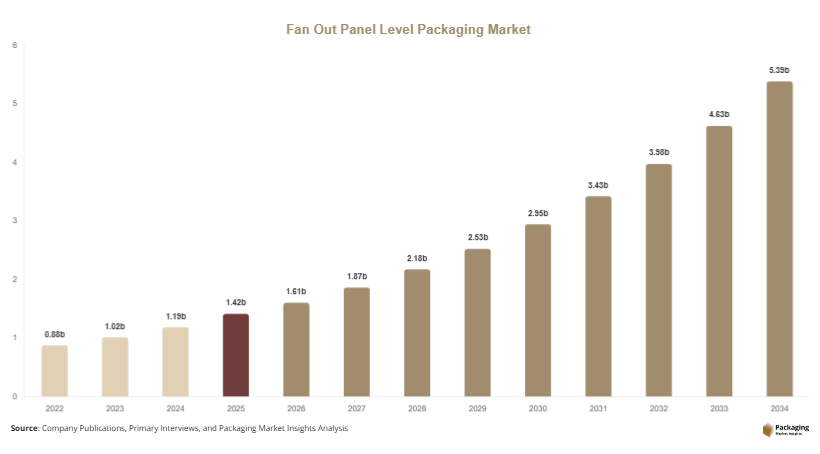
The global fan out panel level packaging market size was valued at USD 1.42 billion in 2025 and is estimated to reach USD 1.61 billion in 2026, reflecting steady momentum as semiconductor manufacturers shift toward panel-based formats for advanced chip integration. The fan out panel level packaging market is projected to expand from USD 1.61 billion in 2026 to USD 5.38 billion by 2034, registering a compound annual growth rate (CAGR) of 16.3% during the forecast period 2025 to 2034. This growth trajectory is supported by rising demand for miniaturized, high-performance electronic devices across smartphones, automotive electronics, wearables, and high-performance computing applications.
Fan out panel level packaging, often referred to by the acronym FOPLP, is an advanced semiconductor packaging technique that redistributes chip interconnections across large rectangular panels rather than smaller circular wafers. This approach allows manufacturers to process more chips per production run, lower per-unit costs, and achieve finer input/output density without the size constraints associated with traditional wafer level packaging. As electronic devices continue to demand thinner form factors and higher processing power, panel level formats are gaining traction among original equipment manufacturers and outsourced semiconductor assembly and test providers alike.
Key Highlights:
- Asia Pacific dominated the fan out panel level packaging market with the largest share of 46.28% in 2025.
- North America is expected to be the fastest-growing region in the fan out panel level packaging market during the forecast period at a CAGR of 18.14%.
- Based on packaging type, the chip first fan out segment dominated the market with a share of 52.61% in 2025.
- Based on panel size, the 600mm x 600mm segment dominated the market with a share of 38.47% in 2025.
- Based on application, the consumer electronics segment dominated the market with a share of 44.92% in 2025.
- Based on end use, the integrated device manufacturers segment dominated the market with 41.73% in 2025.
- The US fan out panel level packaging market size was valued at USD 0.31 billion in 2025 and is projected to reach USD 0.36 billion in 2026.
Explore more data points, trends and opportunities Download Free Sample Report
Market Trends
Shift Toward Larger Panel Formats for Cost Efficiency
Semiconductor packaging houses are increasingly transitioning from smaller substrate sizes toward larger rectangular panels, including 600mm x 600mm and beyond, to maximize the number of dies processed per cycle. This shift mirrors the economies of scale achieved in the display and printed circuit board industries decades earlier. Larger panels reduce material waste at the panel edges and improve throughput, which lowers the effective cost per package. Equipment manufacturers are responding by developing new lithography, molding, and inspection tools calibrated for these expanded dimensions, further reinforcing this trend across the fan out panel level packaging market as suppliers race to standardize panel handling infrastructure.
Integration of Heterogeneous Chiplets in Panel Formats
Chip designers are embracing heterogeneous integration, combining logic, memory, and radio frequency components onto a single package using chiplet architectures. Fan out panel level packaging is well suited for this approach because its larger surface area accommodates multiple dies with varied functions while maintaining tight interconnect pitch. This trend is particularly visible in high-performance computing and artificial intelligence accelerators, where combining specialized chiplets reduces overall system cost compared with monolithic designs. As chiplet standardization initiatives gain industry backing, panel level formats are positioned to become a preferred platform for next-generation multi-die packaging strategies.
Market Drivers
Rising Demand for Compact and High-Density Consumer Electronics
Consumer preference for slimmer smartphones, tablets, and wearable devices continues to push component manufacturers toward packaging solutions that reduce footprint without sacrificing performance. Fan out panel level packaging enables redistribution layers that eliminate the need for traditional substrates, resulting in thinner packages with shorter electrical pathways. This directly supports faster signal transmission and reduced power consumption, both of which are priorities for battery-powered devices. As global smartphone replacement cycles stabilize around premium feature sets, manufacturers are prioritizing packaging technologies capable of supporting advanced camera modules, biometric sensors, and 5G radios within limited internal space, reinforcing sustained demand for panel level solutions.
Expansion of Automotive Electronics and Electrification
The global shift toward electric vehicles and advanced driver assistance systems has significantly increased the semiconductor content per vehicle. Modern vehicles now incorporate sensors, radar modules, and processing units that require packaging capable of withstanding thermal cycling and vibration while maintaining electrical reliability. Fan out panel level packaging offers improved thermal dissipation characteristics compared with conventional wire bonding approaches, making it attractive for power management and sensor fusion applications in vehicles. As automakers accelerate electrification roadmaps and regulatory bodies tighten emissions and safety standards, demand for automotive-grade panel level packaged components is expected to grow at a pace exceeding overall semiconductor market growth.
Market Restraints
High Capital Investment and Yield Management Challenges
Establishing fan out panel level packaging production lines requires substantial capital expenditure for specialized equipment, including panel-compatible molding presses, lithography systems, and metrology tools that differ from those used in conventional wafer processing. Many existing packaging facilities were designed around circular wafer formats, meaning manufacturers must either retrofit existing lines or construct new facilities entirely, both of which carry significant upfront costs. Beyond capital requirements, panel level processes introduce yield management complexities, particularly around warpage control. Larger rectangular panels are more prone to bowing during thermal processing steps than smaller circular wafers, which can lead to alignment errors during lithography and reduce overall yield. Addressing warpage requires precise control of mold compound formulations, curing profiles, and panel carrier systems, adding engineering overhead to production. For example, packaging providers transitioning from 300mm wafer lines to panel formats have reported extended qualification timelines as they refine process parameters to achieve yields comparable to mature wafer level packaging. These technical and financial barriers can slow adoption among smaller assembly and test providers that lack the resources to absorb extended ramp-up periods, potentially limiting near-term market penetration despite strong underlying demand from end applications.
Market Opportunities
Growth in High-Performance Computing and Data Center Applications
The expansion of cloud computing infrastructure and artificial intelligence workloads is creating substantial opportunity for panel level packaging providers to serve high-performance computing customers. These applications demand packages capable of supporting high input/output counts, superior thermal management, and multi-die integration for processors and accelerators. Panel level formats provide the surface area needed to accommodate these complex architectures more efficiently than traditional wafer level approaches. As hyperscale data center operators continue investing in custom silicon to optimize workload-specific performance, packaging providers that can demonstrate reliability at scale for high-performance computing applications stand to capture a growing share of this premium segment over the coming decade.
Development of Standardized Panel Ecosystems and Equipment Interoperability
The absence of universally standardized panel sizes and handling protocols has historically fragmented the fan out panel level packaging supply chain. Industry consortiums and equipment manufacturers are now collaborating to establish common panel dimensions, carrier designs, and process interfaces that would allow packaging providers to source equipment from multiple vendors without compatibility concerns. This standardization effort presents an opportunity for equipment suppliers, material providers, and packaging houses to reduce qualification costs and accelerate capacity expansion. Companies that participate early in shaping these standards may secure favorable positioning as the broader ecosystem matures, lowering barriers to entry for new market participants and supporting faster overall market expansion.
Report Scope
| Report Metric | Details |
|---|---|
| Market Size in 2025 | USD 1.42 billion |
| Market Size in 2026 | USD 1.61 billion |
| Market Size in 2034 | USD 5.38 billion |
| CAGR | 16.3% (2026-2034) |
| Base Year for Estimation | 2025 |
| Historical Data | 2022-2024 |
| Forecast Period | 2026-2034 |
| Report Coverage | Revenue Forecast, Competitive Landscape, Supply Chain Disruption, Growth Factors, Environment & Regulatory Landscape and Trends |
| Geographies Covered | North America, Europe, APAC, Middle East and Africa, LATAM |
| Countries Covered | U.S., Canada, U.K., Germany, France, Spain, Italy, Russia, Nordic, Benelux, Rest of Europe, China, South Korea, Japan, India, Australia, Singapore, Taiwan, South East Asia, Rest of Asia-Pacific, UAE, Turky, Saudi Arabia, South Africa, Egypt, Nigeria, Rest of MEA, Brazil, Mexico, Argentina, Chile, Colombia, Rest of LATAM |
Explore more data points, trends and opportunities Download Free Sample Report
Segmental Analysis
By Packaging Type
The chip first fan out segment dominated the fan out panel level packaging market with a share of 52.61% in 2025. In this approach, individual dies are placed onto a temporary carrier before the redistribution layers and mold compound are applied, allowing manufacturers to visually inspect and test known good dies prior to full panel processing. This method has become the preferred approach among established packaging providers because it reduces the risk of scrapping an entire panel due to a single defective die, thereby improving overall yield economics. The segment's dominance is further reinforced by its compatibility with existing wire bonding and flip chip assembly infrastructure, which lowers the barrier to adoption for packaging houses transitioning from wafer level to panel level formats, particularly for high-volume consumer electronics applications where cost control remains a priority consideration.
The chip last fan out segment is projected to expand at the fastest CAGR of 19.82% through 2034. This growth is attributed to the segment's superior electrical performance characteristics, since redistribution layers are formed before die attachment, allowing for finer line and space geometries that support higher input/output density. Chip last approaches are gaining preference among high-performance computing and artificial intelligence chip developers that require superior signal integrity for multi-die packages. As demand grows for packages capable of supporting increasingly complex chiplet architectures, packaging providers are investing in chip last process capabilities to capture this premium, high-growth segment of the market.
By Panel Size
The 600mm x 600mm panel size segment dominated the fan out panel level packaging market with a share of 38.47% in 2025, reflecting its establishment as an early standardized format adopted by leading packaging providers during initial capacity build-outs. This panel size strikes a practical balance between manufacturing throughput gains and compatibility with existing equipment designed for moderate scale operations. Packaging houses that invested early in 600mm x 600mm capable equipment have been able to serve a broad range of customers across consumer electronics and automotive applications without requiring further capital investment, contributing to the segment's continued relevance despite the emergence of larger panel formats now entering commercial qualification.
The larger panel size segment, encompassing formats exceeding 600mm x 600mm, is expected to register the fastest CAGR of 21.35% during the forecast period. Equipment manufacturers have introduced tools capable of handling these expanded dimensions, enabling packaging providers to further reduce per-unit costs through improved area utilization. Growth in this segment is closely tied to capacity expansion decisions by major packaging providers seeking to serve high-volume consumer electronics and emerging high-performance computing customers simultaneously. As warpage control techniques continue to mature for larger formats, adoption is expected to accelerate meaningfully across the latter half of the forecast period.
By Application
The consumer electronics segment dominated the fan out panel level packaging market with a share of 44.92% in 2025, driven by sustained global demand for smartphones, tablets, and wearable devices that require compact, high-density packaging solutions. Smartphone application processors, power management integrated circuits, and radio frequency front-end modules represent the primary drivers of demand within this segment, as device manufacturers continue prioritizing thinner form factors and extended battery life. The segment's continued dominance reflects the maturity of consumer electronics supply chains and the established relationships between panel level packaging providers and major device brands, which support consistent order volumes even as growth rates in other application segments begin to accelerate more rapidly.
The automotive electronics segment is projected to expand at the fastest CAGR of 20.64% through 2034, supported by rising semiconductor content per vehicle associated with electrification and advanced driver assistance systems. Growth in this segment is driven by increasing adoption of radar sensors, battery management systems, and power electronics modules that benefit from the improved thermal performance characteristics of panel level packaging. As automotive original equipment manufacturers continue to qualify new suppliers capable of meeting stringent reliability standards, packaging providers with established automotive-grade certification are well positioned to capture a growing share of this expanding application segment over the forecast period.
Fan Out Panel Level Packaging Market Segmentations
Packaging Type
- Chip First Fan Out
- Chip Last Fan Out
Panel Size
- Below 600mm x 600mm
- 600mm x 600mm
- Above 600mm x 600mm
Application
- Consumer Electronics
- Automotive Electronics
- High-Performance Computing
- Telecommunications
- Industrial Electronics
End Use
- Integrated Device Manufacturers
- Outsourced Semiconductor Assembly and Test Providers
- Fabless Semiconductor Companies
Regional Analysis
North America
North America accounted for a notable share of the fan out panel level packaging market in 2025 and is anticipated to expand at a CAGR of 18.14% through 2034, the fastest pace among all regions. This growth is underpinned by substantial investment in domestic semiconductor manufacturing capacity, supported by government incentive programs aimed at reducing reliance on overseas packaging and assembly services for critical electronics supply chains.
The United States leads the North American market, driven by strong demand from high-performance computing, artificial intelligence hardware developers, and defense electronics manufacturers. A unique growth factor for the region is the presence of major fabless semiconductor design companies headquartered in the United States that are actively qualifying panel level packaging partners to shorten supply chains and reduce dependence on distant packaging hubs.
Europe
Europe held a moderate share of the fan out panel level packaging market in 2025, with growth expected to progress steadily through 2034 as regional semiconductor initiatives gain traction. The European Union's continued focus on strengthening domestic chip production capabilities is gradually extending into advanced packaging investment, supporting incremental capacity additions across the region.
Germany dominates the European market, reflecting its established automotive electronics and industrial semiconductor base. A unique growth factor for Germany is its concentration of automotive tier-one suppliers that require locally sourced, automotive-qualified packaging solutions to meet stringent regional content and traceability requirements tied to vehicle electrification programs.
Asia Pacific
Asia Pacific dominated the fan out panel level packaging market with the largest share of 46.28% in 2025, supported by the region's dense concentration of semiconductor foundries, outsourced assembly and test providers, and consumer electronics manufacturers. The region is projected to maintain strong growth throughout the forecast period as production capacity continues to expand.
Taiwan leads the Asia Pacific market, given its position as home to some of the world's largest semiconductor packaging and foundry operations. A unique growth factor for Taiwan is the close geographic proximity between chip fabrication and packaging facilities, which streamlines logistics and enables faster qualification cycles for new panel level packaging technologies entering commercial production.
Middle East & Africa
The Middle East & Africa region represented a comparatively small share of the fan out panel level packaging market in 2025, though growth prospects are improving as regional governments pursue economic diversification strategies that include technology manufacturing. Growth is expected to remain gradual but consistent through 2034.
The United Arab Emirates leads regional activity, reflecting its efforts to position itself as a technology and logistics hub. A unique growth factor for the country is targeted investment in digital infrastructure and data center construction, which is generating downstream demand for advanced semiconductor components sourced through international packaging supply chains.
Latin America
Latin America accounted for a modest portion of the fan out panel level packaging market in 2025, with expansion anticipated at a measured pace through 2034. Regional demand is largely tied to consumer electronics assembly and growing telecommunications infrastructure investment across major economies.
Brazil dominates the Latin American market, supported by its sizable electronics assembly sector. A unique growth factor for Brazil is government-backed programs encouraging local electronics manufacturing content, which is prompting global device makers to seek regional packaging and component sourcing partnerships to meet domestic production requirements.
Competitive Landscape
The fan out panel level packaging market features a mix of established outsourced semiconductor assembly and test providers, integrated device manufacturers with in-house packaging capabilities, and equipment suppliers developing panel-compatible production tools. Competition centers on process yield improvement, panel size scalability, and the ability to offer automotive and high-performance computing qualified solutions. Leading providers continue to expand capacity through new facility construction and strategic partnerships with equipment manufacturers to accelerate qualification timelines for larger panel formats.
Among market participants, one leading provider recently announced the commissioning of a new production line dedicated to large-format panel processing, aimed at serving growing demand from high-performance computing customers. This expansion reflects a broader industry pattern of capacity investment as providers position themselves to capture demand associated with artificial intelligence hardware and next-generation consumer electronics, while smaller providers pursue niche specialization in automotive-grade or high-reliability packaging segments to differentiate themselves from larger competitors with broader service portfolios.
Key Players
- Taiwan Semiconductor Manufacturing Company
- ASE Technology Holding
- Amkor Technology
- JCET Group
- Powertech Technology
- Samsung Electro-Mechanics
- Deca Technologies
- Nepes Corporation
- SPIL (Siliconware Precision Industries)
- STATS ChipPAC
- Fujitsu Limited
- Infineon Technologies
- Tongfu Microelectronics
- Unisem Group
- King Yuan Electronics
- Chipbond Technology Corporation
- Walton Advanced Engineering