Diaper Packaging Machines Market Size
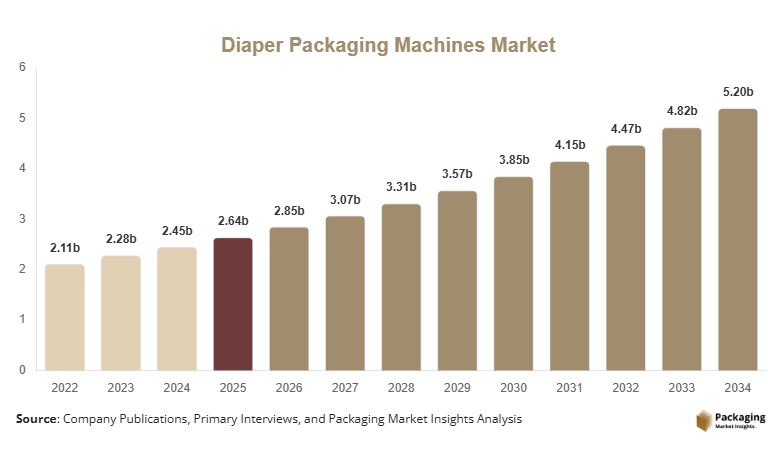
Diaper Packaging Machines market size is projected at USD 2.85 billion in 2026 and is expected to hit USD 5.21 billion by 2034 with a CAGR of 7.8%.” The market expansion is supported by rising disposable hygiene product consumption, automation adoption in manufacturing facilities, and increasing demand for high-speed packaging solutions. The report provides detailed segmentation, production analysis, competitive landscape evaluation, technology trends, and regional insights covering historical years 2022–2024 and forecast period 2026–2034.
The diaper packaging machines market refers to industrial equipment used for packing disposable diapers, baby care products, adult incontinence products, and hygiene articles into bags, cartons, and flexible packaging formats. Global diaper production exceeded 300 billion units annually, with automated packaging systems accounting for nearly 65% of new machine installations in 2025. Asia-Pacific contributes more than 45% of global diaper manufacturing output, driven by China, India, and Southeast Asian countries. Manufacturers are increasingly adopting servo-controlled systems, robotics, and smart monitoring technologies, with approximately 70% of large-scale hygiene product producers integrating automated packaging lines. These developments are strengthening the overall diaper packaging machines market.
Explore more data points, trends and opportunities Download Free Sample Report
Diaper Packaging Machines Trends
Automation and Smart Packaging Integration
The adoption of fully automatic diaper packaging machines is increasing due to higher production efficiency and reduced labor dependency. In 2025, more than 65% of newly installed diaper packaging equipment featured automated feeding, counting, sealing, and quality inspection systems. Advanced machines can process 400–1,200 diaper packs per minute, improving manufacturing throughput by 25–40% compared with conventional systems. Industry players are integrating IoT-enabled monitoring, artificial intelligence-based defect detection, and predictive maintenance technologies, with smart packaging adoption estimated at 35% among premium hygiene manufacturers. These technology shifts continue to drive diaper packaging machines market growth.
Rising Demand for Sustainable Packaging Solutions
Sustainability trends are influencing diaper packaging equipment development as manufacturers shift toward recyclable films and lightweight packaging materials. Around 40% of hygiene product producers introduced eco-friendly packaging formats between 2023 and 2025, increasing demand for flexible packaging-compatible machines. New-generation equipment supports bio-based films, thinner polyethylene structures, and reduced material consumption by 10–20%. Growing diaper consumption, exceeding 350 billion units globally by 2030 projections, is creating strong demand for efficient and sustainable diaper packaging machines.
Diaper Packaging Machines Drivers
Increasing Global Demand for Disposable Hygiene Products
Rising demand for baby diapers and adult incontinence products is the primary driver of the diaper packaging machines market. Global diaper consumption increased by approximately 6% annually between 2022 and 2025, supported by population growth, urbanization, and improved hygiene awareness. Baby diaper manufacturers operating large-scale facilities require machines capable of packaging more than 500 million units annually per production line. Emerging markets contribute nearly 50% of incremental demand, encouraging manufacturers to invest in high-speed automated packaging systems.
Diaper Packaging Machines Restraints
High Initial Investment and Maintenance Costs
The high capital requirement for advanced diaper packaging machines limits adoption among small and medium manufacturers. Fully automated systems typically require investments ranging from USD 500,000 to USD 3 million depending on capacity and configuration. Maintenance expenses can represent 5–8% of annual operating costs due to precision components, software systems, and mechanical parts. Manufacturers in developing economies often prefer semi-automatic solutions due to lower upfront costs, creating challenges for rapid automation adoption.
Diaper Packaging Machines Opportunities
Expansion of Hygiene Product Manufacturing in Emerging Economies
Emerging markets present significant opportunities for diaper packaging machines manufacturers due to increasing hygiene product penetration. Countries across Asia-Pacific, Latin America, and Africa are witnessing diaper adoption growth rates of 8–12% annually. India and Southeast Asia together account for more than 1.5 billion potential consumers requiring affordable hygiene products. Investments in new diaper manufacturing facilities exceeding USD 5 billion globally during 2024–2026 are expected to increase demand for advanced packaging equipment.
Challenges in Diaper Packaging Machines
Complexity in Handling Sustainable and Lightweight Materials
The transition toward recyclable and lightweight packaging materials creates operational challenges for diaper packaging machine manufacturers. Approximately 30–40% of new packaging films require machine adjustments due to different thickness, flexibility, and sealing characteristics. Manufacturers must develop equipment capable of handling multiple materials while maintaining production speeds above 800 packs per minute. Balancing sustainability requirements with operational efficiency remains a major challenge for the diaper packaging machines market.
Report Scope
| Report Metric | Details |
|---|---|
| Market Size in 2025 | USD 2.64 billion |
| Market Size in 2026 | USD 2.85 billion |
| Market Size in 2034 | USD 5.21 billion |
| CAGR | 7.8% (2026-2034) |
| Base Year for Estimation | 2025 |
| Historical Data | 2022-2024 |
| Forecast Period | 2026-2034 |
| Report Coverage | Revenue Forecast, Competitive Landscape, Supply Chain Disruption, Growth Factors, Environment & Regulatory Landscape and Trends |
| Geographies Covered | North America, Europe, APAC, Middle East and Africa, LATAM |
| Countries Covered | U.S., Canada, U.K., Germany, France, Spain, Italy, Russia, Nordic, Benelux, Rest of Europe, China, South Korea, Japan, India, Australia, Singapore, Taiwan, South East Asia, Rest of Asia-Pacific, UAE, Turky, Saudi Arabia, South Africa, Egypt, Nigeria, Rest of MEA, Brazil, Mexico, Argentina, Chile, Colombia, Rest of LATAM |
Explore more data points, trends and opportunities Download Free Sample Report
Diaper Packaging Machines Market Segmentation
The diaper packaging machines market segmentation is categorized based on machine type and application. Automatic machines dominate with nearly 65% market share due to their high-speed capabilities and integration with large-scale production lines. Application-wise, baby diapers account for approximately 70% of demand, while adult diapers and incontinence products represent rapidly growing segments with 10–15% annual expansion rates.
By Type
Automatic Diaper Packaging Machines
Automatic diaper packaging machines represent the largest segment, contributing nearly 65% of total market revenue in 2025. These machines are capable of processing 600–1,200 packs per minute with integrated robotic handling, automated counting, and digital controls. Large manufacturers producing more than 1 billion diapers annually prefer automatic systems due to efficiency improvements of 30–50%. Increasing adoption of Industry 4.0 technologies and smart sensors is further strengthening this segment.
Semi-Automatic Diaper Packaging Machines
Semi-automatic machines account for around 25% market share and are widely used by medium-sized diaper manufacturers. These systems operate at production speeds of 200–600 packs per minute and require partial manual intervention. Their lower investment cost of approximately USD 100,000–700,000 makes them suitable for regional producers. Demand is increasing in developing countries where manufacturers prioritize cost efficiency and flexible production capabilities.
Manual Diaper Packaging Machines
Manual diaper packaging machines represent approximately 10% market share and are primarily used by small-scale producers. These systems generally handle below 200 packs per minute and require higher labor involvement. Despite limited automation, demand remains stable in emerging economies due to lower acquisition costs and simpler maintenance requirements.
By Application
Baby Diapers
Baby diapers represent the dominant application segment with nearly 70% market share. Global baby diaper production surpassed 250 billion units annually, requiring high-speed packaging equipment for efficient distribution. Packaging machines used in this segment support multiple pack sizes ranging from 10 to 80 diapers per package and improve packaging accuracy by more than 95%. Growing birth rates in developing economies and increasing premium diaper adoption continue to support demand.
Adult Diapers
Adult diapers account for approximately 20% market share and represent one of the fastest-growing applications. Aging populations in Japan, Europe, China, and North America are increasing demand for incontinence products. Production volumes exceeded 50 billion adult hygiene units globally, creating demand for specialized packaging systems capable of handling larger product dimensions and absorbent materials.
Incontinence Products
Incontinence products contribute nearly 10% of market revenue and are gaining adoption due to healthcare awareness and elderly care requirements. Packaging machines for these products provide customized sealing, compression packaging, and moisture protection features. The segment is expected to grow at more than 8% CAGR through 2034 due to rising healthcare expenditure and institutional demand.
Diaper Packaging Machines Market Segmentations
Machine Type
- Automatic Diaper Packaging Machines
- Semi-Automatic Diaper Packaging Machines
- Manual Diaper Packaging Machines
Application
- Baby Diapers
- Adult Diapers
- Incontinence Products
Technology
- Servo-Based Packaging Systems
- Robotic Packaging Systems
- IoT-Enabled Smart Packaging Machines
- Conventional Packaging Systems
End-User
- Large-Scale Hygiene Product Manufacturers
- Medium-Sized Diaper Producers
- Small-Scale Manufacturers
Diaper Packaging Machines Regional Outlook
Asia-Pacific
Asia-Pacific dominates the diaper packaging machines market with approximately 45% share in 2025. China contributes nearly 30% of regional production, followed by India, Japan, and Southeast Asian countries. The region produces more than 150 billion diaper units annually and continues to attract investments in automated hygiene manufacturing facilities. Rising disposable income and increasing urban populations are accelerating packaging equipment adoption.
North America
North America accounts for nearly 25% market share, supported by advanced automation adoption and strong demand for premium hygiene products. The United States represents more than 80% of regional demand, with manufacturers focusing on robotic packaging systems and sustainable packaging technologies. More than 70% of large diaper production facilities in the region utilize automated packaging solutions.
Europe
Europe holds approximately 20% market share due to strong sustainability regulations and demand for recyclable packaging systems. Germany, Italy, and France are major contributors, accounting for more than 60% of regional machine installations. Manufacturers are investing in energy-efficient equipment that reduces material waste by 15–25%.
Latin America and Middle East & Africa
Latin America and Middle East & Africa collectively represent around 10% market share. Brazil, Mexico, Saudi Arabia, and South Africa are witnessing increased hygiene product penetration. Regional diaper consumption is growing at 7–10% annually, supporting investments in affordable semi-automatic and automatic packaging machinery.
Top players in Diaper Packaging Machines
- R.A Jones
- Syntegon Technology GmbH
- Coesia S.p.A.
- Focke & Co.
- IMA Group
- Optima Packaging Group GmbH
- PackSys Global AG
- ACMI SpA
- Fuji Machinery Co., Ltd.
- ProMach
- Marchesini Group
- Delta Packaging Machinery
Syntegon Technology GmbH
-
Holds a strong position in automated hygiene packaging solutions with significant adoption among global diaper manufacturers.
-
The company focuses on high-speed systems capable of packaging more than 1,000 units per minute.
-
Its advanced technologies support flexible packaging formats, sustainability requirements, and digital monitoring solutions.
-
Estimated industry positioning accounts for a notable share of premium automated diaper packaging equipment demand.
Coesia S.p.A.
-
Coesia maintains a competitive position through integrated packaging automation technologies and global manufacturing capabilities.
-
The company provides customized diaper packaging systems with production efficiencies improving operational output by 30% or more.
-
Its solutions are widely adopted by multinational hygiene product manufacturers across Europe, North America, and Asia-Pacific.
-
The company continues investing in robotics, automation software, and sustainable packaging compatibility.