Pallet Stretch Wrapping Machines Market Size
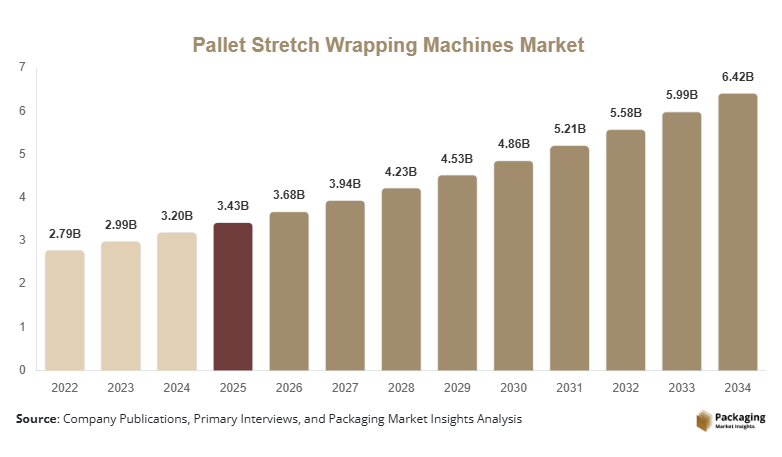
The pallet stretch-wrapping machines market size is projected at USD 3.68 billion in 2026 and is expected to hit USD 6.42 billion by 2034 with a CAGR of 7.2%. Increasing warehouse automation, rising demand for secure palletized transportation, and expanding manufacturing capacity continue to accelerate industry expansion. The report evaluates production output, technology adoption, market segmentation, regional performance, and competitive landscape across major industrial economies.
Pallet stretch wrapping machines are automated and semi-automated systems designed to wrap palletized loads with stretch film for load stabilization, product protection, and efficient logistics operations. Global production exceeded 132,000 machines during 2025, while automated equipment represented approximately 62% of total installations. Food & beverage applications contributed nearly 36% of equipment demand, logistics & warehousing accounted for 34%, and consumer goods represented approximately 18%, reinforcing the Pallet Stretch Wrapping Machines market.
Explore more data points, trends and opportunities Download Free Sample Report
Pallet Stretch Wrapping Machines Trends
Increasing Adoption of Fully Automated Packaging Lines
Manufacturers are integrating robotic pallet handling, IoT monitoring, and intelligent wrapping controls into modern packaging facilities. More than 81,000 automated machines were produced globally during 2025, while smart packaging line adoption increased by 15%. High-speed wrapping systems capable of processing over 90 pallets per hour are becoming increasingly common, strengthening the pallet stretch wrapping machine market.
Growing emphasis on sustainability has encouraged manufacturers to develop machines with optimized film consumption and energy-efficient drives. Stretch film usage has been reduced by nearly 24% through pre-stretch technologies, while servo-driven systems now account for approximately 43% of new installations. Annual production exceeded 135,000 machines, supporting sustainable industrial packaging and reinforcing the pallet stretch wrapping machines market.
Pallet Stretch Wrapping Machines Drivers
Expansion of Warehouse Automation and Industrial Logistics
The rapid growth of distribution centers, e-commerce fulfillment facilities, and automated warehouses continues driving machine installations. More than 10,500 new logistics facilities were commissioned globally during 2025, while warehouse automation investments increased by 14%. Automated pallet wrapping improves operational efficiency by approximately 32% and reduces packaging damage by 21%, supporting the Pallet Stretch Wrapping Machines market.
Pallet Stretch Wrapping Machines Restraints
High Initial Equipment Investment
Advanced rotary arm and ring wrapping systems require investments ranging from USD 70,000 to USD 450,000, depending on automation level. Maintenance expenses represent nearly 5%–7% of equipment value annually, while installation periods average 8–12 weeks. Small and medium manufacturers comprising 39% of packaging facilities continue delaying automation investments, affecting the pallet stretch wrapping machine market.
Pallet Stretch Wrapping Machines Opportunities
Growth of Export-oriented Manufacturing
Global merchandise exports exceeded USD 24 trillion, increasing demand for secure palletized packaging. Export manufacturers improved automated pallet wrapping capacity by 13% during 2025, while industrial pallet shipments surpassed 8.4 billion units annually. These developments create substantial opportunities for the pallet stretch wrapping machine market.
Challenges in Pallet Stretch Wrapping Machines
Integration with Legacy Packaging Systems
Many industrial facilities continue operating older packaging equipment requiring customized software and mechanical integration. Approximately 26% of automation projects experience implementation delays exceeding 45 days, while integration expenses increase project costs by 11%. Workforce training and compatibility issues remain significant challenges for the pallet stretch-wrapping machines market.
Report Scope
| Report Metric | Details |
|---|---|
| Market Size in 2025 | USD 3.43 Billion |
| Market Size in 2026 | USD 3.68 Billion |
| Market Size in 2034 | USD 6.42 Billion |
| CAGR | 7.2% (2026-2034) |
| Base Year for Estimation | 2025 |
| Historical Data | 2022-2024 |
| Forecast Period | 2026-2034 |
| Report Coverage | Revenue Forecast, Competitive Landscape, Supply Chain Disruption, Growth Factors, Environment & Regulatory Landscape and Trends |
| Geographies Covered | North America, Europe, APAC, Middle East and Africa, LATAM |
| Countries Covered | U.S., Canada, U.K., Germany, France, Spain, Italy, Russia, Nordic, Benelux, Rest of Europe, China, South Korea, Japan, India, Australia, Singapore, Taiwan, South East Asia, Rest of Asia-Pacific, UAE, Turkey, Saudi Arabia, South Africa, Egypt, Nigeria, Rest of MEA, Brazil, Mexico, Argentina, Chile, Colombia, Rest of LATAM |
Explore more data points, trends and opportunities Download Free Sample Report
Pallet Stretch Wrapping Machines Market Segmentation
The market is segmented by machine type and end-use industry. Turntable stretch wrappers accounted for nearly 49% of total revenue during 2025, while food & beverage remained the largest end-use segment with approximately 36% market share due to extensive palletized distribution operations.
By Machine Type
Turntable systems dominated the market with approximately 49% share and annual production exceeding 65,000 units. These machines support pallet capacities above 2,000 kg, wrapping speeds up to 35 pallets per hour, and adjustable pre-stretch ratios exceeding 250%.
Rotary arm machines represented nearly 33% of market demand with annual production exceeding 44,000 units. They are suitable for unstable and heavy pallet loads while processing more than 70 pallets per hour in automated production environments.
Ring stretch wrappers accounted for approximately 18% of installations. Annual production exceeded 23,000 units, with high-speed models capable of wrapping over 120 pallets per hour, supporting export logistics and high-volume manufacturing.
By Application
Food & beverage remained the leading application with nearly 36% market share. More than 46,000 machines operate across beverage, dairy, processed food, and frozen food facilities, achieving adoption rates exceeding 68% among large manufacturers.
Logistics & warehousing contributed approximately 34% of market demand. Distribution centers handling over 210 billion parcels annually increasingly deploy automated wrapping systems to improve shipment stability and warehouse productivity.
Consumer goods represented around 18% of total consumption. Manufacturers of electronics, household products, and personal care products utilize high-speed pallet wrapping systems supporting retail-ready distribution and export packaging.
Pallet Stretch Wrapping Machines Market Segmentations
By Product Type
- Turntable Stretch Wrappers
- Rotary Arm Stretch Wrappers
- Ring Stretch Wrappers
- Mobile Stretch Wrappers
By Application
- Food & Beverage
- Logistics & Warehousing
- Consumer Goods
- Pharmaceuticals
- Industrial Manufacturing
By Distribution Channel
- Direct Sales
- Industrial Equipment Distributors
- OEM Suppliers
- Online Sales
Pallet Stretch Wrapping Machines: Regional Outlook
North America
North America accounted for approximately 30% of global revenue during 2025. The United States represented nearly 81% of regional demand, while annual production exceeded 28,000 machines. Warehouse automation and food processing remained primary demand drivers.
Europe
Europe contributed nearly 29% of total revenue. Germany, Italy, France, and the United Kingdom collectively manufactured over 35,000 machines annually. Industrial automation adoption exceeded 61%, supporting strong demand across manufacturing industries.
Asia-Pacific
Asia-Pacific held approximately 33% market share and remained the fastest-growing region. China, Japan, India, and South Korea produced more than 46,000 machines annually. Manufacturing expansion and export logistics supported annual demand growth above 9%.
Latin America
Latin America accounted for approximately 5% of global demand. Brazil and Mexico generated more than 67% of regional consumption through expanding industrial manufacturing and logistics infrastructure.
Middle East & Africa
Middle East & Africa represented around 3% of total market revenue. Increasing warehouse development and food processing investments continued supporting demand across the region.
Top Players In Pallet Stretch Wrapping Machines
- Robopac S.p.A.
- Lantech LLC
- Signode Industrial Group
- FROMM Packaging Systems
- Atlanta Stretch S.p.A.
- Wulftec International Inc.
- Phoenix Wrappers
- ARPAC LLC,
- Cousins Packaging Inc.
- Technowrapp S.r.l.
Robopac S.p.A. Estimated market share: 17%–19% Global leader in stretch wrapping equipment and end-of-line automation. Strong presence across Europe, North America, and Asia-Pacific. The company offers turntable, rotary arm, and ring-wrapping systems featuring advanced pre-stretch technology, IoT-enabled monitoring, and energy-efficient operation. Continuous investments in automation, digital packaging solutions, and global service capabilities strengthen its leadership position. Lantech LLC Estimated market share: 12%–14% Leading supplier of pallet wrapping technologies and industrial packaging systems. Extensive customer base across logistics, manufacturing, and food processing industries. The company focuses on intelligent load containment technologies, automated stretch wrapping solutions, high-speed production systems, and continuous product innovation while maintaining strong global aftermarket support.