Bundling Machine Market Size
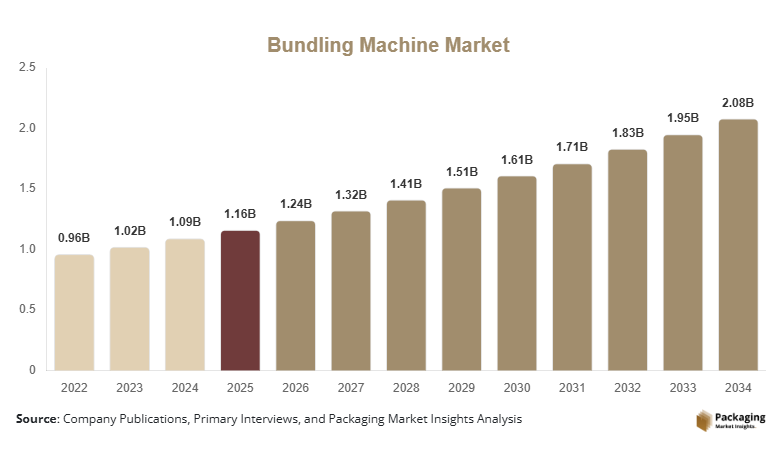
Bundling machine market size is projected at USD 1.24 billion in 2026 and is expected to hit USD 2.08 billion by 2034 with a CAGR of 6.7%. The industry continues to benefit from automation investments, rising packaging efficiency requirements, and increasing demand for integrated material handling systems. Comprehensive market evaluation includes production capacity, technology adoption, segmentation analysis, regional performance, and competitive landscape assessment across major manufacturing economies.
The bundling machine market represents equipment used for grouping, wrapping, strapping, and securing products into transport-ready bundles across manufacturing and distribution facilities. Global production exceeded 142,000 units in 2025, while installations surpassed 18,500 industrial facilities worldwide. Automatic systems contributed nearly 56% of total shipments, with food and beverage applications accounting for approximately 39% of equipment demand. Adoption continues to accelerate across logistics, consumer goods, and pharmaceutical packaging operations, reinforcing long-term bundling machine market expansion.
Explore more data points, trends and opportunities Download Free Sample Report
Bundling Machine Trends
Rising Automation and Smart Packaging Integration
Manufacturers are increasingly integrating PLC controls, robotics, IoT monitoring, and predictive maintenance features into bundling systems. Global production of intelligent bundling equipment exceeded 79,000 units during 2025, while smart monitoring adoption increased to nearly 48% among new installations. Industrial automation investments expanded by more than 11%, enabling higher throughput exceeding 60 bundles per minute in advanced production lines. These developments continue strengthening the bundling machine market.
Growing sustainability initiatives have accelerated demand for recyclable films, paper-based bundling materials, and energy-efficient motors. Nearly 41% of newly installed systems now support recyclable packaging materials, while electricity consumption per machine has declined by approximately 15% over the last five years. Production volumes supporting sustainable packaging surpassed 210 million bundled packages daily, reflecting increasing industrial adoption and reinforcing the bundling machine market.
Bundling Machine Drivers
Growing Industrial Automation Across Manufacturing Facilities
Manufacturing automation investments continue expanding across food processing, pharmaceuticals, logistics, and consumer goods. More than 63% of large manufacturing plants have introduced automated packaging lines, while industrial production output increased by approximately 7.8% during 2025. Automated bundling equipment improves operational efficiency by over 30%, reduces labor requirements by nearly 22%, and minimizes packaging defects below 2%, supporting the continued bundling machine market.
Bundling Machine Restraints
High Capital Investment and Maintenance Costs
Advanced bundling equipment requires a substantial initial investment ranging from USD 80,000 to USD 650,000 depending on system configuration. Annual maintenance expenses account for nearly 5%–8% of equipment value, while installation periods often extend beyond 10 weeks. Small manufacturers representing approximately 38% of packaging facilities continue delaying automation projects because of capital constraints, limiting the bundling machine market.
Bundling Machine Opportunities
Expansion of E-commerce Packaging Infrastructure
Rapid expansion of fulfillment centers and warehouse automation creates significant opportunities for bundling equipment suppliers. Global e-commerce parcel shipments exceeded 200 billion packages annually, while automated warehouse investments expanded by approximately 13%. More than 9,000 new logistics facilities are expected to require high-speed packaging systems before 2034, creating favorable opportunities for the bundling machine market.
Challenges in Bundling Machine
Integration Complexity with Existing Production Lines
Industrial facilities frequently operate legacy packaging equipment requiring customized integration with modern bundling systems. Nearly 27% of automation projects experience implementation delays exceeding 60 days, while integration costs increase total project expenditure by approximately 12%. Workforce training requirements and software compatibility challenges continue affecting deployment timelines, creating operational barriers for the bundling machine market.
Report Scope
| Report Metric | Details |
|---|---|
| Market Size in 2025 | USD 1.16 Billion |
| Market Size in 2026 | USD 1.24 Billion |
| Market Size in 2034 | USD 2.08 Billion |
| CAGR | 6.7% (2026-2034) |
| Base Year for Estimation | 2025 |
| Historical Data | 2022-2024 |
| Forecast Period | 2026-2034 |
| Report Coverage | Revenue Forecast, Competitive Landscape, Supply Chain Disruption, Growth Factors, Environment & Regulatory Landscape and Trends |
| Geographies Covered | North America, Europe, APAC, Middle East and Africa, LATAM |
| Countries Covered | U.S., Canada, U.K., Germany, France, Spain, Italy, Russia, Nordic, Benelux, Rest of Europe, China, South Korea, Japan, India, Australia, Singapore, Taiwan, South East Asia, Rest of Asia-Pacific, UAE, Turkey, Saudi Arabia, South Africa, Egypt, Nigeria, Rest of MEA, Brazil, Mexico, Argentina, Chile, Colombia, Rest of LATAM |
Explore more data points, trends and opportunities Download Free Sample Report
Bundling Machine Market Segmentation
The market is segmented according to machine type and end-use industry. Automatic systems accounted for nearly 56% of global revenue during 2025, while food and beverage applications represented approximately 39% of overall installations due to high packaging throughput requirements.
By Type
Automatic bundling machines dominate with nearly 56% market share and annual production exceeding 79,000 units. These systems deliver speeds above 60 bundles per minute, integrated robotic handling, automated film feeding, and digital monitoring capabilities suitable for large manufacturing facilities.
Semi-automatic equipment represents approximately 29% of installations with production exceeding 41,000 units annually. Operating speeds range between 20 and 40 bundles per minute, making them suitable for medium-scale packaging operations requiring operational flexibility and moderate investment.
Manual bundling machines contribute nearly 15% of market demand and exceed 22,000 units in annual production. These machines remain preferred by small manufacturers due to lower acquisition costs, simplified maintenance, and operational versatility for limited production volumes.
By Application
Food and beverage remains the largest application with nearly 39% market share. Production facilities process more than 85 million bundled packages daily, utilizing automated systems for beverage cartons, canned products, dairy packaging, and multipack applications with adoption rates exceeding 61%.
Logistics and warehousing account for approximately 34% of installations. Distribution centers handling over 200 billion parcels annually increasingly deploy bundling equipment supporting shipment consolidation, transport protection, barcode integration, and warehouse automation.
Consumer goods contribute nearly 27% of demand through electronics, personal care, household products, and retail packaging. Production facilities achieve bundling speeds exceeding 45 bundles per minute, supporting retail-ready packaging and inventory management requirements.
Bundling Machine Market Segmentations
Machine Type
- Automatic
- Semi-Automatic
- Manual
End-use Industry
- Food & Beverage
- Logistics & Warehousing
- Consumer Goods
- Pharmaceuticals
Distribution Channel
- Direct Sales
- Industrial Equipment Distributors
- Online Sales
- OEM Partners
Bundling Machine: Regional/Counties Outlook
North America
North America accounted for approximately 31% of global revenue during 2025. The United States represented nearly 82% of regional demand with production exceeding 26,000 machines annually. Food processing, logistics automation, and pharmaceutical packaging remain primary demand contributors.
Europe
Europe contributed nearly 29% of the market, led by Germany, Italy, France, and the United Kingdom. Regional manufacturers produced over 38,000 units, while automated packaging adoption exceeded 58% across industrial facilities, emphasizing sustainability and Industry 4.0 implementation.
Asia-Pacific
Asia-Pacific remained the fastest-growing region with approximately 30% market share. China, Japan, India, and South Korea collectively manufactured more than 54,000 bundling machines annually. Industrial automation investments expanded by nearly 12%, supported by growing manufacturing capacity and export-oriented production.
Latin America
Latin America accounted for nearly 6% of total revenue. Brazil and Mexico generated over 65% of regional demand through expanding food processing, beverage manufacturing, and logistics infrastructure modernization.
Middle East & Africa
Middle East & Africa represented around 4% of global demand. The UAE, Saudi Arabia, and South Africa continue investing in industrial packaging, with packaging equipment imports increasing by approximately 9% during 2025.
Top Players In Bundling Machines
- Signode Industrial Group
- MOSCA GmbH
- FROMM Packaging Systems
- SMI S.p.A.,
- Krones AG,
- Robopac S.p.A.,
- Lantech LLC
- ITW Mima Packaging Systems
- Cyklop International
- ARPAC LLC
Signode Industrial Group Estimated global market share: 14%–16% Strong presence across automated strapping, bundling, and protective packaging. Extensive manufacturing footprint serving food, beverage, logistics, and industrial customers. Broad product portfolio with digital monitoring capabilities, global service network, and continuous automation innovation supporting leadership in high-volume industrial packaging applications. MOSCA GmbH Estimated global market share: 10%–12% Recognized supplier of advanced strapping and bundling technologies. Strong penetration across European manufacturing and export industries. Focuses on energy-efficient equipment, intelligent automation software, sustainable packaging integration, and customized production solutions for diverse industrial applications while maintaining extensive aftermarket support.