Multihead Weighers Market Size
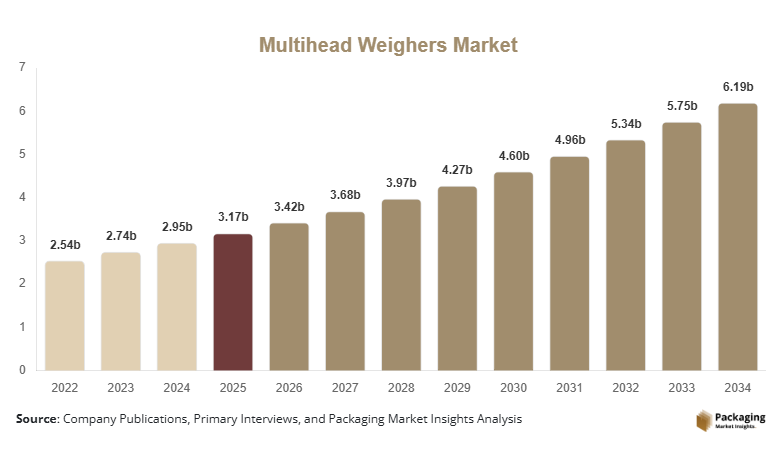
Multihead Weighers market size is projected at USD 3.42 billion in 2026 and is expected to hit USD 6.18 billion by 2034 with a CAGR of 7.7%.”The market growth is supported by increasing automation in food processing, pharmaceutical manufacturing, and industrial packaging operations. The report provides detailed segmentation, competitive landscape analysis, technological developments, production capacity evaluation, and demand assessment across major regions to understand the evolving Multihead Weighers Market.
Multihead weighers are automated precision weighing systems designed to measure and distribute products accurately through multiple weighing heads integrated with advanced control software. These systems are widely used in snack foods, frozen foods, confectionery, pharmaceuticals, and chemical industries where high-speed and accurate filling operations are required. Global multihead weigher installations exceeded 85,000 units by 2025, with food processing applications accounting for nearly 62% of total demand.The adoption rate of automated weighing solutions has increased by approximately 45% over the last decade due to labor shortages, reduced product giveaway requirements, and demand for consistent packaging quality. Combination weighing technology contributes nearly 40% of installed systems, while advanced digital multihead weighers with AI-based optimization features represent more than 25% of new installations. These factors continue to strengthen the Multihead Weighers Market.
Explore more data points, trends and opportunities Download Free Sample Report
Multihead Weighers Market Trends
Increasing Adoption of Smart Automated Weighing Technologies
The integration of artificial intelligence, IoT connectivity, and predictive maintenance features is transforming multihead weighing operations. More than 35% of newly installed systems in 2025 included smart monitoring capabilities, enabling manufacturers to reduce downtime by 20–30%. Food manufacturers producing billions of packaged units annually are increasingly adopting high-speed weighers capable of handling 120–300 weighing cycles per minute. This technological transition is driving the Multihead Weighers Market.
Rising Demand from Packaged Food and Pharmaceutical Industries
The global packaged food industry processed over 3 billion tons of products annually, creating significant demand for automated weighing equipment. Approximately 65% of multihead weigher demand originates from snacks, frozen foods, and ready-to-eat products, while pharmaceutical applications contribute around 12%. Manufacturers are investing in hygienic stainless-steel systems, higher accuracy sensors, and modular designs, supporting long-term Multihead Weighers Market expansion.
Multihead Weighers Market Drivers
Growing Automation Across Food Processing and Packaging Industries
Automation is the primary growth driver, with more than 70% of large-scale food manufacturers adopting automated weighing and filling solutions. Multihead weighers improve accuracy levels up to 99.5%, reduce material giveaway by 2–5%, and increase packaging line productivity by nearly 40%. Rising production of packaged snacks, frozen foods, and confectionery products exceeding hundreds of millions of tons annually is increasing demand for Multihead Weighers Market solutions.
Multihead Weighers Market Restraints
High Initial Investment and Maintenance Costs
The high capital requirement for advanced multihead weighing systems limits adoption among small and medium enterprises. Industrial-grade systems typically cost between USD 25,000 and USD 150,000 depending on configuration, automation level, and weighing heads. Maintenance expenses account for approximately 8–12% of annual operating costs, creating barriers in price-sensitive markets and restricting Multihead Weighers Market penetration.
Multihead Weighers Market Opportunities
Expansion of Smart Packaging and Industry 4.0 Solutions
The adoption of Industry 4.0 technologies creates opportunities for connected multihead weighing systems. Nearly 50% of new packaging lines are expected to integrate digital monitoring platforms by 2030. Emerging markets in Asia-Pacific and Latin America are witnessing packaging automation investments exceeding USD 10 billion annually, creating opportunities for manufacturers offering intelligent weighing technologies and supporting Multihead Weighers Market growth.
Challenges in Multihead Weighers Market
Complex Integration With Existing Production Lines
Integration challenges remain a major concern for manufacturers upgrading existing facilities. Around 25% of companies experience operational delays during installation due to compatibility issues with conveyors, fillers, and packaging machines. Skilled technicians are required for calibration and maintenance, increasing operational complexity and creating challenges for the Multihead Weighers Market.
Report Scope
| Report Metric | Details |
|---|---|
| Market Size in 2025 | USD 3.17 billion |
| Market Size in 2026 | USD 3.42 billion |
| Market Size in 2034 | USD 6.18 billion |
| CAGR | 7.7% (2026-2034) |
| Base Year for Estimation | 2025 |
| Historical Data | 2022-2024 |
| Forecast Period | 2026-2034 |
| Report Coverage | Revenue Forecast, Competitive Landscape, Supply Chain Disruption, Growth Factors, Environment & Regulatory Landscape and Trends |
| Geographies Covered | North America, Europe, APAC, Middle East and Africa, LATAM |
| Countries Covered | U.S., Canada, U.K., Germany, France, Spain, Italy, Russia, Nordic, Benelux, Rest of Europe, China, South Korea, Japan, India, Australia, Singapore, Taiwan, South East Asia, Rest of Asia-Pacific, UAE, Turky, Saudi Arabia, South Africa, Egypt, Nigeria, Rest of MEA, Brazil, Mexico, Argentina, Chile, Colombia, Rest of LATAM |
Explore more data points, trends and opportunities Download Free Sample Report
Multihead Weighers Market Segmentation
Multihead Weighers Market segmentation is categorized by type and application based on technology, operating mechanism, and end-use requirements. Combination weighers dominate with nearly 40% market share due to their high accuracy and flexibility, while food processing applications represent over 60% of total demand. The segmentation analysis evaluates production volume, adoption percentage, and technical capabilities.
BY TYPE
Rotary Multihead Weighers
Rotary multihead weighers account for approximately 35% of the market share due to their suitability for high-speed packaging operations. These systems can achieve speeds of 200–300 weighments per minute and are widely used for snacks, nuts, and confectionery products. More than 30,000 rotary systems are installed globally, supported by accuracy rates above 99%. Their continuous motion design improves throughput and strengthens demand within the Multihead Weighers Market.
Linear Multihead Weighers
Linear multihead weighers represent around 25% market share and are mainly used for granular and free-flowing materials. These systems typically include 2–14 weighing heads and handle production capacities between 10–120 packages per minute. Applications in rice, grains, seeds, and agricultural products contribute significantly, with global installations exceeding 20,000 units.
Combination Weighers
Combination weighers hold the largest share at nearly 40% due to advanced calculation algorithms and flexible product handling capabilities. These machines use multiple weighing heads ranging from 10 to 32 units and reduce product giveaway by up to 5%. More than 35,000 combination systems operate globally across food and industrial packaging facilities.
BY APPLICATION
Food Processing
Food processing represents approximately 62% of total market demand. Snack foods, frozen products, bakery items, and confectionery manufacturers utilize multihead weighers for high-speed filling operations. Over 50,000 units are installed in food production facilities worldwide, improving packaging accuracy and reducing waste by 20%. Rising consumption of packaged foods continues to support Multihead Weighers Market expansion.
Pharmaceutical Industry
Pharmaceutical applications contribute nearly 12% market share due to strict requirements for precision and hygiene. Multihead weighing systems support tablet, capsule, and medical packaging operations with accuracy levels exceeding 99%. Pharmaceutical manufacturers increasingly adopt automated systems as global medicine production surpasses billions of packaged units annually.
Chemical Industry
Chemical applications account for approximately 10% share, including powders, granules, and industrial materials. These systems provide controlled measurement and reduce handling risks. Chemical manufacturers use corrosion-resistant weighing equipment with production capacities ranging from 20–200 kilograms per hour.
Other Industries
Other industries contribute around 16% market share, including agriculture, pet food, and consumer goods. Increasing automation adoption among manufacturers producing millions of packaged products annually is supporting demand for customized multihead weighing solutions.
Multihead Weighers Market Segmentations
Type
- Rotary Multihead Weighers
- Linear Multihead Weighers
- Combination Weighers
- Specialized Multihead Weighers
Application
- Food Processing
- Pharmaceutical Industry
- Chemical Industry
- Other Industries
End-Use Industry
- Snacks and Confectionery
- Frozen Food and Ready-to-Eat Products
- Bakery and Dairy Products
- Agricultural Products
- Pet Food and Consumer Goods
Technology
- Traditional Multihead Weighers
- Digital Multihead Weighers
- AI-Enabled Smart Weighing Systems
- IoT-Connected Weighing Solutions
Multihead Weighers Market Regional Outlook
North America
North America accounts for approximately 28% of the global market share, supported by advanced food processing infrastructure and high automation adoption. The United States contributes nearly 22% of global installations, with more than 25,000 systems operating across food and pharmaceutical facilities. Demand is driven by packaged food production exceeding hundreds of millions of tons annually.
Europe
Europe represents around 30% market share due to strong adoption of automated packaging technologies. Germany, the UK, Italy, and France are major contributors, accounting for nearly 70% of regional demand. Strict quality standards and labor cost pressures encourage manufacturers to invest in precision weighing systems.
Asia-Pacific
Asia-Pacific is the fastest-growing region, accounting for nearly 32% share with significant growth from China, Japan, India, and South Korea. China contributes more than 40% of regional demand due to large-scale food production facilities. Increasing investments in packaging automation exceeding USD 5 billion annually are supporting market growth.
Latin America and Middle East & Africa
These regions collectively contribute around 10% market share. Brazil, Mexico, UAE, and South Africa are increasing adoption due to expanding food processing industries. Rising packaged food consumption and modernization of manufacturing facilities are expected to create new opportunities.
Top players in Multihead Weighers Market
- Ishida Co., Ltd.
- Yamato Scale Co., Ltd.
- Heat and Control, Inc.
- Multiweigh GmbH
- Bilwin Industries
- Comek S.p.A.
- Minebea Intec
- Cabinplant A/S
- Precia Molen
- Excell Packaging Corporation
- Kenwei Intelligent Weighing Machine Co., Ltd.
Ishida Co., Ltd.
-
Holds a leading position with a strong global installed base exceeding 50,000 weighing systems.
-
The company focuses on high-speed food packaging solutions with accuracy improvements of up to 99.7%.
-
Its multihead weighing portfolio supports snack, frozen food, and pharmaceutical applications.
-
Continuous investments in automation and digital technologies strengthen its competitive position.
Yamato Scale Co., Ltd.
-
Maintains significant market presence with advanced precision weighing technologies.
-
The company serves food manufacturers requiring high-speed systems capable of processing millions of packages annually.
-
Its solutions emphasize reduced product giveaway, improved efficiency, and integration with automated production lines.
-
Strong global distribution networks support expansion across Asia, Europe, and North America.