Roll Handling Machine Market Size
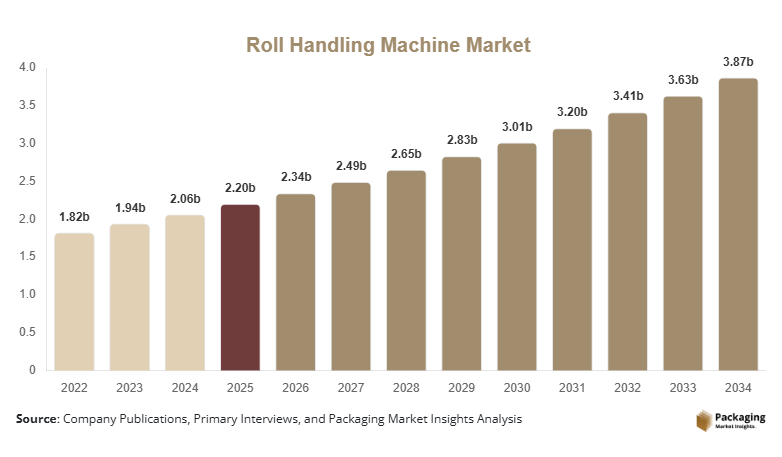
Roll Handling Machine market size is projected at USD 2.34 billion in 2026 and is expected to hit USD 3.87 billion by 2034 with a CAGR of 6.48%. Growing automation across paper mills, packaging plants, and industrial manufacturing facilities is increasing demand for advanced roll handling solutions. The report provides detailed market sizing, production statistics, segmentation, technology assessment, and competitive landscape across key global markets.
The roll handling machine market includes equipment designed to lift, transport, rotate, clamp, and position heavy paper, film, foil, textile, and steel rolls safely throughout manufacturing processes. Global production exceeded 49,800 units in 2025, while automated systems represented approximately 63% of total installations. The paper & pulp sector accounted for nearly 41% of equipment demand, followed by printing & packaging with 35% and textile & film manufacturing with 24%. Automation adoption surpassed 59% among large industrial facilities, strengthening the roll handling machine market.
Explore more data points, trends and opportunities Download Free Sample Report
Roll Handling Machine Trends
Rising Adoption of Automated Material Handling Systems
Industrial manufacturers increasingly deploy automated roll handling equipment integrated with robotic controls and IoT monitoring. More than 18,500 automated machines were installed globally during 2025, improving material handling efficiency by 29% while reducing workplace injuries by 24%. Smart sensors, automated clamping systems, and programmable controls continue advancing productivity across the roll handling machine market.
Demand for energy-efficient hydraulic and electric roll handling equipment increased by 22%, while battery-powered handling machines recorded annual shipment growth of 17%. Production of intelligent material handling systems exceeded 21,000 units, supported by digital manufacturing initiatives and Industry 4.0 investments exceeding USD 1.2 billion, reinforcing the roll handling machine market.
Roll Handling Machine Drivers
Growing Industrial Automation Across Manufacturing Facilities
Manufacturing automation investments exceeded USD 38 billion globally during 2025, encouraging adoption of advanced roll handling systems. Nearly 67% of paper mills upgraded material handling operations to improve safety and productivity. Automated roll handling reduced manual labor requirements by 31% and increased production efficiency by 26%, accelerating the roll handling machine market.
Roll Handling Machine Restraints
High Equipment Acquisition and Maintenance Costs
Advanced roll handling machines require investments ranging between USD 45,000 and USD 450,000, depending on lifting capacity and automation level. Maintenance costs represent approximately 6%–8% of annual operating expenditure, while 29% of small manufacturers postpone automation because of capital constraints. Rising steel and hydraulic component prices continue impacting the roll handling machine market.
Roll Handling Machine Opportunities
Expansion of Smart Manufacturing and Warehouse Automation
Warehouse automation investments increased by 19%, while industrial robotics adoption surpassed 15% annual growth. More than 54% of manufacturing companies announced digital transformation projects incorporating automated material handling equipment. Investments exceeding USD 950 million in intelligent logistics systems present substantial opportunities for the roll handling machine market.
Challenges in Roll Handling Machine
Skilled Workforce Shortage for Equipment Operation
Approximately 34% of manufacturing facilities report shortages of skilled automation technicians capable of operating advanced roll handling equipment. Training costs increased by 11%, while system integration timelines extended by nearly 18% due to workforce limitations. Manufacturers continue developing user-friendly automation platforms to improve deployment across the roll handling machine market.
Report Scope
| Report Metric | Details |
|---|---|
| Market Size in 2025 | USD 2.20 billion |
| Market Size in 2026 | USD 2.34 billion |
| Market Size in 2034 | USD 3.87 billion |
| CAGR | 6.48% (2026-2034) |
| Base Year for Estimation | 2025 |
| Historical Data | 2022-2024 |
| Forecast Period | 2026-2034 |
| Report Coverage | Revenue Forecast, Competitive Landscape, Supply Chain Disruption, Growth Factors, Environment & Regulatory Landscape and Trends |
| Geographies Covered | North America, Europe, APAC, Middle East and Africa, LATAM |
| Countries Covered | U.S., Canada, U.K., Germany, France, Spain, Italy, Russia, Nordic, Benelux, Rest of Europe, China, South Korea, Japan, India, Australia, Singapore, Taiwan, South East Asia, Rest of Asia-Pacific, UAE, Turky, Saudi Arabia, South Africa, Egypt, Nigeria, Rest of MEA, Brazil, Mexico, Argentina, Chile, Colombia, Rest of LATAM |
Explore more data points, trends and opportunities Download Free Sample Report
Roll Handling Machine Market Segmentation
Automatic roll handling machines dominate with approximately 52% of total revenue due to higher operational efficiency, while paper & pulp applications contribute nearly 41% of total equipment demand. Automation, safety regulations, and digital manufacturing continue driving adoption across industrial sectors.
By Type
Automatic Roll Handling Machines account for approximately 52% of market revenue with annual production exceeding 24,000 units. These systems handle rolls weighing above 8 tons, incorporate PLC controls, robotic positioning, and automated clamping mechanisms while improving operational productivity by nearly 30%.
Semi-Automatic Roll Handling Machines represent around 31% of market demand, with production surpassing 15,000 units annually. Typical lifting capacities range from 500 kg to 5 tons, making them suitable for medium-sized manufacturing facilities requiring operational flexibility.
Manual Roll Handling Machines contribute approximately 17% of total demand. More than 10,000 units are produced annually for smaller industrial operations where lower capital investment and simplified maintenance remain priorities.
By Application
Paper & Pulp Industry holds nearly 41% of market demand as global paper production exceeds 420 million metric tons annually. Automated roll handling minimizes material damage while improving warehouse efficiency by 27%.
Printing & Packaging Industry accounts for approximately 35% of total consumption. Growing flexible packaging and corrugated board manufacturing continue increasing demand for precision roll transportation systems, with adoption rates exceeding 63% among large production plants.
Textile & Film Industry contributes around 24% of global demand. Roll handling systems efficiently transport fabric, plastic films, and industrial textiles weighing up to 6 tons, reducing handling damage by nearly 20%.
Roll Handling Machine Market Segmentations
Product Type
- Automatic Roll Handling Machines
- Semi-Automatic Roll Handling Machines
- Manual Roll Handling Machines
Application
- Paper & Pulp Industry
- Printing & Packaging Industry
- Textile & Film Industry
Distribution Channel
- Direct Sales
- Industrial Equipment Distributors
- OEM Suppliers
- Online Industrial Equipment Platforms
- Authorized Dealers
Roll Handling Machine Regional Outlook
North America
North America accounts for approximately 28% of global revenue, supported by advanced manufacturing automation and warehouse modernization. The United States contributes nearly 80% of regional demand through paper production and packaging industries.
Europe
Europe represents around 27% of the market, with Germany, Italy, Sweden, and France leading industrial automation investments. More than 61% of paper manufacturing facilities utilize automated roll handling equipment.
Asia-Pacific
Asia-Pacific dominates with nearly 37% market share. China contributes approximately 46% of regional production, while India, Japan, and South Korea continue investing in smart manufacturing and packaging automation.
Latin America
Latin America holds approximately 5% of global demand. Brazil and Mexico account for more than 69% of regional installations due to expanding paper, packaging, and industrial manufacturing sectors.
Middle East & Africa
The Middle East & Africa contribute nearly 3% of global revenue. Industrial diversification, packaging expansion, and logistics automation continue supporting equipment demand across the region.
Top players in Roll Handling Machine
- BW Integrated Systems
- AUTEFA Solutions
- Mondi Engineering
- Richards-Wilcox Conveyor
- ANVER Corporation
- Cascade Corporation
- Pronomec Oy
- Dotec B.V.
- Tawi AB
- JLT Mobile Computers Material Handling Solutions
- Demag Cranes & Components
- Konecranes
- Schmalz GmbH
- Vaculex AB
- Movomech AB
BW Integrated Systems
-
Estimated global market share of 14%–16%.
-
Provides advanced automated roll handling and industrial material handling systems for paper, packaging, and manufacturing industries.
-
Focuses on robotics integration, automated conveyors, and intelligent warehouse solutions with installations across more than 70 countries.
-
Maintains strong investments in digital automation, predictive maintenance, and safety-enhancing technologies.
Konecranes
-
Estimated global market share of 11%–13%.
-
Offers heavy-duty lifting, roll handling, and intelligent industrial crane solutions supporting high-capacity manufacturing operations.
-
Strong global presence across paper mills, steel processing, logistics, and industrial manufacturing facilities.
-
Invests significantly in automation, remote monitoring, energy-efficient lifting technologies, and smart maintenance platforms.