Industrial Printer Market Size
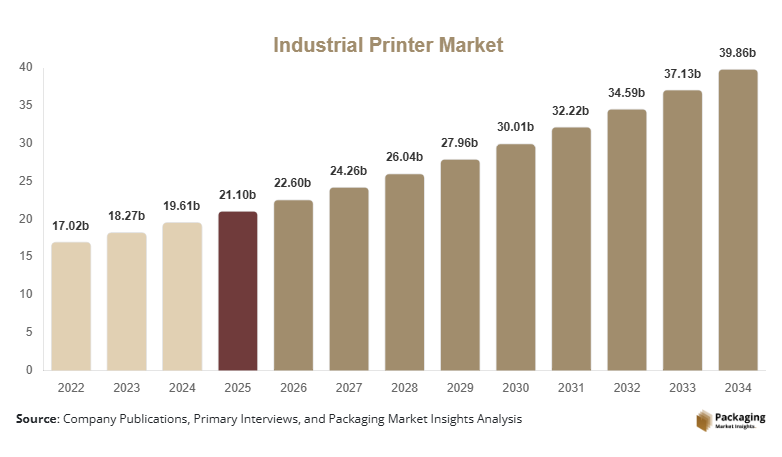
Industrial Printer market size is projected at USD 22.6 billion in 2026 and is expected to hit USD 39.8 billion by 2034 with a CAGR of 7.35%. The report provides detailed analysis of market valuation, production capacity, technology adoption, product segmentation, application performance, competitive landscape, and regional opportunities. The study evaluates key industry trends, investment patterns, manufacturing developments, and strategic initiatives influencing the global Industrial Printer Market.
The Industrial Printer Market includes high-performance printing systems designed for industrial applications such as manufacturing, packaging, automotive, electronics, and logistics. Global industrial printer shipments exceeded 5.8 million units in 2025, with annual production capacity reaching nearly 6.2 million units. Inkjet printers accounted for approximately 46% of total installations, thermal printers represented around 32%, and laser printers contributed nearly 22%. Manufacturing applications generated nearly 39% of demand, packaging and labeling accounted for 34%, while logistics and warehousing contributed approximately 27%, supporting expansion of the Industrial Printer Market.
Explore more data points, trends and opportunities Download Free Sample Report
Industrial Printer Trends
Increasing Adoption of Digital Printing and Automation Technologies
The shift toward automated manufacturing and customized printing solutions is transforming the Industrial Printer Market. Digital industrial printers accounted for nearly 55% of new installations in 2025, with global shipments exceeding 3.2 million units. Manufacturers are adopting high-speed inkjet systems, UV printing technologies, and integrated automation solutions that improve production efficiency by 20–30% and reduce operational waste by nearly 15%.
Advanced connectivity, IoT-enabled monitoring, and AI-driven maintenance systems are gaining adoption across industrial facilities. Approximately 42% of large manufacturing plants implemented connected printing systems by 2025, improving uptime by nearly 18%. Demand from packaging, electronics, and automotive industries continues increasing as companies require precise coding, marking, and variable data printing solutions, strengthening the Industrial Printer Market.
Industrial Printer Market Drivers
Expansion of Manufacturing Automation and Smart Factory Adoption
Increasing industrial automation is a major factor driving demand for industrial printing systems. Global smart factory investments exceeded USD 120 billion in 2025, with more than 60% of automated facilities requiring integrated printing and marking solutions. Manufacturing industries accounted for nearly 39% of printer demand, while automated production lines increased adoption of industrial printers by approximately 14% annually, supporting Industrial Printer Market growth.
Industrial Printer Market Restraints
High Initial Investment and Maintenance Costs
The high cost associated with advanced industrial printing equipment limits adoption among small and medium-sized enterprises. Industrial printer installation costs range between USD 5,000 and USD 250,000 depending on technology and application requirements. Maintenance expenses account for nearly 10–15% of annual operating costs, while replacement components can increase lifecycle expenses by approximately 12%, creating challenges for the Industrial Printer Market.
Industrial Printer Market Opportunities
Growing Demand for Sustainable and High-Efficiency Printing Solutions
The rising focus on sustainable manufacturing is creating new opportunities for energy-efficient industrial printers. Eco-friendly printing technologies reduced energy consumption by approximately 25% compared with conventional systems. Demand for solvent-free inks, recyclable labeling solutions, and low-waste printing technologies increased by nearly 20% in 2025, creating growth opportunities within the Industrial Printer Market.
Challenges in Industrial Printer Market
Rapid Technological Changes and Integration Complexities
Continuous innovation in digital printing technologies creates challenges for manufacturers and users. Companies must invest approximately 8–12% of annual revenue into technology upgrades to remain competitive. Integration challenges between industrial printers, enterprise software, and automated production systems affect nearly 30% of implementation projects, creating operational complexities in the Industrial Printer Market.
Report Scope
| Report Metric | Details |
|---|---|
| Market Size in 2025 | USD 21.1 billion |
| Market Size in 2026 | USD 22.6 billion |
| Market Size in 2034 | USD 39.8 billion |
| CAGR | 7.35% (2026-2034) |
| Base Year for Estimation | 2025 |
| Historical Data | 2022-2024 |
| Forecast Period | 2026-2034 |
| Report Coverage | Revenue Forecast, Competitive Landscape, Supply Chain Disruption, Growth Factors, Environment & Regulatory Landscape and Trends |
| Geographies Covered | North America, Europe, APAC, Middle East and Africa, LATAM |
| Countries Covered | U.S., Canada, U.K., Germany, France, Spain, Italy, Russia, Nordic, Benelux, Rest of Europe, China, South Korea, Japan, India, Australia, Singapore, Taiwan, South East Asia, Rest of Asia-Pacific, UAE, Turky, Saudi Arabia, South Africa, Egypt, Nigeria, Rest of MEA, Brazil, Mexico, Argentina, Chile, Colombia, Rest of LATAM |
Explore more data points, trends and opportunities Download Free Sample Report
Industrial Printer Market Segmentation
The Industrial Printer Market is segmented by type and application based on printing technology and end-use requirements. Inkjet printers dominate with approximately 46% market share due to versatility and high-speed performance, while manufacturing remains the largest application segment with nearly 39% demand contribution.
By Type
Inkjet Printers
Inkjet printers accounted for approximately 46% of global demand in 2025, with shipments exceeding 2.7 million units. These printers are widely used for high-speed coding, marking, and variable data printing applications. Industrial inkjet systems support resolutions between 300 dpi and 1200 dpi, making them suitable for food, beverage, pharmaceutical, and manufacturing industries.
Laser Printers
Laser printers represented nearly 22% market share, with annual shipments exceeding 1.3 million units. These systems provide high precision, durability, and low-maintenance operation. Laser printing technology is widely adopted in electronics, automotive, and industrial component manufacturing applications.
Thermal Printers
Thermal printers contributed around 32% share with shipments exceeding 1.8 million units. Thermal transfer and direct thermal printing technologies are extensively used in logistics, retail, and packaging industries due to reliability, speed, and low operating costs.
By Application
Manufacturing
Manufacturing accounted for approximately 39% of Industrial Printer Market demand, with more than 2.2 million units installed globally in 2025. Automotive, electronics, machinery, and pharmaceutical manufacturers use industrial printers for product identification, traceability, and compliance labeling.
Packaging & Labeling
Packaging and labeling represented nearly 34% share, consuming over 1.9 million units annually. Food, beverage, cosmetic, and pharmaceutical companies utilize industrial printers for barcodes, batch coding, expiration dates, and product branding.
Logistics & Warehousing
Logistics and warehousing applications accounted for around 27% share, with adoption exceeding 1.5 million units. Growth in e-commerce and automated warehouses has increased demand for barcode printing, tracking labels, and inventory management solutions.
Industrial Printer Market Segmentations
Type
- Inkjet Printers
- Laser Printers
- Thermal Printers
Application
- Manufacturing
- Packaging & Labeling
- Logistics & Warehousing
Industrial Printer Regional Outlook
North America
North America accounted for approximately 31% of global Industrial Printer Market revenue in 2025. The United States contributed nearly 78% of regional demand, supported by advanced manufacturing and automation adoption. Regional installations exceeded 1.8 million units, with packaging and automotive industries representing major users.
Europe
Europe represented around 28% market share, led by Germany, France, Italy, and the United Kingdom. The region recorded more than 1.6 million printer installations, driven by Industry 4.0 adoption and advanced manufacturing requirements. Germany contributed nearly 35% of regional demand.
Asia-Pacific
Asia-Pacific dominated industrial printer shipments with approximately 34% share. China, Japan, South Korea, and India collectively accounted for over 2 million units in 2025. Expanding electronics, automotive, and packaging industries significantly supported regional growth.
Latin America
Latin America contributed approximately 5% of global demand. Brazil and Mexico represented nearly 70% of regional consumption due to growing manufacturing and logistics activities.
Middle East & Africa
The Middle East & Africa region accounted for around 2% share, with increasing adoption in food processing, packaging, and industrial manufacturing sectors.
Top players in Industrial Printer Market
- Brother Industries Ltd.
- Canon Inc.
- HP Inc.
- Epson Corporation
- Zebra Technologies Corporation
- Honeywell International Inc.
- Domino Printing Sciences
- Markem-Imaje
- Videojet Technologies Inc.
- SATO Holdings Corporation
- Konica Minolta Inc.
- Ricoh Company Ltd.
Brother Industries Ltd.
-
Estimated global market share: 8–10%.
-
Brother Industries maintains a strong position through industrial labeling, thermal printing, and business printing solutions.
-
The company focuses on compact, efficient, and connected printing systems for manufacturing and logistics applications.
-
Its investments in automation-compatible printing solutions and sustainable technologies strengthen its presence in the Industrial Printer Market.
Zebra Technologies Corporation
-
Estimated global market share: 9–11%.
-
Zebra Technologies is a leading provider of barcode, RFID, and industrial printing solutions.
-
The company serves manufacturing, healthcare, logistics, and retail industries with advanced identification technologies.
-
Strong demand for supply chain automation and inventory tracking solutions supports Zebra’s competitive position in the Industrial Printer Market.