Tray Sealing Machines Market Size
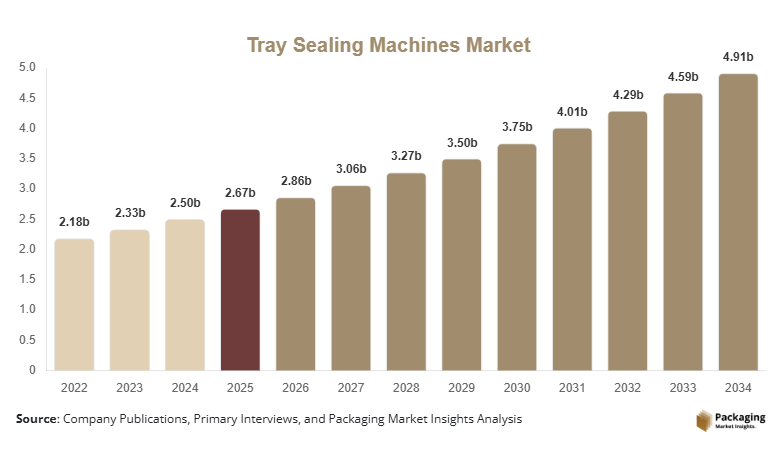
Tray Sealing Machines market size is projected at USD 2.86 billion in 2026 and is expected to hit USD 4.91 billion by 2034 with a CAGR of 7.0%. The report provides comprehensive analysis of production capacity, technology advancements, market segmentation, pricing trends, and the competitive landscape across global packaging equipment manufacturers. More than 148,000 tray sealing machines are manufactured annually, serving food processing, pharmaceutical, and consumer goods industries.
Tray sealing machines are automated packaging systems used to seal trays with plastic films through heat sealing, vacuum sealing, and modified atmosphere packaging (MAP) technologies. Global production exceeded 148,000 units during 2025, with food and beverage applications accounting for nearly 68% of total demand, pharmaceuticals contributing 18%, and consumer goods representing 14%. Automatic systems account for more than 57% of new installations, reinforcing the Tray Sealing Machines market.
Explore more data points, trends and opportunities Download Free Sample Report
Tray Sealing Machines Trends
Growing Adoption of Modified Atmosphere Packaging Technologies
Demand for modified atmosphere packaging continues to increase as food manufacturers seek to extend shelf life and reduce food waste. More than 82,000 MAP-compatible tray sealing machines were installed globally during 2025, representing annual growth of 14%. High-speed sealing systems processing over 180 trays per minute are increasingly adopted across industrial food production, supporting Tray Sealing Machines market trends.
Automation, robotics, and Industry 4.0 technologies are transforming tray sealing operations. Smart monitoring systems achieved adoption rates exceeding 46% among large packaging facilities, while predictive maintenance reduced machine downtime by 19%. Investments in automated packaging lines increased by 17%, strengthening the Tray Sealing Machines market.
Tray Sealing Machines Market Drivers
Increasing Demand for Ready-to-Eat and Fresh Food Packaging
Growing consumption of convenience foods and fresh packaged products continues driving tray sealing equipment demand. Global ready-to-eat food production increased by 12%, while packaged fresh food sales expanded by 10% during 2025. Investments exceeding USD 3.2 billion in food packaging automation continue supporting Tray Sealing Machines market growth.
Tray Sealing Machines Market Restraints
High Capital Investment and Maintenance Costs
Advanced tray sealing machines equipped with robotic handling and MAP technology require substantial capital expenditure. Equipment acquisition costs increased by 9%, while maintenance expenses account for approximately 8% of annual operating costs. Small manufacturers often delay automation investments, affecting the Tray Sealing Machines market.
Tray Sealing Machines Market Opportunities
Expansion of Sustainable Packaging and Smart Manufacturing
Demand for recyclable trays, mono-material packaging, and intelligent packaging systems is creating new business opportunities. Sustainable packaging investments exceeded USD 1.6 billion during 2025, while smart manufacturing implementation increased by 18% globally. Adoption of digital monitoring technologies continues expanding the Tray Sealing Machines market.
Challenges in Tray Sealing Machines Market
Integration with Diverse Packaging Formats
Manufacturers must design machines capable of handling multiple tray materials, sizes, and sealing films while maintaining production efficiency. Equipment customization increases manufacturing costs by approximately 11%, and installation timelines extend by 14% for integrated production lines. Achieving flexibility without compromising speed remains a challenge for the Tray Sealing Machines market.
Report Scope
| Report Metric | Details |
|---|---|
| Market Size in 2025 | USD 2.67 billion |
| Market Size in 2026 | USD 2.86 billion |
| Market Size in 2034 | USD 4.91 billion |
| CAGR | 7.0% (2026-2034) |
| Base Year for Estimation | 2025 |
| Historical Data | 2022-2024 |
| Forecast Period | 2026-2034 |
| Report Coverage | Revenue Forecast, Competitive Landscape, Supply Chain Disruption, Growth Factors, Environment & Regulatory Landscape and Trends |
| Geographies Covered | North America, Europe, APAC, Middle East and Africa, LATAM |
| Countries Covered | U.S., Canada, U.K., Germany, France, Spain, Italy, Russia, Nordic, Benelux, Rest of Europe, China, South Korea, Japan, India, Australia, Singapore, Taiwan, South East Asia, Rest of Asia-Pacific, UAE, Turky, Saudi Arabia, South Africa, Egypt, Nigeria, Rest of MEA, Brazil, Mexico, Argentina, Chile, Colombia, Rest of LATAM |
Explore more data points, trends and opportunities Download Free Sample Report
Tray Sealing Machines Market Segmentation
Automatic tray sealing machines account for approximately 57% of market revenue, followed by semi-automatic systems with 28% and manual machines with 15%. Food and beverage applications dominate with nearly 68% of global demand, supported by annual production exceeding 148,000 units.
By Type
Manual systems account for approximately 15% of total demand, with annual production exceeding 22,000 units. These machines are widely used by small food processors and retail businesses for low-volume packaging operations while providing sealing temperatures between 120°C and 220°C.
Semi-automatic systems contribute nearly 28% of market demand with annual production exceeding 41,000 units. These machines improve packaging efficiency through pneumatic operation, vacuum sealing capabilities, and cycle speeds reaching 18 cycles per minute.
Automatic systems dominate with around 57% market share and production exceeding 85,000 units annually. Equipped with conveyor automation, MAP technology, robotic loading, and output exceeding 180 trays per minute, these systems support high-volume industrial food packaging.
By Application
Food and beverage applications account for nearly 68% of market demand, utilizing more than 100,000 machines globally. Tray sealing systems preserve meat, seafood, dairy products, ready meals, fruits, and bakery products while extending shelf life and maintaining product freshness.
Pharmaceutical applications represent approximately 18% of global demand with over 27,000 units in operation. Sterile packaging, medical trays, diagnostic kits, and healthcare products require precision sealing, contamination control, and regulatory compliance.
Consumer goods contribute around 14% of total demand, with annual production exceeding 21,000 units. Electronics accessories, personal care products, and household items increasingly utilize tray sealing technology for product protection and retail presentation.
Tray Sealing Machines Market Segmentations
Type
- Manual Tray Sealing Machines
- Semi-Automatic Tray Sealing Machines
- Automatic Tray Sealing Machines
Application
- Food & Beverage
- Pharmaceuticals
- Consumer Goods
Tray Sealing Machines Regional Outlook
North America
North America accounts for approximately 29% of global revenue, supported by annual production exceeding 43,000 units. The United States contributes nearly 81% of regional demand through advanced food processing and packaging automation industries.
Europe
Europe represents approximately 33% of global demand with production exceeding 49,000 units annually. Germany, Italy, France, and the United Kingdom collectively account for more than 73% of regional consumption, supported by advanced packaging technology and stringent food safety standards.
Asia-Pacific
Asia-Pacific holds approximately 31% of global revenue with annual production exceeding 46,000 units. China contributes nearly 44% of regional output, followed by Japan, India, and South Korea. Growing food processing industries and increasing packaged food consumption continue supporting regional demand.
Latin America
Latin America contributes approximately 4% of global demand. Brazil and Mexico account for more than 67% of regional installations, driven by expanding processed food manufacturing and retail packaging investments.
Middle East & Africa
The Middle East & Africa account for around 3% of global demand. Saudi Arabia, the UAE, and South Africa continue investing in modern food processing infrastructure, while industrial packaging automation increased by approximately 9% during 2025.
Top players in Tray Sealing Machines Market
- Multivac Group
- ULMA Packaging
- Ishida Co., Ltd.
- Proseal UK Ltd.
- SEALPAC International BV
- ILPRA S.p.A.
- GEA Group AG
- JBT Corporation
- Reiser
- Orved S.p.A.
Multivac Group
-
Estimated global market share of approximately 16%.
-
Leading provider of tray sealing, thermoforming, and packaging automation solutions.
-
Strong presence across food, medical, and industrial packaging sectors.
-
The company focuses on high-speed automated tray sealing systems, modified atmosphere packaging technologies, and digital production monitoring. Continuous investments in sustainable packaging compatibility, robotics, and global manufacturing capabilities strengthen its competitive position across developed and emerging markets.
ULMA Packaging
-
Estimated market share of approximately 13%.
-
Global supplier of advanced food packaging equipment.
-
Comprehensive portfolio of automatic and semi-automatic tray sealing systems.
-
The company emphasizes flexible packaging solutions, Industry 4.0 integration, hygienic machine designs, and sustainable packaging technologies. Ongoing investments in intelligent automation, energy-efficient equipment, and international distribution networks continue expanding its market presence.