Robotic Case Erecting Cells Market Size
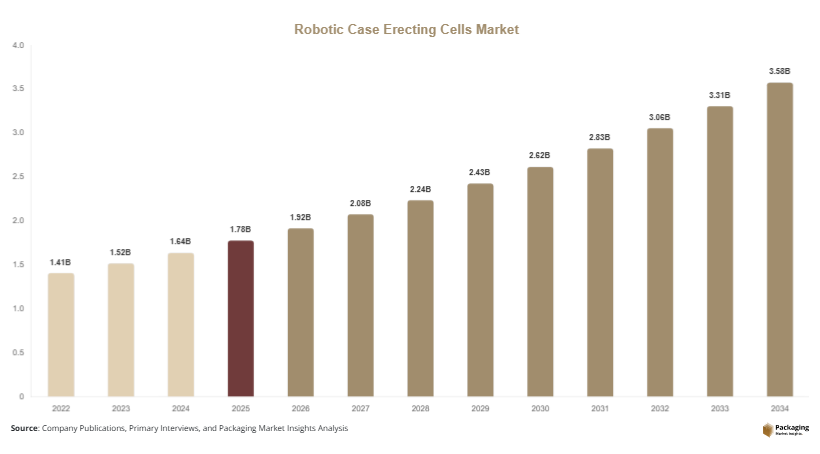
The robotic case erecting cells market size is projected at USD 1.92 billion in 2026 and is expected to hit USD 3.58 billion by 2034 with a CAGR of 8.1%. The report provides comprehensive analysis of production capacity, automation adoption, technology innovation, pricing trends, and competitive benchmarking across global markets. It further evaluates detailed segmentation, regional manufacturing capabilities, supply chain developments, and strategic initiatives adopted by leading automation companies.
Robotic case erecting cells are automated packaging systems designed to erect, fold, seal, and prepare corrugated cases for high-speed production lines using industrial robots, intelligent controls, and integrated conveyor systems. Global production exceeded 18,500 robotic cells in 2025, while manufacturing facility utilization averaged 82%. Food and beverage applications accounted for approximately 45% of total installations, consumer goods represented 32%, and logistics and e-commerce contributed nearly 23%. Growing industrial automation continues strengthening the robotic case erecting cells market.
Explore more data points, trends and opportunities Download Free Sample Report
Robotic Case Erecting Cells Market Trends
Increasing Adoption of Intelligent Packaging Automation
Manufacturers are rapidly investing in robotic case-erecting cells to improve packaging speed, reduce labor dependency, and increase operational efficiency. More than 66% of newly commissioned packaging lines incorporate robotic automation, while annual installations surpassed 19,800 units globally. AI-enabled vision inspection systems recorded adoption growth of approximately 27% between 2023 and 2025, improving packaging accuracy and reducing downtime, supporting the robotic case erecting cell market.
Collaborative robotics, predictive maintenance, and Industrial Internet of Things (IIoT) technologies continue transforming automated packaging operations. Nearly 41% of newly installed robotic cells feature cloud-connected monitoring systems, reducing maintenance costs by approximately 18% while increasing equipment availability above 96%. Flexible robotic tooling and modular automation platforms continue expanding applications across multiple industries within the robotic case-erecting cells market.
Robotic Case Erecting Cells Market Drivers
Rapid Expansion of Warehouse and Packaging Automation
Growing investments in warehouse automation, e-commerce fulfillment, and high-speed packaging facilities continue driving robotic system demand. Global warehouse automation investments exceeded USD 32 billion during 2025, while automated packaging line installations increased by 15% year-over-year. More than 71% of large manufacturing facilities now deploy robotic packaging solutions, supporting sustained expansion of the robotic case-erecting cells market.
Report Scope Robotic Case Erecting Cells Market Restraints
High Initial Capital Investment
Robotic case erecting systems require substantial investment in robotics, conveyors, software integration, and employee training. Initial installation expenses account for nearly 64% of total project costs, while annual maintenance expenditures average 7%–10% of equipment value. Small and medium-sized manufacturers often delay automation investments due to budget limitations and longer return-on-investment periods.
Robotic Case Erecting Cells Market Opportunities
Growing Adoption Across E-commerce Fulfillment Centers
Expanding online retail operations and omnichannel distribution networks continue creating significant opportunities for robotic packaging equipment manufacturers. Global parcel shipments exceeded 205 billion packages during 2025, while automated fulfillment centers increased by 22% worldwide. Rising investments in flexible robotic packaging systems continue creating long-term opportunities across logistics and distribution facilities.
Challenges in Report Scope Robotic Case-Erecting Cells Market
Case Erecting with Legacy Manufacturing Systems
Integrating robotic case-erecting cells with existing packaging lines remains a significant operational challenge. Approximately 29% of automation projects require customized engineering modifications, while commissioning periods average 8–14 weeks depending on production complexity. Manufacturers continue investing in modular software architecture and standardized communication protocols to improve deployment efficiency.
Report Scope
| Report Metric | Details |
|---|---|
| Market Size in 2025 | USD 1.78 Billion |
| Market Size in 2026 | USD 1.92 Billion |
| Market Size in 2034 | USD 3.58 Billion |
| CAGR | 8.1% (2026-2034) |
| Base Year for Estimation | 2025 |
| Historical Data | 2022-2024 |
| Forecast Period | 2026-2034 |
| Report Coverage | Revenue Forecast, Competitive Landscape, Supply Chain Disruption, Growth Factors, Environment & Regulatory Landscape and Trends |
| Geographies Covered | North America, Europe, APAC, Middle East and Africa, LATAM |
| Countries Covered | U.S., Canada, U.K., Germany, France, Spain, Italy, Russia, Nordic, Benelux, Rest of Europe, China, South Korea, Japan, India, Australia, Singapore, Taiwan, South East Asia, Rest of Asia-Pacific, UAE, Turkey, Saudi Arabia, South Africa, Egypt, Nigeria, Rest of MEA, Brazil, Mexico, Argentina, Chile, Colombia, Rest of LATAM |
Explore more data points, trends and opportunities Download Free Sample Report
Robotic Case Erecting Cells Market Segmentation
The market is segmented by robot type and end-use industry. Articulated robots account for approximately 48% of global installations, while the food and beverage sector contributes nearly 45% of overall demand due to high-volume packaging operations and increasing automation investments.
By Robot Type
Articulated robotic systems account for approximately 48% of total installations, with annual production exceeding 8,900 units. Six-axis motion, payload capacities exceeding 20 kg, programmable automation, and high operational flexibility make them ideal for complex packaging applications.
SCARA robots represent nearly 30% of global demand, with annual production surpassing 5,600 units. High-speed positioning, compact installation footprint, repeatability within ±0.02 mm, and rapid cycle times support efficient case erecting operations in medium-speed packaging lines.
Delta robots contribute approximately 22% of installations, with production exceeding 4,000 units annually. Lightweight construction, high-speed pick-and-place capability, precision motion control, and reduced energy consumption support deployment in lightweight packaging applications.
By End-use Industry
Food and beverage applications account for nearly 45% of global demand, utilizing more than 8,300 robotic case-erecting cells worldwide. High-speed packaging, hygiene compliance, automated carton handling, and continuous production requirements continue driving adoption across beverage, dairy, bakery, and processed food industries.
Consumer goods contribute approximately 32% of market demand. Annual installations exceeded 5,900 robotic systems, while automation penetration surpassed 52% among major manufacturers producing household products, personal care products, and packaged consumer goods.
Logistics and e-commerce account for approximately 23% of market demand with more than 4,200 robotic installations globally. Automated parcel handling, order fulfillment, warehouse packaging, and distribution center operations continue increasing deployment across modern logistics facilities.
Robotic Case Erecting Cells Market Segmentations
Robot Type:
- Articulated Robots
- SCARA Robots
- Delta Robots
End-use Industry
- Food & Beverage
- Consumer Goods
- Logistics & E-commerce
Robotic Case Erecting Cells Market Regional Outlook
North America
North America accounts for approximately 33% of global revenue, supported by advanced industrial automation and strong warehouse modernization investments. The United States contributes nearly 85% of regional demand, while annual robotic cell installations exceed 6,200 units across manufacturing and logistics sectors.
Europe
Europe represents approximately 29% of the global market, led by Germany, Italy, France, and the United Kingdom. Regional installations exceeded 5,400 units annually, while robotic packaging automation adoption surpassed 58% among major industrial manufacturers.
Asia-Pacific
Asia-Pacific holds approximately 31% of global demand and remains the fastest-growing regional market. China, Japan, South Korea, and India account for more than 81% of regional production. Annual manufacturing exceeded 5,700 robotic systems, supported by expanding manufacturing capacity and e-commerce infrastructure.
Latin America
Latin America contributes approximately 4% of global revenue, with Brazil and Mexico serving as major industrial automation markets. Regional installations surpassed 750 robotic cells, driven by investments in food processing and consumer goods manufacturing.
Middle East & Africa
The Middle East & Africa account for nearly 3% of the market. Growing warehouse automation, logistics expansion, and manufacturing modernization supported installations exceeding 550 robotic case-erecting cells during 2025.
Top Players In Report Scope: Robotic Case Erecting Cells Market
- ABB Ltd.
- FANUC Corporation
- KUKA AG
- Yaskawa Electric Corporation
- Mitsubishi Electric Corporation
- Rockwell Automation, Inc.
- Omron Corporation
- Schneider Electric SE,
- Bastian Solutions LLC,
- BW Integrated Systems
- Premier Tech Systems and Automation
- A-B-C Packaging Machine Corporation
- Syntegon Technology GmbH
- Krones AG,
- Sidel Group
ABB Ltd. Estimated global market share exceeds 15%, supported by a broad portfolio of industrial robots, packaging automation systems, and intelligent digital solutions. ABB focuses on AI-enabled robotics, machine vision integration, predictive maintenance, modular automation platforms, and energy-efficient robotic technologies. The company serves food processing, logistics, consumer goods, and industrial manufacturing customers through an extensive global distribution network. Continuous investments in collaborative robotics, software development, and digital manufacturing solutions reinforce ABB's competitive position in robotic case erecting cell applications. FANUC Corporation FANUC holds an estimated 13% global market share with extensive expertise in industrial robotics and factory automation. The company offers high-speed articulated robots, intelligent motion control systems, vision-guided automation, and integrated packaging solutions for high-volume manufacturing. Continuous investments in robotic intelligence, predictive diagnostics, remote monitoring, and flexible automation technologies support strong global market positioning. FANUC's comprehensive service network and reliable robotic platforms continue driving adoption across packaging, logistics, food processing, and consumer goods industries.