Personalized Packaging Market Size and Growth
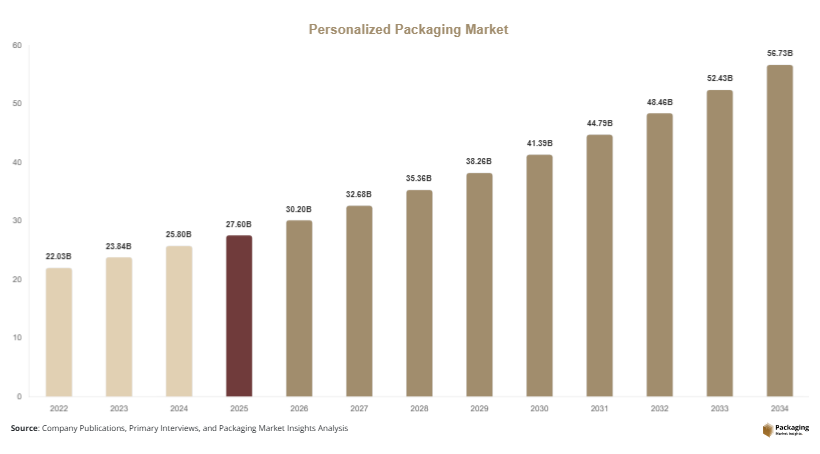
The global personalized packaging market size was valued at USD 27.6 billion in 2025 and is projected to reach USD 30.2 billion in 2026, further expanding to approximately USD 56.8 billion by 2034, registering a CAGR of 8.2% during 2025–2034. The rising importance of customized branding and customer-centric marketing approaches is driving demand for personalized packaging solutions across industries such as food and beverages, cosmetics, e-commerce, and consumer goods. The personalized packaging market is witnessing steady growth as brands increasingly focus on consumer engagement, product differentiation, and direct-to-consumer strategies.
One of the primary growth factors is the expansion of e-commerce and online retail platforms. Brands are leveraging personalized packaging to create a memorable unboxing experience and enhance brand loyalty. Customized messages, names, and design elements on packaging are becoming common, especially in subscription-based services and direct-to-consumer models. This trend is supported by advancements in digital printing technologies, which allow cost-effective short-run production and high customization.
Key Highlights:
- Asia Pacific dominated the market with a 34.8% share in 2025, while Latin America is projected to grow at the fastest CAGR of 8.9%.
- Flexible packaging led the type segment with a 49.6% share, while rigid packaging is expected to grow at a CAGR of 7.9%.
- Paper & paperboard materials dominated with a 46.3% share, while biodegradable materials are forecasted to grow at a CAGR of 9.4%.
- Food & beverage applications led the segment with 38.7% share, while e-commerce packaging is expected to grow at a CAGR of 8.7%.
- The United States remained the dominant country with a market size of USD 7.5 billion in 2025 and USD 8.1 billion in 2026.
Explore more data points, trends and opportunities Download Free Sample Report
Market Trends
Integration of Digital Printing for Mass Customization
Digital printing technology is transforming the personalized packaging market by enabling mass customization with shorter production cycles. Brands can now produce customized packaging designs in small batches without significant cost increases. This capability supports targeted marketing campaigns, seasonal promotions, and personalized customer experiences. Variable data printing allows each package to have unique graphics, text, or codes, which enhances consumer engagement. This trend is particularly strong in industries such as food and beverages and cosmetics, where brand differentiation is essential. As printing technologies continue to improve, customization will become more accessible to small and medium enterprises.
Growing Use of Smart and Interactive Packaging
Smart packaging solutions are increasingly being integrated with personalized packaging to enhance customer interaction. Features such as QR codes, NFC tags, and augmented reality elements allow consumers to access additional product information, promotional content, and brand stories. This interactive approach not only improves consumer engagement but also provides valuable data insights for companies. Personalized packaging combined with smart technologies is particularly effective in e-commerce and premium product segments. As consumers seek more engaging and informative experiences, the adoption of smart packaging is expected to grow steadily.
Market Drivers
Rising Demand for Enhanced Consumer Experience
The increasing focus on customer experience is a major driver for the personalized packaging market. Brands are using customized packaging to create emotional connections with consumers. Personalized messages, names, and designs enhance the unboxing experience and encourage repeat purchases. This approach is especially effective in e-commerce, where packaging serves as a key touchpoint between the brand and the customer. The growing influence of social media and unboxing videos is further amplifying the importance of visually appealing and personalized packaging.
Expansion of Direct-to-Consumer Business Models
The growth of direct-to-consumer (DTC) channels is driving demand for personalized packaging solutions. Brands selling directly to customers are focusing on packaging as a marketing tool to differentiate themselves from competitors. Customized packaging helps build brand identity and improves customer retention. Additionally, DTC brands often rely on subscription models, which require unique and engaging packaging designs for each delivery. This trend is contributing to increased demand for flexible and scalable packaging solutions.
Market Restraint
High Production Costs and Operational Complexity
One of the major challenges in the personalized packaging market is the higher cost associated with customization. Personalized packaging often requires advanced printing technologies, specialized materials, and shorter production runs, which can increase overall costs. This can be a barrier for small businesses with limited budgets. Additionally, managing multiple design variations and maintaining quality consistency can be operationally complex. For example, producing personalized packaging for large-scale campaigns may require advanced data management systems and coordination across supply chains. These factors can limit the adoption of personalized packaging solutions despite their benefits.
Market Opportunities
Growth in Subscription-Based Services
The increasing popularity of subscription-based services presents significant opportunities for personalized packaging. Companies offering monthly or recurring product deliveries are using customized packaging to enhance customer experience and build brand loyalty. Personalized messages, themed designs, and exclusive packaging elements are commonly used in subscription boxes. This trend is particularly strong in industries such as beauty, food, and wellness. As subscription services continue to expand, the demand for personalized packaging solutions is expected to grow.
Adoption of Sustainable Personalized Packaging
Sustainability is creating new opportunities in the personalized packaging market. Consumers are increasingly seeking eco-friendly packaging options, and brands are responding by combining personalization with sustainable materials. Recyclable paper-based packaging, biodegradable films, and water-based inks are gaining popularity. Companies that can offer customized packaging solutions while minimizing environmental impact are likely to gain a competitive advantage. This trend aligns with regulatory requirements and consumer preferences, making it a key growth area for the market.
Report Scope
| Report Metric | Details |
|---|---|
| Market Size in 2025 | USD 27.6 Billion |
| Market Size in 2026 | USD 30.2 Billion |
| Market Size in 2034 | USD 56.8 Billion |
| CAGR | 8.2% (2026-2034) |
| Base Year for Estimation | 2025 |
| Historical Data | 2022-2024 |
| Forecast Period | 2026-2034 |
| Report Coverage | Revenue Forecast, Competitive Landscape, Supply Chain Disruption, Growth Factors, Environment & Regulatory Landscape and Trends |
| Geographies Covered | North America, Europe, APAC, Middle East and Africa, LATAM |
| Countries Covered | U.S., Canada, U.K., Germany, France, Spain, Italy, Russia, Nordic, Benelux, Rest of Europe, China, South Korea, Japan, India, Australia, Singapore, Taiwan, South East Asia, Rest of Asia-Pacific, UAE, Turky, Saudi Arabia, South Africa, Egypt, Nigeria, Rest of MEA, Brazil, Mexico, Argentina, Chile, Colombia, Rest of LATAM |
Explore more data points, trends and opportunities Download Free Sample Report
Segmental Analysis
By Type
Flexible packaging dominated the market, accounting for 49.6% share in 2024. This segment includes pouches, bags, and wraps that are widely used in personalized packaging applications. Flexible packaging offers advantages such as cost efficiency, lightweight design, and ease of customization. Digital printing technologies enable high-quality graphics and variable data printing on flexible materials, making them ideal for personalized packaging.
Rigid packaging is expected to be the fastest-growing segment, with a CAGR of 7.9%. This includes boxes, containers, and bottles used in premium and luxury packaging applications. The growth of this segment is driven by increasing demand for high-quality packaging that enhances product presentation and brand image.
By Material
Paper & paperboard dominated the market with a 46.3% share in 2024, due to their eco-friendly properties and ease of customization. These materials are widely used in packaging applications such as boxes and cartons. They support high-quality printing and are recyclable, making them suitable for sustainable packaging solutions.
Biodegradable materials are the fastest-growing segment, with a CAGR of 9.4%. The increasing focus on sustainability is driving demand for eco-friendly packaging materials. These materials are used in both flexible and rigid packaging formats and are gaining popularity among environmentally conscious consumers.
By Application
Food & beverage applications dominated the market, accounting for 38.7% share in 2024. Personalized packaging is widely used in this segment for branding, promotions, and customer engagement. Customized packaging designs help attract consumers and enhance product visibility.
E-commerce packaging is expected to be the fastest-growing segment, with a CAGR of 8.7%. The growth of online retail platforms is driving demand for personalized packaging solutions that enhance the unboxing experience and improve customer satisfaction.
Personalized Packaging Market Segmentations
By Type
- Flexible Packaging
- Rigid Packaging
By Material
- Paper & Paperboard
- Plastic
- Metal
- Biodegradable Materials
By Application
- Food & Beverage
- Personal Care & Cosmetics
- E-commerce
- Healthcare
Regional Analysis
North America
North America accounted for approximately 30.5% of the market share in 2025 and is expected to grow at a CAGR of 7.6% during the forecast period. The region benefits from a strong presence of e-commerce platforms and advanced printing technologies. Companies in the region are actively investing in personalized packaging solutions to enhance brand differentiation and customer engagement.
The United States dominates the regional market due to its large consumer base and well-established retail sector. A key growth factor is the increasing popularity of subscription-based services, which require innovative and customized packaging solutions to maintain customer interest and loyalty.
Europe
Europe held a market share of 25.1% in 2025 and is projected to grow at a CAGR of 7.9%. The region is characterized by stringent environmental regulations and a strong focus on sustainability. Companies are adopting eco-friendly materials and processes while maintaining high levels of customization.
Germany is the leading country in the European market, supported by its advanced manufacturing capabilities. A unique growth factor is the increasing adoption of digital printing technologies, which enable efficient and cost-effective personalized packaging production.
Asia Pacific
Asia Pacific dominated the market with a 34.8% share in 2025 and is expected to grow at a CAGR of 8.4%. Rapid urbanization, rising disposable incomes, and the expansion of e-commerce platforms are driving demand for personalized packaging solutions in the region.
China is the dominant country, driven by its large population and growing online retail market. A key growth factor is the increasing demand for customized packaging in promotional campaigns and festive seasons, which supports market expansion.
Middle East & Africa
The Middle East & Africa region accounted for a 5.2% share in 2025 and is expected to grow at a CAGR of 7.8%. The market is gradually expanding due to increasing adoption of modern retail formats and growing consumer awareness.
The United Arab Emirates leads the regional market, supported by its strong retail sector. A unique growth factor is the rising demand for luxury and premium packaging, which often includes personalized design elements.
Latin America
Latin America held a market share of 4.4% in 2025 and is projected to grow at the fastest CAGR of 8.9%. The region is experiencing increasing demand for customized packaging solutions, driven by changing consumer preferences and growing e-commerce adoption.
Brazil is the dominant country in the region, supported by its large consumer base. A key growth factor is the expansion of local brands that are using personalized packaging to differentiate their products in competitive markets.
Competitive Landscape
The personalized packaging market is characterized by intense competition, with several global and regional players focusing on innovation and customization capabilities. Companies are investing in advanced printing technologies and sustainable materials to meet evolving consumer demands.
Amcor plc is a leading player in the market, known for its wide range of packaging solutions. The company recently introduced a new digital printing platform for personalized packaging applications, enabling faster production and greater customization. Other major players such as Berry Global, Mondi Group, and Smurfit Kappa are also focusing on expanding their product portfolios and improving sustainability.
Strategic collaborations, mergers, and acquisitions are common in the market, as companies aim to strengthen their market position and expand their geographic presence. The focus on innovation and sustainability is expected to drive competition in the coming years.
Key Players List
- Amcor plc
- Berry Global Inc.
- Mondi Group
- Smurfit Kappa Group
- DS Smith plc
- WestRock Company
- International Paper Company
- Sealed Air Corporation
- Huhtamaki Oyj
- Sonoco Products Company
- Coveris Holdings S.A.
- ProAmpac
- Constantia Flexibles
- Graphic Packaging International
- Stora Enso Oyj