Corrugated Packaging Software Market Size and Growth
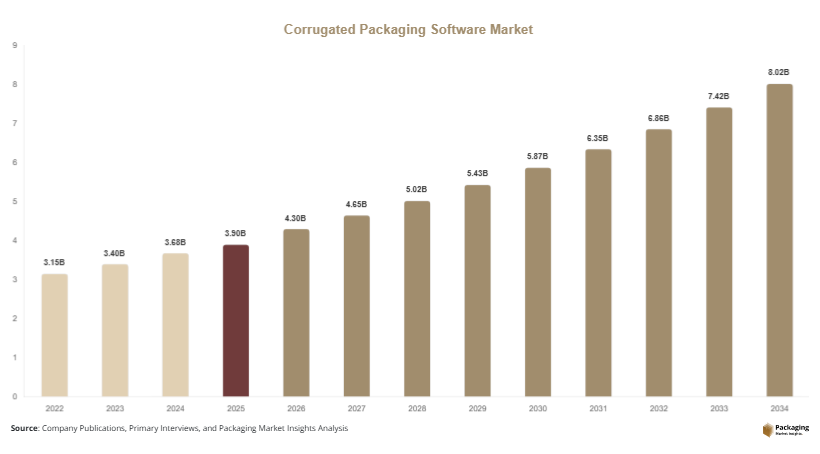
The global corrugated packaging software market was valued at approximately USD 3.9 billion in 2025 and is expected to reach USD 4.3 billion in 2026. By 2034, the market is forecasted to reach nearly USD 8.7 billion, expanding at a CAGR of 8.1% during 2025–2034. Corrugated packaging software solutions are widely used for structural design, production planning, workflow automation, inventory management, order tracking, and print optimization within corrugated packaging manufacturing operations. The corrugated packaging software market is witnessing consistent growth due to the increasing digitization of packaging operations, rising demand for customized corrugated packaging, and the growing adoption of automation technologies across manufacturing facilities.
The increasing expansion of e-commerce and retail logistics is one of the primary factors driving market growth. Corrugated packaging manufacturers are facing rising demand for customized boxes, sustainable shipping solutions, and rapid order fulfillment. Software platforms help companies improve operational efficiency, reduce production waste, and optimize packaging design processes. As online retail continues to expand globally, packaging manufacturers are investing in advanced software tools to manage complex production environments and improve supply chain coordination.
Key Highlights
- Asia Pacific dominated the market with a 36.9% share in 2025.
- North America is projected to grow at the fastest CAGR of 8.6%.
- Cloud-based software led the deployment segment with a 41.7% share.
- Box design and production planning applications dominated with a 33.6% share.
- Large enterprises led the organization size segment with 58.2% share.
- The US remained the dominant country with a market size of USD 1.1 billion in 2025 and USD 1.2 billion in 2026.
Explore more data points, trends and opportunities Download Free Sample Report
Market Trends
Increasing Adoption of Cloud-Based Packaging Management Platforms
Cloud-based software platforms are becoming a major trend in the corrugated packaging software market due to their flexibility, scalability, and cost efficiency. Packaging manufacturers are increasingly shifting from traditional on-premise systems to cloud-based solutions that enable centralized production management and real-time collaboration across facilities. These platforms provide features such as remote monitoring, automated scheduling, inventory tracking, and production analytics. Cloud integration also improves data accessibility for packaging designers, machine operators, and supply chain managers. Small and medium-sized enterprises are particularly adopting cloud-based software because of lower upfront infrastructure costs and simplified software maintenance. This trend is expected to accelerate as corrugated packaging companies focus on improving digital connectivity and operational efficiency.
Integration of Artificial Intelligence and Predictive Analytics
Artificial intelligence and predictive analytics are increasingly being integrated into corrugated packaging software systems to improve operational performance and reduce manufacturing inefficiencies. AI-powered software tools can analyze production data, predict machine failures, optimize packaging dimensions, and automate workflow scheduling. Corrugated packaging manufacturers are using predictive analytics to reduce downtime, improve order accuracy, and minimize raw material waste. These systems also support demand forecasting and inventory optimization by analyzing historical production and customer purchasing patterns. The growing adoption of Industry 4.0 technologies is encouraging software vendors to develop advanced analytics platforms tailored to packaging manufacturing environments. This trend is expected to support higher automation levels and smarter packaging production processes across global markets.
Market Drivers
Expansion of E-Commerce and Logistics Industries
The rapid growth of e-commerce and logistics operations is a major driver supporting the corrugated packaging software market. Online retailers require large volumes of corrugated packaging products for shipping, storage, and product protection. Packaging manufacturers are therefore under pressure to improve production speed, reduce packaging waste, and manage customized order requirements efficiently. Corrugated packaging software enables companies to automate production planning, optimize box dimensions, and improve inventory management processes. The increasing demand for same-day and next-day delivery services is also encouraging packaging converters to adopt digital workflow solutions for faster manufacturing and order processing. As global e-commerce activities continue to expand, demand for intelligent packaging management software is expected to rise significantly.
Rising Demand for Sustainable Packaging Solutions
The growing focus on sustainable packaging practices is another key factor driving market growth. Corrugated packaging manufacturers are increasingly adopting software solutions that help reduce raw material consumption, optimize transportation efficiency, and improve recyclability. Packaging design software allows manufacturers to create lightweight box structures while maintaining product protection standards. Companies are also using production optimization software to reduce energy usage and manufacturing waste. Regulatory pressure related to environmental sustainability is encouraging businesses to invest in digital systems that support eco-friendly packaging production. Rising consumer preference for recyclable and biodegradable packaging products is expected to further strengthen demand for advanced corrugated packaging software solutions during the forecast period.
Market Restraint
High Initial Integration Costs and Technical Complexity
One of the major restraints affecting the corrugated packaging software market is the high cost associated with software integration and digital infrastructure upgrades. Many corrugated packaging manufacturers still operate with legacy systems and manual production processes, making digital transformation expensive and technically challenging. Implementing advanced software solutions often requires investments in cloud infrastructure, automation systems, employee training, and machine connectivity upgrades. Small and medium-sized enterprises may face difficulties adopting sophisticated software platforms because of budget limitations and limited technical expertise. For example, integrating AI-driven workflow management software with existing production equipment can require substantial customization and extended implementation periods. In addition, cybersecurity concerns related to cloud-based production systems may discourage some manufacturers from fully digitizing packaging operations. Operational disruptions during software migration and employee resistance to new technologies can further affect implementation efficiency. These factors may slow software adoption rates in certain cost-sensitive manufacturing environments, particularly among smaller packaging companies with limited digital infrastructure capabilities.
Market Opportunities
Growth of Smart Manufacturing and Industry 4.0 Technologies
The increasing adoption of smart manufacturing technologies presents significant opportunities for the corrugated packaging software market. Packaging manufacturers are investing in Industry 4.0 solutions that combine automation, artificial intelligence, cloud computing, and industrial Internet of Things technologies. Corrugated packaging software integrated with smart sensors and connected production equipment enables real-time monitoring, predictive maintenance, and automated quality control. Manufacturers are seeking software platforms capable of improving machine efficiency, reducing downtime, and supporting data-driven decision-making processes. The growing emphasis on digital factory operations is expected to increase demand for intelligent software systems that enhance productivity and operational transparency within corrugated packaging facilities.
Rising Adoption of Customized and Digital Printing Packaging
The increasing demand for customized packaging and digital printing solutions is creating strong growth opportunities within the market. Brand owners are focusing on personalized packaging designs and short-run production cycles to improve customer engagement and product differentiation. Corrugated packaging software enables rapid box design modifications, automated artwork management, and efficient digital printing integration. Packaging converters are adopting advanced design and workflow software to manage high volumes of customized orders while maintaining production accuracy. The growing popularity of subscription boxes, promotional packaging, and branded e-commerce shipments is expected to further strengthen demand for flexible corrugated packaging software platforms during the forecast period.
Report Scope
| Report Metric | Details |
|---|---|
| Market Size in 2025 | USD 3.9 Billion |
| Market Size in 2026 | USD 4.3 Billion |
| Market Size in 2034 | USD 8.7 Billion |
| CAGR | 8.1% (2026-2034) |
| Base Year for Estimation | 2025 |
| Historical Data | 2022-2024 |
| Forecast Period | 2026-2034 |
| Report Coverage | Revenue Forecast, Competitive Landscape, Supply Chain Disruption, Growth Factors, Environment & Regulatory Landscape and Trends |
| Geographies Covered | North America, Europe, APAC, Middle East and Africa, LATAM |
| Countries Covered | U.S., Canada, U.K., Germany, France, Spain, Italy, Russia, Nordic, Benelux, Rest of Europe, China, South Korea, Japan, India, Australia, Singapore, Taiwan, South East Asia, Rest of Asia-Pacific, UAE, Turky, Saudi Arabia, South Africa, Egypt, Nigeria, Rest of MEA, Brazil, Mexico, Argentina, Chile, Colombia, Rest of LATAM |
Explore more data points, trends and opportunities Download Free Sample Report
Segmental Analysis
By Deployment Type
Cloud-based software dominated the corrugated packaging software market in 2024, accounting for approximately 41.7% of the total market share. Cloud deployment models are widely preferred because they provide scalability, remote accessibility, and reduced infrastructure costs for packaging manufacturers. These systems enable real-time monitoring of production workflows, inventory levels, and order processing activities across multiple manufacturing facilities. Corrugated packaging companies are increasingly adopting cloud-based software to improve collaboration between design teams, production managers, and logistics departments. The integration of cloud platforms with industrial automation systems is also supporting improved production efficiency and operational transparency. Growing demand for flexible and cost-effective software solutions continues to strengthen adoption within this segment.
AI-enabled workflow software is expected to grow at the fastest CAGR of 9.4% during the forecast period. Packaging manufacturers are investing in artificial intelligence-driven software systems to automate production planning, improve predictive maintenance capabilities, and reduce operational inefficiencies. AI-enabled platforms can analyze production data to optimize machine performance, forecast packaging demand, and improve resource allocation. The growing complexity of customized packaging production and short-run manufacturing cycles is encouraging companies to adopt intelligent workflow automation tools. Software vendors are also integrating advanced analytics and machine learning technologies into packaging management platforms to support data-driven operational decisions. These factors are expected to accelerate segment growth over the coming years.
By Application
Box design and production planning applications dominated the market in 2024 with approximately 33.6% share due to increasing demand for customized corrugated packaging solutions across e-commerce, retail, and logistics industries. Packaging manufacturers rely on software platforms for structural box design, dimension optimization, print layout management, and production scheduling. These systems help reduce raw material waste while improving packaging durability and transportation efficiency. Corrugated packaging converters are increasingly adopting advanced design tools capable of supporting digital printing integration and rapid product customization. The growing popularity of branded packaging and subscription-based product shipments is also contributing to demand within this application segment.
Inventory optimization applications are projected to witness the fastest growth, registering a CAGR of 8.9% during the forecast period. Packaging manufacturers are focusing on inventory management software to improve stock visibility, reduce storage costs, and optimize supply chain coordination. These systems enable real-time tracking of packaging materials, finished products, and production schedules across manufacturing facilities. Rising fluctuations in raw material costs and growing demand for just-in-time manufacturing practices are encouraging businesses to invest in intelligent inventory management solutions. Integration with enterprise resource planning systems and warehouse automation technologies is further strengthening adoption within this application segment.
By Organization Size
Large enterprises dominated the corrugated packaging software market in 2024, accounting for approximately 58.2% of total market share. Large packaging manufacturers operate extensive production networks that require advanced workflow management, inventory tracking, and production scheduling capabilities. These organizations invest significantly in automation technologies and cloud-based software systems to improve operational efficiency and maintain production consistency across multiple facilities. Large enterprises are also adopting AI-driven analytics platforms to support predictive maintenance and optimize resource utilization. Growing demand for sustainable packaging and customized production capabilities continues to encourage software investments among major corrugated packaging companies.
Small and medium enterprises are expected to grow at the fastest CAGR of 9.1% during the forecast period. SMEs are increasingly adopting affordable cloud-based software solutions to improve operational efficiency and compete with larger packaging manufacturers. Subscription-based deployment models and simplified implementation processes are making digital packaging management platforms more accessible for smaller businesses. The rising demand for customized packaging services from regional retailers and e-commerce businesses is also encouraging SMEs to invest in production planning and inventory management software. Increasing awareness regarding workflow automation and material optimization is expected to further strengthen growth within this segment.
Corrugated Packaging Software Market Segmentations
By Deployment Type
- Cloud-Based Software
- On-Premise Software
- Hybrid Deployment Solutions
By Application
- Box Design & Production Planning
- Inventory Optimization
- Print & Artwork Management
- Workflow Automation
- Supply Chain Management
By Organization Size
- Large Enterprises
- Small & Medium Enterprises
Regional Analysis
North America
North America accounted for approximately 28.4% of the global corrugated packaging software market share in 2025 and is projected to grow at a CAGR of 8.6% during the forecast period. Strong adoption of digital manufacturing technologies, advanced logistics infrastructure, and rising demand for sustainable packaging solutions are supporting market growth across the region. Corrugated packaging manufacturers are increasingly investing in cloud-based workflow systems and automation software to improve production efficiency and reduce operational costs.
The United States dominates the North American market because of its large e-commerce industry and advanced packaging manufacturing ecosystem. A unique growth factor is the rapid expansion of omnichannel retail operations requiring efficient packaging production and order management systems. Packaging companies are increasingly deploying AI-powered software solutions to improve inventory visibility, optimize shipping box dimensions, and manage customized packaging requirements.
Europe
Europe represented nearly 24.1% of the global market share in 2025 and is expected to register a CAGR of 7.8% during the forecast period. The region is witnessing growing adoption of sustainable packaging practices and digital production technologies across packaging manufacturing facilities. Corrugated packaging companies are focusing on software systems that support material optimization, waste reduction, and compliance with environmental regulations.
Germany remains the dominant country in the European market due to its strong industrial manufacturing sector and advanced automation capabilities. A unique growth factor is the increasing integration of smart factory technologies within packaging production facilities. Manufacturers are investing in predictive maintenance software and automated workflow management systems to improve production reliability and operational efficiency.
Asia Pacific
Asia Pacific dominated the corrugated packaging software market with a 36.9% share in 2025 and is projected to expand at a CAGR of 8.3% during the forecast period. Rapid industrialization, rising e-commerce penetration, and expanding manufacturing activities are major factors driving regional market growth. Packaging manufacturers across China, India, Japan, and Southeast Asia are increasingly adopting digital software platforms to improve packaging production and logistics management.
China dominates the Asia Pacific market because of its extensive manufacturing infrastructure and large packaging production capacity. A unique growth factor is the rapid expansion of cross-border e-commerce operations requiring advanced packaging workflow management systems. Corrugated packaging companies are investing in cloud-based software and automated design platforms to improve production scalability and order processing efficiency.
Middle East & Africa
The Middle East & Africa region accounted for approximately 4.6% of the global market share in 2025 and is projected to grow at a CAGR of 6.7% during the forecast period. Increasing industrial development, growing retail activities, and rising investments in logistics infrastructure are supporting demand for corrugated packaging software across the region. Businesses are adopting digital packaging management systems to improve supply chain efficiency and reduce packaging waste.
The United Arab Emirates dominates the regional market because of its expanding logistics and distribution sector. A unique growth factor is the growing development of regional fulfillment centers supporting e-commerce and international trade operations. Packaging companies are implementing automated production planning and inventory management software to improve packaging throughput and operational coordination.
Latin America
Latin America represented approximately 6.0% of the corrugated packaging software market share in 2025 and is expected to grow at a CAGR of 7.2% during the forecast period. Rising consumer goods production, increasing e-commerce activities, and expanding packaging manufacturing operations are contributing to regional market growth. Corrugated packaging companies are investing in digital software systems to improve operational visibility and reduce manufacturing inefficiencies.
Brazil dominates the Latin American market due to its growing retail packaging and food distribution industries. A unique growth factor is the increasing modernization of local packaging manufacturing facilities through digital workflow automation. Packaging converters are adopting software platforms for production scheduling, inventory management, and packaging design optimization to improve competitiveness within regional markets.
Competitive Landscape
The corrugated packaging software market is characterized by increasing competition among software providers focusing on automation, cloud integration, and packaging workflow optimization technologies. Companies are investing heavily in artificial intelligence, predictive analytics, and industrial Internet of Things integration to strengthen product capabilities and improve customer experience. Strategic partnerships between packaging software vendors and corrugated packaging manufacturers are becoming increasingly common as businesses seek customized digital workflow solutions.
EFI is recognized as one of the leading companies in the market because of its broad portfolio of corrugated packaging workflow automation and production management solutions. In 2025, the company launched an upgraded cloud-based packaging management platform with enhanced AI-driven production scheduling capabilities. Other major players include Esko, Arden Software, Amtech Software, and Packsize International. These companies are focusing on software scalability, integration with digital printing technologies, and real-time production analytics to improve market competitiveness.
Competition is expected to intensify further as corrugated packaging manufacturers continue investing in digital transformation initiatives and smart factory technologies. Market participants are also emphasizing cybersecurity, sustainable packaging optimization, and remote operational management features to meet evolving customer requirements.