Homogenizers Market Size and Growth
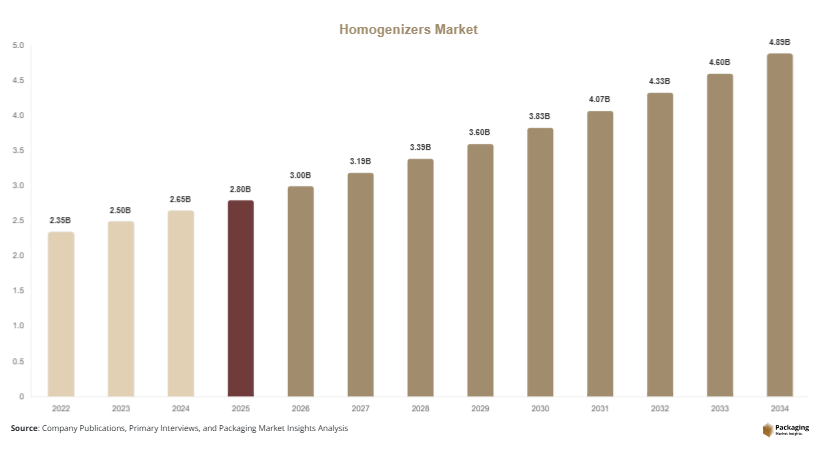
The global homogenizers market size is estimated at USD 2.8 billion in 2025, and it is projected to reach approximately USD 3.0 billion in 2026. By 2034, the market is forecast to reach nearly USD 5.2 billion, registering a CAGR of 6.3% during 2025–2034. The homogenizers market is witnessing stable expansion due to increasing demand for advanced fluid processing equipment across food & beverage, pharmaceutical, biotechnology, cosmetics, and chemical industries. Homogenizers are widely used to reduce particle size, improve product consistency, and enhance stability in emulsions and suspensions.
One of the primary growth factors supporting the market is the rapid expansion of processed and functional food production. Dairy products, beverages, sauces, and plant-based foods increasingly require homogenization technologies to ensure smooth texture and longer shelf life. Another major growth factor is the increasing pharmaceutical and biotechnology manufacturing sector, where homogenizers are essential for vaccine production, nanoemulsions, and injectable formulations. Rising investments in biologics and biosimilars are further supporting equipment demand globally.
Key Highlights:
- Asia Pacific dominated the market with a 36.9% share in 2025.
- Latin America is projected to grow at the fastest CAGR of 6.8%.
- High-pressure homogenizers led the type segment with a 34.7% share.
- Stainless steel systems dominated the material segment with a 58.4% share.
- Food & beverage applications led the market with 46.2% share.
- The US remained the dominant country with a market size of USD 720 million in 2025 and USD 765 million in 2026.
Explore more data points, trends and opportunities Download Free Sample Report
Market Trends
Rising Adoption of Automation and Smart Processing Systems
The homogenizers market is increasingly shifting toward automated and digitally connected processing systems. Manufacturers are integrating smart sensors, programmable controls, and remote monitoring features into homogenizers to improve production efficiency and reduce operational errors. Food and pharmaceutical manufacturers are investing in automated homogenization systems to maintain consistent particle distribution and product quality across large production batches. For example, dairy processing plants are using IoT-enabled homogenizers that can track pressure levels and operational performance in real time. The future impact of this trend is expected to include predictive maintenance capabilities, lower energy consumption, and improved production scalability, particularly in high-volume industrial processing facilities.
Growth of Plant-Based and Functional Food Processing
The increasing popularity of plant-based beverages and functional nutrition products is significantly influencing the homogenizers market. Products such as oat milk, almond milk, protein drinks, and nutritional emulsions require advanced homogenization to achieve smooth texture and stable formulations. Food manufacturers are adopting high-pressure homogenizers to improve consistency and extend shelf life without affecting nutritional value. For instance, beverage companies producing dairy alternatives are expanding homogenizer installations to support rising consumer demand. This trend is expected to create long-term growth opportunities as consumers increasingly prefer health-focused and protein-enriched food products across global markets.
Market Drivers
Expansion of Pharmaceutical and Biotechnology Manufacturing
The rapid growth of pharmaceutical and biotechnology industries is a major driver of the homogenizers market. Homogenizers are essential for producing vaccines, injectable drugs, liposomal formulations, and biologics that require precise particle size reduction and stable emulsions. Increasing investment in biologics manufacturing has created strong demand for laboratory-scale and industrial homogenization systems. For example, biotechnology firms developing monoclonal antibodies use advanced homogenizers to maintain formulation consistency during production. The cause-and-effect relationship is clear, as growing pharmaceutical output directly increases demand for high-performance processing equipment that can ensure compliance with strict quality standards.
Rising Demand for Processed and Packaged Foods
The increasing consumption of processed and convenience foods is another important driver supporting market expansion. Food manufacturers rely on homogenizers to improve texture, stability, and appearance in products such as milk, yogurt, sauces, soups, and dressings. Rapid urbanization and changing dietary habits are increasing the production of packaged foods worldwide. For example, large dairy processing companies are upgrading homogenization systems to support rising demand for flavored milk and probiotic beverages. This growth in packaged food production continues to strengthen the requirement for reliable homogenization equipment across industrial processing facilities.
Market Restraint
High Initial Investment and Maintenance Costs
One of the major restraints affecting the homogenizers market is the high capital investment associated with advanced homogenization systems. Industrial high-pressure homogenizers require significant upfront expenditure, particularly for large-scale food, pharmaceutical, and biotechnology applications. In addition to installation costs, maintenance expenses related to valves, seals, pumps, and pressure components can increase operational spending over time. Small and medium-sized enterprises often face budget limitations that restrict the adoption of premium systems. For example, regional food processors in developing economies may continue using traditional mixing technologies instead of investing in automated homogenizers. This financial barrier can slow market penetration, especially in cost-sensitive industries and emerging markets where infrastructure investment remains limited.
Market Opportunities
Expansion of Laboratory and Research Applications
The increasing number of biotechnology research projects and pharmaceutical development activities presents strong opportunities for the homogenizers market. Laboratory-scale homogenizers are widely used in nanoparticle research, cell disruption, and drug formulation studies. Universities, pharmaceutical laboratories, and biotechnology startups are investing in compact homogenization systems to support innovation and product development. For instance, research organizations involved in mRNA vaccine development require advanced homogenizers for lipid nanoparticle preparation. As biotechnology research expands globally, demand for precision homogenization equipment is expected to increase significantly.
Growth in Emerging Food Processing Industries
Emerging economies are witnessing rapid growth in food processing infrastructure, creating substantial opportunities for homogenizer manufacturers. Countries such as India, Brazil, Indonesia, and Vietnam are expanding dairy processing, beverage manufacturing, and packaged food production facilities. Increasing urban populations and rising disposable income levels are supporting consumption of processed foods that require homogenization technology. For example, regional beverage producers are investing in modern processing lines equipped with energy-efficient homogenizers. The future outlook remains positive as governments continue supporting domestic food manufacturing and cold chain development across emerging markets.
Report Scope
| Report Metric | Details |
|---|---|
| Market Size in 2025 | USD 2.8 Billion |
| Market Size in 2026 | USD 3.0 Billion |
| Market Size in 2034 | USD 5.2 Billion |
| CAGR | 6.3% (2026-2034) |
| Base Year for Estimation | 2025 |
| Historical Data | 2022-2024 |
| Forecast Period | 2026-2034 |
| Report Coverage | Revenue Forecast, Competitive Landscape, Supply Chain Disruption, Growth Factors, Environment & Regulatory Landscape and Trends |
| Geographies Covered | North America, Europe, APAC, Middle East and Africa, LATAM |
| Countries Covered | U.S., Canada, U.K., Germany, France, Spain, Italy, Russia, Nordic, Benelux, Rest of Europe, China, South Korea, Japan, India, Australia, Singapore, Taiwan, South East Asia, Rest of Asia-Pacific, UAE, Turky, Saudi Arabia, South Africa, Egypt, Nigeria, Rest of MEA, Brazil, Mexico, Argentina, Chile, Colombia, Rest of LATAM |
Explore more data points, trends and opportunities Download Free Sample Report
Segmental Analysis
By Type
High-pressure homogenizers dominated the homogenizers market in 2024, accounting for approximately 34.7% of the total market share. These systems are widely used across food processing, pharmaceutical manufacturing, dairy production, and biotechnology applications because of their ability to achieve uniform particle size reduction and stable emulsification. High-pressure homogenizers are particularly important in milk processing, where they improve texture, consistency, and shelf life. Pharmaceutical manufacturers also depend on these systems for injectable formulations, nanoemulsions, and vaccine production. Their ability to operate under controlled pressure conditions while ensuring consistent product quality has strengthened their adoption across industrial processing facilities. In addition, food manufacturers are increasingly upgrading older systems with automated high-pressure homogenizers that improve energy efficiency and reduce maintenance requirements. Growing demand for packaged dairy products, nutritional beverages, and pharmaceutical biologics continues to support the dominance of this segment globally.
Ultrasonic homogenizers are projected to be the fastest-growing type segment, registering a CAGR of 7.2% during the forecast period. These homogenizers use ultrasonic waves to disrupt particles and create stable emulsions, making them highly suitable for laboratory research, biotechnology studies, and specialty pharmaceutical applications. Increasing demand for precision processing in nanotechnology and cell disruption applications is driving adoption of ultrasonic systems. Biotechnology companies developing advanced drug delivery systems are increasingly investing in compact ultrasonic homogenizers to support research activities. The cosmetics industry is also adopting these systems for premium skincare and serum formulations that require fine emulsification. Furthermore, rising investments in research laboratories and pharmaceutical innovation centers across Asia Pacific and North America are expected to create long-term growth opportunities for ultrasonic homogenizer manufacturers.
By Material
Stainless steel systems dominated the homogenizers market in 2024 with a market share of approximately 58.4%. Stainless steel remains the preferred material because of its corrosion resistance, durability, hygienic properties, and ability to withstand high operational pressures. Food and beverage manufacturers widely use stainless steel homogenizers because they comply with strict hygiene and safety standards required in dairy, beverage, and processed food production. Pharmaceutical companies also rely heavily on stainless steel systems due to their compatibility with sterile processing environments. In large-scale dairy processing plants, stainless steel homogenizers are commonly integrated into automated production lines for milk, yogurt, and cream products. The material’s resistance to chemical reactions and high temperatures further supports its dominance in industrial applications. Additionally, manufacturers continue investing in advanced stainless steel designs that improve energy efficiency and reduce cleaning time in food and pharmaceutical facilities.
Corrosion-resistant alloy systems are expected to witness the fastest growth, expanding at a CAGR of 6.6% during the forecast period. These materials are increasingly used in applications involving aggressive chemicals, biotechnology formulations, and high-acid food processing environments. Pharmaceutical and chemical manufacturers are adopting advanced alloy homogenizers to improve equipment lifespan and reduce operational downtime caused by material degradation. For example, biotechnology companies processing enzyme-based formulations often require specialized alloy systems capable of handling reactive substances under high pressure conditions. Demand for corrosion-resistant materials is also increasing in marine food processing and industrial chemical applications where standard stainless steel systems may face performance limitations. In the future, technological advancements in material engineering and rising investments in sustainable processing infrastructure are expected to strengthen adoption of advanced alloy homogenization systems globally.
By End-Use
Food & beverage applications dominated the homogenizers market in 2024, holding approximately 46.2% of the total market share. The segment benefits from rising consumption of processed dairy products, flavored beverages, sauces, dressings, and plant-based nutritional drinks. Homogenizers play a critical role in maintaining product consistency, improving texture, and extending shelf life in food processing operations. Dairy manufacturers extensively use homogenization systems for milk, yogurt, cream, and cheese production to achieve stable fat distribution and improved sensory quality. Beverage companies are also increasing investments in high-capacity homogenizers to support rising demand for protein drinks, fruit beverages, and functional nutrition products. In addition, food safety regulations are encouraging manufacturers to adopt advanced processing equipment that ensures consistent quality standards. Expanding urban populations and changing consumer dietary habits continue to support strong demand for homogenization technologies in global food processing industries.
Biotechnology applications are projected to register the fastest CAGR of 7.0% during the forecast period. Rising research activities related to biologics, biosimilars, gene therapies, and vaccine production are significantly increasing demand for advanced homogenization systems. Biotechnology laboratories use homogenizers for cell disruption, nanoparticle preparation, and formulation development processes that require precise particle size control. For example, pharmaceutical companies developing lipid nanoparticle-based therapies are investing in high-performance homogenizers to improve drug delivery efficiency. Increasing funding for biotechnology startups and research institutions is further accelerating segment growth. In addition, personalized medicine and biologic drug production are expected to expand rapidly over the coming years, creating long-term opportunities for laboratory-scale and industrial homogenizer manufacturers worldwide.
Homogenizers Market Segmentations
By Type
- High-Pressure Homogenizers
- Ultrasonic Homogenizers
- Mechanical Homogenizers
- Laboratory Homogenizers
- Vacuum Homogenizers
By Material
- Stainless Steel Systems
- Corrosion-Resistant Alloy Systems
- Carbon Steel Systems
- Hybrid Composite Materials
By End-User
- Food & Beverage
- Pharmaceuticals
- Biotechnology
- Cosmetics & Personal Care
- Chemical Processing
Regional Analysis
North America
North America accounted for approximately 29.1% of the global homogenizers market share in 2025 and is projected to grow at a CAGR of 5.9% during the forecast period. The region benefits from a highly developed food processing sector, advanced pharmaceutical manufacturing capabilities, and strong technological adoption across industrial facilities. Food companies in the United States and Canada increasingly use automated homogenization systems to improve product consistency and operational efficiency. Growth in plant-based beverage manufacturing and biologics production is further supporting regional demand. Additionally, rising investment in laboratory research equipment is creating additional opportunities for homogenizer manufacturers operating across North America.
The United States dominates the North American homogenizers market due to its large pharmaceutical, dairy, and biotechnology industries. A unique growth driver in the country is the increasing production of protein-enriched beverages and nutritional supplements. Beverage manufacturers are adopting advanced high-pressure homogenizers to improve texture and maintain ingredient stability in protein drinks and meal replacement products. Pharmaceutical companies are also investing in compact laboratory homogenizers for biologics and vaccine development. Furthermore, the expansion of contract manufacturing organizations is contributing to rising equipment demand across industrial processing facilities in the United States.
Europe
Europe held around 24.8% of the global homogenizers market share in 2025 and is expected to expand at a CAGR of 5.8% during the forecast period. The region benefits from strong pharmaceutical manufacturing, high dairy product consumption, and increasing demand for energy-efficient food processing equipment. European manufacturers are increasingly adopting automated homogenizers equipped with digital monitoring systems to improve process efficiency and reduce energy usage. The cosmetics industry is also contributing to regional demand, particularly for homogenizers used in creams, lotions, and skincare formulations. Growing emphasis on sustainable manufacturing processes is supporting investment in advanced processing technologies across Europe.
Germany is the leading country in the European homogenizers market due to its advanced industrial infrastructure and strong engineering sector. One unique growth factor is the increasing use of homogenization systems in premium dairy and cheese production. German dairy manufacturers are investing in energy-efficient processing equipment to maintain product quality while reducing operational costs. In addition, pharmaceutical companies are expanding biologics production facilities that require precision homogenization technologies. The country’s strong export-oriented food and pharmaceutical industries continue to support long-term market growth for homogenizer manufacturers operating in Germany.
Asia Pacific
Asia Pacific dominated the homogenizers market with a 36.9% share in 2025 and is projected to register the fastest regional CAGR of 6.9% during the forecast period. Rapid industrialization, expanding food processing infrastructure, and rising pharmaceutical manufacturing activities are driving strong market growth across the region. Countries such as China, India, Japan, and South Korea are investing heavily in dairy processing, biotechnology research, and beverage production facilities. Increasing urbanization and changing dietary preferences are boosting demand for processed foods and nutritional beverages requiring homogenization technology. Furthermore, growing exports of packaged food products are supporting installation of advanced industrial processing systems.
China remains the dominant country in the Asia Pacific homogenizers market due to its extensive manufacturing ecosystem and large-scale food processing industry. A unique growth driver in China is the rapid expansion of plant-based beverage manufacturing. Domestic beverage companies are investing in modern homogenization systems to improve product texture and shelf stability in soy milk, oat milk, and protein drinks. The biotechnology sector is also growing rapidly, creating demand for laboratory and industrial homogenizers used in biologics production. Additionally, government support for domestic pharmaceutical manufacturing continues to strengthen the country’s processing equipment market.
Middle East & Africa
The Middle East & Africa region accounted for approximately 4.9% of the global homogenizers market in 2025 and is forecast to grow at a CAGR of 6.1% through 2034. Growth in the region is supported by expanding food manufacturing activities, increasing dairy processing investments, and rising pharmaceutical imports. Gulf countries are investing in advanced food production infrastructure to reduce dependence on imports and strengthen domestic manufacturing capabilities. Demand for homogenizers is increasing in beverage, dairy, and personal care applications. In addition, improving industrial automation and logistics infrastructure is supporting adoption of modern processing technologies across regional manufacturing facilities.
The United Arab Emirates dominates the Middle East & Africa homogenizers market because of its strong food processing and hospitality industries. One unique growth driver is the expansion of premium beverage manufacturing and bottled dairy product production. Local beverage companies are increasingly using advanced homogenization systems to improve consistency and shelf stability in flavored milk and juice products. The country is also investing in pharmaceutical manufacturing capabilities to strengthen healthcare infrastructure. Furthermore, increasing tourism and hospitality activities are supporting consumption of processed food and beverage products that require advanced homogenization technologies.
Latin America
Latin America represented around 4.3% of the global homogenizers market share in 2025 and is projected to expand at a CAGR of 6.8% during the forecast period. The market is benefiting from rising dairy consumption, increasing processed food production, and expanding pharmaceutical manufacturing activities. Countries across the region are modernizing food processing facilities to improve production efficiency and product quality. Demand for homogenizers is particularly strong in beverage manufacturing and dairy processing applications. In addition, increasing foreign investment in regional pharmaceutical production is contributing to market growth for industrial homogenization systems.
Brazil dominates the Latin American homogenizers market due to its large dairy and beverage manufacturing industries. One unique growth factor is the increasing export of processed dairy products requiring stable emulsions and consistent texture. Dairy producers are investing in high-capacity homogenizers to improve production efficiency and meet international quality standards. The cosmetics sector is also contributing to equipment demand, particularly for emulsification and formulation applications. Moreover, growing investments in food processing automation and packaging modernization are expected to strengthen long-term market growth across Brazil.
Competitive Landscape
The global homogenizers market is moderately competitive, with major companies focusing on product innovation, automation technologies, and strategic expansion initiatives to strengthen their market presence. Manufacturers are increasingly investing in energy-efficient homogenization systems equipped with digital monitoring, automated pressure controls, and predictive maintenance capabilities. The market leader, GEA Group AG, maintains a strong position through its extensive industrial processing portfolio and global distribution network. The company recently introduced advanced high-pressure homogenizers designed for dairy and biotechnology applications with improved operational efficiency and reduced energy consumption.
Other major players include SPX FLOW, Krones AG, Bertoli Homogenizers, and Sonic Corporation. These companies are emphasizing research and development activities to introduce compact laboratory systems and large-scale industrial homogenizers for pharmaceutical and food processing applications. Strategic collaborations with dairy manufacturers and biotechnology firms are also supporting market expansion. Several companies are increasing investments in Asia Pacific production facilities to meet growing regional demand. In addition, manufacturers are focusing on sustainable engineering practices by developing homogenizers that reduce water consumption, operational noise, and carbon emissions during industrial processing activities.
Key Players List
- GEA Group AG
- SPX FLOW Inc.
- Krones AG
- Bertoli Homogenizers
- Sonic Corporation
- FBF Italia Srl
- NETZSCH Group
- Microfluidics International Corporation
- Ekato Holding GmbH
- Avestin Inc.
- Bosch Packaging Technology
- Silverson Machines
- Alfa Laval AB
- IDEX Corporation
- Simes SA