Semiconductor Packaging Equipment Market Size and Growth
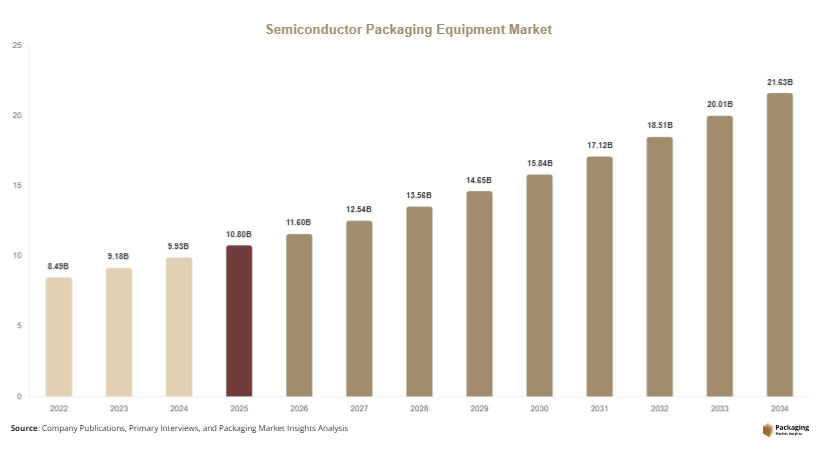
The global semiconductor packaging equipment market was valued at approximately USD 10.8 billion in 2025 and is expected to reach USD 11.6 billion in 2026. By 2034, the market is projected to attain nearly USD 21.7 billion, expanding at a CAGR of 8.1% during 2025–2034. Semiconductor packaging equipment includes machinery and systems used for assembly, bonding, encapsulation, inspection, and testing of semiconductor chips before final integration into electronic products. The semiconductor packaging equipment market is experiencing strong growth due to the rising demand for advanced semiconductor devices across consumer electronics, automotive, telecommunications, industrial automation, and data center applications.
The increasing adoption of artificial intelligence, 5G infrastructure, electric vehicles, and high-performance computing systems is one of the primary growth factors driving the semiconductor packaging equipment market. These technologies require compact, energy-efficient, and high-speed semiconductor devices with advanced packaging capabilities. Semiconductor manufacturers are therefore investing in next-generation packaging equipment that supports miniaturization, improved thermal management, and higher chip density.
Key Highlights
- Asia Pacific dominated the market with a 46.7% share in 2025.
- North America is projected to grow at the fastest CAGR of 8.5%.
- Die bonding equipment led the equipment type segment with a 31.9% share.
- Outsourced semiconductor assembly and test providers dominated the end-use segment with a 40.8% share.
- Consumer electronics applications led the market with a 37.5% share, while automotive semiconductor packaging is expected to grow at a CAGR of 9.1%.
- The US remained the dominant country with a market size of USD 2.4 billion in 2025 and USD 2.6 billion in 2026.
Explore more data points, trends and opportunities Download Free Sample Report
Market Trends
Rising Adoption of Advanced Packaging Technologies
Advanced semiconductor packaging technologies are becoming a major trend within the semiconductor packaging equipment market. Manufacturers are increasingly adopting fan-out wafer-level packaging, 2.5D and 3D packaging, and system-in-package designs to improve chip performance and reduce device size. These technologies support higher input and output density while improving thermal efficiency and signal transmission speed. Semiconductor companies are investing in high-precision bonding and encapsulation equipment capable of handling complex package architectures. The growing demand for artificial intelligence processors, data center chips, and high-performance mobile devices is accelerating the shift toward advanced packaging solutions. This trend is expected to increase investments in next-generation packaging equipment and automation systems across global semiconductor manufacturing facilities.
Integration of Automation and AI in Packaging Equipment
Automation and artificial intelligence integration are transforming semiconductor packaging equipment operations. Manufacturers are adopting AI-enabled inspection systems, robotic handling technologies, and predictive maintenance platforms to improve manufacturing efficiency and reduce production defects. Automated packaging equipment allows faster chip assembly processes while supporting higher precision and consistency in high-volume semiconductor manufacturing environments. AI-driven analytics systems are also being used to monitor equipment performance and optimize packaging workflows in real time. Semiconductor fabrication facilities are increasingly investing in smart factory infrastructure to reduce labor dependency and improve operational reliability. This trend is expected to accelerate as semiconductor manufacturers focus on increasing productivity and maintaining quality standards across advanced packaging applications.
Market Drivers
Increasing Demand for Consumer Electronics and Smart Devices
The growing demand for consumer electronics and connected smart devices is a major driver supporting the semiconductor packaging equipment market. Smartphones, tablets, wearable electronics, gaming consoles, and smart appliances require compact semiconductor components with advanced packaging capabilities. Semiconductor packaging equipment is essential for assembling chips with improved power efficiency, thermal management, and miniaturized designs suitable for modern electronic products. The rapid expansion of Internet of Things devices and smart home technologies is further increasing semiconductor production volumes worldwide. Electronics manufacturers are investing in advanced packaging infrastructure to support product innovation and maintain supply chain competitiveness. Rising consumer demand for faster and more energy-efficient electronic devices is expected to continue driving market growth during the forecast period.
Expansion of Electric Vehicles and Automotive Electronics
The increasing adoption of electric vehicles and advanced automotive electronics is another major growth driver influencing the semiconductor packaging equipment market. Modern vehicles require large numbers of semiconductor chips for battery management systems, driver assistance technologies, infotainment systems, and power electronics. Automotive semiconductor components must meet strict reliability and thermal performance standards, increasing the need for advanced packaging technologies. Semiconductor packaging equipment capable of supporting high-power and high-temperature applications is therefore experiencing rising demand. Government initiatives supporting electric mobility and vehicle electrification are encouraging automotive manufacturers to increase semiconductor procurement and invest in secure supply chain partnerships. This trend is expected to strengthen long-term market expansion for advanced packaging equipment providers.
Market Restraint
High Capital Investment and Technological Complexity
One of the major restraints affecting the semiconductor packaging equipment market is the high capital investment required for advanced packaging equipment and manufacturing infrastructure. Semiconductor packaging systems involve sophisticated bonding, inspection, encapsulation, and testing technologies that require substantial financial resources for procurement and maintenance. Small and medium-sized semiconductor manufacturers may struggle to adopt advanced packaging equipment due to budget limitations and high operational costs. In addition, rapid technological advancements in chip packaging designs require continuous equipment upgrades and specialized engineering expertise. For example, implementing 3D packaging systems and wafer-level packaging equipment often requires facility modifications, precision robotics, and highly skilled technical personnel. These factors can increase production costs and delay investment decisions for some manufacturers. Supply chain disruptions related to semiconductor materials and electronic components can also affect equipment availability and lead times. The combination of high investment requirements and technical complexity may therefore limit market adoption in cost-sensitive manufacturing environments during the forecast period.
Market Opportunities
Growth of Artificial Intelligence and High-Performance Computing Chips
The rapid expansion of artificial intelligence and high-performance computing applications presents substantial growth opportunities for the semiconductor packaging equipment market. AI processors and advanced computing chips require sophisticated packaging technologies capable of supporting high-speed data processing, improved heat dissipation, and compact form factors. Semiconductor manufacturers are increasingly investing in advanced packaging equipment such as hybrid bonding systems and fan-out wafer-level packaging technologies to meet these requirements. Data centers, cloud computing platforms, and AI-driven industrial systems are creating strong demand for high-performance semiconductor components. This trend is expected to encourage further investment in next-generation packaging infrastructure and precision assembly equipment.
Increasing Government Support for Domestic Semiconductor Manufacturing
Governments across major economies are increasing investments in domestic semiconductor manufacturing capabilities, creating favorable opportunities for packaging equipment suppliers. Countries such as the United States, China, South Korea, Japan, and members of the European Union are introducing financial incentives, infrastructure programs, and supply chain localization initiatives to strengthen semiconductor independence. Packaging equipment manufacturers are benefiting from rising investments in new semiconductor fabrication facilities and assembly plants. Public-private partnerships supporting advanced chip packaging research and manufacturing expansion are also increasing demand for innovative packaging systems. This opportunity is expected to strengthen long-term market growth across both developed and emerging semiconductor production regions.
Report Scope
| Report Metric | Details |
|---|---|
| Market Size in 2025 | USD 10.8 Billion |
| Market Size in 2026 | USD 11.6 Billion |
| Market Size in 2034 | USD 21.7 Billion |
| CAGR | 8.1% (2026-2034) |
| Base Year for Estimation | 2025 |
| Historical Data | 2022-2024 |
| Forecast Period | 2026-2034 |
| Report Coverage | Revenue Forecast, Competitive Landscape, Supply Chain Disruption, Growth Factors, Environment & Regulatory Landscape and Trends |
| Geographies Covered | North America, Europe, APAC, Middle East and Africa, LATAM |
| Countries Covered | U.S., Canada, U.K., Germany, France, Spain, Italy, Russia, Nordic, Benelux, Rest of Europe, China, South Korea, Japan, India, Australia, Singapore, Taiwan, South East Asia, Rest of Asia-Pacific, UAE, Turky, Saudi Arabia, South Africa, Egypt, Nigeria, Rest of MEA, Brazil, Mexico, Argentina, Chile, Colombia, Rest of LATAM |
Explore more data points, trends and opportunities Download Free Sample Report
Segmental Analysis
By Equipment Type
Die bonding equipment dominated the semiconductor packaging equipment market in 2024, accounting for approximately 31.9% of the total market share. Die bonding systems are widely used for attaching semiconductor chips to substrates or lead frames with high precision and reliability. These systems are essential for manufacturing consumer electronics, automotive semiconductors, industrial sensors, and communication devices. Semiconductor manufacturers prefer advanced die bonding equipment because it supports miniaturization, improved electrical performance, and efficient heat dissipation. The growing production of smartphones, wearable electronics, and connected devices is further increasing demand for high-speed die bonding technologies. Automation capabilities and AI-driven inspection systems are also improving operational efficiency within this equipment segment.
Advanced wafer-level packaging equipment is expected to grow at the fastest CAGR of 9.2% during the forecast period. Wafer-level packaging technologies enable semiconductor manufacturers to achieve smaller package sizes, higher chip density, and improved electrical performance. These systems are increasingly used for artificial intelligence processors, 5G communication chips, and high-performance computing applications. Semiconductor companies are investing in advanced wafer-level packaging equipment to support compact and energy-efficient device architectures. The increasing adoption of fan-out wafer-level packaging and heterogeneous integration technologies is further accelerating market demand. Rising investments in advanced semiconductor manufacturing facilities are expected to create substantial opportunities for this segment over the coming years.
By Application
Consumer electronics applications dominated the market in 2024 with approximately 37.5% share due to rising global demand for smartphones, laptops, gaming systems, smart televisions, and wearable devices. Semiconductor packaging equipment plays a critical role in producing compact, lightweight, and high-performance chips for modern electronic products. Electronics manufacturers are increasingly investing in advanced packaging technologies to improve power efficiency, processing speed, and thermal management capabilities. The rapid growth of smart home devices and Internet of Things applications is also supporting semiconductor production expansion. High-volume manufacturing requirements within the consumer electronics sector continue to increase demand for automated packaging equipment and precision bonding systems.
Automotive semiconductor packaging is projected to witness the fastest growth, registering a CAGR of 9.1% during the forecast period. Electric vehicles, advanced driver assistance systems, infotainment systems, and autonomous driving technologies require sophisticated semiconductor components with high reliability and thermal stability. Semiconductor packaging equipment designed for automotive applications must support durable packaging structures capable of operating under extreme environmental conditions. Automotive manufacturers are increasing partnerships with semiconductor suppliers to secure advanced chip packaging solutions for next-generation mobility technologies. Government incentives supporting vehicle electrification and connected transportation systems are expected to further strengthen demand within this segment.
By End-Use
Outsourced semiconductor assembly and test providers dominated the semiconductor packaging equipment market in 2024, accounting for approximately 40.8% of total market share. OSAT companies specialize in semiconductor assembly, packaging, and testing services for fabless semiconductor manufacturers and integrated device manufacturers. These providers invest heavily in advanced packaging equipment to handle large production volumes efficiently while maintaining high quality standards. The increasing complexity of semiconductor packaging designs and rising demand for specialized assembly solutions are supporting growth within this segment. OSAT providers are also expanding investments in automation technologies, wafer-level packaging systems, and AI-enabled inspection platforms to improve manufacturing productivity and operational flexibility.
Integrated device manufacturers are expected to grow at the fastest CAGR of 8.7% during the forecast period. Semiconductor companies are increasingly expanding internal packaging capabilities to strengthen supply chain control and improve product customization. IDMs are investing in advanced packaging equipment for artificial intelligence chips, automotive semiconductors, and high-performance computing devices. The growing importance of secure semiconductor supply chains and government-supported domestic chip manufacturing initiatives are encouraging IDMs to increase in-house packaging infrastructure investments. This trend is expected to accelerate demand for advanced packaging systems capable of supporting complex semiconductor architectures and next-generation electronic applications.
Semiconductor Packaging Equipment Market Segmentations
By Equipment Type
- Die Bonding Equipment
- Wire Bonding Equipment
- Wafer-Level Packaging Equipment
- Encapsulation Equipment
- Inspection & Testing Equipment
By Application
- Consumer Electronics
- Automotive Electronics
- Telecommunications
- Industrial Applications
- Healthcare Electronics
By End-User
- Outsourced Semiconductor Assembly & Test Providers
- Integrated Device Manufacturers
- Foundries
- Research & Development Facilities
Regional Analysis
North America
North America accounted for approximately 24.8% of the global semiconductor packaging equipment market share in 2025 and is projected to grow at a CAGR of 8.5% during the forecast period. Increasing investments in domestic semiconductor manufacturing, advanced packaging research, and artificial intelligence chip development are supporting market growth across the region. Government incentives encouraging semiconductor supply chain localization are also contributing to rising demand for advanced packaging equipment and smart factory infrastructure.
The United States dominates the North American market because of its strong semiconductor design ecosystem and expanding investment in advanced chip manufacturing facilities. A unique growth factor is the increasing development of AI processors and data center semiconductors requiring advanced packaging technologies. Semiconductor companies are investing heavily in wafer-level packaging and high-density chip assembly systems to improve performance and energy efficiency.
Europe
Europe represented nearly 18.6% of the global market share in 2025 and is expected to register a CAGR of 7.4% during the forecast period. The region is witnessing increasing investments in automotive semiconductor production and industrial electronics manufacturing. European semiconductor companies are focusing on advanced packaging technologies to support electric vehicle systems, industrial automation, and telecommunications infrastructure.
Germany remains the dominant country in the European market due to its strong automotive electronics industry and engineering capabilities. A unique growth factor is the rapid expansion of semiconductor demand for electric mobility and industrial robotics applications. Manufacturers are increasing investments in precision packaging equipment to support high-reliability automotive semiconductor production and advanced sensor integration technologies.
Asia Pacific
Asia Pacific dominated the semiconductor packaging equipment market with a 46.7% share in 2025 and is projected to expand at a CAGR of 8.2% during the forecast period. Strong semiconductor manufacturing infrastructure, high consumer electronics production, and increasing investments in chip fabrication facilities are major factors driving regional market growth. Countries such as China, Taiwan, South Korea, and Japan continue to lead global semiconductor assembly and packaging activities.
China dominates the Asia Pacific market due to its extensive electronics manufacturing ecosystem and growing domestic semiconductor industry. A unique growth factor is the increasing government support for semiconductor self-sufficiency and local chip production expansion. Manufacturers are investing in advanced packaging facilities and automation technologies to strengthen domestic semiconductor supply chains and reduce import dependency.
Middle East & Africa
The Middle East & Africa region accounted for approximately 3.8% of the global market share in 2025 and is projected to grow at a CAGR of 6.5% during the forecast period. Rising investments in digital infrastructure, telecommunications networks, and industrial automation are supporting semiconductor demand across the region. Governments are also increasing focus on technology diversification and electronics manufacturing initiatives.
The United Arab Emirates dominates the regional market because of its expanding technology infrastructure and increasing investment in smart city development projects. A unique growth factor is the growing adoption of data centers and cloud computing facilities requiring advanced semiconductor components. Businesses are investing in semiconductor supply chain partnerships to support regional digital transformation initiatives.
Latin America
Latin America represented approximately 6.1% of the semiconductor packaging equipment market share in 2025 and is expected to grow at a CAGR of 7.0% during the forecast period. Increasing electronics manufacturing activities, rising automotive production, and expanding telecommunications infrastructure are supporting regional market growth. Countries across the region are also focusing on improving semiconductor supply chain participation through industrial development initiatives.
Brazil dominates the Latin American market due to its growing automotive electronics and consumer appliance manufacturing industries. A unique growth factor is the increasing production of connected automotive systems and industrial automation equipment. Semiconductor packaging equipment demand is rising as manufacturers expand local electronics assembly capabilities to reduce import dependency and improve regional production efficiency.
Competitive Landscape
The semiconductor packaging equipment market is highly competitive, with global semiconductor equipment manufacturers focusing on technological innovation, automation integration, and advanced packaging capabilities. Companies are investing heavily in research and development to improve wafer-level packaging systems, hybrid bonding technologies, and AI-enabled inspection equipment. Strategic collaborations between semiconductor manufacturers and equipment suppliers are also increasing as demand for high-performance packaging solutions continues to grow.
ASMPT Limited is recognized as one of the leading companies in the market due to its broad portfolio of semiconductor assembly and packaging solutions. In 2025, the company introduced advanced hybrid bonding equipment designed for next-generation AI semiconductor applications. Other major market participants include Tokyo Electron Limited, Kulicke & Soffa Industries, BE Semiconductor Industries N.V., and TOWA Corporation. These companies continue expanding manufacturing capacity and automation capabilities to strengthen market competitiveness.
Competition is expected to intensify further as semiconductor manufacturers increase investments in advanced packaging technologies for artificial intelligence, automotive electronics, and 5G communication systems. Market participants are also focusing on sustainability, energy-efficient equipment designs, and smart manufacturing integration to address evolving industry requirements.
Key Players List
- ASMPT Limited
- Tokyo Electron Limited
- Kulicke & Soffa Industries
- BE Semiconductor Industries N.V.
- TOWA Corporation
- Applied Materials Inc.
- Advantest Corporation
- Hitachi High-Tech Corporation
- DISCO Corporation
- Canon Machinery Inc.
- Panasonic Connect Co., Ltd.
- Hanmi Semiconductor Co., Ltd.
- Palomar Technologies
- Fasford Technology Co., Ltd.
- Shinkawa Ltd.