Microplastic Recycling Market Size and Growth
Market Overview
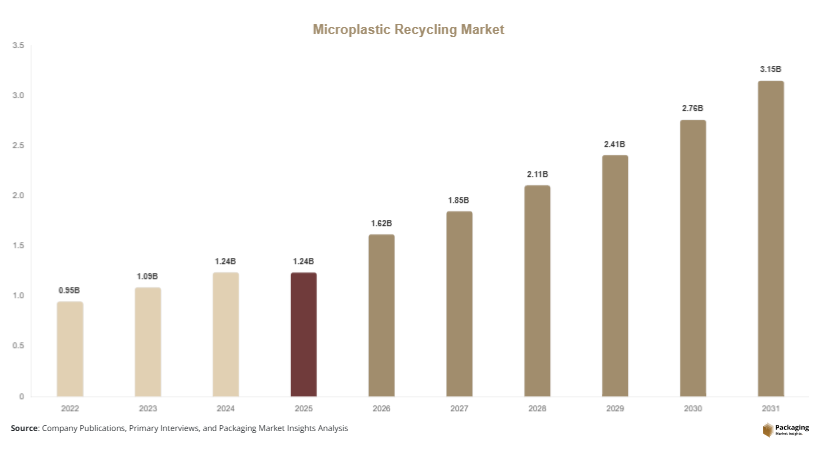
The Microplastic Recycling Market was valued at USD 1.42 billion in 2025 and is projected to reach USD 3.18 billion by 2030, expanding at a CAGR of 14.2% during 2025–2031. The market is gaining traction as environmental concerns over microplastic pollution intensify across marine ecosystems, freshwater systems, and soil environments. Governments, research institutions, and private stakeholders are investing in advanced technologies to capture, process, and recycle microplastics into reusable materials.
A key global factor supporting the growth of the Microplastic Recycling Market is the increasing enforcement of environmental regulations targeting plastic waste and microplastic discharge. Regulatory frameworks mandating wastewater filtration, industrial effluent treatment, and circular economy practices are pushing industries to adopt microplastic recovery and recycling solutions. Additionally, rising awareness among consumers and corporations about sustainability is encouraging the integration of recycled microplastic materials into manufacturing processes.
Key Highlights:
- Europe dominated the market in 2025 with a 34.6% share, while Asia Pacific will register the fastest CAGR of 16.1% through 2031.
- Primary microplastics led the type segment, while secondary microplastics recycling will grow fastest at a CAGR of 15.3%.
- Polyethylene (PE) dominated the material segment, while polypropylene (PP) will be the fastest-growing at 15.8% CAGR.
- Wastewater treatment emerged as the leading application, whereas industrial recycling systems will grow fastest at 16.5% CAGR.
- Germany led the market with USD 310 million in 2025 and is expected to reach USD 345 million in 2026.
Explore more data points, trends and opportunities Download Free Sample Report
Market Trends
Integration of Advanced Filtration and AI-Based Sorting
The Microplastic Recycling Market is witnessing a shift toward advanced filtration systems combined with AI-driven sorting technologies. Companies are adopting membrane filtration, electrocoagulation, and nanotechnology to capture microplastics efficiently from wastewater streams. AI-enabled sorting systems are further improving the classification of microplastic particles based on polymer type and size. This integration enhances recovery rates and reduces operational costs, making recycling processes more scalable and commercially viable.
Circular Economy Adoption Across Industries
Another notable trend is the increasing incorporation of recycled microplastics into circular economy models. Industries such as textiles, packaging, and construction are utilizing recycled microplastic materials to reduce dependence on virgin plastics. This trend is supported by sustainability commitments from multinational corporations and regulatory mandates promoting recycled content usage. As a result, the Microplastic Recycling Market is evolving from a niche environmental solution into a key component of global resource efficiency strategies.
Market Drivers
Rising Regulatory Pressure on Plastic Pollution
Governments worldwide are implementing stringent policies to control plastic waste and microplastic emissions. Regulations targeting single-use plastics, wastewater discharge standards, and marine pollution are driving demand for microplastic recycling technologies. Compliance requirements are compelling industries to invest in recycling infrastructure, thereby accelerating market growth.
Increasing Industrial Adoption of Sustainable Materials
Industries are increasingly shifting toward sustainable production practices, including the use of recycled materials. Microplastic recycling provides an alternative feedstock for manufacturing processes, particularly in packaging and consumer goods. This shift is driven by corporate sustainability goals, investor expectations, and consumer demand for eco-friendly products, boosting the Microplastic Recycling Market.
Market Restraint
High Cost and Technological Complexity
One of the major restraints in the Microplastic Recycling Market is the high cost associated with advanced recycling technologies and infrastructure. Capturing and processing microplastics requires sophisticated equipment such as high-precision filtration systems and chemical treatment units. Additionally, the heterogeneous nature of microplastics complicates sorting and recycling processes. These challenges increase operational costs and limit scalability, particularly in developing regions. As a result, market adoption may be slower in cost-sensitive industries.
Market Opportunities
Development of Scalable Recycling Technologies
The development of cost-effective and scalable recycling technologies presents a significant opportunity in the Microplastic Recycling Market. Innovations in chemical recycling, enzymatic degradation, and modular filtration systems are expected to reduce costs and improve efficiency. These advancements will enable wider adoption across industries and regions.
Expansion in Emerging Economies
Emerging economies in Asia Pacific, Latin America, and Africa offer substantial growth opportunities due to increasing urbanization and plastic consumption. Governments in these regions are beginning to address microplastic pollution through policy initiatives and infrastructure investments. This creates a favorable environment for market expansion and technology deployment.
Report Scope
| Report Metric | Details |
|---|---|
| Market Size in 2025 | USD 1.24 Billion |
| Market Size in 2026 | USD 1.62 Billion |
| Market Size in 2031 | USD 3.63 Billion |
| CAGR | 14.2% (2026-2031) |
| Base Year for Estimation | 2025 |
| Historical Data | 2022-2024 |
| Forecast Period | 2026-2031 |
| Report Coverage | Revenue Forecast, Competitive Landscape, Supply Chain Disruption, Growth Factors, Environment & Regulatory Landscape and Trends |
| Geographies Covered | North America, Europe, APAC, Middle East and Africa, LATAM |
| Countries Covered | U.S., Canada, U.K., Germany, France, Spain, Italy, Russia, Nordic, Benelux, Rest of Europe, China, South Korea, Japan, India, Australia, Singapore, Taiwan, South East Asia, Rest of Asia-Pacific, UAE, Turky, Saudi Arabia, South Africa, Egypt, Nigeria, Rest of MEA, Brazil, Mexico, Argentina, Chile, Colombia, Rest of LATAM |
Explore more data points, trends and opportunities Download Free Sample Report
Segmental Analysis
By Type
Primary microplastics dominated the Microplastic Recycling Market in 2024, accounting for 58.3% of the share, driven by their widespread presence in industrial products such as cosmetics and cleaning agents.
Secondary microplastics will grow at a CAGR of 15.3%, supported by increasing efforts to recycle degraded plastic waste from environmental sources.
By Material
Polyethylene (PE) held the largest share of 36.7% in 2024, owing to its extensive use in packaging and consumer products.
Polypropylene (PP) will register the fastest growth at a CAGR of 15.8%, driven by its rising application in automotive and industrial sectors.
By Technology
Mechanical recycling dominated with a 42.5% share in 2024, due to its cost-effectiveness and widespread adoption.
Chemical recycling will grow at a CAGR of 16.7%, as it enables the breakdown of complex microplastics into reusable raw materials.
By Application
Wastewater treatment led the market with a 40.2% share in 2024, as microplastics are commonly found in water systems.
Industrial recycling systems will grow at a CAGR of 16.5%, driven by increasing adoption in manufacturing facilities.
By End-Use Industry
The packaging industry dominated with a 33.8% share in 2024, supported by high plastic consumption.
The textile industry will grow at a CAGR of 15.9%, due to rising concerns over microfiber pollution.
Microplastic Recycling Market Segmentations
By Type:
- Primary Microplastics
- Secondary Microplastics
By Material:
- Polyethylene (PE)
- Polypropylene (PP)
- Polystyrene (PS)
- Polyethylene Terephthalate (PET)
- Others
By Technology:
- Mechanical Recycling
- Chemical Recycling
- Biological Recycling
By Application:
- Wastewater Treatment
- Marine Cleanup
- Industrial Recycling
- Soil Remediation
By End-Use Industry:
- Packaging
- Textiles
- Automotive
- Construction
- Consumer Goods
Regional Analysis
North America
North America accounted for 22.8% of the Microplastic Recycling Market share in 2025 and will grow at a CAGR of 13.5% through 2033. The region’s growth is supported by strong environmental policies and investments in advanced recycling technologies.
The United States dominated the regional market due to its robust research ecosystem and industrial adoption of recycling technologies. Federal initiatives targeting water pollution and plastic waste management have driven investments in microplastic filtration and recycling systems.
Europe
Europe held the largest share of 34.6% in 2025 and will expand at a CAGR of 13.8% during the forecast period. The region benefits from stringent environmental regulations and widespread adoption of circular economy practices.
Germany emerged as the leading country, driven by its advanced waste management infrastructure and strong industrial base. The country’s focus on sustainable manufacturing and recycling innovation has positioned it as a key contributor to market growth.
Asia Pacific
Asia Pacific accounted for 25.2% of the market in 2025 and is projected to grow at the fastest CAGR of 16.1%. Rapid industrialization and increasing plastic consumption are driving demand for recycling solutions.
China dominated the region due to its large-scale manufacturing sector and government initiatives to reduce plastic pollution. Investments in wastewater treatment and recycling infrastructure are supporting market expansion.
Middle East & Africa
The Middle East & Africa held 9.4% of the market share in 2025 and will grow at a CAGR of 12.6%. The region is gradually adopting recycling technologies to address environmental challenges.
United Arab Emirates led the market, driven by government initiatives focused on sustainability and waste management. Investments in smart city projects are also contributing to the adoption of microplastic recycling systems.
Latin America
Latin America accounted for 8.0% of the market in 2025 and is expected to grow at a CAGR of 12.9%. Increasing awareness of environmental issues is driving demand for recycling solutions.
Brazil dominated the region due to its large population and growing industrial base. Government efforts to improve waste management infrastructure are supporting the growth of the Microplastic Recycling Market.
Competitive Landscape
The Microplastic Recycling Market is moderately fragmented, with several players focusing on technological innovation and strategic partnerships. Key companies are investing in R&D to enhance recycling efficiency and reduce costs.
The market leader, Veolia Environnement, has strengthened its position through investments in advanced filtration and recycling technologies. The company recently launched a new microplastic recovery solution for wastewater treatment plants, improving capture efficiency.
Other notable players include SUEZ, BASF SE, Dow Inc., and Aquafil S.p.A., each contributing to market development through innovation and sustainability initiatives.
Key Players in the Microplastic Recycling Market
- Veolia Environnement
- SUEZ Group
- BASF SE
- Dow Inc.
- Aquafil S.p.A.
- Plastics Energy
- Loop Industries
- Carbios
- TOMRA Systems
- Waste Management Inc.
- TerraCycle
- Borealis AG
- Indorama Ventures
- Covestro AG
- Renewlogy