Pet Material Packaging Market Size
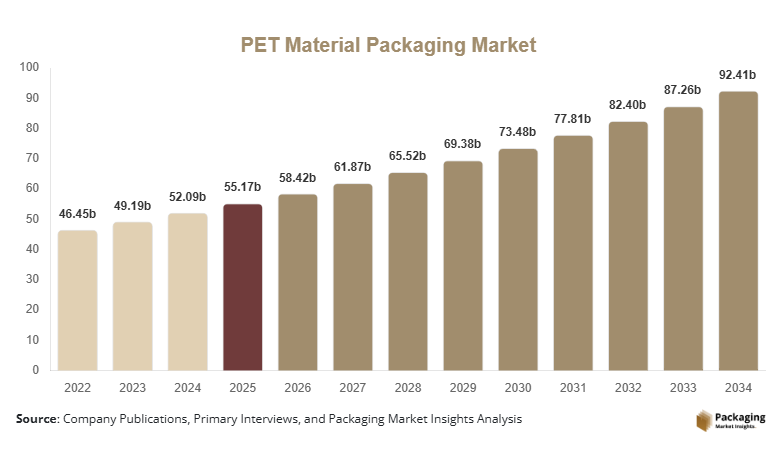
Pet Material Packaging market size is projected at USD 58.42 billion in 2026 and is expected to hit USD 92.15 billion by 2034 with a CAGR of 5.9%. Rising demand for lightweight packaging, recyclable plastics, and high-performance barrier materials continues to support industry expansion. The report evaluates production capacity, market segmentation, competitive landscape, and regional demand across major end-use industries.
PET material packaging refers to packaging products manufactured using polyethylene terephthalate (PET), offering superior strength, transparency, recyclability, and chemical resistance. Global PET packaging production exceeded 41.8 million metric tons during 2025, while recycled PET (rPET) utilization reached approximately 28% of total PET packaging production. PET bottles accounted for nearly 56% of total demand, PET films represented 24%, and PET trays & containers contributed 20%. Food & beverage packaging generated approximately 63% of worldwide consumption, reinforcing the Pet Material Packaging Market.
Explore more data points, trends and opportunities Download Free Sample Report
Pet Material Packaging Trends
Increasing Adoption of Recycled PET Packaging
The growing transition toward circular packaging solutions continues accelerating recycled PET adoption worldwide. Global rPET production exceeded 11.7 million metric tons during 2025, representing annual growth of 12.4%. More than 46% of beverage manufacturers increased recycled content in PET bottles, while food-grade rPET capacity expanded by approximately 15%, strengthening the Pet Material Packaging Market.
Packaging manufacturers continue investing in lightweight bottle technologies, mono-material packaging, and advanced barrier coatings. Industry investments exceeded USD 3.6 billion between 2023 and 2025, while lightweight PET bottle production reduced resin consumption by nearly 9%. Smart packaging integration increased by approximately 18%, supporting the Pet Material Packaging Market.
Pet Material Packaging Drivers
Growing Demand for Sustainable Food and Beverage Packaging
Increasing beverage consumption, expanding packaged food production, and corporate sustainability commitments continue driving PET packaging adoption. Global beverage packaging production exceeded 620 billion PET containers during 2025, while recyclable packaging adoption surpassed 61% among multinational consumer goods companies. Demand from packaged food manufacturers increased by approximately 10%, accelerating the Pet Material Packaging Market.
Pet Material Packaging Restraints
Volatility in PET Resin Prices
Fluctuating crude oil prices and raw material costs continue influencing PET resin pricing. Virgin PET resin prices increased by approximately 8% during 2025, while transportation and energy expenses rose nearly 7%. Regulatory pressure regarding single-use plastics also affects market expansion in selected regions, limiting the Pet Material Packaging Market.
Pet Material Packaging Opportunities
Expansion of Food-Grade Recycled PET
Growing investments in food-grade recycling infrastructure create significant opportunities for PET packaging manufacturers. Global food-grade rPET production capacity increased by 17% during 2025, while closed-loop recycling investments exceeded USD 2.4 billion. Brand commitments targeting 50% recycled content by 2030 continue creating long-term opportunities for the Pet Material Packaging Market.
Challenges in Pet Material Packaging Market
Collection and Recycling Infrastructure Gaps
Limited recycling infrastructure in developing economies continues restricting recycled PET availability. Global PET collection rates averaged approximately 59%, while recycling efficiency remained below 43% across several emerging markets. Contamination levels exceeding 11% continue increasing processing costs, creating challenges for the Pet Material Packaging Market.
Report Scope
| Report Metric | Details |
|---|---|
| Market Size in 2025 | USD 55.17 billion |
| Market Size in 2026 | USD 58.42 billion |
| Market Size in 2034 | USD 92.15 billion |
| CAGR | 5.9% (2026-2034) |
| Base Year for Estimation | 2025 |
| Historical Data | 2022-2024 |
| Forecast Period | 2026-2034 |
| Report Coverage | Revenue Forecast, Competitive Landscape, Supply Chain Disruption, Growth Factors, Environment & Regulatory Landscape and Trends |
| Geographies Covered | North America, Europe, APAC, Middle East and Africa, LATAM |
| Countries Covered | U.S., Canada, U.K., Germany, France, Spain, Italy, Russia, Nordic, Benelux, Rest of Europe, China, South Korea, Japan, India, Australia, Singapore, Taiwan, South East Asia, Rest of Asia-Pacific, UAE, Turky, Saudi Arabia, South Africa, Egypt, Nigeria, Rest of MEA, Brazil, Mexico, Argentina, Chile, Colombia, Rest of LATAM |
Explore more data points, trends and opportunities Download Free Sample Report
Pet Material Packaging Market Segmentation
The market is segmented by type and application. PET bottles accounted for approximately 56% of global revenue during 2025, while food & beverage packaging represented nearly 63% of worldwide consumption due to increasing demand for lightweight and recyclable packaging solutions.
By Type
PET bottles held approximately 56% of market revenue with annual production exceeding 620 billion units. Superior transparency, lightweight construction, impact resistance, and recyclability support extensive beverage and household product packaging applications.
PET films represented approximately 24% of worldwide demand with production exceeding 9.8 million metric tons. High tensile strength, dimensional stability, and moisture resistance make them suitable for flexible packaging and labeling.
PET trays & containers accounted for nearly 20% of market revenue, producing more than 8.3 million metric tons annually. These products offer excellent rigidity, food safety compliance, and microwave compatibility.
By Application
This segment generated approximately 63% of total market demand with annual production exceeding 26 million metric tons. Carbonated beverages, bottled water, edible oils, dairy products, and ready-to-eat meals continue driving PET packaging demand.
This application represented approximately 21% of global demand. Premium packaging appearance, chemical resistance, and lightweight properties continue supporting cosmetic bottle production.
Pharmaceutical packaging accounted for nearly 16% of worldwide consumption. PET provides moisture resistance, product safety, and excellent transparency for medical packaging applications.
PET Material Packaging Market Segmentations
Product Type
- PET Bottles
- PET Films
- PET Trays & Containers
Application
- Food & Beverage Packaging
- Personal Care & Cosmetics Packaging
- Pharmaceutical Packaging
Distribution Channel
- Direct Sales
- Packaging Distributors
- Online B2B Platforms
- OEM Supply Agreements
- Industrial Packaging Suppliers
Pet Material Packaging Regional Outlook
North America
North America accounted for approximately 29% of global revenue during 2025 with production exceeding 12.1 million metric tons annually. The United States represented nearly 82% of regional demand due to beverage packaging and food processing industries.
Europe
Europe represented approximately 27% of worldwide demand with annual PET packaging production exceeding 11.3 million metric tons. Germany, France, Italy, Spain, and the United Kingdom remain major contributors, supported by advanced recycling infrastructure.
Asia-Pacific
Asia-Pacific captured approximately 37% of global revenue. China, India, Japan, South Korea, and Southeast Asia accounted for over 78% of regional demand due to expanding food processing, beverage manufacturing, and consumer goods industries.
Latin America, Middle East & Africa
These regions collectively represented approximately 7% of global demand with production exceeding 2.9 million metric tons annually. Brazil, Mexico, Saudi Arabia, South Africa, and the UAE continue investing in sustainable PET packaging production.
Top players in Pet Material Packaging Market
- Amcor plc
- Berry Global Inc.
- ALPLA Group
- Plastipak Holdings Inc.
- Retal Industries Ltd.
- Gerresheimer AG
- Silgan Holdings Inc.
- Resilux NV
- Indorama Ventures Public Company Limited
- Greiner Packaging International GmbH
- Sonoco Products Company
- CCL Industries Inc.
Amcor plc
-
Estimated global market share of approximately 15%.
-
Strong portfolio of PET bottles, recyclable packaging, and sustainable material technologies.
-
Extensive manufacturing footprint across North America, Europe, Asia-Pacific, and Latin America.
-
Continuous investments in recycled PET solutions, lightweight packaging, and circular economy initiatives strengthen long-term market leadership.
Berry Global Inc.
-
Estimated market share of approximately 11% globally.
-
Leading supplier of rigid and flexible PET packaging solutions.
-
Strong presence in food, beverage, healthcare, and personal care packaging.
-
Ongoing investments in food-grade recycled PET, advanced packaging technologies, and sustainable manufacturing improve competitive positioning.