Overcaps Market Size
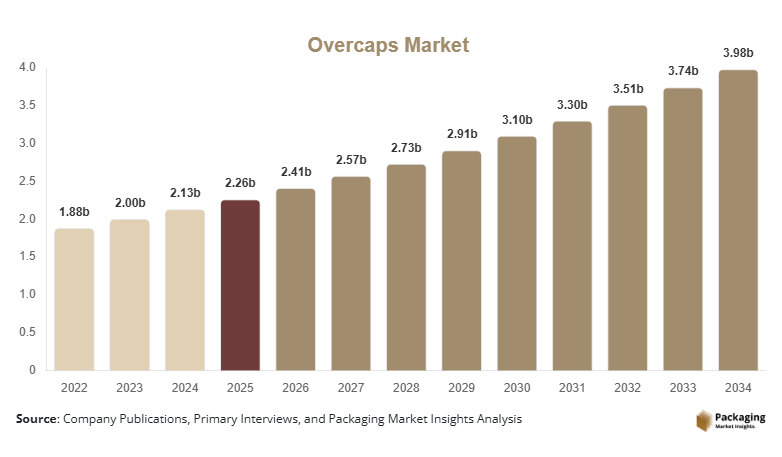
Overcaps market size is projected at USD 2.41 billion in 2026 and is expected to hit USD 3.98 billion by 2034 with a CAGR of 6.47%. The report provides comprehensive quantitative and qualitative analysis covering market performance from 2022–2025 and forecasts through 2034. It evaluates production capacity, pricing trends, raw material availability, distribution channels, competitive landscape, and segmentation across major end-use industries. More than 120 manufacturers, 45 countries, and annual production exceeding 92 billion overcaps are assessed to provide an accurate industry outlook.
The overcaps market comprises protective closures designed to shield dispensing valves, pumps, aerosol cans, bottles, and pharmaceutical packaging from contamination and accidental activation. Global production surpassed 92 billion units during 2025, with plastic overcaps contributing nearly 68% of total output. Food & beverage applications represented approximately 36% of demand, pharmaceuticals 28%, and personal care & cosmetics 24%, while automated packaging line adoption exceeded 71% among leading manufacturers, reinforcing the overcaps market.
Explore more data points, trends and opportunities Download Free Sample Report
Overcaps Trends
Rising Adoption of Sustainable Packaging Solutions
Manufacturers are increasingly replacing conventional plastics with recyclable polypropylene (PP), polyethylene (PE), and bio-based materials. More than 24 billion recyclable overcaps were produced in 2025, representing an annual increase of 13%. Sustainability initiatives have increased recycled resin utilization to nearly 32%, while lightweight designs reduced material consumption by approximately 11%, supporting overcaps market trends.
Growing investments exceeding USD 650 million in injection molding automation and recycled polymer processing continue improving production efficiency. Smart manufacturing technologies have reduced cycle times by 15% while maintaining defect rates below 2%, strengthening overcaps market trends.
Increasing Demand from Pharmaceutical Packaging
Pharmaceutical packaging continues generating strong demand due to increasing production of inhalers, spray pumps, nasal dispensers, and medical bottles. Annual pharmaceutical overcap production exceeded 18 billion units during 2025, while child-resistant packaging adoption increased above 42% across regulated markets.
Tamper-evident technologies, antimicrobial coatings, and precision-molded closures are becoming standard across premium pharmaceutical packaging. Manufacturers continue expanding production capacities to meet rising healthcare requirements, reinforcing overcaps market trends.
Overcaps Market Drivers
Expanding Demand for Packaged Consumer Goods
Global packaged food production exceeded 2.3 billion tons in 2025, while personal care product manufacturing surpassed 58 billion units. More than 74% of aerosol and dispensing products now utilize protective overcaps to improve product safety and shelf appeal. Rising investments in automated packaging continue accelerating Overcaps Market Growth.
Overcaps Market Restraints
Volatility in Polymer and Metal Prices
Polypropylene, polyethylene, and aluminum prices fluctuated between 9% and 17% during recent years. Raw materials account for nearly 61% of total manufacturing costs, while logistics contribute approximately 12%, creating margin pressure for manufacturers and influencing overall overcaps market performance.
Overcaps Market Opportunities
Growth in Premium Cosmetic and Healthcare Packaging
Luxury cosmetics, skincare products, pharmaceutical sprays, and premium beverage packaging continue creating new opportunities. Premium dispensing packaging production is expected to exceed 38 billion units by 2030, while demand for customized overcaps is projected to expand above 8% annually, creating significant opportunities for the overcaps market.
Challenges in Overcaps Market
Maintaining Product Precision Across High-Speed Manufacturing
Manufacturers must produce overcaps with dimensional tolerances below ±0.05 mm, cycle times under 6 seconds, and defect rates below 1.5% while operating production lines exceeding 450 units per minute. Maintaining quality alongside cost efficiency remains a significant challenge across the industry.
Report Scope
| Report Metric | Details |
|---|---|
| Market Size in 2025 | USD 2.26 billion |
| Market Size in 2026 | USD 2.41 billion |
| Market Size in 2034 | USD 3.98 billion |
| CAGR | 6.47% (2026-2034) |
| Base Year for Estimation | 2025 |
| Historical Data | 2022-2024 |
| Forecast Period | 2026-2034 |
| Report Coverage | Revenue Forecast, Competitive Landscape, Supply Chain Disruption, Growth Factors, Environment & Regulatory Landscape and Trends |
| Geographies Covered | North America, Europe, APAC, Middle East and Africa, LATAM |
| Countries Covered | U.S., Canada, U.K., Germany, France, Spain, Italy, Russia, Nordic, Benelux, Rest of Europe, China, South Korea, Japan, India, Australia, Singapore, Taiwan, South East Asia, Rest of Asia-Pacific, UAE, Turky, Saudi Arabia, South Africa, Egypt, Nigeria, Rest of MEA, Brazil, Mexico, Argentina, Chile, Colombia, Rest of LATAM |
Explore more data points, trends and opportunities Download Free Sample Report
Overcaps Market Segmentation
The market is segmented by material and end-use. Plastic overcaps dominate with approximately 68% of global revenue, while food & beverage applications account for nearly 36% of total demand due to extensive utilization across bottled beverages, aerosol products, and packaged foods.
By Material
Plastic Overcaps
Plastic overcaps account for nearly 68% of the market. Annual production exceeded 62 billion units during 2025. PP and HDPE remain the preferred materials because of lightweight construction, chemical resistance, dimensional stability, and cost-efficient injection molding suitable for high-volume manufacturing.
Metal Overcaps
Metal overcaps represent approximately 19% of global demand. Production surpassed 17 billion units, primarily serving premium beverages, industrial containers, and specialty packaging requiring superior mechanical strength, corrosion resistance, and decorative finishes.
Aluminum Overcaps
Aluminum overcaps contribute around 13% of total revenue. Annual production exceeded 13 billion units, offering lightweight construction, recyclability above 90%, premium aesthetics, and excellent barrier performance for pharmaceutical and cosmetic packaging.
By End-Use
Food & Beverage
Food & beverage remains the largest application with approximately 36% market share. Production exceeded 33 billion overcaps annually for bottled drinks, sauces, edible oils, aerosols, and convenience foods. High-speed filling compatibility and contamination protection continue driving adoption.
Pharmaceuticals
Pharmaceutical applications account for nearly 28% of total demand. More than 26 billion units were utilized across inhalers, nasal sprays, topical medications, and diagnostic products. Precision molding, tamper evidence, and contamination prevention remain critical technical requirements.
Personal Care & Cosmetics
Personal care & cosmetics contribute approximately 24% of market consumption. Annual usage exceeded 22 billion units for deodorants, perfumes, hair sprays, skincare products, and cosmetic dispensers. Premium appearance, customized colors, and ergonomic designs continue supporting product differentiation.
Overcaps Market Segmentations
Material
- Plastic Overcaps
- Metal Overcaps
- Aluminum Overcaps
End-Use
- Food & Beverage
- Pharmaceuticals
- Personal Care & Cosmetics
Overcaps Regional Outlook
North America
North America accounts for approximately 27% of global revenue. The United States contributes nearly 81% of regional demand, supported by pharmaceutical manufacturing, packaged food production, and personal care industries. Annual production exceeds 24 billion units, with automation penetration above 76%.
Europe
Europe represents nearly 29% of the global market. Germany, France, Italy, and the United Kingdom account for approximately 74% of regional consumption. Strong sustainability regulations and advanced packaging technologies continue supporting market expansion.
Asia-Pacific
Asia-Pacific dominates the market with approximately 35% global share. China contributes nearly 48% of regional production, followed by India, Japan, and South Korea. Regional manufacturing exceeds 32 billion overcaps annually due to expanding consumer goods, pharmaceutical, and cosmetics industries.
Middle East & Africa
The Middle East & Africa account for approximately 4% of global demand. GCC countries represent nearly 58% of regional consumption, supported by investments in packaged food manufacturing and healthcare infrastructure.
Latin America
Latin America contributes approximately 5% of global revenue. Brazil and Mexico collectively account for nearly 71% of regional demand, driven by beverage production, cosmetics manufacturing, and pharmaceutical packaging.
Top players in Overcaps Market
- Berry Global Inc.
- Silgan Holdings Inc.
- AptarGroup Inc.
- Berlin Packaging
- Amcor plc
- O.Berk Company LLC
- United Caps
- Closure Systems International Inc.
- Guala Closures S.p.A.
- Albéa Group
- Tecnocap S.p.A.
- Cap & Seal Pvt. Ltd.
- C.L. Smith Company
- M&H Plastics Ltd.
- Plastic Closures Limited
Berry Global Inc.
-
Estimated global market share: 13–15%
-
Berry Global maintains a leading position through extensive production capabilities across North America, Europe, and Asia. The company manufactures billions of packaging closures annually using advanced injection molding technologies. Its diversified product portfolio includes sustainable overcaps, pharmaceutical closures, and food packaging solutions. Continued investments in recycled polymers, lightweight packaging, and automation strengthen its competitive position while supporting global customer requirements across consumer goods and healthcare industries.
AptarGroup Inc.
-
Estimated global market share: 10–12%
-
AptarGroup is recognized for high-performance dispensing systems and precision closure technologies. The company supplies pharmaceutical, beauty, personal care, and food manufacturers across more than 20 countries. Significant investments in innovative dispensing solutions, recyclable materials, and digital manufacturing technologies enhance operational efficiency and product quality. Its strong research capabilities continue supporting premium packaging applications worldwide.