Industrial Film Market Size
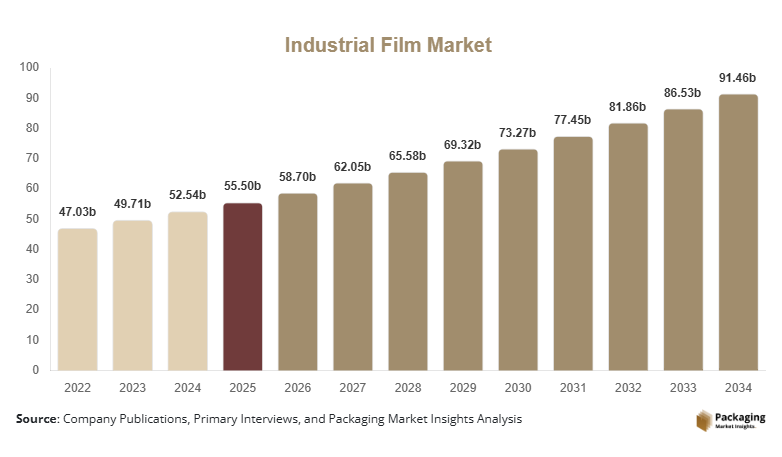
Industrial Film market size is projected at USD 58.7 billion in 2026 and is expected to hit USD 91.6 billion by 2034 with a CAGR of 5.7%. The market expansion is supported by increasing demand for protective films, barrier materials, flexible packaging solutions, and high-performance polymer films across industrial sectors. Comprehensive segmentation analysis, production assessment, and competitive landscape evaluation provide detailed insights into emerging opportunities and technological advancements.
The Industrial Film Market includes polymer-based films manufactured for industrial applications such as packaging, construction, automotive components, electronics protection, and manufacturing processes. Global production exceeded 52.4 million metric tons in 2025, with polyethylene films accounting for nearly 46% of total volume. Packaging applications contributed approximately 54% of demand, followed by construction at 19% and automotive applications at 15%. Advanced recyclable and specialty films achieved adoption rates of nearly 38% among industrial users, strengthening the Industrial Film Market.
Explore more data points, trends and opportunities Download Free Sample Report
Industrial Film Market Trends
Increasing Adoption of Sustainable and High-Performance Films
Manufacturers are shifting toward recyclable polymers, bio-based materials, and multilayer barrier films to meet sustainability targets. Global production of sustainable industrial films exceeded 8.9 million metric tons in 2025, representing nearly 17% of total industrial film output. More than 42% of packaging companies have adopted downgauged films to reduce material consumption by approximately 15–20%, supporting the Industrial Film Market Trend.
Advanced extrusion technologies, nanocoatings, and smart film solutions are transforming industrial applications. Over 12.6 million tons of specialty industrial films were produced in 2025, while demand from electronics, automotive, and healthcare sectors increased by 14.5% annually. Nearly 55% of large manufacturers are investing in automated film processing technologies to improve efficiency and product quality across the Industrial Film Market.
Industrial Film Market Drivers
Rising Demand from Flexible Packaging and Manufacturing Industries
The expansion of flexible packaging and industrial manufacturing is a major growth driver. Global flexible packaging consumption surpassed USD 250 billion in 2025, while industrial film usage increased by 6.8% year-over-year. More than 68% of packaging manufacturers rely on industrial films for lightweight and durable solutions, reducing material waste by approximately 25% and driving Industrial Film Market Growth.
Industrial Film Market Restraints
Volatility in Raw Material Prices
Dependence on petrochemical-based polymers creates cost challenges for manufacturers. Polymer resin prices fluctuated by approximately 18% during 2025 due to crude oil variations and supply chain disruptions. Production costs for polyethylene and polypropylene films increased by 9–12%, affecting profitability among small and medium producers and limiting Industrial Film Market expansion.
Industrial Film Market Opportunities
Growing Adoption of Recyclable and Specialty Films
Increasing environmental regulations and sustainability initiatives create opportunities for recyclable and high-performance industrial films. Demand for recycled polymer films increased by 21% in 2025, with production exceeding 6.4 million metric tons globally. Emerging applications in electric vehicles, electronics, renewable energy, and medical packaging are expected to generate significant opportunities for the Industrial Film Market.
Challenges in Industrial Film Market
Environmental Concerns Related to Plastic Films
Plastic waste management remains a significant challenge for the industry. Approximately 32% of industrial film waste is still dependent on conventional disposal methods, while recycling infrastructure availability differs across regions. Manufacturers face increased compliance costs of nearly 10–15% due to evolving sustainability regulations, creating challenges for the Industrial Film Market.
Report Scope
| Report Metric | Details |
|---|---|
| Market Size in 2025 | USD 55.5 billion |
| Market Size in 2026 | USD 58.7 billion |
| Market Size in 2034 | USD 91.6 billion |
| CAGR | 5.7% (2026-2034) |
| Base Year for Estimation | 2025 |
| Historical Data | 2022-2024 |
| Forecast Period | 2026-2034 |
| Report Coverage | Revenue Forecast, Competitive Landscape, Supply Chain Disruption, Growth Factors, Environment & Regulatory Landscape and Trends |
| Geographies Covered | North America, Europe, APAC, Middle East and Africa, LATAM |
| Countries Covered | U.S., Canada, U.K., Germany, France, Spain, Italy, Russia, Nordic, Benelux, Rest of Europe, China, South Korea, Japan, India, Australia, Singapore, Taiwan, South East Asia, Rest of Asia-Pacific, UAE, Turky, Saudi Arabia, South Africa, Egypt, Nigeria, Rest of MEA, Brazil, Mexico, Argentina, Chile, Colombia, Rest of LATAM |
Explore more data points, trends and opportunities Download Free Sample Report
Industrial Film Market Segmentation
The market is segmented based on type and application to address diverse industrial requirements. Polyethylene films dominate with approximately 46% market share due to cost efficiency and versatility, while packaging applications represent nearly 54% of total demand because of increasing consumption of flexible packaging solutions.
By Type
Polyethylene Films
Polyethylene films represent the largest segment with approximately 46% market share. Global production exceeded 24 million metric tons in 2025, supported by applications in packaging liners, protective covers, agricultural films, and industrial wrapping. These films provide high flexibility, moisture resistance, and durability with thickness ranges from 20 to 200 microns.
Polypropylene Films
Polypropylene films account for nearly 32% of the market. Production surpassed 16.8 million metric tons in 2025 due to increasing use in food packaging, labeling, and industrial applications. These films provide high tensile strength, transparency, and heat resistance, making them suitable for demanding manufacturing environments.
Polyester Films
Polyester films contribute approximately 22% of market demand. Annual production exceeded 11.6 million metric tons in 2025. Their excellent dimensional stability, chemical resistance, and temperature tolerance make them suitable for electronics, automotive insulation, and specialty industrial applications.
By Application
Packaging
Packaging dominates the application segment with approximately 54% share. More than 28 million metric tons of industrial films were consumed by packaging manufacturers in 2025. Flexible packaging penetration exceeded 72% across major consumer goods industries, driven by lightweight, durable, and barrier protection requirements.
Construction
Construction applications represent nearly 19% of demand. Approximately 10 million metric tons of industrial films were used for vapor barriers, insulation layers, protective coverings, and waterproofing systems. Adoption increased by 11% due to infrastructure development and energy-efficient building initiatives.
Automotive
Automotive applications account for around 15% of market consumption. More than 7.8 million metric tons of industrial films supported vehicle interiors, protective coatings, electrical insulation, and lightweight components. Electric vehicle manufacturing increased demand by nearly 18% during 2025.
Industrial Film Market Segmentations
Type
- Polyethylene Films
- Polypropylene Films
- Polyester Films
Application
- Packaging
- Construction
- Automotive
Industrial Film Market Regional Outlook
North America
North America accounts for approximately 26% of global market revenue. The United States contributes nearly 82% of regional demand due to strong packaging, automotive, and construction industries. Regional consumption exceeded 13.6 million metric tons in 2025, with packaging representing over 58% of usage.
Europe
Europe holds nearly 28% market share, supported by Germany, France, Italy, and the United Kingdom. These countries collectively account for more than 76% of regional demand. Sustainable film adoption exceeds 45%, driven by strict recycling regulations and circular economy initiatives.
Asia-Pacific
Asia-Pacific dominates global production with approximately 38% market share. China, India, Japan, South Korea, and Southeast Asian countries produced over 20 million metric tons of industrial films in 2025. Packaging contributes nearly 61% of regional consumption, supported by expanding manufacturing activities.
Middle East & Africa
The Middle East & Africa account for approximately 8% of global demand. Production exceeded 4.2 million metric tons in 2025, supported by construction growth, industrial packaging demand, and petrochemical advantages in countries such as Saudi Arabia, UAE, and South Africa.
Top players in Industrial Film Market
- Berry Global Inc.
- Amcor plc
- Toray Industries Inc.
- DuPont de Nemours Inc.
- Mitsubishi Chemical Group Corporation
- Covestro AG
- Eastman Chemical Company
- Sealed Air Corporation
- RKW Group
- Inteplast Group
Berry Global Inc.
-
Estimated market share: 10–12%
-
Berry Global maintains a leading position through extensive polymer film manufacturing capabilities and global production facilities.
-
The company serves packaging, healthcare, agriculture, and industrial markets with advanced polyethylene and specialty film solutions.
-
Its focus on recyclable materials, lightweight film development, and circular economy initiatives strengthens its competitive position across North America, Europe, and Asia-Pacific industrial film markets.
Amcor plc
-
Estimated market share: 9–11%
-
Amcor is a major global supplier of flexible and specialty film solutions for packaging and industrial applications.
-
The company focuses on sustainable film technologies, recyclable structures, and high-barrier materials.
-
Strong investments in research, innovation, and manufacturing expansion support its presence across food packaging, healthcare, consumer goods, and industrial sectors worldwide.