Horticulture Film Market Size
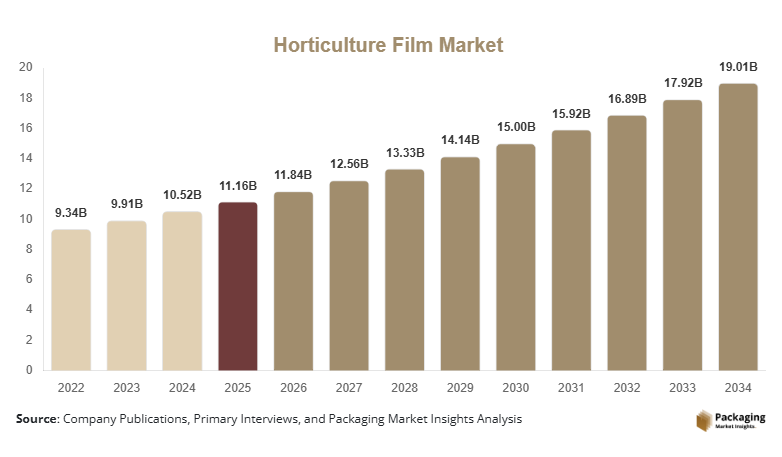
The horticulture film market size is projected at USD 11.84 billion in 2026 and is expected to hit USD 18.96 billion by 2034 with a CAGR of 6.1%. Rising investments in protected cultivation, precision agriculture, and crop productivity improvement continue to accelerate industry expansion. The report provides comprehensive market data, detailed segmentation, competitive benchmarking, production analysis, and regional performance across major economies while evaluating the horticulture film market.
The horticulture film market consists of polymer-based agricultural films used to improve crop yield, regulate temperature, reduce moisture loss, and protect crops against adverse climatic conditions. Global production exceeded 9.8 million metric tons in 2025, with greenhouse films contributing approximately 46% of total demand, mulch films accounting for 37%, and silage films representing 17%. Adoption of protected cultivation has surpassed 41% across commercial horticulture farms in developed economies, while multilayer agricultural films account for nearly 32% of premium installations, strengthening the horticulture film market.
Explore more data points, trends and opportunities Download Free Sample Report
Horticulture Film Market Trends
Growing Adoption of Advanced Protected Cultivation Technologies
Protected agriculture continues to expand worldwide as growers seek higher productivity and year-round cultivation. Global greenhouse film consumption exceeded 3.9 million metric tons during 2025, while UV-stabilized and anti-drip films represented nearly 38% of premium product demand. Advanced multilayer films have improved crop productivity by 18% and reduced water evaporation by 25%, reinforcing the horticulture film market.
Demand for recyclable and high-durability horticulture films continues to increase with sustainability initiatives. More than 44% of new horticulture projects now utilize long-life polyethylene films with enhanced light diffusion technology. Agricultural film manufacturers have expanded production capacity by over 820,000 metric tons, while precision farming adoption exceeded 36%, supporting the horticulture film market.
Horticulture Film Market Drivers
Increasing Adoption of Protected Agriculture
Growing concerns regarding food security and climate variability are accelerating investments in protected cultivation. Global protected farming area surpassed 6.2 million hectares, while greenhouse cultivation increased by approximately 7.4% annually. Governments allocated more than USD 2.3 billion toward modern agricultural infrastructure during 2025, driving significant expansion of the horticulture film market growth.
Horticulture Film Market Restraints
Volatility in Polymer Raw Material Prices
Price fluctuations in polyethylene and specialty agricultural polymers continue to impact manufacturing costs. Resin prices experienced variations between 11% and 19%, while logistics expenses increased by nearly 8% during recent years. Disposal and recycling compliance costs have also risen by approximately 14%, creating operational challenges for manufacturers within the horticulture film market.
Horticulture Film Market Opportunities
Expansion of Sustainable Agricultural Films
Demand for biodegradable and recyclable horticulture films continues to create substantial market opportunities. More than 29% of commercial growers now prefer environmentally friendly agricultural films, while investments exceeding USD 1.1 billion have been directed toward sustainable film manufacturing technologies. Growing precision agriculture adoption above 35% further supports the horticulture film market.
Challenges in Horticulture Film Market
Balancing Performance, Cost, and Sustainability
Manufacturers face increasing pressure to improve durability while reducing environmental impact. Agricultural films must maintain UV stability for over 36 months, achieve light transmission above 90%, and reduce film thickness by nearly 15% without compromising strength. Meeting evolving environmental regulations and recycling requirements continues to challenge the horticulture film market.
Report Scope
| Report Metric | Details |
|---|---|
| Market Size in 2025 | USD 11.16 Billion |
| Market Size in 2026 | USD 11.84 Billion |
| Market Size in 2034 | USD 18.96 Billion |
| CAGR | 6.1% (2026-2034) |
| Base Year for Estimation | 2025 |
| Historical Data | 2022-2024 |
| Forecast Period | 2026-2034 |
| Report Coverage | Revenue Forecast, Competitive Landscape, Supply Chain Disruption, Growth Factors, Environment & Regulatory Landscape and Trends |
| Geographies Covered | North America, Europe, APAC, Middle East and Africa, LATAM |
| Countries Covered | U.S., Canada, U.K., Germany, France, Spain, Italy, Russia, Nordic, Benelux, Rest of Europe, China, South Korea, Japan, India, Australia, Singapore, Taiwan, South East Asia, Rest of Asia-Pacific, UAE, Turkey, Saudi Arabia, South Africa, Egypt, Nigeria, Rest of MEA, Brazil, Mexico, Argentina, Chile, Colombia, Rest of LATAM |
Explore more data points, trends and opportunities Download Free Sample Report
Horticulture Film Market Segmentation
Greenhouse films remain the leading segment with approximately 46% of total demand, while vegetable cultivation accounts for nearly 48% of application consumption due to expanding commercial farming operations worldwide.
By Type
Greenhouse films account for nearly 46% of the market, with annual production exceeding 4.5 million metric tons. These films provide UV protection, anti-drip coatings, light diffusion, and thermal insulation, making them ideal for commercial greenhouses, nurseries, hydroponics, and protected cultivation systems.
Mulch films represent approximately 37% of total demand and exceed 3.6 million metric tons in annual production. These films reduce weed growth, conserve soil moisture, regulate soil temperature, and improve crop quality while supporting vegetables, fruits, and plantation crops.
Silage films contribute nearly 17% of market demand with production surpassing 1.7 million metric tons annually. High puncture resistance, oxygen barrier performance, UV stability, and mechanical durability make these films suitable for forage preservation and livestock feed storage.
By Application
Vegetable cultivation dominates the application segment with approximately 48% market share and annual consumption exceeding 4.7 million metric tons. Horticulture films are extensively utilized in tomatoes, cucumbers, peppers, leafy vegetables, and greenhouse crops, with adoption surpassing 61% among commercial growers.
Fruit cultivation accounts for nearly 34% of demand, with production utilization exceeding 3.3 million metric tons annually. Films support berries, grapes, citrus fruits, melons, and orchards by improving moisture retention, reducing pest exposure, and enhancing crop quality. Commercial penetration exceeds 46%.
Flowers represent approximately 18% of the application market with consumption exceeding 1.8 million metric tons. Floriculture operations utilize greenhouse films for climate control, humidity management, and optimized light transmission, particularly within commercial export-oriented production facilities.
Horticulture Film Market Segmentations
Type
- Greenhouse Films
- Mulch Films
- Silage Films
Application
- Vegetables
- Fruits
- Flowers
Horticulture Film Regional Outlook
North America
North America accounts for approximately 24% of global revenue. The United States contributes nearly 79% of regional demand through greenhouse farming, fruit cultivation, and commercial vegetable production. Annual production exceeds 2.2 million metric tons, supported by precision agriculture investments.
Europe
Europe represents approximately 29% of the global market. Spain, Italy, France, Germany, and the Netherlands account for over 74% of regional demand. Production exceeds 2.8 million metric tons, supported by advanced greenhouse infrastructure and sustainable farming initiatives.
Asia-Pacific
Asia-Pacific dominates the market with approximately 39% of the global share. China contributes nearly 49% of regional production, followed by India, Japan, and South Korea. Manufacturing exceeds 3.9 million metric tons, driven by expanding horticulture acreage, government subsidies, and rising food demand.
Latin America
Latin America contributes approximately 5% of the global market. Brazil, Mexico, and Chile collectively account for nearly 68% of regional demand. Annual production exceeds 510,000 metric tons, supported by export-oriented fruit and vegetable cultivation.
Middle East & Africa
The Middle East & Africa represent nearly 3% of the market. Saudi Arabia, the UAE, South Africa, and Egypt continue investing in greenhouse agriculture and water-efficient farming technologies. Regional production exceeds 290,000 metric tons, supported by increasing adoption of protected cultivation.
Top Players in Horticulture Film Market
- Berry Global Inc.
- RKW Group
- Coveris Holdings S.A.
- Armando Alvarez Group
- Trioplast AB
- Plastika Kritis S.A.
- Ab Rani Plast Oy
- BASF SE
- ExxonMobil Corporation,
- Dow Inc.
Berry Global Inc. Estimated market share: 11–13% Global leader with extensive agricultural film manufacturing capabilities. Berry Global Inc. maintains a strong market position through advanced polyethylene film technologies, global manufacturing facilities, and diversified agricultural product offerings. The company continues investing in recyclable horticulture films, multilayer extrusion technology, and lightweight agricultural solutions. Its extensive distribution network and strategic partnerships with agricultural suppliers strengthen its leadership across greenhouse, mulch, and silage film applications while supporting long-term growth through sustainable product innovation. RKW Group Estimated market share: 8–10% Strong presence in specialty agricultural and horticulture film solutions. RKW Group is recognized for manufacturing high-performance horticulture films designed for protected cultivation and commercial agriculture. The company's portfolio includes greenhouse films, mulch films, and silage wrapping solutions featuring enhanced UV stability, durability, and light transmission. Continued investments in sustainable polymers, recycling technologies, and advanced multilayer film production enable RKW Group to maintain a competitive position across European and international agricultural markets.