Anti Scratch Film Market Size
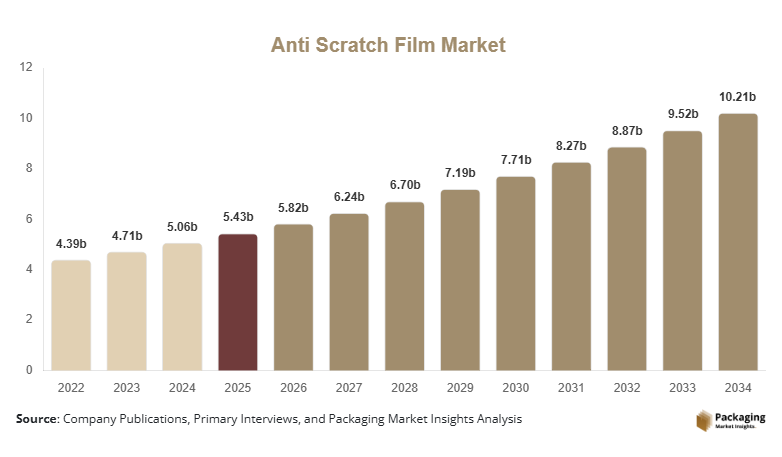
Anti Scratch Film market size is projected at USD 5.82 billion in 2026 and is expected to hit USD 10.21 billion by 2034 with a CAGR of 7.28%. The report evaluates historical performance from 2022–2025 and provides detailed forecasts through 2034, supported by extensive segmentation, production analysis, pricing trends, demand assessment, supply chain evaluation, and competitive benchmarking. The study analyzes more than 40 countries, reviews over 150 manufacturers, and examines production exceeding 3.4 billion square meters annually across major industrial sectors.
The anti scratch film market comprises transparent protective films engineered with advanced hard-coating technologies to improve scratch resistance, abrasion protection, UV stability, and optical clarity across multiple end-use industries. Global production exceeded 3.4 billion square meters in 2025, with automotive applications accounting for approximately 38%, consumer electronics 34%, and construction nearly 16% of total consumption. Penetration of coated protective films surpassed 72% in premium electronic displays and reached nearly 58% across new passenger vehicle exterior protection applications, supported by increasing investments in advanced polymer processing and nanocoating technologies.
Explore more data points, trends and opportunities Download Free Sample Report
Anti Scratch Film Trends
Rising Adoption of Nano-Coating Technologies
Manufacturers are increasingly adopting nano-ceramic and hybrid hard-coating technologies to improve scratch resistance above 4H–9H pencil hardness while maintaining optical transparency exceeding 92%. Production of nano-coated anti scratch films surpassed 1.2 billion square meters during 2025, representing an annual increase of nearly 11%. Automotive OEMs and electronics manufacturers continue expanding adoption as product durability requirements become stricter, strengthening anti scratch film market trends.
Increasing investments exceeding USD 1.4 billion in advanced coating equipment have accelerated commercialization of UV-curable coatings, plasma surface treatment, and multilayer protective films. Smart manufacturing facilities have improved production efficiency by approximately 18%, while defect rates declined below 2.5% across leading manufacturing plants. These developments continue reinforcing anti scratch film market trends.
Growing Demand from Consumer Electronics
Consumer electronics manufacturers continue integrating ultra-thin anti scratch films with thickness ranging from 50–250 microns for smartphones, tablets, laptops, and wearable devices. Electronics production exceeded 9.8 billion units globally during 2025, with protective film penetration approaching 76% among premium devices.
Flexible OLED displays, foldable smartphones, and automotive infotainment systems are expanding demand for high-performance protective films capable of resisting over 100,000 abrasion cycles while maintaining more than 95% optical transmission. Continuous innovation across display technologies supports sustained anti scratch film market trends.
Anti Scratch Film Market Drivers
Growing Automotive Surface Protection Requirements
Global vehicle production exceeded 93 million units in 2025, while paint protection film installations increased by nearly 13% year-over-year. Premium passenger vehicles now account for approximately 62% of advanced anti scratch film installations, driven by increasing consumer preference for enhanced vehicle durability. Investments exceeding USD 850 million in automotive coating technologies continue supporting Anti Scratch Film Market Growth.
Anti Scratch Film Market Restraints
Volatility in Raw Material Prices
Prices of specialty polymers including PET, TPU, acrylic adhesives, and coating chemicals experienced fluctuations between 8% and 18% during recent years. Raw materials contribute nearly 58% of manufacturing costs, while energy expenses account for another 14%, creating pricing pressure across manufacturers and limiting profit margins, thereby influencing anti scratch film market performance.
Anti Scratch Film Market Opportunities
Expansion of Smart Electronics and Display Protection
Production of smart devices is projected to exceed 12 billion units by 2030, while adoption of flexible displays continues growing above 20% annually. Manufacturers investing in recyclable films, anti-fingerprint coatings, and self-healing technologies are expected to benefit from expanding applications, creating significant opportunities for the anti scratch film market.
Challenges in Anti Scratch Film Market
Balancing Durability with Optical Performance
Manufacturers must achieve hardness exceeding 7H, transparency above 92%, haze below 1.5%, and flexibility for curved surfaces simultaneously. Meeting these technical requirements while maintaining competitive pricing and large-scale production above 500 million square meters annually remains a major industry challenge for manufacturers.
Report Scope
| Report Metric | Details |
|---|---|
| Market Size in 2025 | USD 5.43 billion |
| Market Size in 2026 | USD 5.82 billion |
| Market Size in 2034 | USD 10.21 billion |
| CAGR | 7.28% (2026-2034) |
| Base Year for Estimation | 2025 |
| Historical Data | 2022-2024 |
| Forecast Period | 2026-2034 |
| Report Coverage | Revenue Forecast, Competitive Landscape, Supply Chain Disruption, Growth Factors, Environment & Regulatory Landscape and Trends |
| Geographies Covered | North America, Europe, APAC, Middle East and Africa, LATAM |
| Countries Covered | U.S., Canada, U.K., Germany, France, Spain, Italy, Russia, Nordic, Benelux, Rest of Europe, China, South Korea, Japan, India, Australia, Singapore, Taiwan, South East Asia, Rest of Asia-Pacific, UAE, Turky, Saudi Arabia, South Africa, Egypt, Nigeria, Rest of MEA, Brazil, Mexico, Argentina, Chile, Colombia, Rest of LATAM |
Explore more data points, trends and opportunities Download Free Sample Report
Anti Scratch Film Market Segmentation
The market is segmented by type and application, with PET-based products accounting for nearly 47% of global revenue, while automotive applications contribute approximately 38% of total industry demand due to increasing paint protection requirements and display integration.
By Type
PET Anti Scratch Film
PET anti scratch film remains the largest segment with approximately 47% market share. Production exceeded 1.6 billion square meters during 2025. These films provide excellent transparency above 91%, thickness ranging from 75–200 microns, superior dimensional stability, and cost-effective manufacturing for electronics and automotive applications.
TPU Anti Scratch Film
TPU anti scratch films represent approximately 34% of market demand due to superior elasticity and self-healing capability. Production exceeded 980 million square meters annually, with elongation above 350% and high resistance against environmental degradation, making them ideal for automotive paint protection and premium electronic devices.
Polycarbonate Anti Scratch Film
Polycarbonate films contribute nearly 19% of total industry revenue. Production surpassed 620 million square meters, offering impact resistance nearly 250 times greater than conventional glass alongside improved heat resistance exceeding 120°C, making them suitable for industrial displays and specialty construction applications.
By Application
Automotive
Automotive applications dominate with approximately 38% market share. More than 35 million vehicles incorporated advanced anti scratch films during 2025 across exterior paint protection, dashboards, infotainment systems, and interior trims. High abrasion resistance, UV durability, and chemical stability remain key technical requirements.
Consumer Electronics
Consumer electronics account for approximately 34% of total demand. More than 3.3 billion smartphones, tablets, laptops, monitors, and wearable devices utilized anti scratch films during 2025. Film thickness typically ranges between 50–150 microns, providing high transparency, fingerprint resistance, and extended display lifespan.
Building & Construction
Building and construction contribute nearly 16% of market consumption. Annual installation exceeded 520 million square meters across decorative panels, windows, partitions, elevators, and architectural surfaces. Increasing commercial infrastructure development continues supporting protective film adoption.
Anti Scratch Film Market Segmentations
Type
- PET Anti Scratch Film
- TPU Anti Scratch Film
- Polycarbonate Anti Scratch Film
Application
- Automotive
- Consumer Electronics
- Building & Construction
Anti Scratch Film Regional Outlook
North America
North America accounts for approximately 28% of global revenue. The United States contributes nearly 82% of regional demand, supported by advanced automotive manufacturing, electronics production, and construction renovation activities. Annual production exceeds 760 million square meters, while premium vehicle applications continue expanding.
Europe
Europe represents nearly 26% of the global market. Germany, France, Italy, and the United Kingdom contribute more than 72% of regional consumption. Automotive OEMs account for nearly 44% of total regional demand, supported by advanced coating technologies and sustainability initiatives.
Asia-Pacific
Asia-Pacific leads the market with approximately 37% global share. China contributes nearly 46% of regional production, followed by Japan, South Korea, and India. Regional manufacturing exceeds 1.5 billion square meters annually due to strong electronics production and expanding automotive manufacturing capacity.
Middle East & Africa
The Middle East & Africa account for approximately 4% of global demand. Infrastructure modernization, automotive imports, and premium construction projects continue driving market expansion, with GCC countries representing nearly 61% of regional consumption.
Latin America
Latin America contributes nearly 5% of total revenue. Brazil and Mexico collectively account for approximately 69% of regional demand, supported by automotive assembly facilities, consumer electronics distribution, and commercial construction projects.
Top players in Anti Scratch Film Market
- 3M Company
- Eastman Chemical Company
- Nitto Denko Corporation
- LINTEC Corporation
- Toray Industries Inc.
- Saint-Gobain
- Avery Dennison Corporation
- Hexis S.A.
- XPEL Inc.
- ORAFOL Europe GmbH
- Madico Inc.
- Covestro AG
- Mitsubishi Chemical Group
- LG Chem Ltd.
- BASF SE
3M Company
-
Estimated global market share: 12–14%
-
Strong leadership in automotive paint protection, industrial films, and electronics.
-
Extensive R&D investments exceeding USD 2 billion annually support continuous innovation in hard-coated protective films.
-
Broad manufacturing footprint across North America, Europe, and Asia enhances global supply capabilities and premium product positioning.
Eastman Chemical Company
-
Estimated global market share: 8–10%
-
Strong portfolio of performance films for automotive and architectural applications.
-
Advanced coating technologies, integrated polymer manufacturing, and expanding distribution across more than 100 countries strengthen competitive positioning.
-
Continuous investments in sustainable specialty materials improve long-term market competitiveness.