Collation Shrink Films Market Size
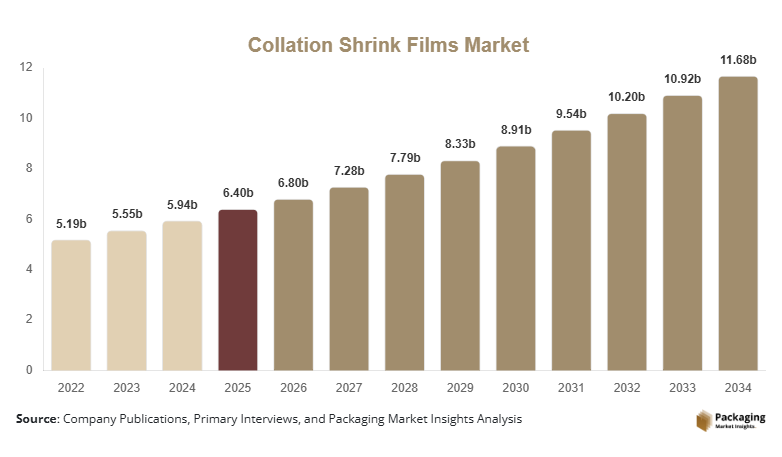
Collation Shrink Films market size is projected at USD 6.8 billion in 2026 and is expected to hit USD 11.7 billion by 2034 with a CAGR of 7.0%.The report provides comprehensive analysis of production capacity, material innovations, end-use demand, market segmentation, and the competitive landscape across major regional markets. It evaluates historical performance from 2022–2024, establishes 2025 as the base year, and forecasts industry developments through 2034.
Collation shrink films are high-strength packaging films used to bundle multiple products for transportation, retail display, and warehouse handling. These films provide load stability, moisture resistance, and improved logistics efficiency across beverage, food, and industrial sectors. Global production exceeded 9.6 million metric tons during 2025, while polyethylene-based films accounted for approximately 64% of total production. Food & beverage applications represented nearly 48% of market demand, while automated packaging line adoption surpassed 61%, reinforcing the Collation Shrink Films Market.
Explore more data points, trends and opportunities Download Free Sample Report
Collation Shrink Films Market Trends
Rising Demand for Multipack Beverage Packaging
The beverage industry continues increasing the use of collation shrink films for bundled packaging of bottled water, soft drinks, dairy products, and alcoholic beverages. More than 4.8 million metric tons of shrink films were consumed by beverage manufacturers during 2025, while automated packaging systems improved production efficiency by 20%. Sustainable downgauged film technologies continue strengthening the Collation Shrink Films Market Trend.
Growing Adoption of High-Performance Recyclable Films
Manufacturers are investing in recyclable mono-material films with enhanced puncture resistance and reduced thickness. More than 2,300 packaging facilities upgraded to advanced shrink film technologies during 2025, reducing material consumption by approximately 14% while maintaining packaging performance. Sustainable film innovations continue supporting the Collation Shrink Films Market.
Collation Shrink Films Market Drivers
Expanding Demand for Secondary Packaging Across FMCG Industries
Rapid growth in packaged beverages, consumer goods, and e-commerce logistics continues driving shrink film demand. More than 68% of FMCG manufacturers utilize collation shrink films for secondary packaging, while global packaged beverage production exceeded 1.2 trillion liters during 2025. Investments in automated packaging systems increased by nearly 17%, accelerating Collation Shrink Films Market Growth.
Collation Shrink Films Market Restraints
Environmental Concerns Related to Plastic Packaging
Plastic waste regulations and sustainability concerns continue challenging conventional shrink film adoption. Approximately 28% of global packaging regulations introduced between 2023 and 2025 focused on reducing single-use plastics. Resin price fluctuations of nearly 12% annually also affect manufacturing costs, limiting the Collation Shrink Films Market.
Collation Shrink Films Market Opportunities
Development of Recyclable and Lightweight Shrink Film Solutions
Increasing investments in recyclable polyethylene films and downgauged packaging technologies present significant opportunities. Sustainable packaging investments exceeded USD 21 billion globally during 2025, while recyclable film adoption increased by 19% annually across consumer goods industries. These trends continue expanding opportunities in the Collation Shrink Films Market.
Challenges in Collation Shrink Films Market
Balancing Material Reduction with Packaging Performance
Manufacturers face challenges in reducing film thickness while maintaining strength, puncture resistance, and load stability. Average film thickness declined by approximately 12% over five years, while packaging performance requirements increased by nearly 18%. Continuous material innovation remains essential for the Collation Shrink Films Market.
Report Scope
| Report Metric | Details |
|---|---|
| Market Size in 2025 | USD 6.4 billion |
| Market Size in 2026 | USD 6.8 billion |
| Market Size in 2034 | USD 11.7 billion |
| CAGR | 7.0% (2026-2034) |
| Base Year for Estimation | 2025 |
| Historical Data | 2022-2024 |
| Forecast Period | 2026-2034 |
| Report Coverage | Revenue Forecast, Competitive Landscape, Supply Chain Disruption, Growth Factors, Environment & Regulatory Landscape and Trends |
| Geographies Covered | North America, Europe, APAC, Middle East and Africa, LATAM |
| Countries Covered | U.S., Canada, U.K., Germany, France, Spain, Italy, Russia, Nordic, Benelux, Rest of Europe, China, South Korea, Japan, India, Australia, Singapore, Taiwan, South East Asia, Rest of Asia-Pacific, UAE, Turky, Saudi Arabia, South Africa, Egypt, Nigeria, Rest of MEA, Brazil, Mexico, Argentina, Chile, Colombia, Rest of LATAM |
Explore more data points, trends and opportunities Download Free Sample Report
Collation Shrink Films Market Segmentation
The market is segmented by material type and end-use industry. Polyethylene films accounted for approximately 64% of market revenue during 2025, while food & beverage remained the leading application with nearly 48% of global demand.
By Type
Polyethylene (PE)
Polyethylene represented approximately 64% of total market demand, with annual production exceeding 6.1 million metric tons. Excellent toughness, shrink performance, and low production costs make PE the preferred material for beverage multipacks and industrial packaging.
Polyolefin (POF)
Polyolefin accounted for nearly 23% of market revenue. Annual production exceeded 2.2 million metric tons, providing improved clarity, puncture resistance, and environmental performance for premium retail packaging applications.
Polypropylene (PP)
Polypropylene contributed approximately 13% of market demand, with production surpassing 1.3 million metric tons annually. High tensile strength and excellent heat resistance support specialized industrial packaging requirements.
By Application
Food & Beverage
Food & beverage accounted for approximately 48% of total demand. More than 4.6 million metric tons of shrink films were utilized annually for bottled beverages, canned products, dairy items, and packaged foods.
Consumer Goods
Consumer goods represented nearly 29% market share, with annual consumption exceeding 2.8 million metric tons. Household products, personal care items, and retail multipacks continue driving segment growth.
Industrial Packaging
Industrial packaging contributed approximately 18% of market demand. Heavy-duty shrink films are increasingly used for construction materials, chemicals, and logistics applications requiring enhanced load stability.
Collation Shrink Films Market Segmentations
Material Type
- Polyethylene (PE)
- Polyolefin (POF)
- Polypropylene (PP)
End Use Industry
- Food & Beverage
- Consumer Goods
- Industrial Packaging
Collation Shrink Films Regional Outlook
North America
North America accounted for approximately 29% of global market revenue during 2025. The United States represented over 82% of regional demand, supported by advanced beverage manufacturing and automated packaging operations.
Europe
Europe held approximately 31% market share. Germany, France, Italy, and the United Kingdom led regional demand due to strong food processing industries and increasing investments in recyclable packaging technologies.
Asia-Pacific
Asia-Pacific represented nearly 33% of global market revenue. China, India, Japan, and South Korea contributed more than 74% of regional production capacity. Expanding FMCG production and industrial manufacturing continue driving demand.
Rest of World
Latin America and Middle East & Africa accounted for approximately 7% of global revenue. Growing packaged food production, retail expansion, and logistics modernization are expected to support annual growth above 7% through 2034.
Top players in Collation Shrink Films Market
- Berry Global Inc.
- Amcor plc
- Sealed Air Corporation
- Coveris Holdings S.A.
- Inteplast Group
- Dow Inc.
- RKW Group
- Sigma Plastics Group
- Bolloré Group
- Intertape Polymer Group Inc.
Berry Global Inc.
-
Holds an estimated 14–17% share in the global collation shrink films market.
-
Operates advanced manufacturing facilities producing high-performance PE and recyclable shrink films.
-
Focuses on downgauged packaging solutions that reduce resin consumption while maintaining load stability.
-
Invests significantly in circular packaging technologies and sustainable polymer innovations.
-
Maintains strong partnerships with beverage, food, and consumer goods manufacturers worldwide.
Amcor plc
-
Accounts for approximately 11–13% of the market through its flexible packaging portfolio.
-
Develops recyclable shrink films with enhanced clarity and strength for FMCG applications.
-
Expands sustainable packaging capabilities through continuous material innovation and manufacturing investments.
-
Serves multinational food, beverage, healthcare, and industrial customers across global markets.
-
Strengthens market position through advanced polymer engineering and sustainability initiatives.