Surface Printed Film Market Size
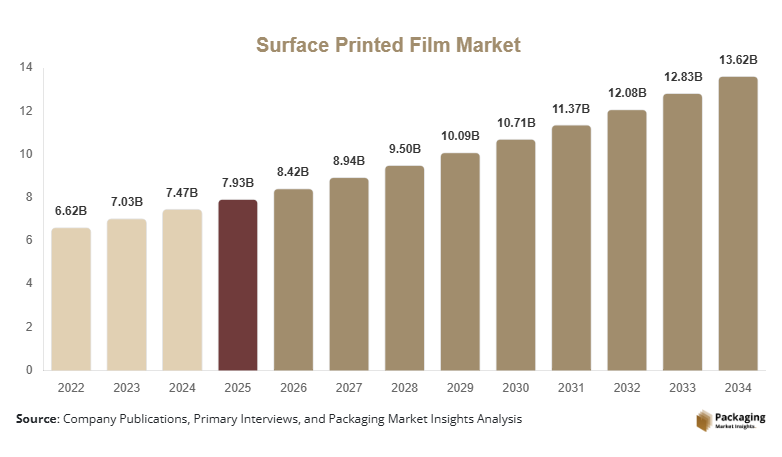
The surface-printed film market size is projected at USD 8.42 billion in 2026 and is expected to hit USD 13.58 billion by 2034 with a CAGR of 6.2%. Growing demand for visually appealing flexible packaging, advancements in printing technologies, and increasing consumption of packaged consumer goods continue to drive market expansion. The report provides detailed market sizing, production analysis, segmentation, competitive benchmarking, and regional evaluation across the surface-printed film market.
The surface-printed film market comprises polymer films printed directly on the outer surface for branding, product identification, and decorative packaging applications. Global production exceeded 12.4 million metric tons during 2025, with food packaging accounting for approximately 48% of total demand, consumer goods packaging representing 32%, and industrial packaging contributing 20%. Polypropylene surface printed films held nearly 43% of production, while flexographic printing technologies represented approximately 52% of commercial installations. Increasing adoption of recyclable films and high-definition printing continues to strengthen the surface-printed film market.
Explore more data points, trends and opportunities Download Free Sample Report
Surface Printed Film Market Trends
Rising Adoption of High-Definition Digital and Flexographic Printing
Packaging manufacturers are increasingly investing in high-speed digital and flexographic printing systems capable of delivering superior graphics and shorter production cycles. Production of premium printed films exceeded 4.8 million metric tons during 2025, while high-definition printing adoption surpassed 38% among premium packaging manufacturers. Automated color management systems have improved print consistency by nearly 17%, reinforcing the surface-printed film market.
Sustainability initiatives continue encouraging water-based inks, recyclable substrates, and lightweight film structures. More than 41% of newly commissioned printing lines now support low-VOC inks, while energy-efficient printing equipment has reduced operational energy consumption by approximately 13%. Demand from food, personal care, and household packaging continues expanding steadily, supporting the surface-printed film market.
Surface Printed Film Market Drivers
Growing Demand for Attractive Flexible Packaging
Brand owners increasingly require premium printed packaging to improve shelf visibility and product differentiation. Global flexible packaging production exceeded 39 million metric tons during 2025, while branded consumer goods packaging increased by approximately 8%. Investments exceeding USD 2.4 billion in advanced printing and converting equipment continue supporting surface-printed film market growth.
Surface Printed Film Market Restraints
Fluctuating Raw Material and Ink Prices
Volatility in polymer resins, specialty inks, and pigments continues affecting manufacturing costs. Resin prices fluctuated between 11% and 19%, while printing ink prices increased by approximately 10% during recent years. Compliance costs for low-emission printing technologies also increased by nearly 12%, creating pricing pressure across the surface-printed film market.
Surface Printed Film Market Opportunities
Expansion of Sustainable Printed Packaging
Growing demand for recyclable packaging and environmentally friendly printing solutions creates significant market opportunities. More than 35% of packaging converters have adopted recyclable mono-material printed films, while investments exceeding USD 1.5 billion have been directed toward digital printing technologies and sustainable ink formulations. Premium packaging demand continues supporting the surface-printed film market.
Challenges in Surface Printed Film Market
Maintaining Print Quality with Sustainable Materials
Manufacturers face increasing pressure to balance superior graphics with environmental compliance. Surface printed films require print resolution exceeding 1,200 dpi, abrasion resistance above 95%, and consistent color accuracy while reducing film thickness by approximately 12%. Achieving high productivity and sustainability simultaneously remains a key challenge for the surface-printed film market.
Report Scope
| Report Metric | Details |
|---|---|
| Market Size in 2025 | USD 7.93 Billion |
| Market Size in 2026 | USD 8.42 Billion |
| Market Size in 2034 | USD 13.58 Billion |
| CAGR | 6.2% (2026-2034) |
| Base Year for Estimation | 2025 |
| Historical Data | 2022-2024 |
| Forecast Period | 2026-2034 |
| Report Coverage | Revenue Forecast, Competitive Landscape, Supply Chain Disruption, Growth Factors, Environment & Regulatory Landscape and Trends |
| Geographies Covered | North America, Europe, APAC, Middle East and Africa, LATAM |
| Countries Covered | U.S., Canada, U.K., Germany, France, Spain, Italy, Russia, Nordic, Benelux, Rest of Europe, China, South Korea, Japan, India, Australia, Singapore, Taiwan, South East Asia, Rest of Asia-Pacific, UAE, Turkey, Saudi Arabia, South Africa, Egypt, Nigeria, Rest of MEA, Brazil, Mexico, Argentina, Chile, Colombia, Rest of LATAM |
Explore more data points, trends and opportunities Download Free Sample Report
Surface Printed Film Market Segmentation
Polypropylene surface printed films dominate with approximately 43% market share owing to superior printability and mechanical performance, while food packaging accounts for nearly 48% of total application demand due to extensive packaged food consumption.
By Type
Polyethylene surface printed films account for approximately 34% of market demand, with annual production exceeding 4.2 million metric tons. These films provide excellent flexibility, moisture resistance, sealability, and compatibility with flexographic and gravure printing for food and consumer packaging.
Polypropylene surface printed films represent nearly 43% of global production with annual output exceeding 5.3 million metric tons. High gloss, superior printability, excellent stiffness, and chemical resistance make these films suitable for snack foods, confectionery, labels, and personal care packaging.
Polyester surface printed films contribute approximately 23% of total production, exceeding 2.9 million metric tons annually. These films provide high tensile strength, dimensional stability, excellent heat resistance, and premium graphic performance for industrial and high-value packaging applications.
By Application
Food packaging dominates the application segment with approximately 48% market share, consuming more than 5.9 million metric tons annually. Surface printed films are widely used for snacks, bakery products, frozen foods, dairy packaging, and confectionery, with adoption exceeding 72% among branded food manufacturers.
Consumer goods packaging accounts for approximately 32% of total demand with annual consumption exceeding 4 million metric tons. Personal care products, detergents, cosmetics, and household products increasingly utilize surface-printed films for enhanced branding, product identification, and retail visibility.
Industrial packaging contributes approximately 20% of market demand with production exceeding 2.5 million metric tons annually. Applications include chemicals, fertilizers, building materials, and industrial products requiring durable graphics, product information, and transportation labeling.
Surface Printed Film Market Segmentations
Type
- Polyethylene Surface Printed Film
- Polypropylene Surface Printed Film
- Polyester Surface Printed Film
Application
- Food Packaging
- Consumer Goods Packaging
- Industrial Packaging
Surface Printed Film Regional Outlook
North America
North America accounts for approximately 27% of global revenue. The United States contributes nearly 79% of regional demand through food packaging, consumer products, and industrial applications. Annual production exceeds 3.1 million metric tons, supported by advanced printing infrastructure and premium packaging demand.
Europe
Europe represents approximately 30% of the global market. Germany, France, Italy, the United Kingdom, and Spain collectively account for over 72% of regional consumption. Production exceeds 3.5 million metric tons, supported by sustainable packaging regulations and technological advancements.
Asia-Pacific
Asia-Pacific dominates the market with approximately 35% of the global share. China contributes nearly 47% of regional production, followed by India, Japan, and South Korea. Manufacturing exceeds 4.4 million metric tons, driven by expanding packaging industries, urbanization, and rising consumer goods demand.
Latin America
Latin America contributes approximately 5% of global revenue. Brazil and Mexico account for nearly 67% of regional demand, while annual production exceeds 650,000 metric tons, supported by growing packaged food and consumer goods industries.
Middle East & Africa
The Middle East & Africa represent approximately 3% of the market. Saudi Arabia, the UAE, and South Africa continue investing in packaging manufacturing, with production exceeding 420,000 metric tons annually across food, beverage, and industrial sectors.
Top Players in Surface Printed Film Market
- Amcor plc
- Berry Global Inc.
- CCL Industries Inc.,
- Mondi plc
- Cosmo First Limited,
- Toray Industries, Inc.
- UFlex Limited
- Jindal Poly Films Ltd.,
- Taghleef Industries
- Coveris Holdings S.A.
Amcor plc Estimated market share: 13–15% Global leader in flexible packaging and printed film solutions. Amcor plc maintains a leading position through advanced flexible packaging technologies, high-definition printing capabilities, and sustainable packaging innovations. The company supplies premium surface-printed films for the food, beverage, healthcare, and consumer goods industries while investing in recyclable mono-material packaging and digital printing technologies. Its global manufacturing footprint, strong research capabilities, and strategic customer partnerships continue strengthening its competitive position within the surface-printed film market. Berry Global Inc. Estimated market share: 10–12% Strong global manufacturer of printed flexible packaging films. Berry Global Inc. offers an extensive portfolio of polyethylene, polypropylene, and specialty printed films serving food packaging, industrial packaging, and consumer products. The company focuses on lightweight packaging, sustainable film development, high-speed printing technologies, and operational efficiency. Continuous investments in advanced converting equipment and recyclable packaging solutions support Berry Global's long-term leadership across international packaging markets.