MOPP Packaging Films Market Size
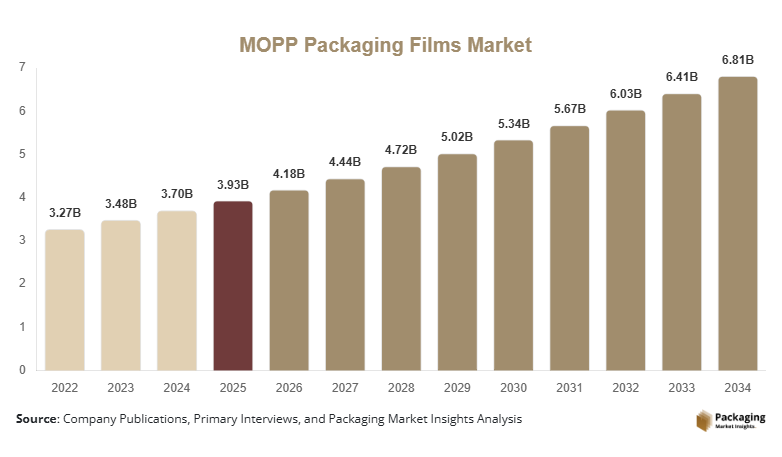
The MOPP packaging films market size is projected at USD 4.18 billion in 2026 and is expected to hit USD 6.79 billion by 2034 with a CAGR of 6.3%. The report provides an in-depth assessment of production capacity, pricing trends, raw material supply, competitive landscape, and technological developments. It further analyzes market performance through segmentation by type, application, and geography while evaluating investment opportunities and supply chain dynamics.
MOPP (Mono-Oriented Polypropylene) packaging films are high-strength polypropylene films manufactured through mono-directional orientation to provide superior tear resistance, printability, and dimensional stability for flexible packaging applications. Global production exceeded 8.6 million metric tons in 2025, while food packaging accounted for approximately 58% of total consumption. Consumer goods packaging contributed nearly 26%, and label & lamination applications represented 16% of industry demand. Adoption across flexible packaging manufacturing facilities surpassed 74%, reinforcing the expansion of the MOPP packaging films market.
Explore more data points, trends and opportunities Download Free Sample Report
MOPP Packaging Films Trends
Rising Adoption of High-Performance Sustainable Packaging Films
Manufacturers are increasingly utilizing recyclable polypropylene films to replace multi-material packaging structures. More than 5.3 million metric tons of recyclable MOPP films were produced in 2025, representing nearly 62% of total production. High-speed film orientation technology adoption exceeded 46%, while downgauging initiatives reduced material consumption by approximately 14%. These developments continue strengthening the MOPP packaging films market.
Digital printing compatibility, improved barrier coatings, and advanced extrusion technologies are enhancing product performance across packaging applications. Automated production lines improved manufacturing efficiency by approximately 17%, while demand for premium printed packaging increased by 12%. Food processing and FMCG sectors expanded consumption by over 10%, supporting continuous innovation across the MOPP packaging films market.
MOPP Packaging Films Market Drivers
Growing Demand for Flexible Food Packaging
Global flexible packaging production exceeded 36 million metric tons in 2025, while packaged food consumption increased by nearly 9%. Ready-to-eat food production expanded by approximately 13%, and e-commerce packaging demand rose by 18%. These factors continue accelerating the MOPP packaging films market.
MOPP Packaging Films Market Restraints
Volatility in Polypropylene Resin Prices
Polypropylene resin prices fluctuated by approximately 15% during 2025, increasing production costs by nearly 9%. Energy expenses rose by 8%, while transportation costs increased by approximately 6%, limiting profitability for manufacturers and restraining the MOPP Packaging Films market's growth.
MOPP Packaging Films Market Opportunities
Expansion of Sustainable and Recyclable Packaging
Investments in recyclable flexible packaging exceeded USD 7.5 billion during 2025, while mono-material packaging adoption increased by 21% globally. Sustainable FMCG packaging demand expanded by nearly 18%, and Asia-Pacific accounted for approximately 44% of new production investments, creating significant opportunities across the MOPP packaging films market.
Challenges in MOPP Packaging Films Market
Meeting Sustainability and Recycling Requirements
Packaging manufacturers are required to improve recyclability while maintaining high mechanical performance and print quality. More than 70 countries implemented stricter packaging regulations during 2025, while recycled-content requirements exceeded 30% in several developed markets. Manufacturers allocated approximately 6–8% of annual revenue toward product innovation and compliance, creating operational challenges within the MOPP packaging films market.
Report Scope
| Report Metric | Details |
|---|---|
| Market Size in 2025 | USD 3.93 Billion |
| Market Size in 2026 | USD 4.18 Billion |
| Market Size in 2034 | USD 6.79 Billion |
| CAGR | 6.3% (2026-2034) |
| Base Year for Estimation | 2025 |
| Historical Data | 2022-2024 |
| Forecast Period | 2026-2034 |
| Report Coverage | Revenue Forecast, Competitive Landscape, Supply Chain Disruption, Growth Factors, Environment & Regulatory Landscape and Trends |
| Geographies Covered | North America, Europe, APAC, Middle East and Africa, LATAM |
| Countries Covered | U.S., Canada, U.K., Germany, France, Spain, Italy, Russia, Nordic, Benelux, Rest of Europe, China, South Korea, Japan, India, Australia, Singapore, Taiwan, South East Asia, Rest of Asia-Pacific, UAE, Turkey, Saudi Arabia, South Africa, Egypt, Nigeria, Rest of MEA, Brazil, Mexico, Argentina, Chile, Colombia, Rest of LATAM |
Explore more data points, trends and opportunities Download Free Sample Report
MOPP Packaging Films Market Segmentation
The market is segmented by type and application, with transparent MOPP films accounting for approximately 51% of total market revenue, while food packaging contributes nearly 58% of industry demand due to increasing adoption of flexible packaging solutions.
By Type
Transparent MOPP Films: This segment accounted for approximately 51% of the market, with annual production exceeding 4.4 million metric tons. These films provide excellent transparency, high tensile strength, superior printability, dimensional stability, and moisture resistance, making them ideal for premium flexible packaging.
Matte MOPP Films: Representing nearly 28% of global production, output exceeded 2.4 million metric tons during 2025. Matte films offer a premium appearance, scratch resistance, excellent ink adhesion, and compatibility with high-quality labels and decorative packaging applications.
Pearlized MOPP Films: Holding around 21% market share, production surpassed 1.8 million metric tons annually. These films provide enhanced opacity, superior aesthetics, lightweight performance, improved stiffness, and effective product differentiation across consumer packaging.
By Application
Food Packaging: This segment accounted for approximately 58% of total demand, consuming more than 5.0 million metric tons annually. Applications include snack packaging, bakery products, confectionery, frozen foods, dry foods, and ready-to-eat meals requiring moisture resistance, durability, and attractive shelf presentation.
Consumer Goods Packaging: Representing nearly 26% of market demand, this segment consumed approximately 2.2 million metric tons during 2025. MOPP packaging films are extensively used for personal care products, household goods, stationery, and textile packaging requiring high print quality and durability.
Label & Lamination: Accounting for approximately 16% of industry consumption, production exceeded 1.4 million metric tons annually. These films provide excellent dimensional stability, surface protection, premium graphics, and enhanced durability for labels, book covers, and laminated products.
MOPP Packaging Films Market Segmentations
Type
- Transparent MOPP Films
- Matte MOPP Films
- Pearlized MOPP Films
Application
- Food Packaging
- Consumer Goods Packaging
- Label & Lamination
MOPP Packaging Films Regional Outlook
North America
North America accounted for approximately 26% of global demand, producing more than 2.2 million metric tons annually. The United States represented nearly 81% of regional consumption, supported by food processing, FMCG manufacturing, and advanced flexible packaging technologies.
Europe
Europe contributed approximately 29% of global demand with production exceeding 2.5 million metric tons. Germany, Italy, France, Spain, and the United Kingdom generated nearly 72% of regional output, driven by sustainable packaging regulations and premium consumer packaging demand.
Asia-Pacific
Asia-Pacific dominated the industry with approximately 39% market share and production exceeding 3.4 million metric tons annually. China accounted for approximately 47% of regional manufacturing, followed by India, Japan, and South Korea, supported by rapid industrialization and expanding food packaging industries.
Latin America
Latin America represented around 4% of the global market. Brazil and Mexico together accounted for approximately 66% of regional production, supported by growing food processing and consumer goods manufacturing.
Middle East & Africa
The Middle East & Africa accounted for approximately 2% of global demand. Saudi Arabia, the UAE, and South Africa collectively contributed over 58% of regional consumption through expanding packaging and FMCG industries.
Top Players In MOPP Packaging Films Market
- Cosmo First Limited,
- Jindal Poly Films Ltd.,
- Taghleef Industries,
- Toray Industries, Inc.
- Treofan Group
- Oben Group
- Inteplast Group
- Irplast S.p.A.,
- Manucor S.p.A.,
- Polibak Plastik Film Sanayi ve Ticaret A.Ş.,
- Futamura Group
- FlexFilm Ltd.,
- Uflex Limited
- SIBUR Holding
- LC Packaging
Cosmo First Limited Estimated market share: 14–16% Cosmo First Limited is a leading producer of specialty BOPP and MOPP films with advanced manufacturing facilities and global distribution capabilities. The company focuses on high-performance packaging films, sustainable mono-material solutions, premium labeling products, and innovative extrusion technologies. Continuous investments in R&D, production expansion, recyclable packaging solutions, and value-added film technologies strengthen its leadership in the global MOPP packaging films industry. Jindal Poly Films Ltd. Estimated market share: 11–13% Jindal Poly Films Ltd. maintains a strong competitive position through integrated polypropylene film manufacturing, advanced orientation technologies, and diversified packaging products. The company serves food packaging, consumer goods, industrial packaging, and labeling industries with high-quality specialty films. Its large-scale manufacturing capacity, continuous technology upgrades, extensive export network, and sustainable product development reinforce its position in the global MOPP packaging films industry.