BOPP Dielectric Films Market Size
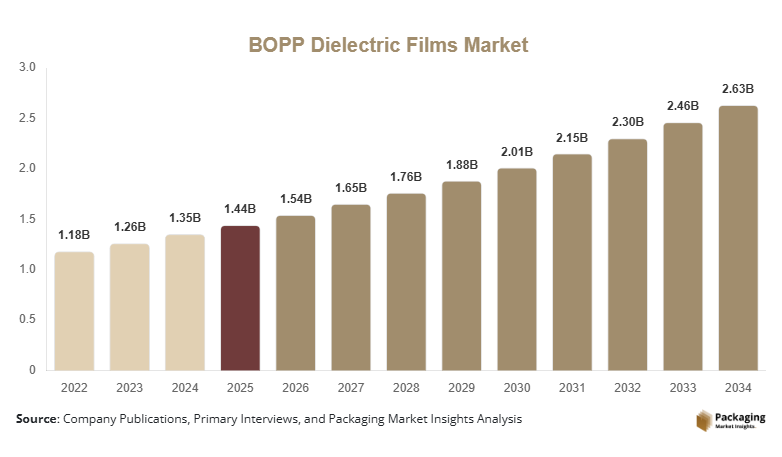
The BOPP dielectric films market size is projected at USD 1.54 billion in 2026 and is expected to hit USD 2.63 billion by 2034 with a CAGR of 6.9%.
Growing investments in electrical infrastructure, renewable energy systems, and electronic components are accelerating the requirement for advanced dielectric materials. The report evaluates production trends, detailed segmentation, technological developments, pricing patterns, supply chains, and competitive positioning across major countries, enabling stakeholders to assess long-term investment opportunities and evolving industry dynamics.
BOPP dielectric films are biaxially oriented polypropylene films designed to provide high dielectric strength, low dielectric loss, and superior thermal stability for capacitor manufacturing. Global production exceeded 620 thousand metric tons in 2025, while capacitor-grade films represented nearly 42% of total specialty BOPP film output. Electronics applications accounted for approximately 48% of total consumption, followed by industrial power equipment at 31% and automotive electronics at 21%. Penetration of high-performance capacitor films surpassed 58% across premium electronic devices, reinforcing the BOPP dielectric films market.
Explore more data points, trends and opportunities Download Free Sample Report
BOPP Dielectric Films Trends
Increasing Adoption of High-Energy-Density Capacitors
The expansion of renewable energy installations and electric mobility is driving demand for capacitor-grade dielectric films with higher voltage endurance. Global capacitor production exceeded 95 billion units in 2025, while renewable energy capacitor demand increased by 14.8% year-over-year. Manufacturers are introducing thinner films below 2.8 microns, improving capacitance by over 12% while reducing material usage by nearly 8%, strengthening the BOPP dielectric films market.
Automation in film stretching, plasma surface treatment, and AI-enabled quality inspection has improved production efficiency by approximately 16%. Manufacturing facilities operating above 35,000 tons annually continue expanding in Asia-Pacific, while metallized film adoption has exceeded 61% among premium capacitor manufacturers. These technological improvements continue supporting the BOPP dielectric films market.
BOPP Dielectric Films Drivers
Growing Demand from Electric Vehicles and Renewable Energy
Electric vehicle production exceeded 18 million units globally in 2025, while renewable energy capacity additions crossed 620 GW. Film capacitors used in traction inverters, charging stations, and grid infrastructure require high dielectric reliability above 700 V operating conditions. Demand for capacitor-grade BOPP films increased by 11.6%, while industrial capacitor production expanded by 9.3%, supporting continuous investment across the BOPP dielectric films market.
BOPP Dielectric Films Restraints
Volatility in Polypropylene Resin Prices
Polypropylene resin accounts for nearly 52% of the total manufacturing cost. Feedstock price fluctuations of 15–22% annually impact production margins and long-term supply contracts. Rising energy costs have increased film manufacturing expenses by approximately 9%, while logistics expenses remain nearly 12% above pre-2022 levels, creating pressure across the BOPP dielectric films market.
BOPP Dielectric Films Opportunities
Expansion of Smart Grid Infrastructure
Global smart grid investments surpassed USD 180 billion in 2025, increasing demand for high-performance power capacitors. Grid modernization projects require dielectric films capable of operating beyond 105°C with dielectric losses below 0.02%. Industrial automation projects are projected to increase capacitor installations by 13%, creating substantial opportunities for manufacturers across the BOPP dielectric films market.
Challenges in BOPP Dielectric Films
Maintaining Ultra-High Manufacturing Precision
Producing dielectric films with thickness tolerances below ±0.2 microns requires advanced stretching technology and contamination-free environments. Manufacturing rejection rates can exceed 5% if process consistency declines, while equipment investments above USD 60 million for new production lines increase entry barriers. These technical challenges continue influencing the BOPP dielectric films market.
Report Scope
| Report Metric | Details |
|---|---|
| Market Size in 2025 | USD 1.44 Billion |
| Market Size in 2026 | USD 1.54 Billion |
| Market Size in 2034 | USD 2.63 Billion |
| CAGR | 6.9% (2026-2034) |
| Base Year for Estimation | 2025 |
| Historical Data | 2022-2024 |
| Forecast Period | 2026-2034 |
| Report Coverage | Revenue Forecast, Competitive Landscape, Supply Chain Disruption, Growth Factors, Environment & Regulatory Landscape and Trends |
| Geographies Covered | North America, Europe, APAC, Middle East and Africa, LATAM |
| Countries Covered | U.S., Canada, U.K., Germany, France, Spain, Italy, Russia, Nordic, Benelux, Rest of Europe, China, South Korea, Japan, India, Australia, Singapore, Taiwan, South East Asia, Rest of Asia-Pacific, UAE, Turkey, Saudi Arabia, South Africa, Egypt, Nigeria, Rest of MEA, Brazil, Mexico, Argentina, Chile, Colombia, Rest of LATAM |
Explore more data points, trends and opportunities Download Free Sample Report
BOPP Dielectric Films Market Segmentation
Type-based and application-based segmentation reflects changing demand across electronics, industrial equipment, and automotive sectors. Metallized variants contribute nearly 46% of industry revenue, while power capacitor applications account for approximately 49% of total consumption.
By Type
Single-layer BOPP dielectric films hold approximately 29% of total demand. Production exceeds 180 thousand metric tons annually, offering dielectric strength above 650 V/µm and excellent insulation for standard capacitors.
Metallized BOPP dielectric films represent nearly 46% of the market. Annual production exceeds 285 thousand metric tons, supporting self-healing capacitor technology with improved operational efficiency exceeding 98%.
Co-extruded BOPP dielectric films account for approximately a 25% share. Multi-layer construction improves thermal stability by nearly 15%, while production exceeds 155 thousand metric tons annually for high-frequency electronic applications.
By Application
Power capacitors contribute around 49% of overall demand. Annual production surpasses 32 billion capacitor units, with penetration above 70% across transmission, renewable energy, and industrial automation systems.
Consumer electronics account for nearly a 31% share. More than 48 billion electronic devices require capacitor-grade dielectric films annually, with usage increasing alongside miniaturization and high-frequency circuit designs.
Automotive electronics represent approximately 20% of demand. Electric vehicle electronics utilize dielectric films in DC-link capacitors operating above 800 V, while automotive-grade production continues expanding at over 12% annually.
BOPP Dielectric Films Market Segmentations
Type
- Single-Layer BOPP Dielectric Films
- Metallized BOPP Dielectric Films
- Co-Extruded BOPP Dielectric Films
Application
- Power Capacitors
- Consumer Electronics
- Automotive Electronics
BOPP Dielectric Films Regional Outlook
North America
North America contributes approximately 24% of global revenue. The United States generates nearly 78% of regional demand, supported by advanced electronics manufacturing and renewable energy investments. Regional production exceeds 115 thousand metric tons annually.
Europe
Europe represents nearly 27% of industry revenue. Germany, France, and Italy account for over 67% of regional capacitor production, while electric mobility projects continue increasing dielectric film consumption by around 10% annually.
Asia-Pacific
Asia-Pacific dominates with approximately 41% market share. China, Japan, South Korea, and India produce over 360 thousand metric tons annually, supplying more than 70% of global capacitor manufacturing requirements and supporting large-scale electronics exports.
Latin America
Latin America contributes nearly 5% of total demand. Brazil and Mexico remain the leading consumers, supported by expanding industrial automation and consumer electronics manufacturing.
Middle East & Africa
The Middle East & Africa account for around 3% of global demand. Investments in power transmission, renewable energy, and industrial infrastructure continue supporting gradual adoption of advanced dielectric films.
Top Players In BOPP Dielectric Films
- Toray Industries Inc.
- Treofan Group
- Cosmo First Limited
- Jindal Poly Films Ltd.,
- Oben Group
- Uflex Ltd.,
- Taghleef Industries
- Polyplex Corporation Ltd.,
- FSPG Hi-Tech Co., Ltd.
- Impex Global
- Vibac Group
- SRF Limited
Toray Industries Inc. Estimated global market presence of 12–14%. Strong positioning in premium capacitor-grade dielectric films. Operates advanced production facilities with high-purity film manufacturing and continuous investment in ultra-thin dielectric technologies. The company maintains a diversified portfolio serving renewable energy, automotive electronics, industrial power systems, and consumer electronics manufacturers through global distribution and long-term supply partnerships. Cosmo First Limited has an estimated global market presence of 8–10%. Strong supplier across Asia-Pacific and export markets. Focuses on specialty BOPP technologies, metallized capacitor films, and process innovation to improve thickness consistency and electrical performance. Continuous capacity expansion, sustainability initiatives, and strategic customer relationships strengthen its competitive position across electronics and industrial capacitor manufacturing industries.