Foamed Polypropylene Films Market Size
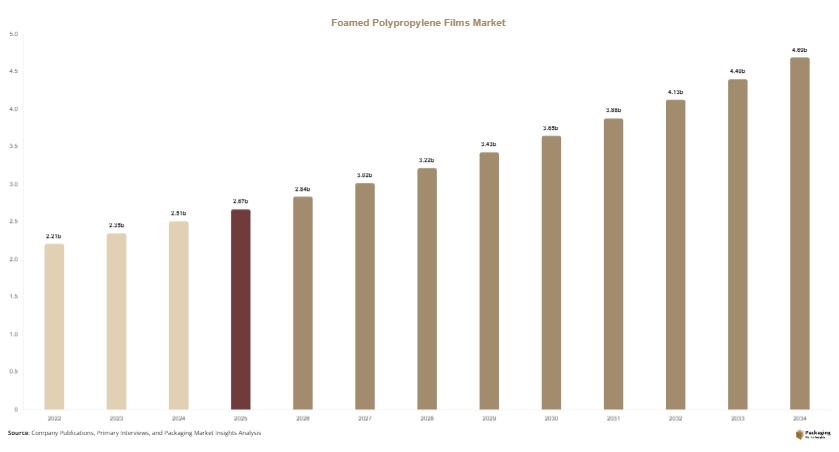
Foamed Polypropylene Films market size is projected at USD 2.84 billion in 2026 and is expected to hit USD 4.69 billion by 2034 with a CAGR of 6.46%. The report provides comprehensive analysis of production capacity, raw material trends, pricing, technological developments, competitive benchmarking, and end-user demand. It further evaluates regional opportunities, application analysis, and manufacturer strategies to provide a detailed assessment of the competitive landscape.
The Foamed Polypropylene Films Market comprises lightweight cellular polypropylene films manufactured through physical and chemical foaming technologies for packaging, automotive, insulation, and industrial applications. Global production exceeded 1.46 million metric tons in 2025, with packaging accounting for approximately 48% of total consumption, automotive representing 31%, and construction contributing nearly 21%. Multi-layer foamed polypropylene films accounted for 44% of production, followed by single-layer films at 38% and laminated films at 18%. Increasing demand for lightweight and recyclable polymer solutions continues strengthening the Foamed Polypropylene Films Market.
Explore more data points, trends and opportunities Download Free Sample Report
Foamed Polypropylene Films Market Trends
Rising Adoption of Lightweight and Recyclable Polypropylene Films
Manufacturers continue replacing conventional plastic structures with lightweight foamed polypropylene films to reduce material consumption and improve sustainability. Global production exceeded 1.5 million metric tons annually, while recyclable polymer adoption surpassed 66% across advanced packaging manufacturers. Improved extrusion foaming technologies have reduced material usage by 17% while enhancing impact resistance by approximately 21%, reinforcing the Foamed Polypropylene Films Market.
Growing demand from automotive and industrial sectors continues accelerating production investments. More than 72% of automotive interior manufacturers utilize lightweight polymer materials to reduce vehicle weight, while advanced multilayer extrusion technology has increased production efficiency by nearly 19%. Investments exceeding USD 780 million in polymer processing facilities continue supporting innovation across the Foamed Polypropylene Films Market.
Foamed Polypropylene Films Market Drivers
Growing Demand for Lightweight Packaging and Automotive Components
Increasing adoption of lightweight packaging and vehicle weight reduction strategies is driving market expansion. Automotive lightweight material consumption increased by 8.2% during 2025, while packaging manufacturers expanded foamed polymer utilization by approximately 10.5%. More than 69% of flexible packaging manufacturers now incorporate lightweight polymer structures, accelerating production and supporting the Foamed Polypropylene Films Market.
Foamed Polypropylene Films Market Restraints
Fluctuating Polypropylene Resin Prices
Variability in polypropylene resin prices continues affecting production costs. Resin prices fluctuated by approximately 15% over recent years, while energy expenses increased by nearly 11%. Raw materials account for more than 57% of manufacturing costs, limiting profitability and creating pricing pressure throughout the Foamed Polypropylene Films Market.
Foamed Polypropylene Films Market Opportunities
Expansion of Sustainable Flexible Packaging
Increasing sustainability regulations and recyclable packaging initiatives are creating new growth opportunities. More than 54% of packaging converters are investing in recyclable foamed polypropylene solutions, while mono-material packaging adoption increased by approximately 23%. Production of sustainable foamed polymer films is projected to exceed 2 million metric tons before 2030, generating substantial opportunities for the Foamed Polypropylene Films Market.
Challenges in Foamed Polypropylene Films Market
Balancing Performance with Recycling Requirements
Manufacturers face challenges in maintaining mechanical strength while improving recyclability. More than 61% of producers continue investing in advanced foam structures, while maintaining density below 0.65 g/cm³ requires sophisticated processing technologies. Compliance with sustainability regulations and product performance standards remains a significant challenge for the Foamed Polypropylene Films Market.
Report Scope
| Report Metric | Details |
|---|---|
| Market Size in 2025 | USD 2.67 billion |
| Market Size in 2026 | USD 2.84 billion |
| Market Size in 2034 | USD 4.69 billion |
| CAGR | 6.46% (2026-2034) |
| Base Year for Estimation | 2025 |
| Historical Data | 2022-2024 |
| Forecast Period | 2026-2034 |
| Report Coverage | Revenue Forecast, Competitive Landscape, Supply Chain Disruption, Growth Factors, Environment & Regulatory Landscape and Trends |
| Geographies Covered | North America, Europe, APAC, Middle East and Africa, LATAM |
| Countries Covered | U.S., Canada, U.K., Germany, France, Spain, Italy, Russia, Nordic, Benelux, Rest of Europe, China, South Korea, Japan, India, Australia, Singapore, Taiwan, South East Asia, Rest of Asia-Pacific, UAE, Turky, Saudi Arabia, South Africa, Egypt, Nigeria, Rest of MEA, Brazil, Mexico, Argentina, Chile, Colombia, Rest of LATAM |
Explore more data points, trends and opportunities Download Free Sample Report
Foamed Polypropylene Films Market Segmentation
The market is segmented by type and application, with packaging accounting for approximately 48% of total revenue and multi-layer foamed polypropylene films representing around 44% of production. Continuous innovation in extrusion technology and recyclable polymer formulations continues expanding market penetration.
By Type
Single-Layer Foamed Polypropylene Films
Single-layer films account for approximately 38% of total demand and annual production exceeding 550 thousand metric tons. These films provide lightweight construction, excellent cushioning performance, and cost-effective packaging for industrial and consumer applications.
Multi-Layer Foamed Polypropylene Films
Multi-layer foamed polypropylene films dominate with approximately 44% market share and production exceeding 640 thousand metric tons annually. These products offer superior barrier properties, higher mechanical strength, improved insulation, and enhanced durability.
Laminated Foamed Polypropylene Films
Laminated films contribute nearly 18% of total consumption. Production exceeded 270 thousand metric tons in 2025, providing enhanced moisture resistance, thermal insulation, and compatibility with specialty packaging and construction applications.
By Application
Packaging
Packaging accounts for approximately 48% of total consumption. More than 700 thousand metric tons are utilized annually for food packaging, protective packaging, consumer goods, and industrial wrapping. High cushioning efficiency and lightweight characteristics continue driving adoption.
Automotive
Automotive applications represent nearly 31% of market demand. Annual consumption exceeds 450 thousand metric tons for vehicle interiors, insulation materials, headliners, and vibration control components. Lightweight construction supports fuel efficiency and electric vehicle development.
Construction
Construction applications contribute approximately 21% of global demand. More than 300 thousand metric tons are utilized annually for insulation systems, vapor barriers, flooring underlays, and protective building materials requiring moisture resistance and thermal performance.
Foamed Polypropylene Films Market Segmentations
Type
- Single-Layer Foamed Polypropylene Films
- Multi-Layer Foamed Polypropylene Films
- Laminated Foamed Polypropylene Films
Application
- Packaging
- Automotive
- Construction
Foamed Polypropylene Films Regional Outlook
North America
North America accounts for approximately 31% of global demand. The United States contributes nearly 81% of regional consumption, supported by advanced packaging and automotive manufacturing. Annual production exceeds 450 thousand metric tons.
Europe
Europe represents approximately 29% of the global market. Germany, France, Italy, and the United Kingdom contribute over 71% of regional production. Automotive applications account for nearly 36% of regional demand due to lightweight material adoption.
Asia-Pacific
Asia-Pacific holds approximately 34% of worldwide demand and remains the fastest-growing production hub. China contributes nearly 48% of regional production, followed by Japan at 17%, India at 16%, and South Korea at 8%. Annual production exceeds 500 thousand metric tons.
Latin America
Latin America contributes approximately 4% of global demand. Brazil represents nearly 44% of regional consumption, while Mexico contributes approximately 27%, supported by expanding automotive manufacturing.
Middle East & Africa
The Middle East & Africa account for approximately 2% of global demand. Increasing investments in industrial manufacturing and construction activities continue supporting regional market expansion.
Top players in Foamed Polypropylene Films Market
- JSP Corporation
- Sekisui Chemical Co., Ltd.
- Borealis AG
- Treofan Group
- Mitsui Chemicals, Inc.
- Braskem S.A.
- Toray Industries, Inc.
- Coveris Holdings S.A.
- Pregis LLC
- Berry Global Inc.
- Sonoco Products Company
- Sealed Air Corporation
JSP Corporation
-
Holds an estimated 13–15% global market share.
-
Maintains a leading position in engineered foamed polypropylene materials.
-
Operates advanced production facilities serving packaging, automotive, and industrial sectors.
-
The company focuses on lightweight polymer technologies, recyclable foam materials, and advanced extrusion processes. Continuous investment in sustainable manufacturing and high-performance polymer solutions strengthens its competitive position across global packaging and automotive applications.
Sekisui Chemical Co., Ltd.
-
Accounts for approximately 10–12% global market share.
-
Strong presence across automotive, construction, and industrial polymer solutions.
-
Operates integrated manufacturing facilities throughout Asia, Europe, and North America.
-
The company continues investing in advanced foam technologies, environmentally friendly materials, and lightweight structural products while expanding production capacity to support growing global demand for high-performance foamed polypropylene films.