CPP Films For Packaging Market Size and Growth
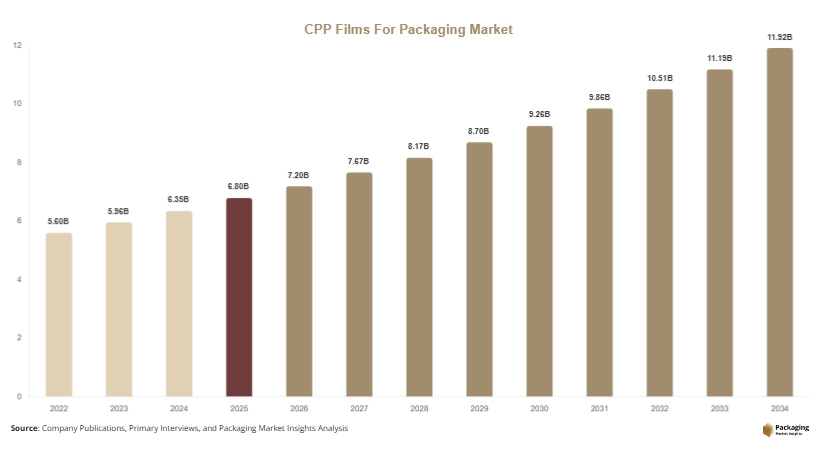
The global market was valued at approximately USD 6.8 billion in 2025 and is expected to reach nearly USD 7.2 billion in 2026. By 2034, the market is projected to attain around USD 11.9 billion, expanding at a CAGR of 6.5% during 2025–2034. The CPP films for packaging market is witnessing steady growth due to the rising demand for flexible packaging solutions across food, healthcare, consumer goods, and industrial applications. Cast polypropylene (CPP) films are widely used because of their superior heat sealability, moisture resistance, transparency, durability, and cost efficiency.
The increasing adoption of flexible packaging in the food and beverage industry is one of the major factors supporting market growth. Food manufacturers are using CPP films for snack packaging, bakery products, frozen foods, and ready-to-eat meals because these films offer strong barrier protection and excellent printability. The growing demand for lightweight and cost-effective packaging materials is also contributing significantly to market expansion. CPP films help reduce transportation costs and improve packaging efficiency, making them suitable for high-volume industrial applications.
Key Highlights
- Asia Pacific dominated the market with a 46.8% share in 2025.
- Latin America is projected to grow at the fastest CAGR of 6.9%.
- General CPP films led the product type segment with a 41.7% share.
- Food packaging dominated the application segment with a 52.4% share.
- Transparent CPP films led the film type segment with a 48.5% share.
- The US remained the dominant country with a market size of USD 1.1 billion in 2025 and USD 1.2 billion in 2026.
Explore more data points, trends and opportunities Download Free Sample Report
Market Trends
Rising Adoption of Recyclable Mono-Material Flexible Packaging
The CPP films for packaging market is witnessing increasing demand for recyclable mono-material flexible packaging solutions. Packaging manufacturers and brand owners are focusing on reducing multi-material structures that are difficult to recycle under existing waste management systems. CPP films are gaining attention because they can be integrated into polypropylene-based recyclable packaging formats while maintaining strong sealing performance and moisture resistance. Food and personal care brands are increasingly adopting mono-material pouches and laminated structures based on CPP films to comply with sustainability regulations and consumer preferences. This trend is encouraging investments in advanced film extrusion technologies and recyclable packaging product development.
Growing Demand for High-Barrier and Retort CPP Films
The demand for high-barrier and retort CPP films is increasing due to the expansion of ready-to-eat meals, processed foods, and microwaveable packaging products. Manufacturers are developing advanced CPP films with enhanced heat resistance, oxygen barriers, and puncture durability to improve product shelf life and packaging reliability. Retort CPP films are widely used in food sterilization processes because they can withstand high temperatures without compromising structural integrity. The pharmaceutical and industrial sectors are also adopting high-performance CPP films for protective packaging applications. This trend is supporting innovation in multilayer film structures and specialized packaging solutions.
Market Drivers
Expansion of the Global Flexible Packaging Industry
The rapid growth of the global flexible packaging industry is a major driver supporting the CPP films for packaging market. Flexible packaging solutions are increasingly preferred across food, healthcare, and consumer goods sectors due to their lightweight structure, lower transportation costs, and improved shelf appeal. CPP films provide excellent seal strength, flexibility, and printability, making them suitable for a wide range of packaging applications. Manufacturers are increasingly using CPP films in pouches, wraps, and laminated packaging formats to improve product protection and packaging efficiency. Growing urbanization and rising consumption of packaged products are expected to continue driving demand for CPP films globally.
Increasing Consumption of Packaged and Convenience Foods
The rising consumption of packaged and convenience foods is another key factor driving market growth. Changing lifestyles, busy work schedules, and increasing urban populations are encouraging consumers to purchase ready-to-eat and processed food products. CPP films offer strong moisture barriers and heat-sealing performance that help maintain product freshness and shelf life. Snack foods, frozen meals, confectionery products, and bakery items increasingly rely on CPP-based flexible packaging structures. Food manufacturers are also using printed and transparent CPP films to improve product visibility and brand presentation, further supporting market expansion.
Market Restraint
Environmental Concerns Related to Plastic Waste and Recycling Challenges
One of the major restraints affecting the CPP films for packaging market is the growing concern regarding plastic waste generation and recycling limitations. Although polypropylene-based films are recyclable in certain systems, many regions still lack sufficient recycling infrastructure to efficiently process flexible plastic packaging materials. Environmental regulations targeting single-use plastics are increasing pressure on packaging manufacturers to develop sustainable alternatives and reduce plastic consumption. For example, several food companies in Europe have announced packaging reduction initiatives aimed at minimizing flexible plastic waste, which may limit demand for conventional CPP films in some applications. In addition, fluctuations in raw material prices and increasing regulatory compliance costs are creating operational challenges for manufacturers. The need to balance sustainability goals with packaging performance and affordability remains a major issue across the flexible packaging industry. Companies are investing in recyclable and thinner film structures, but transitioning existing production systems requires significant capital expenditure and technological adaptation.
Market Opportunities
Growth of Sustainable and Recyclable Packaging Solutions
The increasing focus on sustainable packaging presents a significant opportunity for the CPP films for packaging market. Brand owners and retailers are actively seeking recyclable packaging materials that comply with environmental regulations and consumer sustainability expectations. CPP films can be integrated into mono-material polypropylene packaging systems that are easier to recycle compared to mixed-material laminates. Manufacturers are developing advanced recyclable CPP film structures with improved barrier performance and sealability to meet changing market requirements. Growing investment in circular economy initiatives and sustainable packaging technologies is expected to create long-term opportunities for CPP film producers worldwide.
Expansion of Pharmaceutical and Medical Packaging Applications
The expansion of pharmaceutical and medical packaging applications is creating additional growth opportunities for CPP film manufacturers. Pharmaceutical products require packaging materials with excellent moisture resistance, chemical stability, and sealing performance to maintain product integrity and safety. CPP films are increasingly used in medical device packaging, blister pack laminations, and sterile product pouches due to their durability and compatibility with sterilization processes. Rising healthcare spending, increasing pharmaceutical production, and growing demand for packaged medical products are expected to support market growth. Manufacturers are also developing specialized CPP films for high-barrier healthcare packaging applications.
Report Scope
| Report Metric | Details |
|---|---|
| Market Size in 2025 | USD 6.8 Billion |
| Market Size in 2026 | USD 7.2 Billion |
| Market Size in 2034 | USD 11.9 Billion |
| CAGR | 6.5% (2026-2034) |
| Base Year for Estimation | 2025 |
| Historical Data | 2022-2024 |
| Forecast Period | 2026-2034 |
| Report Coverage | Revenue Forecast, Competitive Landscape, Supply Chain Disruption, Growth Factors, Environment & Regulatory Landscape and Trends |
| Geographies Covered | North America, Europe, APAC, Middle East and Africa, LATAM |
| Countries Covered | U.S., Canada, U.K., Germany, France, Spain, Italy, Russia, Nordic, Benelux, Rest of Europe, China, South Korea, Japan, India, Australia, Singapore, Taiwan, South East Asia, Rest of Asia-Pacific, UAE, Turky, Saudi Arabia, South Africa, Egypt, Nigeria, Rest of MEA, Brazil, Mexico, Argentina, Chile, Colombia, Rest of LATAM |
Explore more data points, trends and opportunities Download Free Sample Report
Segmental Analysis
By Product Type
General CPP films dominated the CPP films for packaging market in 2024, accounting for approximately 41.7% of the total market share. These films are widely used in food packaging, textile packaging, and consumer goods applications because they provide strong heat-sealing performance, transparency, and flexibility. General CPP films are compatible with high-speed packaging systems and are commonly integrated into multilayer laminates for moisture protection and enhanced shelf appeal. Manufacturers prefer these films due to their cost efficiency and broad applicability across multiple industries. The growth of packaged food consumption and retail product distribution continues to support strong demand for standard CPP film products.
Retort CPP films are expected to be the fastest-growing product type segment, registering a CAGR of 7.2% during the forecast period. Retort films are designed to withstand high-temperature sterilization processes used in ready-to-eat meals, processed foods, and microwaveable packaging products. These films provide superior heat resistance, puncture durability, and barrier performance compared to standard CPP films. Food manufacturers are increasingly adopting retort packaging formats to improve shelf life and reduce refrigeration requirements. Rising demand for convenient packaged foods and advanced food preservation technologies is expected to accelerate growth in the retort CPP film segment.
By Application
Food packaging dominated the CPP films for packaging market in 2024 with a market share of approximately 52.4%. CPP films are extensively used in snack foods, bakery products, frozen meals, confectionery, and dairy packaging applications because they provide effective moisture barriers and attractive product presentation. Flexible food packaging manufacturers increasingly use CPP films in laminated pouch structures and wrapping solutions to improve shelf life and packaging efficiency. The growing global consumption of processed and convenience foods continues to support strong demand for CPP packaging materials. In addition, advancements in high-barrier and printable film technologies are improving packaging functionality and visual appeal.
Pharmaceutical packaging is projected to be the fastest-growing application segment, expanding at a CAGR of 7.1% during the forecast period. The pharmaceutical industry requires packaging materials with strong sealing properties, moisture resistance, and chemical stability to ensure product safety and compliance. CPP films are increasingly used in medical device packaging, sachets, and blister pack laminates due to their durability and sterilization compatibility. Rising pharmaceutical manufacturing activities and increasing healthcare spending are contributing to segment growth. Manufacturers are also developing specialized CPP film structures optimized for sensitive healthcare and medical packaging applications.
By Film Type
Transparent CPP films accounted for the largest market share in 2024 at approximately 48.5%. These films are widely preferred because they provide excellent product visibility, gloss, and printability while maintaining strong sealing performance. Food and consumer goods manufacturers increasingly use transparent CPP films to improve product presentation and brand recognition in retail environments. Transparent films are also commonly integrated into multilayer laminates to enhance packaging durability and moisture protection. The increasing demand for visually attractive flexible packaging solutions across retail and e-commerce channels is supporting continued growth in this segment.
Metalized CPP films are projected to be the fastest-growing film type segment, with an expected CAGR of 6.8% during 2025–2034. Metalized films provide enhanced oxygen and moisture barrier properties, making them suitable for snack foods, confectionery products, and pharmaceutical packaging. These films help extend product shelf life while improving packaging aesthetics and light protection. Growing demand for premium packaged food products and high-barrier packaging solutions is driving segment expansion. Manufacturers are increasingly investing in advanced metalizing technologies to improve film durability, barrier performance, and recyclability.
CPP Films For Packaging Market Segmentations
By Product Type
- General CPP Films
- Retort CPP Films
- Metalized CPP Films
- High-Barrier CPP Films
By Application
- Food Packaging
- Pharmaceutical Packaging
- Consumer Goods Packaging
- Industrial Packaging
By Film Type
- Transparent CPP Films
- White/Opaque CPP Films
- Metalized CPP Films
- Matte CPP Films
Regional Analysis
North America
North America accounted for approximately 24.3% of the global CPP films for packaging market share in 2025 and is expected to grow at a CAGR of 6.1% during the forecast period. The region benefits from strong demand for packaged foods, advanced flexible packaging infrastructure, and increasing adoption of recyclable packaging solutions. Packaging manufacturers are investing in high-performance CPP films for food, healthcare, and industrial packaging applications. E-commerce growth is also increasing demand for lightweight and durable packaging materials.
The United States dominates the North American market because of its large food processing industry and strong flexible packaging manufacturing base. One unique growth factor is the rapid expansion of online grocery and meal delivery services, which require durable and moisture-resistant flexible packaging solutions based on CPP films.
Europe
Europe held nearly 22.1% of the global CPP films for packaging market share in 2025 and is projected to grow at a CAGR of 5.9% during the forecast period. Increasing sustainability regulations and growing consumer preference for recyclable packaging materials are supporting regional market growth. Food manufacturers and retailers are adopting mono-material flexible packaging structures to improve recyclability and reduce environmental impact. The pharmaceutical industry also contributes significantly to demand for high-quality CPP packaging films across the region.
Germany remains the dominant country in the European market due to its advanced packaging manufacturing sector and strong industrial base. One unique growth factor is the increasing adoption of circular economy packaging strategies that encourage development of recyclable polypropylene-based flexible packaging solutions.
Asia Pacific
Asia Pacific dominated the CPP films for packaging market with a 46.8% share in 2025 and is expected to grow at a CAGR of 6.7% through 2034. The region benefits from expanding food processing industries, rising packaged product consumption, and growing retail infrastructure. China, India, Japan, and Southeast Asian countries are major contributors to market growth. Increasing urbanization and changing consumer lifestyles are driving strong demand for flexible packaging materials across multiple industries.
China dominates the Asia Pacific market because of its extensive packaging manufacturing capacity and rapidly expanding food and beverage sector. One unique growth factor is the increasing investment in domestic flexible packaging production facilities designed to support rising consumer demand and export-oriented packaging industries.
Middle East & Africa
The Middle East & Africa market represented approximately 3.9% of the global CPP films for packaging market share in 2025 and is forecast to grow at a CAGR of 5.8% during the study period. Rising demand for packaged foods, expanding retail networks, and improving healthcare infrastructure are supporting market development. Flexible packaging solutions are increasingly used across food and industrial sectors due to their lightweight structure and transportation efficiency.
Saudi Arabia leads the regional market because of its expanding food processing and retail industries. One unique growth factor is the growing investment in domestic packaging manufacturing facilities aimed at reducing dependence on imported flexible packaging materials and supporting industrial diversification initiatives.
Latin America
Latin America accounted for approximately 2.9% of the global CPP films for packaging market share in 2025 and is projected to grow at the fastest CAGR of 6.9% during the forecast period. Increasing packaged food consumption, retail modernization, and rising pharmaceutical production are contributing to regional market growth. Flexible packaging adoption is increasing across consumer goods and industrial sectors due to its affordability and functionality.
Brazil dominates the Latin American market because of its large food and beverage manufacturing industry and growing consumer packaging demand. One unique growth factor is the increasing expansion of regional snack food and processed food industries requiring cost-effective flexible packaging materials.
Competitive Landscape
The CPP films for packaging market is moderately fragmented, with leading companies focusing on capacity expansion, sustainable film development, and advanced multilayer packaging technologies. Manufacturers are investing in recyclable mono-material CPP film solutions and high-barrier packaging products to address changing environmental regulations and customer requirements. Strategic partnerships with food processing and consumer goods companies remain important competitive strategies across the industry.
Profol GmbH is one of the leading players in the market due to its extensive CPP film product portfolio and strong global distribution network. In 2024, the company introduced recyclable high-barrier CPP films designed for mono-material food packaging applications. Other key market participants include Jindal Poly Films Ltd., Mitsui Chemicals Tohcello Inc., Polyplex Corporation Ltd., and Uflex Ltd. These companies continue to focus on technological innovation, sustainable packaging materials, and regional manufacturing expansion to strengthen market competitiveness.
Key Players List
- Profol GmbH
- Jindal Poly Films Ltd.
- Mitsui Chemicals Tohcello Inc.
- Polyplex Corporation Ltd.
- Uflex Ltd.
- Oben Holding Group
- Taghleef Industries
- Manuli Stretch S.p.A.
- TriPack Films
- Futamura Group
- Plastchim-T AD
- Polibak Plastik Film Sanayi
- PT Bhineka Tatamulya
- Schur Flexibles Group
- Cosmo Films Ltd.