Plastic Dielectric Films Market Size and Growth
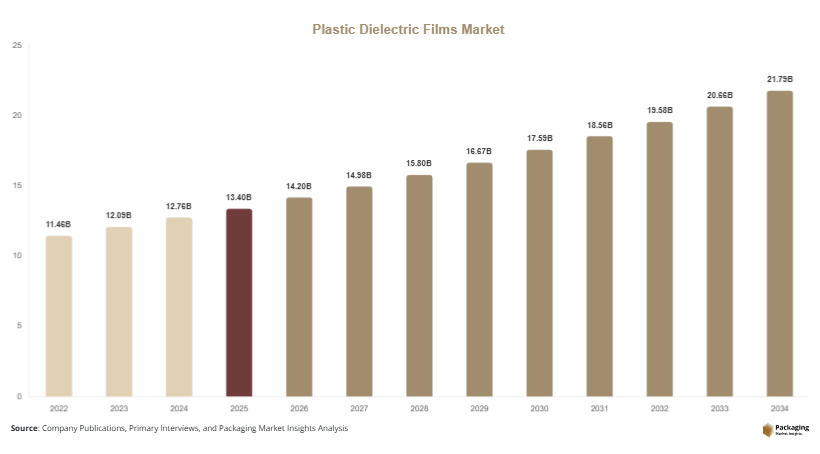
The global plastic dielectric films market size was valued at approximately USD 13.4 billion in 2025 and is projected to reach USD 14.2 billion in 2026. Over the forecast period, the market is expected to grow to nearly USD 21.8 billion by 2034, registering a CAGR of 5.5% from 2025 to 2034. Plastic dielectric films are widely used in capacitors, insulation systems, and flexible electronics due to their excellent electrical insulation properties, thermal stability, and mechanical strength. The plastic dielectric films market is witnessing consistent expansion driven by rising demand across electronics, energy storage, and industrial applications.
One of the primary growth factors driving the market is the rapid expansion of the consumer electronics industry. Devices such as smartphones, laptops, and wearable electronics require compact and efficient components, including capacitors that rely heavily on dielectric films. The increasing trend toward miniaturization of electronic components is further supporting demand for high-performance dielectric materials. Another key factor is the growth of renewable energy and electric vehicles. Plastic dielectric films are essential in power electronics, energy storage systems, and electric vehicle components, where reliability and efficiency are critical.
Key Highlights
- Asia Pacific dominated the market with a 41.2% share in 2025, while Latin America is projected to grow at the fastest CAGR of 6.1%.
- Polypropylene films led the type segment with a 34.7% share, while polyphenylene sulfide films are expected to grow at a CAGR of 6.4%.
- Electronics applications dominated with a 48.3% share, while energy storage is forecasted to grow at a CAGR of 6.6%.
- Automotive applications led the segment with 29.5% share, while renewable energy is expected to grow at a CAGR of 6.8%.
- China remained the dominant country with a market size of USD 3.1 billion in 2025 and USD 3.3 billion in 2026.
Explore more data points, trends and opportunities Download Free Sample Report
Market Trends
Growing Demand for High-Performance Capacitor Films
The increasing demand for high-performance capacitors is shaping the plastic dielectric films market. Capacitors are critical components in electronic devices, power systems, and renewable energy applications. Manufacturers are focusing on developing dielectric films with enhanced electrical properties, such as higher dielectric strength and lower energy loss. These improvements enable the production of compact and efficient capacitors that meet the requirements of modern electronics. Additionally, the shift toward electric vehicles and renewable energy systems is increasing the demand for advanced capacitor technologies. As a result, the development of high-performance dielectric films is becoming a key focus area for manufacturers.
Increasing Adoption of Sustainable and Recyclable Materials
Sustainability is emerging as a significant trend in the market. Manufacturers are exploring the use of recyclable and biodegradable materials to reduce environmental impact. The development of eco-friendly dielectric films is gaining attention as industries seek to comply with environmental regulations. Additionally, companies are investing in energy-efficient production processes to minimize waste and reduce carbon emissions. This trend is also influenced by consumer demand for sustainable products. As environmental concerns continue to grow, the adoption of sustainable materials in dielectric film production is expected to increase, shaping the future of the market.
Market Drivers
Expansion of Consumer Electronics Industry
The rapid growth of the consumer electronics industry is a major driver of the plastic dielectric films market. The increasing demand for smartphones, laptops, and wearable devices is driving the need for compact and efficient electronic components. Dielectric films are essential in capacitors and insulation systems used in these devices. The trend toward miniaturization and high performance is further supporting demand for advanced dielectric materials. Additionally, the rising adoption of smart devices and IoT technologies is contributing to market growth. As the electronics industry continues to expand, the demand for plastic dielectric films is expected to increase.
Growth of Electric Vehicles and Renewable Energy
The growth of electric vehicles and renewable energy systems is another key driver of the market. Dielectric films are used in power electronics, energy storage systems, and electric vehicle components. The increasing adoption of electric vehicles is driving demand for efficient and reliable components. Similarly, the expansion of renewable energy projects is creating opportunities for dielectric films in power transmission and storage applications. Governments around the world are supporting the adoption of clean energy, further boosting market growth. These factors are expected to drive the demand for plastic dielectric films.
Market Restraint
Volatility in Raw Material Prices and Supply Chain Challenges
The volatility in raw material prices is a significant restraint for the plastic dielectric films market. Materials such as polypropylene and polyethylene are derived from petrochemicals, making them susceptible to fluctuations in crude oil prices. These fluctuations can impact production costs and profit margins for manufacturers. Additionally, supply chain disruptions can affect the availability of raw materials, leading to production delays. For example, disruptions in global supply chains during economic uncertainties can increase costs and reduce production efficiency. These challenges may hinder market growth and create uncertainty for manufacturers.
Market Opportunities
Advancements in Flexible Electronics and Wearable Devices
The development of flexible electronics and wearable devices presents significant opportunities for the market. Dielectric films are used in flexible circuits and components, enabling the production of lightweight and flexible devices. The increasing demand for wearable technology, such as smartwatches and fitness trackers, is driving the need for advanced materials. These applications require dielectric films with high flexibility and durability. As technology continues to evolve, the demand for innovative dielectric materials is expected to grow, creating new opportunities for market players.
Expansion of Industrial Automation and Smart Infrastructure
The expansion of industrial automation and smart infrastructure is creating new opportunities for the plastic dielectric films market. Dielectric films are used in motors, transformers, and other industrial equipment to ensure efficient operation. The increasing adoption of automation technologies is driving demand for reliable and high-performance components. Additionally, the development of smart infrastructure, such as smart grids and energy-efficient buildings, is supporting market growth. These applications require advanced materials that offer durability and efficiency. As industries continue to adopt automation and smart technologies, the demand for dielectric films is expected to increase.
Report Scope
| Report Metric | Details |
|---|---|
| Market Size in 2025 | USD 13.4 Billion |
| Market Size in 2026 | USD 14.2 Billion |
| Market Size in 2034 | USD 21.8 Billion |
| CAGR | 5.5% (2026-2034) |
| Base Year for Estimation | 2025 |
| Historical Data | 2022-2024 |
| Forecast Period | 2026-2034 |
| Report Coverage | Revenue Forecast, Competitive Landscape, Supply Chain Disruption, Growth Factors, Environment & Regulatory Landscape and Trends |
| Geographies Covered | North America, Europe, APAC, Middle East and Africa, LATAM |
| Countries Covered | U.S., Canada, U.K., Germany, France, Spain, Italy, Russia, Nordic, Benelux, Rest of Europe, China, South Korea, Japan, India, Australia, Singapore, Taiwan, South East Asia, Rest of Asia-Pacific, UAE, Turky, Saudi Arabia, South Africa, Egypt, Nigeria, Rest of MEA, Brazil, Mexico, Argentina, Chile, Colombia, Rest of LATAM |
Explore more data points, trends and opportunities Download Free Sample Report
Segmental Analysis
By Type
Polypropylene films accounted for the largest market share in 2024, contributing 34.7% to the overall market. These films are widely used due to their excellent dielectric properties, low cost, and high thermal stability. Polypropylene films are commonly used in capacitors and insulation applications, making them a preferred choice for manufacturers. Their ability to withstand high temperatures and electrical stress enhances their performance in demanding applications.
Polyphenylene sulfide films are expected to grow at the fastest CAGR of 6.4%. These films offer superior thermal resistance and chemical stability, making them suitable for high-performance applications. The increasing demand for advanced materials in electronics and automotive industries is driving the growth of this segment.
By Application
Electronics applications held the largest share in 2024, accounting for 48.3% of the market. Dielectric films are widely used in capacitors, circuits, and insulation systems in electronic devices. The growing demand for consumer electronics is driving the adoption of dielectric films in this segment.
Energy storage is expected to grow at the fastest CAGR of 6.6%. The increasing adoption of renewable energy and electric vehicles is driving demand for energy storage systems. Dielectric films play a crucial role in improving the efficiency and reliability of these systems.
By End-Use
Automotive applications accounted for the largest market share in 2024, contributing 29.5% to the overall market. Dielectric films are used in electric vehicles and automotive electronics to ensure efficient performance. The growing adoption of electric vehicles is driving demand in this segment.
Renewable energy is expected to grow at the fastest CAGR of 6.8%. The expansion of renewable energy projects is driving the demand for dielectric films in power systems. These films are used in energy transmission and storage applications, supporting the growth of this segment.
Plastic Dielectric Films Market Segmentations
By Product Type
- Polypropylene Films
- Polyethylene Terephthalate Films
- Polyphenylene Sulfide Films
By Application
- Electronics
- Energy Storage
- Industrial Equipment
By End-User
- Automotive
- Renewable Energy
- Consumer Electronics
Regional Analysis
North America
North America accounted for approximately 22.6% of the global market share in 2025 and is expected to grow at a CAGR of 5.0% during the forecast period. The region benefits from a strong presence of electronics manufacturers and advanced technological infrastructure. The demand for dielectric films is driven by the growing adoption of electric vehicles and renewable energy systems. Additionally, the increasing focus on energy efficiency and sustainability is supporting market growth.
The United States dominates the regional market due to its well-established industrial base and high investment in research and development. A key growth factor is the increasing adoption of advanced electronics and smart technologies, which is driving demand for high-performance dielectric materials.
Europe
Europe held a market share of 24.1% in 2025 and is projected to grow at a CAGR of 5.2%. The region is characterized by strong regulatory frameworks and a focus on sustainability. The demand for dielectric films is driven by the growing adoption of renewable energy and electric vehicles. Additionally, the emphasis on energy efficiency is supporting market growth.
Germany is the leading country in the European market, supported by its strong automotive and industrial sectors. A unique growth factor is the increasing investment in renewable energy projects, which is driving demand for dielectric films in power systems.
Asia Pacific
Asia Pacific dominated the market with a 41.2% share in 2025 and is expected to grow at a CAGR of 5.9%. The region’s growth is driven by the rapid expansion of the electronics industry and increasing industrialization. The demand for dielectric films is supported by the growing adoption of consumer electronics and electric vehicles.
China leads the regional market due to its large manufacturing base and strong demand for electronics. A key growth factor is the increasing production of electronic devices and components, which is driving demand for dielectric films.
Middle East & Africa
The Middle East & Africa region accounted for 5.3% of the market share in 2025 and is expected to grow at a CAGR of 5.3%. The region is witnessing increasing demand for energy and industrial applications. The adoption of dielectric films is supported by the development of infrastructure and energy projects.
The United Arab Emirates is the dominant country in the region, driven by its focus on infrastructure development. A unique growth factor is the increasing investment in smart infrastructure and energy-efficient systems.
Latin America
Latin America held a market share of 6.8% in 2025 and is projected to grow at the fastest CAGR of 6.1%. The region is experiencing growth in industrial and energy sectors. The demand for dielectric films is driven by the increasing adoption of renewable energy and industrial automation.
Brazil dominates the regional market, supported by its expanding industrial base. A key growth factor is the increasing focus on renewable energy projects, which is driving demand for dielectric films.
Competitive Landscape
The plastic dielectric films market is characterized by moderate competition, with several global and regional players focusing on innovation and product development. Companies are investing in advanced materials and production technologies to enhance product performance. Strategic partnerships and acquisitions are also common strategies used to strengthen market presence.
Toray Industries, Inc. is recognized as a leading player in the market, known for its advanced polymer technologies. The company recently introduced high-performance dielectric films designed for energy storage applications, reflecting its focus on innovation. Other key players are also expanding their product portfolios to meet the evolving demands of the market.
Key Players List
- Toray Industries, Inc.
- DuPont de Nemours, Inc.
- Mitsubishi Chemical Group Corporation
- SABIC
- Covestro AG
- 3M Company
- Eastman Chemical Company
- Polyplex Corporation Ltd.
- Uflex Ltd.
- Jindal Poly Films Ltd.
- Kolon Industries, Inc.
- SKC Co., Ltd.
- Toyobo Co., Ltd.
- Flex Films (Uflex)
- Teijin Limited