Photovoltaic Packaging EVA Film Market Size and Growth
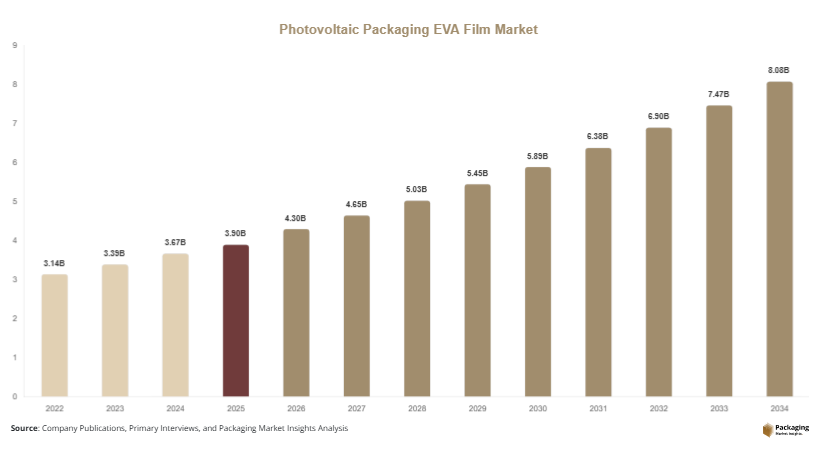
The global photovoltaic packaging EVA film market was valued at approximately USD 3.9 billion in 2025 and is projected to reach USD 4.3 billion in 2026. By 2034, the market is expected to attain nearly USD 8.7 billion, registering a CAGR of 8.2% during 2025–2034. EVA (Ethylene Vinyl Acetate) film is widely used in photovoltaic module encapsulation because it provides excellent transparency, adhesion, durability, and protection against environmental conditions such as moisture, UV radiation, and temperature fluctuations. The photovoltaic packaging EVA film market is experiencing strong growth due to rising solar energy installations, increasing investments in renewable energy infrastructure, and growing demand for high-efficiency photovoltaic modules.
One of the major growth factors driving the market is the rapid expansion of solar power generation projects worldwide. Governments and private organizations are increasingly investing in renewable energy to reduce carbon emissions and improve energy security. Photovoltaic EVA films play a critical role in enhancing the durability and operational performance of solar panels. Another key growth factor is the rising adoption of high-efficiency solar modules in residential, commercial, and utility-scale applications. Manufacturers are increasingly using advanced EVA encapsulation films to improve power output and extend module lifespan.
Key Highlights
- Asia Pacific dominated the market with a 51.6% share in 2025.
- North America is projected to grow at the fastest CAGR of 8.6%.
- Standard EVA film led the product type segment with a 44.8% share.
- Utility-scale solar projects dominated the application segment with a 49.5% share.
- Crystalline silicon photovoltaic modules led the technology segment with a 63.7% share.
- The US remained the dominant country with a market size of USD 0.8 billion in 2025 and USD 0.9 billion in 2026.
Explore more data points, trends and opportunities Download Free Sample Report
Market Trends
Rising Adoption of High-Performance EVA Films for Advanced Solar Modules
The photovoltaic packaging EVA film market is witnessing increasing demand for high-performance encapsulation materials designed for advanced solar technologies. Solar panel manufacturers are adopting EVA films with enhanced UV resistance, anti-yellowing properties, and superior moisture protection to improve module durability and energy output. Bifacial and high-efficiency photovoltaic modules require encapsulation materials capable of maintaining optical transparency and structural stability over extended operational periods. Manufacturers are also focusing on anti-PID EVA films to reduce potential-induced degradation and improve long-term performance. This trend is encouraging investment in advanced polymer formulations and precision film manufacturing technologies.
Expansion of Sustainable and Recyclable Solar Packaging Materials
Sustainability is becoming an important trend in the photovoltaic packaging EVA film market as governments and manufacturers focus on environmentally responsible solar production practices. Companies are increasingly investing in recyclable encapsulation materials and low-carbon manufacturing processes to reduce environmental impact. The solar industry is also exploring bio-based polymers and recyclable EVA alternatives suitable for future photovoltaic module recycling systems. Manufacturers are developing thinner and lightweight EVA films that reduce raw material usage while maintaining module performance. As solar energy adoption continues to rise globally, demand for sustainable photovoltaic packaging materials is expected to increase steadily.
Market Drivers
Rapid Expansion of Global Solar Energy Installations
The increasing deployment of solar power projects worldwide is a major factor driving the photovoltaic packaging EVA film market. Governments across multiple countries are implementing renewable energy policies, subsidies, and clean energy targets to reduce dependence on fossil fuels. Utility-scale solar farms, rooftop solar systems, and commercial photovoltaic installations require durable encapsulation materials to protect solar cells from environmental exposure. EVA films provide excellent adhesion, transparency, and weather resistance, making them essential for photovoltaic module manufacturing. Rising investments in solar infrastructure development are expected to continue supporting demand for EVA packaging films.
Growing Demand for High-Efficiency Photovoltaic Modules
The increasing adoption of high-efficiency solar modules is another major driver supporting market growth. Solar panel manufacturers are focusing on improving module performance and operational lifespan to increase energy generation efficiency. Advanced photovoltaic technologies such as bifacial modules and high-power crystalline silicon panels require premium encapsulation materials with improved thermal and optical properties. EVA films help maintain solar module stability and reduce degradation caused by UV radiation and moisture penetration. Growing competition in the solar industry is encouraging manufacturers to invest in high-quality encapsulation solutions that improve module reliability and performance.
Market Restraint
Volatility in Raw Material Prices and Competition from Alternative Encapsulation Materials
One of the major restraints affecting the photovoltaic packaging EVA film market is the volatility in raw material prices associated with petrochemical-based polymers. Fluctuations in the prices of ethylene and vinyl acetate can significantly impact manufacturing costs and profit margins for EVA film producers. In addition, increasing competition from alternative encapsulation materials such as POE (Polyolefin Elastomer) films is creating challenges for traditional EVA film manufacturers. POE films offer advantages including improved moisture resistance and lower degradation rates, particularly in high-humidity environments and bifacial solar applications. For example, several premium solar module manufacturers are increasingly adopting POE films for advanced photovoltaic systems requiring enhanced long-term durability. This shift may reduce demand for standard EVA films in certain applications. Manufacturers also face pressure to improve product performance while maintaining competitive pricing in a highly cost-sensitive solar energy industry. These factors may limit profitability and create challenges for smaller market participants with limited technological capabilities.
Market Opportunities
Growth of Bifacial and High-Efficiency Solar Modules
The increasing adoption of bifacial and high-efficiency photovoltaic modules presents a significant opportunity for the photovoltaic packaging EVA film market. Bifacial solar panels require advanced encapsulation materials capable of maintaining high transparency and durability on both sides of the module. EVA film manufacturers are developing specialized products with enhanced optical performance and anti-PID properties to meet these requirements. As utility-scale solar projects increasingly adopt bifacial technologies to improve energy output, demand for premium EVA encapsulation materials is expected to rise substantially. This trend is encouraging innovation in film design and polymer engineering.
Expansion of Domestic Solar Manufacturing Facilities
The expansion of domestic photovoltaic manufacturing capacities across North America, Europe, and Asia Pacific is creating new opportunities for EVA film suppliers. Governments are encouraging local solar panel production through subsidies, tax incentives, and renewable energy investment programs. Solar manufacturers require reliable encapsulation material supply chains to support increasing module production volumes. EVA film producers are investing in regional manufacturing facilities and advanced production technologies to meet rising demand. Growing efforts to reduce dependence on imported solar components are expected to support long-term market expansion for locally produced EVA packaging films.
Report Scope
| Report Metric | Details |
|---|---|
| Market Size in 2025 | USD 3.9 Billion |
| Market Size in 2026 | USD 4.3 Billion |
| Market Size in 2034 | USD 8.7 Billion |
| CAGR | 8.2% (2026-2034) |
| Base Year for Estimation | 2025 |
| Historical Data | 2022-2024 |
| Forecast Period | 2026-2034 |
| Report Coverage | Revenue Forecast, Competitive Landscape, Supply Chain Disruption, Growth Factors, Environment & Regulatory Landscape and Trends |
| Geographies Covered | North America, Europe, APAC, Middle East and Africa, LATAM |
| Countries Covered | U.S., Canada, U.K., Germany, France, Spain, Italy, Russia, Nordic, Benelux, Rest of Europe, China, South Korea, Japan, India, Australia, Singapore, Taiwan, South East Asia, Rest of Asia-Pacific, UAE, Turky, Saudi Arabia, South Africa, Egypt, Nigeria, Rest of MEA, Brazil, Mexico, Argentina, Chile, Colombia, Rest of LATAM |
Explore more data points, trends and opportunities Download Free Sample Report
Segmental Analysis
By Product Type
Standard EVA film dominated the photovoltaic packaging EVA film market in 2024, accounting for approximately 44.8% of the total market share. Standard EVA films are widely used in photovoltaic module manufacturing because they provide reliable adhesion, optical transparency, and environmental protection at relatively cost-effective prices. Crystalline silicon solar modules commonly use standard EVA encapsulation materials for residential, commercial, and utility-scale solar projects. Manufacturers continue to improve UV resistance and thermal stability in standard EVA formulations to enhance module lifespan and operational performance. The broad compatibility of standard EVA films with existing solar panel production systems further supports their widespread adoption.
Anti-PID EVA films are projected to be the fastest-growing subsegment, registering a CAGR of 9.1% during the forecast period. Potential-induced degradation remains a major challenge affecting photovoltaic module efficiency, particularly in high-voltage and humid operating environments. Anti-PID EVA films help improve module reliability by reducing electrical degradation and maintaining long-term energy performance. Utility-scale solar projects and advanced photovoltaic technologies increasingly require high-performance encapsulation solutions to maximize energy output and operational durability. Manufacturers are investing in advanced polymer formulations and enhanced cross-linking technologies to improve anti-PID performance and product durability.
By Application
Utility-scale solar projects dominated the photovoltaic packaging EVA film market in 2024 with a share of approximately 49.5%. Large solar farms require significant volumes of photovoltaic modules and encapsulation materials to support electricity generation infrastructure. EVA films are widely used in utility-scale installations because they provide reliable environmental protection and long-term module stability under outdoor operating conditions. Governments and private energy companies are increasingly investing in large solar projects to meet renewable energy targets and reduce carbon emissions. Growth in grid-scale photovoltaic installations continues to support strong demand for EVA encapsulation materials worldwide.
Bifacial solar modules are expected to be the fastest-growing application segment, expanding at a CAGR of 9.4% during the forecast period. Bifacial modules generate electricity from both front and rear surfaces, increasing energy output and operational efficiency. These advanced photovoltaic systems require encapsulation materials with excellent optical transparency and durability on both sides of the panel. EVA film manufacturers are developing specialized high-transparency products designed specifically for bifacial applications. Increasing adoption of bifacial modules in utility-scale solar projects and commercial installations is expected to support rapid segment growth over the forecast period.
By Technology
Crystalline silicon photovoltaic modules accounted for the largest market share in 2024 at approximately 63.7%. These modules dominate the global solar industry because they offer high energy efficiency, long operational lifespan, and established manufacturing infrastructure. EVA films play a critical role in encapsulating crystalline silicon solar cells and protecting them from moisture, UV exposure, and mechanical stress. The rapid expansion of rooftop solar systems and utility-scale projects continues to support strong demand for crystalline silicon module encapsulation materials. Manufacturers are increasingly improving EVA film formulations to enhance compatibility with advanced high-power crystalline silicon technologies.
Thin-film photovoltaic modules are projected to be the fastest-growing technology segment, with a forecast CAGR of 8.7% during 2025–2034. Thin-film solar technologies offer advantages such as lightweight structures, flexibility, and improved performance under low-light conditions. These modules require specialized encapsulation materials capable of supporting flexible and lightweight photovoltaic designs. Increasing use of thin-film solar systems in building-integrated photovoltaics and portable energy applications is contributing to segment expansion. Manufacturers are developing thinner and more flexible EVA films optimized for emerging photovoltaic technologies and next-generation solar applications.
Photovoltaic Packaging EVA Film Market Segmentations
By Product Type
- Standard EVA Film
- Anti-PID EVA Film
- UV Resistant EVA Film
- High Transparency EVA Film
By Application
- Residential Solar Systems
- Commercial Solar Installations
- Utility-Scale Solar Projects
- Bifacial Solar Modules
By Technology
- Crystalline Silicon Photovoltaic Modules
- Thin-Film Photovoltaic Modules
- Flexible Photovoltaic Modules
- Building-Integrated Photovoltaics
Regional Analysis
North America
North America accounted for approximately 18.6% of the global photovoltaic packaging EVA film market share in 2025 and is projected to grow at the fastest CAGR of 8.6% during the forecast period. Increasing renewable energy investments, expansion of utility-scale solar projects, and supportive government policies are driving market growth across the region. Solar manufacturers are increasingly focusing on advanced encapsulation technologies to improve module performance and comply with domestic clean energy initiatives.
The United States dominates the North American market due to its rapidly expanding solar energy infrastructure and strong policy support for domestic photovoltaic manufacturing. One unique growth factor is the increasing investment in locally produced solar modules and renewable energy supply chains supported by federal clean energy incentive programs and industrial expansion strategies.
Europe
Europe held nearly 21.4% of the global photovoltaic packaging EVA film market share in 2025 and is expected to grow at a CAGR of 7.8% through 2034. The region benefits from strong renewable energy targets, increasing rooftop solar adoption, and government initiatives promoting clean electricity generation. European photovoltaic manufacturers are investing in advanced solar module technologies requiring high-performance encapsulation materials. Sustainability regulations are also encouraging the use of recyclable and environmentally friendly EVA film products.
Germany remains the dominant country in the European market because of its well-established solar industry and large renewable energy infrastructure. One unique growth factor is the increasing integration of photovoltaic systems into residential and commercial buildings, driving demand for durable and high-efficiency solar encapsulation materials.
Asia Pacific
Asia Pacific dominated the photovoltaic packaging EVA film market with a 51.6% share in 2025 and is projected to grow at a CAGR of 8.3% during the forecast period. The region benefits from large-scale solar manufacturing capacities, expanding renewable energy installations, and strong government support for photovoltaic production. China, India, Japan, and South Korea are major contributors to regional market growth. Increasing utility-scale solar projects and rapid industrialization are further supporting demand for EVA encapsulation films.
China dominates the Asia Pacific market because of its extensive solar module manufacturing ecosystem and large photovoltaic installation capacity. One unique growth factor is the strong export-oriented solar panel industry, which requires high-volume production of advanced EVA films for domestic and international photovoltaic markets.
Middle East & Africa
The Middle East & Africa market accounted for around 3.8% of the global photovoltaic packaging EVA film market share in 2025 and is expected to grow at a CAGR of 7.1% during the forecast period. Rising investments in renewable energy diversification and large-scale desert solar projects are supporting regional market expansion. Countries across the region are increasingly adopting photovoltaic technologies to reduce dependence on fossil fuel-based electricity generation.
Saudi Arabia dominates the regional market due to its ambitious renewable energy development programs and expanding solar infrastructure investments. One unique growth factor is the increasing deployment of utility-scale solar farms designed to support national energy diversification strategies and long-term sustainability goals.
Latin America
Latin America represented approximately 4.6% of the global photovoltaic packaging EVA film market share in 2025 and is projected to grow at a CAGR of 8.0% during the forecast period. Expanding solar energy adoption, improving renewable energy policies, and increasing electricity demand are driving market growth across the region. Utility-scale and distributed solar installations are creating additional demand for durable photovoltaic encapsulation materials.
Brazil remains the dominant country in the Latin American market because of its growing solar energy capacity and favorable renewable energy investment environment. One unique growth factor is the increasing development of distributed rooftop solar systems supported by government incentives and rising commercial electricity demand.
Competitive Landscape
The photovoltaic packaging EVA film market is moderately competitive, with major manufacturers focusing on product innovation, manufacturing expansion, and advanced encapsulation technologies to strengthen market positioning. Companies are investing in UV-resistant, anti-PID, and recyclable EVA film solutions to support evolving photovoltaic module requirements. Strategic partnerships with solar panel manufacturers and expansion of regional production capacities remain common competitive strategies across the industry.
Hangzhou First Applied Material Co., Ltd. is one of the leading companies in the market due to its strong global presence and advanced photovoltaic encapsulation product portfolio. In 2024, the company expanded its high-performance anti-PID EVA film production capacity to support rising demand for bifacial solar modules. Other major companies operating in the market include STR Holdings Inc., Sveck Photovoltaic New Materials Co., Ltd., HIUV Materials Technology, and Cybrid Technologies Inc. These companies continue to focus on advanced polymer technologies, sustainable manufacturing, and high-transparency encapsulation materials to improve competitiveness.
Key Players List
- Hangzhou First Applied Material Co., Ltd.
- STR Holdings Inc.
- Sveck Photovoltaic New Materials Co., Ltd.
- HIUV Materials Technology
- Cybrid Technologies Inc.
- Bridgestone Corporation
- Mitsui Chemicals Inc.
- RenewSys India Pvt. Ltd.
- Lucent CleanEnergy
- Zhejiang Feiyu New Energy Co., Ltd.
- Changzhou Sveck Photovoltaic New Material Co., Ltd.
- 3M Company
- Jolywood Solar Technology Co., Ltd.
- Hanwha Solutions Corporation
- Dow Inc.