Lithium Battery Flexible Packaging Material Market Size and Growth
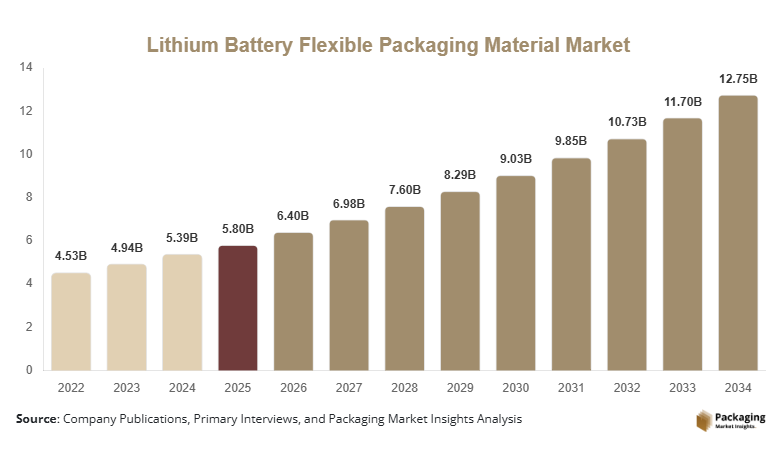
The global lithium battery flexible packaging material market size was valued at USD 5.8 billion in 2025 and is projected to reach USD 6.4 billion in 2026. The market is forecast to reach USD 13.9 billion by 2034, expanding at a CAGR of 9.0% during the forecast period from 2025 to 2034. Growth in electric mobility infrastructure, increasing investments in battery gigafactories, and rising demand for lightweight battery technologies are supporting market expansion across developed and emerging economies.
The lithium battery flexible packaging material market is experiencing consistent growth due to the rising deployment of lithium-ion batteries across electric vehicles, consumer electronics, energy storage systems, and industrial equipment. Flexible packaging materials are widely used in pouch cell batteries because they offer lightweight construction, thermal stability, compact design, and improved energy density compared to rigid battery casings. These materials generally include aluminum laminated films, polymer layers, nylon films, and heat-sealing coatings designed to protect lithium battery cells from moisture, oxygen, and mechanical stress.
Key Highlights
- Asia Pacific dominated the lithium battery flexible packaging material market with a 42.8% share in 2025.
- Latin America is projected to grow at the fastest CAGR of 10.1%.
- Aluminum laminated films led the material segment with a 48.6% share in 2025.
- Electric vehicle batteries dominated the application segment with a 46.3% share.
- Consumer electronics accounted for 31.5% of end-use demand in 2025.
- The US remained the dominant country in North America with a market size of USD 1.1 billion in 2025 and USD 1.2 billion in 2026.
Explore more data points, trends and opportunities Download Free Sample Report
Market Trends
Rising Adoption of Aluminum Laminated Films in Pouch Cell Batteries
Manufacturers are increasingly adopting aluminum laminated films in lithium battery flexible packaging because these materials provide strong moisture resistance, lightweight structure, and thermal protection. Pouch cell batteries used in electric vehicles and portable electronics require high-performance barrier properties to maintain battery stability and safety. Aluminum laminated films help reduce battery swelling and improve overall energy density, making them suitable for advanced battery systems. Battery producers are investing in multilayer film technologies that combine nylon, aluminum foil, and polypropylene sealing layers to improve durability and flexibility. The increasing commercialization of high-capacity pouch batteries across automotive and electronics sectors is expected to strengthen demand for advanced laminated packaging materials throughout the forecast period.
Expansion of Battery Manufacturing Gigafactories Worldwide
Global investments in lithium battery manufacturing facilities are increasing significantly due to the rapid transition toward electrification and renewable energy storage. Battery manufacturers are expanding production capacities in the United States, China, South Korea, Germany, and India to meet growing demand from automotive and energy sectors. These gigafactories require large volumes of flexible packaging materials for pouch cell battery production. Governments are also supporting domestic battery supply chains through subsidies and localization initiatives, which is encouraging regional packaging material manufacturing. As battery production scales up, suppliers are focusing on automated coating technologies, recyclable film materials, and advanced sealing structures to improve efficiency and reduce production costs in flexible battery packaging applications.
Market Drivers
Increasing Demand for Electric Vehicles
The rapid adoption of electric vehicles is one of the primary drivers of the lithium battery flexible packaging material market. Automakers are investing heavily in lightweight battery technologies that improve driving range and energy efficiency. Flexible packaging materials used in pouch cell batteries reduce battery pack weight while enabling compact module designs. This makes them suitable for electric passenger cars, buses, and commercial vehicles. Government incentives promoting electric vehicle adoption in regions such as Europe, North America, and Asia Pacific are further increasing battery production volumes. As automotive manufacturers continue expanding EV platforms, demand for high-performance flexible battery packaging materials is expected to rise steadily during the forecast period.
Growth in Portable Consumer Electronics Production
The increasing production of smartphones, tablets, laptops, smartwatches, and wireless electronic devices is driving demand for lithium battery flexible packaging materials. Consumer electronics manufacturers prefer pouch batteries because they support slim product designs and high energy density. Flexible packaging materials provide durability, heat resistance, and protection against moisture penetration, helping maintain battery reliability in compact electronic devices. Rising disposable income and growing adoption of connected devices are increasing electronics sales globally. In addition, advancements in wearable technology and portable medical equipment are creating further demand for lightweight lithium batteries, supporting long-term market growth for flexible packaging materials.
Market Restraint
Fluctuating Raw Material Prices and Complex Manufacturing Requirements
The lithium battery flexible packaging material market faces challenges related to fluctuating raw material prices and technically demanding production processes. Aluminum foil, specialty polymers, nylon films, and adhesive coatings used in flexible battery packaging are subject to price volatility due to supply chain disruptions, mining constraints, and changing trade conditions. Rising raw material costs can reduce profit margins for packaging manufacturers and increase overall battery production expenses. In addition, manufacturing high-performance multilayer flexible packaging materials requires precision coating, lamination, and sealing technologies that involve substantial capital investment.
The market also faces challenges related to maintaining consistent product quality and safety standards. Battery packaging defects can lead to moisture penetration, swelling, or thermal instability, which may impact battery performance and safety. For example, pouch battery manufacturers supplying electric vehicle companies must comply with strict quality regulations regarding puncture resistance and thermal management. Smaller manufacturers often face difficulties in scaling production while maintaining advanced barrier performance standards. These challenges may limit market entry for new companies and slow adoption in price-sensitive regions where low-cost battery alternatives remain available.
Market Opportunities
Growing Energy Storage System Installations
The expansion of renewable energy storage projects presents a significant opportunity for the lithium battery flexible packaging material market. Governments and utility providers are increasing investments in grid-scale battery storage systems to support solar and wind energy integration. Flexible lithium battery packaging materials are widely used in energy storage applications because they support lightweight battery modules and improve thermal management. Residential energy storage demand is also increasing as consumers seek backup power solutions and energy independence. Manufacturers that develop high-durability flexible packaging materials capable of supporting long battery cycles are expected to benefit from growing demand across utility-scale and residential energy storage applications.
Development of Recyclable and Sustainable Packaging Materials
Sustainability initiatives are creating opportunities for manufacturers to develop recyclable and environmentally responsible flexible packaging materials for lithium batteries. Battery producers and automotive companies are increasingly focusing on reducing environmental impact across battery supply chains. This is encouraging the adoption of eco-friendly polymer coatings, low-emission lamination technologies, and recyclable multilayer films. Governments in Europe and North America are introducing regulations related to battery recycling and sustainable material usage, further supporting innovation. Companies investing in biodegradable coatings and recyclable aluminum composite films can strengthen their competitive position as industries move toward circular battery manufacturing and environmentally compliant packaging solutions.
Report Scope
| Report Metric | Details |
|---|---|
| Market Size in 2025 | USD 5.8 Billion |
| Market Size in 2026 | USD 6.4 Billion |
| Market Size in 2034 | USD 13.9 Billion |
| CAGR | 9.0% (2026-2034) |
| Base Year for Estimation | 2025 |
| Historical Data | 2022-2024 |
| Forecast Period | 2026-2034 |
| Report Coverage | Revenue Forecast, Competitive Landscape, Supply Chain Disruption, Growth Factors, Environment & Regulatory Landscape and Trends |
| Geographies Covered | North America, Europe, APAC, Middle East and Africa, LATAM |
| Countries Covered | U.S., Canada, U.K., Germany, France, Spain, Italy, Russia, Nordic, Benelux, Rest of Europe, China, South Korea, Japan, India, Australia, Singapore, Taiwan, South East Asia, Rest of Asia-Pacific, UAE, Turky, Saudi Arabia, South Africa, Egypt, Nigeria, Rest of MEA, Brazil, Mexico, Argentina, Chile, Colombia, Rest of LATAM |
Explore more data points, trends and opportunities Download Free Sample Report
Segmental Analysis
By Material Type
Aluminum laminated films dominated the material type segment and accounted for 48.6% of the market share in 2024. These materials are widely used because they provide strong barrier protection against moisture, oxygen, and external contaminants. Aluminum laminated structures also improve thermal resistance and mechanical stability in lithium-ion pouch batteries. Battery manufacturers prefer these films for electric vehicle and consumer electronics applications because they support lightweight battery designs while maintaining structural integrity. The growing adoption of pouch cell batteries across automotive and portable electronics sectors continues to strengthen demand for aluminum laminated flexible packaging materials globally.
Multilayer polymer films are projected to be the fastest-growing subsegment, expanding at a CAGR of 9.8% during the forecast period. These materials are gaining attention because they offer flexibility, puncture resistance, and improved sealing performance for advanced lithium battery applications. Manufacturers are developing high-performance polymer structures capable of supporting high-capacity battery cells used in electric mobility and energy storage systems. Growth is also supported by rising investments in sustainable polymer technologies and recyclable packaging materials. Increasing research focused on lightweight and thermally stable polymer coatings is expected to accelerate market adoption across multiple industries.
By Application
Electric vehicle batteries accounted for the largest application share of 46.3% in 2024. Flexible packaging materials are increasingly used in EV battery packs because they reduce weight and improve energy density compared to rigid battery casings. Automotive manufacturers are adopting pouch cell battery technology to enhance vehicle performance and optimize battery module layouts. The expansion of EV production facilities across North America, Europe, and Asia Pacific is significantly increasing demand for high-barrier flexible packaging films. Government incentives supporting zero-emission transportation and growing consumer interest in electric mobility continue to strengthen the automotive battery packaging market.
Energy storage systems are projected to register the fastest CAGR of 10.4% during the forecast period. The increasing integration of renewable energy sources such as solar and wind power is driving demand for efficient battery storage technologies. Flexible packaging materials used in lithium-ion storage batteries provide durability, thermal stability, and improved cycle performance. Utility providers and residential consumers are increasingly adopting battery storage systems to improve energy reliability and reduce dependence on conventional power grids. Growing investments in grid modernization and decentralized energy infrastructure are expected to create long-term growth opportunities for flexible battery packaging manufacturers.
By End-Use Industry
Consumer electronics held the dominant share of 31.5% in 2024 due to strong global demand for smartphones, tablets, laptops, and wearable devices. Flexible lithium battery packaging materials are preferred in electronic devices because they enable compact and lightweight battery configurations. Electronics manufacturers are continuously focusing on slimmer product designs and higher battery efficiency, increasing the need for advanced packaging materials with superior barrier protection. Rising disposable income, expanding internet connectivity, and growing adoption of portable smart devices are supporting continued market demand across developed and emerging economies.
Industrial applications are anticipated to grow at the fastest CAGR of 9.5% during the forecast period. Industrial lithium battery systems are increasingly used in robotics, warehouse automation equipment, telecommunications infrastructure, and backup power applications. Flexible packaging materials support high-performance industrial batteries by improving durability and thermal management under demanding operational conditions. The rapid adoption of automation technologies and industrial electrification projects is creating additional demand for advanced battery systems. Manufacturers supplying industrial battery applications are focusing on durable multilayer packaging structures capable of supporting long operational lifecycles and enhanced safety standards.
Lithium Battery Flexible Packaging Material Market Segmentations
By Material Type
- Aluminum Laminated Films
- Multilayer Polymer Films
- Nylon Films
- Polypropylene Films
- Heat Sealing Coatings
By Application
- Electric Vehicle Batteries
- Consumer Electronics Batteries
- Energy Storage Systems
- Industrial Batteries
- Medical Device Batteries
By End-Use Industry
- Automotive
- Consumer Electronics
- Energy & Utilities
- Industrial Manufacturing
- Healthcare
Regional Analysis
North America
North America accounted for 24.6% of the lithium battery flexible packaging material market share in 2025 and is projected to expand at a CAGR of 8.4% through 2034. The region is benefiting from rising electric vehicle production, increasing battery manufacturing investments, and government support for domestic energy storage supply chains. Demand for advanced battery packaging materials is increasing as companies establish new lithium battery facilities across the United States and Canada.
The United States dominates the regional market due to strong electric vehicle manufacturing activity and large-scale battery plant expansion. A major growth factor is the implementation of government incentives encouraging localized battery production. Automotive manufacturers and battery suppliers are investing in domestic supply chain partnerships to reduce import dependence, which is increasing demand for flexible packaging materials used in lithium-ion pouch batteries.
Europe
Europe represented 22.8% of the global lithium battery flexible packaging material market in 2025 and is forecast to grow at a CAGR of 8.7% during the assessment period. The region is witnessing strong growth due to strict emission regulations, increasing EV adoption, and expanding battery gigafactory investments. Countries across Europe are supporting sustainable battery production initiatives that require advanced flexible packaging materials with improved recyclability and thermal stability.
Germany remains the dominant country within Europe because of its established automotive manufacturing sector and strong investment in battery research. One unique growth factor is the region’s emphasis on circular economy regulations for battery materials. European manufacturers are increasingly adopting recyclable laminated films and low-emission packaging technologies to comply with sustainability standards and environmental regulations.
Asia Pacific
Asia Pacific held the largest market share of 42.8% in 2025 and is projected to grow at a CAGR of 9.6% during the forecast period. The region dominates due to large-scale lithium battery manufacturing operations in China, Japan, and South Korea. Growing production of electric vehicles, consumer electronics, and energy storage systems is increasing demand for flexible battery packaging materials across the regional supply chain.
China leads the Asia Pacific market due to its massive battery manufacturing ecosystem and extensive electric vehicle production capacity. A unique growth factor is the country’s vertically integrated battery supply chain, which supports efficient sourcing of aluminum foil, polymers, and coating materials. Government support for battery exports and renewable energy projects continues to strengthen regional packaging material demand.
Middle East & Africa
The Middle East & Africa region accounted for 4.9% of the global market in 2025 and is expected to grow at a CAGR of 7.5% through 2034. Market growth is supported by increasing investments in renewable energy infrastructure and rising adoption of battery storage technologies in industrial applications. Demand for lithium battery flexible packaging materials is gradually increasing across telecommunications, solar storage, and backup power sectors.
Saudi Arabia dominates the regional market due to expanding renewable energy projects and industrial diversification initiatives. A unique growth factor is the development of large-scale solar energy storage facilities requiring lithium-ion battery systems. Governments across the Gulf region are investing in energy transition programs that encourage battery technology adoption and support future demand for advanced battery packaging materials.
Latin America
Latin America represented 4.9% of the global lithium battery flexible packaging material market in 2025 and is anticipated to register the fastest CAGR of 10.1% during the forecast period. Increasing renewable energy deployment, electric mobility adoption, and electronics manufacturing activities are supporting market growth. Countries in the region are expanding investments in battery assembly operations and localized energy storage solutions.
Brazil remains the leading market in Latin America due to its growing electric transportation sector and renewable energy infrastructure development. One unique growth factor is the increasing installation of residential solar power systems combined with lithium battery storage. This trend is generating additional demand for lightweight and durable flexible battery packaging materials throughout the country.
Competitive Landscape
The lithium battery flexible packaging material market is moderately consolidated, with major companies focusing on product innovation, strategic partnerships, and production expansion to strengthen their market positions. Leading manufacturers are investing in advanced laminated film technologies, recyclable packaging solutions, and high-barrier coatings to address growing demand from electric vehicle and energy storage industries. Companies are also expanding regional manufacturing facilities to support localized battery supply chains and reduce transportation costs.
Showa Denko Materials Co., Ltd. remains one of the leading players in the market due to its extensive portfolio of aluminum laminated films for lithium-ion pouch batteries. The company recently expanded its battery material production capacity in Asia to support growing electric vehicle demand. Other major companies such as Dai Nippon Printing Co., Ltd., Toppan Holdings Inc., and Youlchon Chemical Co., Ltd. are focusing on high-performance multilayer flexible films designed for next-generation battery systems.
Competition is increasing as manufacturers prioritize sustainable packaging technologies and lightweight battery materials. Strategic collaborations between battery producers and flexible packaging suppliers are becoming more common to improve material compatibility, safety performance, and production efficiency.
Key Players List
- Showa Denko Materials Co., Ltd.
- Dai Nippon Printing Co., Ltd.
- Toppan Holdings Inc.
- Youlchon Chemical Co., Ltd.
- Zhejiang Wazam New Materials Co., Ltd.
- SELEN Science & Technology Co., Ltd.
- Leeden National Oxygen Ltd.
- MTI Corporation
- Mitsui Chemicals Inc.
- UACJ Corporation
- Sumitomo Chemical Co., Ltd.
- Resonac Holdings Corporation
- Targray Technology International Inc.
- Shenzhen Kedali Industry Co., Ltd.
- Zhejiang Great Southeast Corp.