Wide Mouth Bottles Market Size
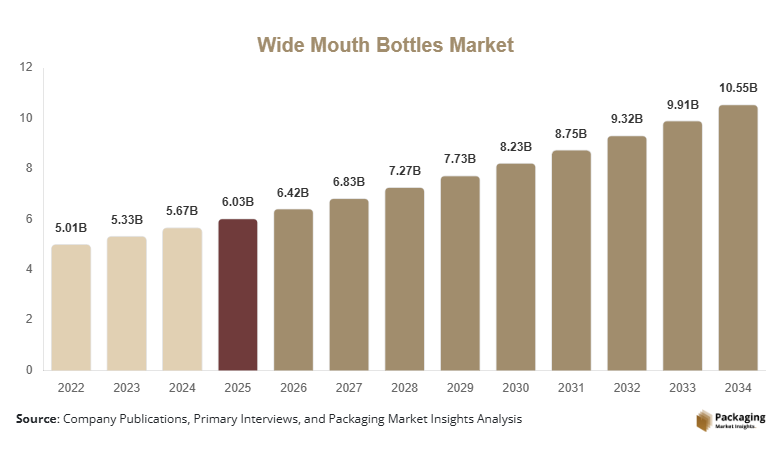
The wide-mouth bottle market size is projected at USD 6.42 billion in 2026 and is expected to hit USD 10.51 billion by 2034 with a CAGR of 6.4%. The market expansion is supported by increasing demand for durable and reusable packaging solutions across food, pharmaceutical, and personal care industries. The report provides comprehensive quantitative analysis covering market segmentation, production volumes, consumption trends, pricing analysis, and the competitive landscape to support strategic business decisions across the forecast period.
Wide-mouth bottles are rigid packaging containers designed with larger openings that facilitate easy filling, dispensing, cleaning, and storage of liquids, powders, granules, and semi-solid products. Global production exceeded 5.8 billion units during 2025, while manufacturing utilization remained above 81% across major production facilities. Plastic bottles accounted for nearly 63% of total production, glass represented 24%, and metal contributed 13%. Food and beverage applications generated approximately 46% of total consumption, pharmaceutical packaging contributed 31%, and personal care applications accounted for 23%, reinforcing sustained demand for wide-mouth bottles across multiple industries.
Explore more data points, trends and opportunities Download Free Sample Report
Wide Mouth Bottles Market Trends
Growing Adoption of Sustainable and Lightweight Packaging
Manufacturers are increasingly adopting recyclable materials and lightweight bottle designs to reduce material consumption while maintaining product durability. More than 2.9 billion units of wide-mouth recyclable bottles were produced during 2025, representing nearly 50% of global production. Recycled resin utilization increased by 21%, while lightweight bottle adoption exceeded 44% among new product launches. These developments continue to strengthen the wide-mouth bottle market.
Digital manufacturing technologies, automated inspection systems, and high-speed molding equipment continue transforming production efficiency. Smart manufacturing adoption surpassed 39% among large-scale producers, while automated quality inspection improved production efficiency by 18% and reduced defects by 12%. Rising demand from pharmaceutical and food processing industries continues supporting the wide-mouth bottle market.
Wide-Mouth Bottles Drivers
Increasing Demand for Convenient and Durable Packaging Solutions
Growing consumption of packaged food, nutritional supplements, laboratory chemicals, and healthcare products continues driving demand for wide-mouth bottles. Food processing output expanded by 7.3%, pharmaceutical packaging demand increased by 8.5%, and reusable packaging adoption exceeded 41% across industrial applications. Annual production capacity additions surpassed 420 million units, supporting long-term expansion of the wide-mouth bottle market.
Wide-Mouth Bottles Restraints
Volatility in Raw Material Prices and Manufacturing Costs
Fluctuating prices of plastic resins, glass raw materials, and metals continue influencing production economics. Raw material costs increased by nearly 9%, transportation expenses rose by 6%, and energy costs accounted for approximately 17% of manufacturing expenditure. Smaller manufacturers also reported utilization rates below 72%, creating pricing pressure across the wide-mouth bottle market.
Wide-Mouth Bottles Opportunities
Expansion Across Healthcare and Premium Packaging Applications
Demand for pharmaceutical-grade bottles, laboratory storage containers, and premium cosmetic packaging continues creating significant opportunities. Healthcare packaging production expanded by 9.2%, cosmetic packaging demand increased by 7.8%, and premium packaging adoption reached nearly 36% among new product launches. Investments exceeding USD 420 million in manufacturing upgrades further support the wide-mouth bottle market.
Challenges in the Wide-Mouth Bottles Market
Regulatory Compliance and Recycling Infrastructure Limitations
Manufacturers continue facing stricter packaging regulations, recycling targets, and quality certification requirements. Compliance costs increased by 11%, recycled material availability remained below 55% of total demand, and certification timelines extended by approximately 14% across regulated industries. These operational challenges continue influencing the wide-mouth bottle market.
Report Scope
| Report Metric | Details |
|---|---|
| Market Size in 2025 | USD 6.03 Billion |
| Market Size in 2026 | USD 6.42 Billion |
| Market Size in 2034 | USD 10.51 Billion |
| CAGR | 6.4% (2026-2034) |
| Base Year for Estimation | 2025 |
| Historical Data | 2022-2024 |
| Forecast Period | 2026-2034 |
| Report Coverage | Revenue Forecast, Competitive Landscape, Supply Chain Disruption, Growth Factors, Environment & Regulatory Landscape and Trends |
| Geographies Covered | North America, Europe, APAC, Middle East and Africa, LATAM |
| Countries Covered | U.S., Canada, U.K., Germany, France, Spain, Italy, Russia, Nordic, Benelux, Rest of Europe, China, South Korea, Japan, India, Australia, Singapore, Taiwan, South East Asia, Rest of Asia-Pacific, UAE, Turky, Saudi Arabia, South Africa, Egypt, Nigeria, Rest of MEA, Brazil, Mexico, Argentina, Chile, Colombia, Rest of LATAM |
Explore more data points, trends and opportunities Download Free Sample Report
Wide Mouth Bottles Market Segmentation
The market is segmented by material and end user, with plastic products contributing approximately 63% of total revenue, followed by glass at 24% and metal at 13%. Food and beverage applications dominated with nearly 46% share, while pharmaceutical applications represented 31% and personal care accounted for 23%.
By Material
Plastic wide-mouth bottles represented nearly 63% of total production, with more than 3.65 billion units manufactured in 2025. HDPE, PET, and PP materials remain dominant due to lightweight construction, chemical resistance, and impact strength. Bottle capacities commonly range from 100 ml to 5 liters, supporting broad industrial utilization.
Glass bottles accounted for approximately 24% of the market and exceeded 1.39 billion units in annual production. They provide excellent chemical stability, premium appearance, and high-temperature resistance, making them suitable for pharmaceuticals, laboratory chemicals, and premium food packaging.
Metal wide-mouth bottles contributed about 13% of total production, reaching nearly 754 million units annually. Stainless steel and aluminum variants offer corrosion resistance, extended durability, and reusable performance for industrial, healthcare, and specialty beverage applications.
By Application
This segment generated around 46% of total demand with production exceeding 2.67 billion units annually. Wide-mouth bottles are extensively used for sauces, powders, beverages, snacks, and nutritional products, achieving penetration above 58% across packaged food categories while supporting efficient filling and dispensing operations.
Pharmaceutical applications accounted for nearly 31% of demand, with production surpassing 1.80 billion units. These bottles provide contamination control, chemical compatibility, and regulatory compliance for tablets, powders, capsules, and laboratory reagents, maintaining adoption rates above 52% among pharmaceutical packaging manufacturers.
Personal care represented approximately 23% of market demand with annual production exceeding 1.33 billion units. Applications include creams, lotions, bath salts, powders, and cosmetic formulations, where consumer preference for reusable and premium packaging continues driving adoption beyond 43%.
Wide Mouth Bottles Market Segmentations
Material
- Plastic
- Glass
- Metal
End User
- Food & Beverage
- Pharmaceuticals
- Personal Care
Wide-Mouth Bottles: Regional Outlook
North America
North America accounted for nearly 31% of global demand with production exceeding 1.80 billion units annually. The United States contributed more than 82% of regional production, while Canada supported growing pharmaceutical and food packaging capacity. Food packaging represented 47% of regional consumption.
Europe
Europe held approximately 27% market share with production surpassing 1.56 billion units. Germany, France, Italy, and the United Kingdom remained major manufacturing hubs. Pharmaceutical applications accounted for nearly 35% of regional demand, supported by advanced packaging standards.
Asia-Pacific
The Asia-Pacific represented the largest regional market with approximately a 34% share and production exceeding 1.97 billion units annually. China, India, Japan, and South Korea dominated manufacturing, while food and beverage applications contributed nearly 49% of total regional demand.
Latin America
Latin America accounted for nearly 5% of global demand. Brazil and Mexico remained leading production centers, supported by expanding food processing and personal care industries. Production exceeded 290 million units during 2025.
Middle East & Africa
The Middle East & Africa contributed approximately 3% of global consumption, supported by increasing investments in food packaging, pharmaceuticals, and industrial storage solutions. Regional production exceeded 175 million units, with Gulf countries leading manufacturing expansion.
Top Players In The Wide-Mouth Bottle Market
- Berry Global Inc.
- Gerresheimer AG
- Amcor plc
- Alpha Packaging
- Silgan Holdings Inc.
- O.Berk Company
- Comar LLC
- Plastipak Packaging Inc.
- Nalgene
- Pretium Packaging
- Berlin Packaging
- Alpla Group
- Graham Packaging
- AptarGroup Inc.
- Cospack America Corp.
Berry Global Inc.
- Estimated market share: 12–14%
- Global manufacturing footprint with extensive plastic packaging capacity.
- Strong presence across food, pharmaceutical, and industrial packaging markets.
- Focuses on lightweight bottle technologies, recycled resin integration, automation, and sustainable manufacturing initiatives. The company continues expanding production capacity through advanced molding technologies, product innovation, and strategic partnerships while strengthening customer relationships across multinational consumer goods manufacturers.
Gerresheimer AG
- Estimated market share: 8–10%
- Leading supplier of pharmaceutical and specialty packaging solutions.
- Strong expertise in glass and plastic wide-mouth bottle manufacturing.
- Maintains advanced quality standards, regulatory compliance, and global production facilities serving pharmaceutical, healthcare, laboratory, and premium packaging customers. Continuous investment in automation, precision manufacturing, and sustainable packaging solutions supports its competitive positioning across regulated industries.